
Yeti

Search documents
哈尔斯20260211
2026-02-11 15:40
Summary of the Conference Call for Ersi Company Industry Overview - The global insulated cup market is transitioning from functional value to emotional value, with consumers increasingly seeking psychological satisfaction and social experiences, leading to a willingness to pay a premium for design [2][9] - The market is expected to reach approximately 70 billion RMB by 2026-2027, with North America, Asia, and Europe each accounting for about one-third of the market share [4][12] Company Overview - Ersi Company has established deep partnerships with top international brands such as Yeti, Stanley, and Osprey, enhancing its overseas production capacity [2][6] - The company acquired SIGG, a high-end Swiss brand, to strengthen its presence in non-English speaking European markets [2][7] Key Points Revenue Growth - Projected revenue for Ersi Company is expected to reach 4.276 billion RMB in 2026, a year-on-year increase of 23.42%, and 5.175 billion RMB in 2027, with a growth rate of 21.01% [3][4] - Expected net profit for 2026 is between 280 million to 290 million RMB, with a forecast of 400 million RMB for 2027 [3][4] Domestic Market Strategy - The company aims to expand its young customer base through collaborations with popular IPs, launching new hit products quarterly, especially during shopping festivals [2][5] - Ersi is focusing on the gift market by enhancing traditional craftsmanship and product quality, targeting adult gifting scenarios [2][5] International Market Performance - Ersi's export business is performing well, with Yeti maintaining over 50% of order share, and Stanley's share expected to increase from 20% to 35% [6][16][17] - Osprey has shown rapid growth, with quarterly increases exceeding 100% [6] Brand Development - The company is consolidating resources into its main brand and developing a product matrix to capture niche markets [7][8] - Ersi's management team has extensive experience, which is driving the company's stable growth [8] Market Trends - The North American market is a mature segment of the insulated cup market, with potential for replication of its growth model in Europe, China, Japan, and South Korea [11] - The trend towards emotional consumption is driving up product prices and sales volumes, with consumers increasingly desiring multiple cups for personal use and gifting [10][13] Online and New Media Influence - The shift towards online sales and new media marketing is expected to contribute to industry growth, aligning with Ersi's strategic direction [15][24] Customer Contributions - Key customers include Bloomage and Taitia, with expected revenues of 245 million RMB and 77.53 million RMB respectively in 2024, indicating potential growth points for Ersi [20] Future Outlook - Overall, Ersi Company is projected to achieve total revenues of 4.276 billion RMB and 5.175 billion RMB in 2026 and 2027 respectively, with net profits of 280 million RMB and close to 400 million RMB [25]

1 Investment Firm Just Loaded Up on Yeti Shares. Here's why.
Yahoo Finance· 2026-02-11 14:52
Company Overview - Yeti has a market capitalization of $3.66 billion and reported a revenue of $1.83 billion with a net income of $160.31 million for the trailing twelve months [3] - The company's stock price was $47.06 as of market close on February 10, 2026, reflecting a 30.2% increase over the past year, outperforming the S&P 500 by 15.79 percentage points [2][3] Business Model - Yeti designs premium coolers and drinkware targeting outdoor enthusiasts, utilizing a multi-channel strategy that includes direct-to-consumer e-commerce, independent retailers, and international distribution [5][7] - The company focuses on durable coolers and innovative drinkware, positioning itself strongly within the leisure and outdoor recreation market [5] Recent Developments - Reinhart Partners, LLC increased its position in Yeti by 373,641 shares during Q4 2025, with an estimated value of $14.37 million, bringing the total Yeti position to $134.08 million, an increase of approximately $45.76 million from the previous period [1] - Following this acquisition, Yeti accounted for about 4.02% of the 13F reportable assets under management (AUM) at the end of December 2025 [2] Upcoming Financial Results - Yeti is set to release its fourth-quarter and fiscal-year 2025 financial results on February 19, 2026, and investors are advised to monitor this report closely due to recent pressures on the business [6][8]
Fresh Air, Fresh Highs: 3 Premium Outdoor Brands with 2026 Tailwinds
Yahoo Finance· 2025-12-27 14:15
Industry Overview - The outdoor recreation industry generated over $1.2 trillion in annual economic output by the end of 2023, accounting for more than 2.3% of total U.S. GDP [2] - More than 3% of the U.S. workforce is employed in outdoor services, totaling over 5 million jobs in 2023 [2] - The industry has shown strong growth since the availability of COVID-19 vaccines in 2021, primarily catering to high-net-worth clients [6] Company Performance - Winnebago Industries Inc. experienced a significant sales boom during the COVID-19 pandemic, but its stock has declined over 50% since reaching an all-time high in March 2021 due to slowing sales and rare earnings beats [4] - Winnebago has recently shown signs of a turnaround, posting three consecutive earnings beats, including a fiscal Q1 2026 report with over 12% year-over-year revenue growth [5] - The company raised its full-year 2026 revenue guidance to a range of $2.8 billion to $3 billion, despite facing tariff threats [5] Stock Analysis - Winnebago's stock trades at 12 times forward earnings and 0.43 times sales, with shares up nearly 30% in the last three months [9] - A technical analysis indicates a trend reversal, with the 50-day simple moving average crossing above the 200-day simple moving average, forming a Golden Cross [9] - The Moving Average Convergence Divergence (MACD) indicator has also reversed, confirming the new uptrend and suggesting strong buying momentum [9]

为什么越来越多品牌开始故意做小众?
36氪· 2025-12-24 09:51
Core Insights - The article discusses the shift in marketing strategies from targeting mass markets to focusing on niche markets, highlighting that brands are increasingly finding success by catering to specific consumer needs rather than trying to appeal to everyone [4][11][53]. Group 1: Market Dynamics - The traditional approach of mass marketing is becoming less effective as consumer preferences evolve and markets become saturated [15][19]. - Brands that once dominated through broad appeal are now facing challenges as they attempt to satisfy diverse consumer demands, leading to increased competition and lower profit margins [12][16]. - The rise of niche brands is attributed to their ability to address specific pain points that larger brands overlook, allowing them to establish a loyal customer base and maintain pricing power [17][41]. Group 2: Consumer Behavior - Modern consumers, particularly younger generations, prioritize self-expression and individuality in their purchasing decisions, often choosing niche products that reflect their personal values and identities [28][30]. - The shift from functional needs to self-expression means that consumers are willing to pay a premium for products that resonate with their personal beliefs and lifestyles [30][41]. Group 3: Marketing Strategies - Successful niche brands focus on creating exceptional products tailored to specific market segments, often disregarding broader appeal in favor of deep engagement with a targeted audience [35][37]. - The effectiveness of marketing has shifted from mass persuasion to attracting the right audience through unique brand values and aesthetics, reducing marketing costs while increasing customer loyalty [49][51]. - Brands like Lululemon and Patagonia exemplify this strategy by initially targeting specific consumer groups and building strong brand identities that resonate with their core audience [43][44]. Group 4: Future Implications - The article suggests that the concept of a unified mass market is fading, with brands needing to adapt by embracing niche strategies to survive in an increasingly fragmented market [53][54]. - Companies that fail to develop a distinct niche focus risk becoming irrelevant in a landscape dominated by specialized brands that cater to specific consumer needs [55][56].



为什么越来越多品牌开始故意做小众?
3 6 Ke· 2025-12-22 10:47
Core Insights - The article discusses the shift in consumer behavior and market dynamics, highlighting how niche brands are thriving in a saturated market by addressing specific consumer needs and preferences [5][25]. Group 1: Market Dynamics - The traditional approach of targeting mass markets is becoming less effective as competition intensifies and profit margins shrink in a saturated environment [6][7]. - Brands are increasingly focusing on niche markets that larger companies overlook, allowing them to establish stronger customer loyalty and pricing power [8][19]. Group 2: Consumer Behavior - Modern consumers, especially younger generations, prioritize self-expression and individuality over mere functionality in their purchasing decisions [12][14]. - Consumers are willing to pay a premium for niche products that reflect their values and identity, contrasting with the past when purchases were primarily driven by functional needs [12][14]. Group 3: Brand Strategy - Successful niche brands, such as Yeti and Lululemon, focus on creating high-quality products tailored to specific consumer needs, allowing them to command higher prices and maintain profitability [19][20]. - The marketing approach has shifted from trying to persuade everyone to recognizing and attracting the right audience, which enhances customer loyalty and reduces marketing costs [21][23]. Group 4: Industry Implications - The article suggests that the future of branding lies in defining differences rather than seeking commonalities, as the concept of a mass market is fragmenting into various interest-based communities [25][26]. - Brands that fail to adapt to this new reality risk becoming irrelevant and losing their competitive edge in an increasingly niche-focused market [25][26].

哈尔斯:海外产能卡位全球格局,自主品牌开辟价值新篇章
Xin Lang Cai Jing· 2025-12-15 13:35
Investment View - The company is a leading manufacturer and brand operator of thermal cups in China, driving industry innovation and high-quality development through strong partnerships with key clients like Yeti, Stanley, and Owala, supported by continuous R&D investment and overseas production capacity [1][4] - The first phase of the Thailand production base was fully operational in 2023, with the second phase expected to reach production capacity by the first half of 2025, rapidly increasing output [1][42] - The company is actively investing in channel development, product innovation, and IP collaborations to enhance its own brand, Hars, and strengthen governance through employee stock ownership and share buybacks [1][12] Investment Logic - The company is solidifying overseas customer loyalty through efficient R&D and overseas production, with Yeti's stable growth and focus on high-margin new products, Stanley's transition to steady growth, and Owala's innovative designs driving high growth [2][9] - The company is expanding its customer matrix by actively seeking high-potential emerging brands like Brumate and Takeya, smoothing out fluctuations caused by brand rotation [2][41] - The company is entering a harvest period for its self-owned brand investments, focusing on channel expansion and product innovation to enhance brand recognition [2][10] Financial Performance - For the first three quarters of 2025, the company reported revenue of 2.437 billion yuan, a year-on-year increase of 2.94%, while net profit attributable to shareholders was 100 million yuan, down 55.49% due to short-term impacts from overseas capacity ramp-up and domestic brand investments [7] - Revenue from vacuum vessels, aluminum bottles, and other businesses in the first half of 2025 was 1.376 billion yuan, 165 million yuan, and 30 million yuan respectively, with year-on-year growth rates of 13.00%, 11.31%, and 13.54% [7] - The company's overseas revenue accounted for 86.91% of total revenue in the first half of 2025, with a year-on-year increase of 14.14% [7] Supply Chain and Production Capacity - The company is enhancing its supply chain advantages and production capacity, with the Thailand base's first phase producing approximately 5.5 million units annually and the second phase expected to reach 24.5 million units [42][43] - The company is implementing localized operations and optimizing logistics and procurement costs through a rapidly forming local supply chain in Thailand [42][43] - The company is advancing its smart manufacturing initiatives, aiming to replicate the lighthouse factory model to improve efficiency and reduce costs [46] Brand Development - The company is focusing on expanding its self-owned brand, Hars, and leveraging the Swiss brand SIGG to penetrate the European market [52][53] - The company is enhancing brand recognition through a multi-channel strategy, including online and offline retail, and has seen significant sales growth in platforms like Tmall and Douyin [55][57] - The company is integrating emotional value and product functionality into its branding strategy, collaborating with various IPs to attract younger consumers and enhance market penetration [59][63]
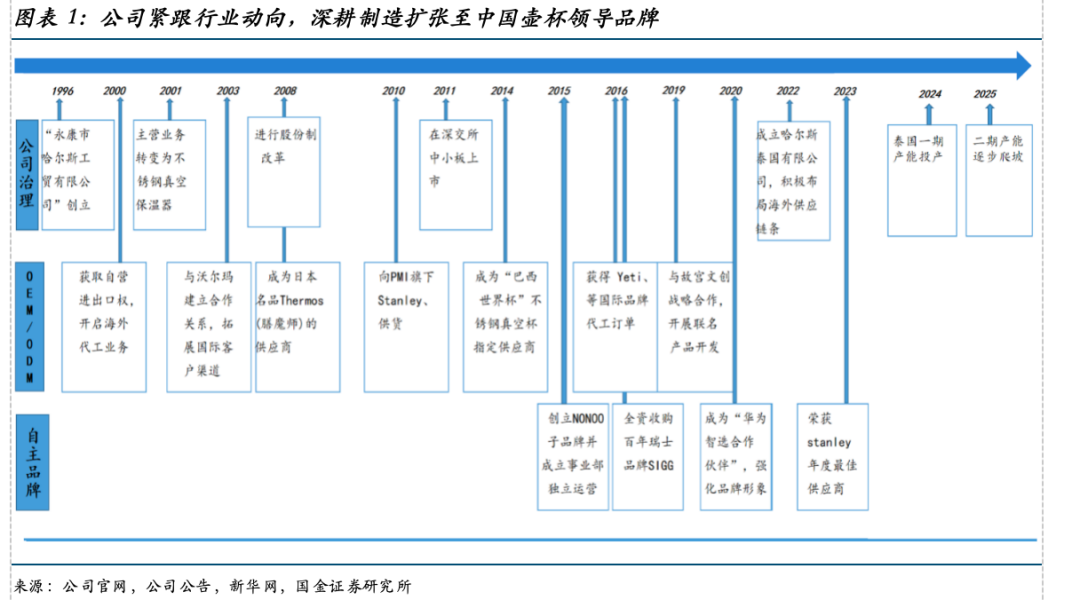
哈尔斯(002615):杯壶行业龙头,制造与品牌协同并进
Guoxin Securities· 2025-11-27 11:36
Investment Rating - The report assigns an "Outperform" rating to the company for the first time [6]. Core Insights - Hars is a leading company in the domestic cup and kettle industry, focusing on both OEM/ODM and proprietary brand businesses, with a projected revenue CAGR of 25% from 2021 to 2024, reaching 3.3 billion yuan, and net profit increasing from 136 million yuan to 287 million yuan by 2024 [1][22]. - The cup and kettle industry is evolving from durable goods to fashionable consumer products, with significant growth potential in both domestic and international markets [1][2]. - The company has established strong partnerships with international brands like YETI and PMI, enhancing its competitive advantage through advanced manufacturing capabilities and a robust customer base [3][54]. Summary by Sections Company Overview - Hars, founded in 1996, is a prominent manufacturer of stainless steel vacuum insulated containers, with a comprehensive supply chain from R&D to production [14][22]. - The company operates both OEM/ODM and proprietary brand businesses, with brands including Hars and SIGG targeting different consumer segments [14][70]. Industry Analysis - The global insulated cup market is estimated to exceed 37 billion USD, with North America being a major demand region [33]. - The domestic insulated cup market is projected to surpass 400 billion yuan, indicating substantial growth potential compared to mature markets like Japan and the USA [37][40]. Competitive Advantages - Hars maintains a leading position in R&D and production capabilities, with a focus on digital transformation and smart manufacturing [3][55]. - The company has a solid foundation of long-term partnerships with major international clients, which supports its market expansion [54][65]. Financial Performance and Forecast - The company’s revenue is expected to grow from 24.07 billion yuan in 2023 to 33.32 billion yuan in 2024, with a net profit forecast of 250 million yuan in 2023, declining to 141 million yuan in 2025 due to transitional production impacts [5][22]. - The projected EPS for 2025 is 0.30 yuan, with a PE ratio of 27, indicating a reasonable valuation range of 8.77 to 9.94 yuan per share [4][6].
东南亚多国调研精要,小米多模型构建AI端侧生态,3D打印高增
SINOLINK SECURITIES· 2025-11-23 11:39
Investment Rating - The report does not explicitly provide an investment rating for the industry Core Insights - The research highlights the significant generational differences in consumer behavior and production capabilities across Thailand, Vietnam, and Cambodia, with Thailand resembling a "miniature" version of the Western consumer market, Vietnam in a rapid growth phase, and Cambodia reflecting characteristics of less developed nations [1] - The report emphasizes the potential for investment in Southeast Asia, particularly in consumer goods and technology-driven sectors, as companies leverage local production capabilities and growing consumer markets [1][2] Summary by Sections 1. Industry Insights - Thailand is compared to a "miniature" Western market, showcasing a mature consumer culture and a well-developed service industry, making it a reference point for companies looking to expand into Western markets [1] - Vietnam is characterized as a rapidly developing economy, with a GDP projected to reach approximately 62.69 trillion VND (around 4,700 USD) in 2024, indicating a significant consumer market potential [1] - Cambodia is noted for its low average income and high income disparity, with consumer spending primarily focused on essential goods, suggesting a slower penetration of discretionary spending [1] 2. Segment Tracking - Xiaomi Group is exploring the future of smart home technology with its Xiaomi Miloco initiative, aiming to enhance user interaction and privacy through advanced AI models [9][10] - The pet food sector saw significant growth during the Double Eleven shopping festival, with sales for the brand Guibao exceeding 1 billion RMB, reflecting a trend towards premium pet products [11][12] - The AI and 3D printing industry is experiencing high demand, with companies like Tuozhu achieving record sales during major shopping events, indicating strong market potential [21][22] 3. Macro Consumption Data - In October, the Consumer Price Index (CPI) showed a year-on-year increase of 0.2%, with service sector prices rising, indicating a recovery in consumer spending [35] - The Producer Price Index (PPI) decreased by 2.1% year-on-year, but showed signs of improvement in the month-on-month trend, suggesting a potential stabilization in production costs [45] - Online sales data from major platforms indicated a decline in the home appliance sector, with specific brands like Ecovacs and Roborock showing positive growth despite overall market challenges [50]

X @LBank.com
LBank.com· 2025-10-09 11:30
👀 Something’s coming…We’re kicking off the countdown to #LBank10thAnniversary with a little surprise from our friends at @yeti_dyorStay close.The first reveal drops in 30 minutes. https://t.co/zDKG54txHb ...