
中国出口

Search documents
李迅雷:如何解读对出口引擎的“认知偏差”
Xin Lang Cai Jing· 2026-02-22 03:03
Core Viewpoint - The divergence between intuition and data regarding China's export growth is attributed to the continuous drag from export prices and exchange rates, which affects the dollar-denominated export growth and global share of China's exports. Excluding these factors, the quantity of China's exports as a share of global exports continues to rise, contributing significantly to GDP growth [1][3][14]. Export Growth Analysis - The WTO data indicates that only in 2024 did China's dollar-denominated exports grow faster than the global average, while in 2022, 2023, and the first three quarters of 2025, China's export growth lagged behind the global rate [2][14]. - From 2015 to 2019, China's export share of global exports remained stable at around 13%. From 2020 to the first three quarters of 2025, this share slightly increased but fluctuated between 14% and 15%. The peak was in 2021 at 14.9%, with subsequent years showing lower shares [2][14]. Factors Influencing Export Quantity Share - China's export quantity share increased from 13.2% in 2019 to 17.0% in the first three quarters of 2025, driven by three main factors: 1. Accelerated industrial transformation and an increase in high-value-added product exports. Labor-intensive and raw material-intensive exports decreased from 18.43% and 5.13% in 2019 to 13.67% and 4.09% respectively by 2025, while capital-intensive exports rose from 56.80% to 62.97% [4][16]. 2. Continuous decline in export product prices due to a "strong supply, weak demand" environment, with a cumulative price drop of 10.1% from 2023 to 2025 [4][16]. 3. Expansion into new markets through the Belt and Road Initiative, which mitigated external shocks. Key trading partners like ASEAN, Africa, and India saw increased export shares, while traditional partners like the US and EU saw declines [5][18]. Future Export Trends - Future predictions indicate that China's export quantity share will continue to rise due to several factors: 1. The ongoing support for technology and industrial transformation as highlighted in the recent party congress [6][19]. 2. Limited likelihood of significant increases in export prices in the short term due to the absence of large-scale capacity reductions [6][19]. 3. Potential improvements in the external environment, leading to increased shares in emerging markets [6][19]. Price Factors and Currency Exchange - Price factors that have negatively impacted exports are expected to gradually weaken. The absolute level of export prices has limited room for further decline due to: 1. Trade friction risks that may restrict price reductions [7][20]. 2. Government policies aimed at stabilizing export prices and encouraging industrial upgrades [7][20]. 3. The linkage between domestic and export prices, which limits the incentive for further price cuts [7][20]. - The RMB's exchange rate is a significant factor affecting exports. Since 2022, despite a growing trade surplus, the RMB's effective exchange rate has declined by 16.12% [10][23]. Future expectations suggest a stable or rising RMB due to resilient exports and limited short-term dollar appreciation [10][23]. Long-term Export Share Projections - Estimates suggest that from 2026 onwards, China's global export share will continue to recover, potentially reaching around 17% by 2030, indicating a more than 2% increase from current levels [12][25].


价格因素对中国出口的拖累将逐步减弱
Xin Lang Cai Jing· 2026-02-18 06:59
Core Viewpoint - Recent data indicates that China's export growth is lagging behind the global average, but long-term factors suggest that the negative impact of price factors on exports will gradually diminish [1] Group 1: Export Growth Factors - Price and exchange rate factors have constrained China's export growth measured in USD over the past few years [1] - Excluding these factors, the share of China's export volume has been continuously increasing, highlighting its significant role in global trade [1] - The increase in China's export volume share is attributed to industrial upgrades, declining product prices, and market diversification from the Belt and Road Initiative [1] Group 2: Future Outlook - The negative impact of price factors on exports is expected to weaken in the future due to trade friction risks, optimization of export tax rebate policies, and the linkage of domestic and foreign sales prices [1] - A stable and appreciating RMB exchange rate is predicted to support exports, with limited short-term potential for USD appreciation [1] - It is forecasted that by 2030, China's export value share of the global market will reach a new steady state of approximately 17%, an increase of 2 percentage points from the current level, indicating resilience in China's export performance in the coming years [1]
李迅雷:如何理解出口引擎的“数据错觉”
Jing Ji Guan Cha Bao· 2026-02-18 05:50
Core Viewpoint - The article discusses the divergence between intuition and data regarding China's export growth, highlighting that while exports are traditionally seen as a key driver of economic growth, recent data shows a decline in China's export growth compared to global averages [1][2]. Group 1: Export Growth Analysis - According to WTO data, only in 2024 did China's export growth in USD terms exceed the global average over the past four years, with lower growth rates observed in 2022, 2023, and the first three quarters of 2025 [1]. - China's share of global exports has remained relatively stable, fluctuating between 14% and 15% from 2020 to the first three quarters of 2025, with a peak of 14.9% in 2021 [1][2]. - The actual effectiveness of China's exports as a GDP driver is masked by price and exchange rate factors, but when these are adjusted for, the quantity of exports as a share of global totals has been increasing [2][3]. Group 2: Factors Influencing Export Performance - The increase in China's export quantity share from 13.2% in 2019 to 17.0% by the first three quarters of 2025 is attributed to three main factors: accelerated industrial upgrading, declining export prices, and the diversification of markets through the Belt and Road Initiative [3][4]. - The share of high-value-added products in China's exports has risen, with capital-intensive goods increasing from 56.80% in 2019 to 62.97% in 2025, while labor-intensive and raw material exports have decreased [3]. - The prices of Chinese export products have been declining, with a cumulative drop of 10.1% in export prices from 2023 to 2025, reflecting a "strong supply, weak demand" environment [3][4]. Group 3: Market Diversification and Future Outlook - The Belt and Road Initiative has successfully opened new markets, with significant increases in export shares to ASEAN, Africa, Russia, India, and Mexico, while shares to the US and EU have decreased [4][5]. - Future predictions indicate that China's export quantity share will continue to rise due to ongoing industrial upgrades, stable export prices, and improved external conditions [5][6]. - The potential for further increases in China's global export share is estimated to be around 2 percentage points by 2030, suggesting continued resilience in export growth [11].
拆解危言耸听:清空美债≠出口崩塌,理性看待中国美债减持
Sou Hu Cai Jing· 2026-02-11 20:16
更关键的是,"抛美债=美元暴跌=出口停滞"的逻辑链,本身就是空中楼阁。从经济原理来看,抛售美 债换回的是美元现金,而非"瞬间暴跌的美元"——美元的汇率波动取决于美国经济基本面、货币政策、 全球资本流动等多重复杂因素,单一国家的美债减持行为,根本不可能导致其"瞬间暴跌"。退一步讲, 即便美元出现短期波动,对中国出口的影响也绝非"一张订单都接不到":中国出口的竞争力,源于完整 的产业链供应链、高性价比的产品、稳定的交付能力,以及与全球各国长期建立的贸易合作关系,而非 美债持有量的多寡。 文章最大的误导,在于将美债与出口强行绑定为"生死关系",却无视两者的核心关联逻辑。事实上,美 债是中国外汇储备的重要组成部分,持有美债的核心目的是实现外汇资产的保值增值、增强国际支付能 力,而出口则取决于全球需求、贸易政策、产品竞争力等实际因素,两者分属不同的经济领域,不存在 直接的因果绑定。相反,若美元真的出现合理波动,人民币汇率适度调整,反而可能增强中国出口商品 的价格竞争力,利好部分出口企业,而非导致全行业停滞。 回顾中国美债减持的历程,这是一个循序渐进、稳步推进的过程,而非"一次性清空"的激进操作。近年 来,中国逐步降低美 ...
全球瞭望丨肯尼亚媒体:中国出口增长是全球消费者对中国制造的“信任投票”
Xin Hua She· 2026-01-25 05:19
Core Viewpoint - China's trade surplus is driven by global market demand and is providing tangible benefits to economies around the world [1] Group 1: Impact on Developing Countries and Emerging Economies - Developing countries and emerging economies benefit from the expansion of Chinese exports, which provide essential products for infrastructure development and energy transition [1] - A significant portion of Chinese exports consists of intermediate goods, which help African regions reduce costs and enhance competitiveness, allowing deeper integration into global value chains [1] - A report from the International Monetary Fund indicates that Chinese investment has significantly increased local processing rates in African countries, promoting their industrialization [1] Group 2: Benefits to Developed Economies - Western developed economies also benefit from Chinese exports, as multinational companies are deeply embedded in the Chinese manufacturing system, using China as a production base for global markets [2] - Foreign enterprises in China account for nearly one-third of China's total exports, providing consumers worldwide with higher cost-performance products [2] Group 3: China's Economic Adjustments - China is actively adjusting its economic structure to enhance domestic demand's role in economic development [2] - The country's large population and growing middle-income group present significant consumption potential, representing one of the most important growth opportunities globally [2]
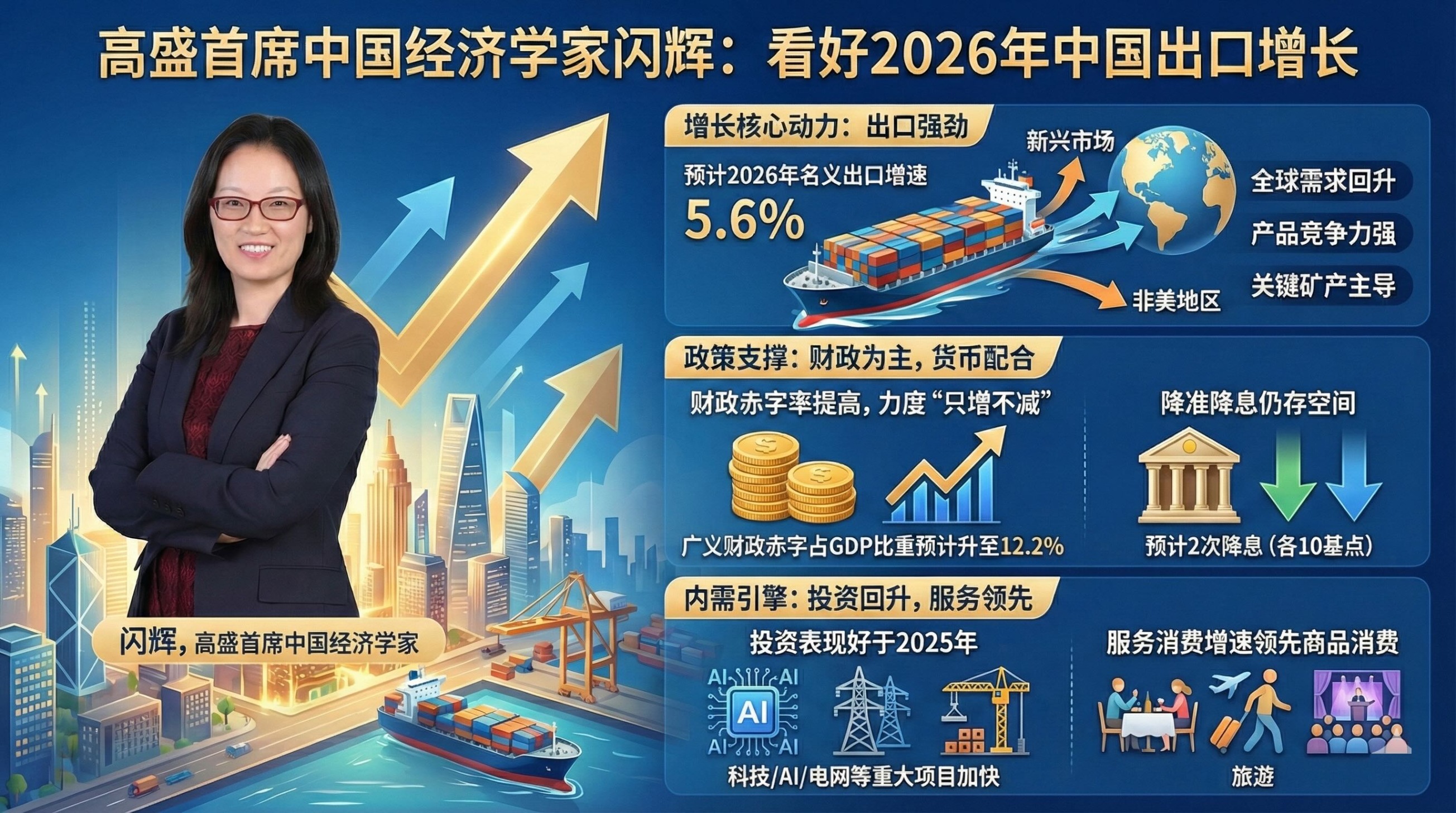
高盛首席中国经济学家闪辉:看好2026年中国出口增长
Zhong Guo Jing Ying Bao· 2026-01-22 06:48
Monetary Policy - The People's Bank of China is expected to implement two interest rate cuts in 2026, each by 10 basis points, with room for further reductions in reserve requirements and interest rates [3][4] - The average reserve requirement ratio for financial institutions is currently 6.3%, indicating potential for a reduction [3] Fiscal Policy - The fiscal deficit rate is projected to increase from 11% of GDP in 2025 to 12.2% in 2026, with overall spending expected to increase in key areas [3][4] - The Ministry of Finance emphasizes that the total scale of fiscal deficits, debt, and expenditures will be maintained at necessary levels to ensure spending does not decrease [4] Economic Growth - China's exports are anticipated to remain strong in 2026, driven by global economic growth, expansion into emerging markets, and China's competitive product strength [5] - In 2025, China's total foreign trade reached 45.47 trillion yuan, a 3.8% increase year-on-year, maintaining its position as the world's largest goods trader [4][5] Investment Outlook - Investment performance in 2026 is expected to improve compared to 2025, with significant projects in technology, AI, and power grids likely to accelerate [5] Consumer Trends - Consumption is expected to show structural differentiation, with service consumption growth outpacing that of goods consumption in 2026 [6]

芦哲:中国出口“惧怕”人民币升值吗
Di Yi Cai Jing· 2026-01-22 06:20
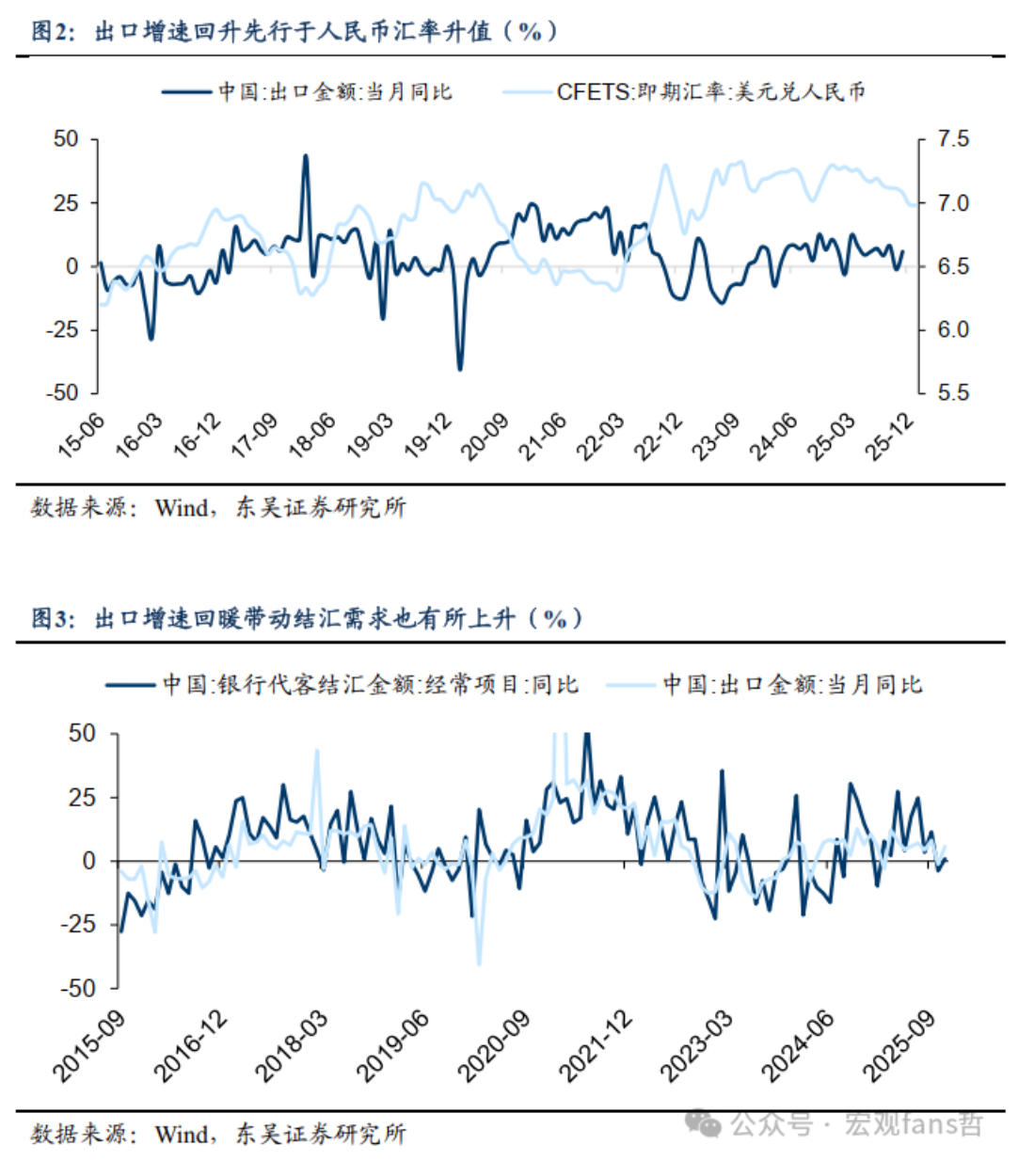
Core Viewpoint - The impact of exchange rates on exports is gradually diminishing due to the optimization of export product structure and the absolute comparative advantage of certain high-end products [1][2]. Group 1: Exchange Rate Trends - By the end of 2025, the RMB is expected to appreciate against the USD, potentially reaching 6.7 to 6.8 by the end of 2026, driven by market forces and policy adjustments [1]. - Since the "8.11 exchange rate reform" in 2015, the correlation between RMB exchange rate movements and export trends has weakened significantly, with a correlation coefficient of only 0.3% from September 2015 to November 2025 [2]. - During the two appreciation cycles since the reform, exports maintained stable growth despite RMB appreciation, indicating that exchange rate changes do not negatively impact export growth [2][3]. Group 2: Export Competitiveness - The actual effective exchange rate of the RMB remains low compared to major economies, providing a price advantage for Chinese exports despite the appreciation of the RMB [5]. - The central bank's refined management of the exchange rate has reduced the impact of exchange rate fluctuations on exports, allowing exporters to adjust pricing and lock in rates [6]. - The competitiveness of Chinese exports has been enhanced due to the continuous upgrading of industrial structure, with technology-intensive products gaining a stronger market position [9][10]. Group 3: Trade Settlement and Currency Internationalization - The proportion of RMB in international trade settlements is increasing, with RMB cross-border payments for goods trade reaching approximately 12.4 trillion yuan in 2024, a 15.9% increase year-on-year [11]. - Significant breakthroughs have been made in RMB settlement for major exports, such as large ships and aircraft, indicating a shift away from the dominance of the USD in trade transactions [12].
宏观深度报告20260115:中国出口“惧怕”人民币升值吗
Soochow Securities· 2026-01-15 11:14
Group 1: Core Insights - The appreciation of the RMB is expected to raise concerns about its impact on China's exports in 2026, as higher prices could weaken competitive advantages[1] - Since 2018, the sensitivity of China's exports to exchange rate changes has decreased, with "technical barriers" becoming the main competitive strength over "price advantages" due to product upgrades[1] - The proportion of RMB settlements in international trade is gradually increasing, which is expected to further reduce the impact of exchange rate fluctuations on exports[1] Group 2: Historical Review - Historical data shows that during the RMB appreciation cycles from December 2016 to April 2018 and from May 2020 to March 2022, export growth remained stable, recovering from -6.3% to over 10% and from -3.5% to 13.4%, respectively[2] - Export recovery often precedes RMB appreciation by about one quarter, indicating that rising exports may contribute to RMB appreciation rather than the other way around[2] Group 3: Factors Reducing Impact of RMB Appreciation - The actual effective exchange rate of the RMB has decreased to approximately 88.6% as of November 2025, down 16.7% from its peak in March 2022, enhancing the price competitiveness of exports[2] - The RMB's purchasing power in international markets has increased due to appreciation, benefiting imports and reducing reliance on depreciation for export competitiveness[2] - The share of labor-intensive exports is declining, while the proportion of intermediate and capital goods exports is increasing, reflecting a shift towards more technology-intensive products[2] Group 4: Trade Settlement Trends - In 2024, RMB cross-border payments for goods trade reached approximately 12.4 trillion yuan, a 15.9% increase year-on-year, with RMB settlements accounting for 27.2% of total cross-border payments, up 2.4 percentage points from 2023[2] - The RMB settlement ratio is significantly increasing in trade with emerging markets, particularly in regions like ASEAN and Africa, where growth rates of 21.8% and 35.9% were recorded, respectively[2] Group 5: Risk Considerations - There are uncertainties regarding U.S. tariff policies, which could negatively impact exports if additional tariffs are imposed[2] - A potential downturn in the U.S. economy could adversely affect global demand, posing risks to China's export performance[2]
2025年,“中国好物”在全球广受欢迎
Xin Hua She· 2026-01-15 03:38
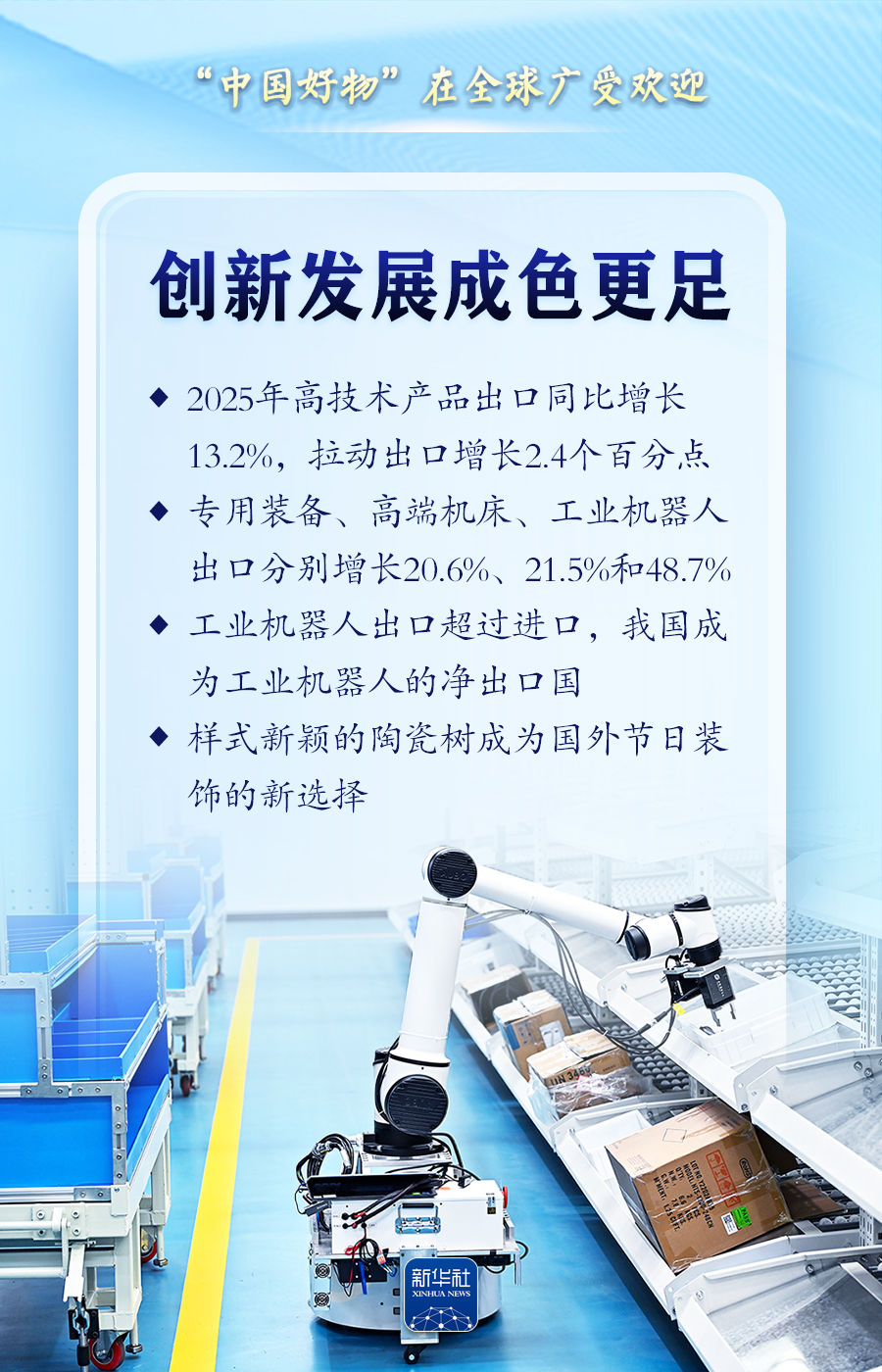
Core Viewpoint - In 2025, China's exports are projected to reach 26.99 trillion yuan, reflecting a year-on-year growth of 6.1%, driven by quality improvements and the global popularity of "Chinese good products" [1] Group 1: Export Growth - Exports of lithium batteries and wind turbine generators are expected to grow by 26.2% and 48.7% respectively [3] - Exports of electric motorcycles and bicycles increased by 18.1%, while electric locomotives saw a growth of 27.1% [3] - Exports of industrial gas purification equipment rose by 17.3%, and electric forklifts experienced a growth of 5.2% [3] Group 2: Market Expansion - Exports to countries involved in the Belt and Road Initiative grew by 11.2%, contributing 5.4 percentage points to overall export growth [5] - ASEAN has been China's largest export market for three consecutive years [5] - Export growth rates to emerging markets in Latin America, the Middle East, Central Asia, and Africa are all faster than the overall growth rate [5] - China has become a "key link" in the global industrial and supply chains [5]
中信建投:预计2026年出口有望延续强势 同比增速为5%
Jin Rong Jie· 2026-01-14 23:45
Core Viewpoint - The report from CITIC Securities highlights the unexpected resilience of China's export performance despite increased tariffs from the US, with a year-on-year export growth rate of 5.5% in the previous year, slightly below the projected 5.8% for 2024 [1] Group 1: Export Performance - China's export growth rate reached 5.5% year-on-year, defying pessimistic expectations despite US tariffs exceeding 30% [1] - December recorded the highest monthly export scale in history, with a month-on-month growth rate marking the highest since 2016 for the same period [1] Group 2: Future Projections - Exports are expected to maintain strong performance, with a projected year-on-year growth rate of 5% in 2026 due to improved foreign trade conditions and new fiscal expansions in Europe and the US [1] - The deepening cooperation between China and non-US countries is anticipated to continue, leading to an increasing share of Chinese products in the import market of non-US regions [1]
