电网

Search documents
2026年3月五维行业比较观点:把握成长机遇-20260310
EBSCN· 2026-03-10 07:21
Core Insights - The report introduces a "Five-Dimensional Industry Comparison Framework" that integrates market style, fundamentals, liquidity, trading, and valuation to analyze industry performance comprehensively. It emphasizes that a single indicator is insufficient for effective industry comparison and that future market drivers should be weighted more heavily [3][9]. - Historical backtesting from 2016 to February 2025 shows that industries with higher scores in the framework tend to perform better, with annualized returns of 11.8% for the top group and -10.5% for the bottom group. A long-short strategy between the top and bottom groups yielded an annualized return of 23.7% [21][23]. - In March, the report predicts a market style shift towards growth and balanced styles, with high valuation sectors expected to perform better. Key industries to focus on include electric power equipment, defense, electronics, and machinery [33][34]. Five-Dimensional Industry Comparison Framework - The framework consists of five dimensions: market style, fundamentals, liquidity, trading, and valuation, combining both objective data and subjective judgments to enhance flexibility [8][9]. - The scoring process involves adjusting weights based on market conditions, with a focus on subjective assessments in market style, liquidity, and valuation, while fundamentals and trading rely on objective data [12][20]. March Insights and Industry Recommendations - The report suggests that in March, the focus should be on growth and balanced styles, with high-scoring industries such as electric power equipment, defense, electronics, and machinery being highlighted for potential investment [34][39]. - Specific recommendations include companies like Shenghong Co., Yangguang Electric, and Siyi Electric in the electric power sector, which are expected to benefit from trends in energy storage and grid investments [37][39]. Market Style - The report anticipates fluctuations in economic expectations and market sentiment, leading to a rotation between growth and balanced styles. It predicts that financing funds will dominate the liquidity landscape in March [33][34]. Fundamentals - In March, the weight assigned to fundamentals is reduced to 20% due to it being a non-earnings season, with equal weighting applied to other dimensions [33][34]. Liquidity - The report indicates that financing funds are expected to be the main source of liquidity in March, with public funds likely to see net inflows [33][34]. Trading and Valuation - The trading dimension focuses on identifying industries with potential positive catalysts that have not yet been fully reflected in stock prices, while the valuation dimension assesses industries based on market sentiment and expected future performance [20][21]. Recommended Industries - **Electric Power**: Focus on hydrogen, ammonia, and integrated energy systems, with companies like Shenghong Co. and Yangguang Electric highlighted for their growth potential [39]. - **Electronics and Communication**: Companies such as Zhongji Xuchuang and ShenNan Circuit are recommended due to their roles in AI and data center infrastructure [41]. - **High-End Manufacturing**: Companies like Anpeilong and Jingjin Equipment are noted for their strong market positions and growth prospects in robotics and AI-related sectors [43]. - **Automotive**: Companies like Geely and NIO are recommended for their strategic advancements in smart and high-end vehicles [46]. - **Pharmaceuticals**: Continuous focus on innovative drugs and medical devices is emphasized, although specific companies are not detailed in the provided content [48].
有色金属周报-20260306
Jian Xin Qi Huo· 2026-03-06 11:05
1. Report Industry Investment Rating - There is no information about the industry investment rating in the report. 2. Core Views - **Copper**: The current copper market presents a game situation of "short - term high inventory and medium - term demand improvement". Short - term fundamentals are under pressure, but the medium - term demand growth prospect and macro - strategic attributes offset the downward risk. It is expected that copper prices will fluctuate in the short term to gradually digest inventory pressure [6][7]. - **Lithium Carbonate**: In March, domestic lithium carbonate production, imports, and demand are all increasing. It is expected that the de - stocking intensity of social inventory will slow down. However, the current inventory structure shows that over 44% of social inventory is in the hands of downstream enterprises, and the low upstream inventory will limit the price decline space. Therefore, it is expected that lithium carbonate futures prices will fluctuate in the short term [22]. - **Zinc**: Zinc price fluctuations are more due to emotional trading in the market about the escalation of conflicts rather than its own fundamental drivers. The current geopolitical sentiment remains high, and the game around the Middle East situation continues, providing some support for zinc prices. However, the reality of high inventory and weak demand continues to suppress zinc prices. In the future, two core variables need to be concerned: the change in the duration of the US - Middle East conflict and the progress of domestic downstream resumption of work and inventory de - stocking rhythm [38][39]. 3. Summary by Directory Copper 3.1.1. Market Review and Operation Suggestions - **Market Review**: This week, the main contract of Shanghai copper operated in the range of (100030, 104540), with a total position of 584,000 lots, a 0.3% increase from last week. The 04 - 05 spread was - 160. Due to the decline in copper prices, downstream buying willingness increased, and the spot discount narrowed from 190 at the beginning of the week to 70. Affected by the Iranian situation, the market risk - aversion sentiment increased, the US dollar index rose, and funds chased the energy and chemical sectors, causing copper prices to rise and then fall. LME copper operated in the range of (12722, 13433). Overseas funds' enthusiasm for going long has decreased recently [7]. - **Operation Suggestions**: On the supply side, the TC of copper concentrate imports continues to decline, and the processing fee in the scrap copper market has declined. Although the raw material pressure has increased, it will take time for the raw material shortage to be transmitted to the smelting end. In March, the output is expected to exceed 1.2 million tons, and the pressure of concentrated maintenance of smelters may appear from April. At the same time, the import arbitrage window for the far - month contract on the disk is open, and subsequent imports are expected to increase. On the demand side, the peak season is coming, and the operating rates of refined copper rods, wires and cables, and enameled wires have all increased significantly. However, the current domestic and foreign inventories are at a high level, and it is necessary to wait for the de - stocking intensity in the domestic peak season to verify the peak - season performance. In the medium term, the application prospects of copper in the power grid and AI fields are optimistic, and demand growth is expected. Macroscopically, the market generally expects the Fed to keep interest rates unchanged in March, and the US dollar index will mainly fluctuate. Geopolitical risks and the signal of state reserves strengthen the strategic resource attribute of copper, providing bottom support for prices. Overall, it is expected that copper prices will fluctuate in the short term to gradually digest inventory pressure [7]. 3.1.2. Fundamental Analysis - **Supply Side**: The inversion of copper ore processing fees has intensified. As of March 6, the weekly TC of imported ore decreased by 5.62 to - 56.05 US dollars/ton, and the pricing coefficient of domestic copper concentrate remained at 96.5%. The long - term TC in 2026 is 0 US dollars/ton, a decrease of 21.25 US dollars/ton compared with 2025. The inventory of copper concentrate at seven ports increased by 2.15 to 632,700 tons. The processing fees of crude copper in the south and north decreased by 100 yuan/ton respectively, and the import processing fee of crude copper remained unchanged at 95 US dollars/ton. The anode plate processing fee remained unchanged at 1450 yuan/ton. The total imported metal volume of scrap copper and anode plates in December increased by 12.3% month - on - month and decreased by 0.6% year - on - year. The refined - scrap spread continued to weaken, and the processing fee of domestic scrap copper decreased. The by - product sulfuric acid revenue fluctuated at a high level. In February, the output of electrolytic copper was 1.1424 million tons, a decrease of 3.13% month - on - month and an increase of 7.96% year - on - year. It is expected that the output in March will increase by 4.62% month - on - month. The import window of refined copper is closed [10][11][12]. - **Demand Side**: The weekly operating rate of scrap copper rods increased by 3.42 percentage points to 5.57%. The refined - scrap spread and the spread between refined and scrap copper rods decreased, and the substitution effect of scrap copper weakened. The weekly operating rate of refined copper rods increased by 44.09% to 62.47%, and it is expected to further increase to 70.46% next week. The operating rate of wires and cables increased by 33.17 percentage points to 60.9%, and it is expected to further increase to 66.1% next week. The operating rate of enameled wires increased by 31.14 percentage points to 81.07%, and new orders increased significantly at the beginning of the week but decreased at the end of the week [13][14][15]. - **Spot Side**: Domestic inventory increased by 44,900 tons to 644,200 tons, and it is expected to decrease next week. The inventory in the bonded area decreased by 600 tons to 67,000 tons. The inventory in the LME + COMEX market increased by 26,795 tons to 826,000 tons [16]. Lithium Carbonate 3.2.1. Market Review and Operation Suggestions - **Market Review**: This week, the futures price of lithium carbonate continued to decline weakly. The main contract operated in the range of (146060, 179500), and the total position decreased by 11.7% to 628,000 lots. The near - month spread structure remained in CONTANGO. The spot price of battery - grade lithium carbonate also declined, and the spot holders' reluctance to sell increased after the sharp decline in the futures price [21]. - **Operation Suggestions**: On the supply side, the weekly output continued to rise, and it is expected that the domestic lithium carbonate output in March will increase by 28% to 106,390 tons. The amount of lithium carbonate exported from Chile to China in February increased by 32% to 22,381 tons, and the domestic supply in March is expected to exceed 130,000 tons, putting pressure on short - term lithium prices. On the demand side, the peak season is coming. The output of ternary materials and lithium iron phosphate increased by 5.8% and 8.4% respectively this week, and it is expected to increase by 19.3% and 23.6% respectively in March. The demand for new energy vehicles is expected to pick up in March. In the energy storage field, although the Iranian situation affects the Middle East energy storage installation in 2026, the Chinese energy storage market is in a period of rapid development, and the domestic energy storage demand growth is expected to offset the decline in Middle East demand. Overall, in March, domestic lithium carbonate production, imports, and demand are all increasing, and it is expected that the de - stocking intensity of social inventory will slow down. It is expected that lithium carbonate futures prices will fluctuate in the short term [22]. 3.2.2. Fundamental Analysis - **Supply Side**: This week, lithium ore prices fell. The spot price of Australian ore (6%, CIF China) decreased by 7.8% to 2200 US dollars/ton, the price of high - grade phospho - lithium - aluminum stone ore decreased by 8.8% to 14,000 yuan/ton, and the price of high - grade lithium mica concentrate decreased by 7.3% to 5190 yuan/ton. The production profit of purchasing lithium spodumene concentrate and lithium mica concentrate turned into a loss. The weekly output of lithium carbonate in China was 22,590 tons, an increase of 768 tons from last week. It is expected that the total output of lithium carbonate in March will increase to 106,390 tons, and the output of lithium hydroxide will increase to 30,050 tons. The cash cost of producing lithium carbonate from purchased lithium spodumene concentrate and high - grade lithium mica concentrate decreased [26]. - **Demand Side**: The prices of ternary materials, lithium iron phosphate, and cobalt acid lithium all decreased. The production enthusiasm of iron lithium enterprises was high, and the demand in the power and energy storage fields rebounded in March. The price center of battery cells moved up slightly, and the production cost of some battery cells decreased [27][28][29]. - **Spot Side**: The spread between battery - grade and industrial - grade lithium carbonate was at a low level, and the spread between spot and the main contract fluctuated sharply. The inventory of lithium carbonate decreased by 720 tons to 99,373 tons, with the inventory of smelters decreasing, the downstream inventory increasing, and the trader inventory decreasing [31]. Zinc 3.3.1. Market Review and Operation Suggestions - **Market Review**: The macro - situation is affected by the US - Iran conflict and the opening of the domestic two sessions. The US dollar index rebounded strongly, putting pressure on non - ferrous metals. The zinc price was mainly affected by the overall sentiment of the sector, with high inventory and weak demand suppressing the price, but the supply disturbance expectation of Iranian zinc ore limited the downward space [36]. - **Operation Suggestions**: On the supply side, northern mines are gradually resuming production, and the domestic supply of zinc concentrate is expected to increase. The average domestic TC of SMM Zn50 increased by 50 to 1550 yuan/metal ton. The output of refined zinc in March is expected to increase month - on - month. On the demand side, the downstream resumption of work is uneven, and the demand for zinc in the real estate industry chain is weak. The social inventory accumulation pressure continues, and the de - stocking inflection point may come around mid - March. In the future, two core variables need to be concerned: the change in the duration of the US - Middle East conflict and the progress of domestic downstream resumption of work and inventory de - stocking rhythm [38][39]. 3.3.2. Fundamental Analysis - **Supply Side**: The game between mines and smelters intensifies, and the increase in processing fees is limited. The domestic supply of zinc concentrate is expected to increase in March, and the average domestic TC of SMM Zn50 increased by 50 to 1550 yuan/metal ton. The economy of imported zinc concentrate has decreased, and the smelter's purchasing willingness is low. The output of zinc ingots in March is expected to increase month - on - month [46][47][48]. - **Demand Side**: The operating rate of galvanizing increased by 32.22% to 39.,06%, the operating rate of die - casting zinc alloy increased by 23.73% to 32.46%, and the operating rate of zinc oxide increased by 24.46% to 44.22%. The raw material inventory of each industry increased slightly, and the finished product inventory decreased [49][50]. - **Spot Market**: The domestic inventory increased by 1700 tons to 256,300 tons, and the LME zinc inventory decreased to 95,000 tons, with the Cash - 3M contango narrowing to around 20 US dollars/ton [51].
A股探底回升全线翻红!超4000只个股上涨,现货黄金、白银由跌转涨丨盘中播报
Mei Ri Jing Ji Xin Wen· 2026-02-06 02:55
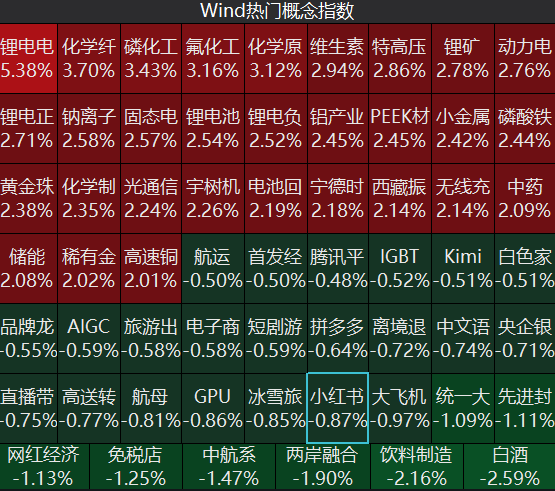
Core Viewpoint - The major stock indices rebounded on February 6, with over 4,000 stocks rising, particularly in sectors such as lithium batteries, traditional Chinese medicine, chemicals, electric grid, and oil and gas [1]. Group 1: Market Performance - The three major indices experienced a bottoming out and all turned positive, with the ChiNext index initially dropping nearly 2% [1]. - More than 4,000 stocks saw gains, indicating a broad market recovery [1]. Group 2: Sector Performance - Sectors with notable gains included lithium batteries, traditional Chinese medicine, chemicals, electric grid, and oil and gas, with lithium battery stocks leading the charge [1]. - Specific concept indices showed significant increases, such as lithium battery at 5.38%, chemical fibers at 3.70%, and phosphorous chemicals at 3.43% [2]. Group 3: Commodity Prices - Spot gold and silver prices reversed from declines to gains, with spot gold rising over 1% to $4,835.03 per ounce and spot silver increasing by 2.57% to $72.51 per ounce [2]. - The dollar index was reported at 97.8525, showing a slight decrease of 0.0791% [3].

高盛首席中国经济学家闪辉:看好2026年中国出口增长
Zhong Guo Jing Ying Bao· 2026-01-22 06:48
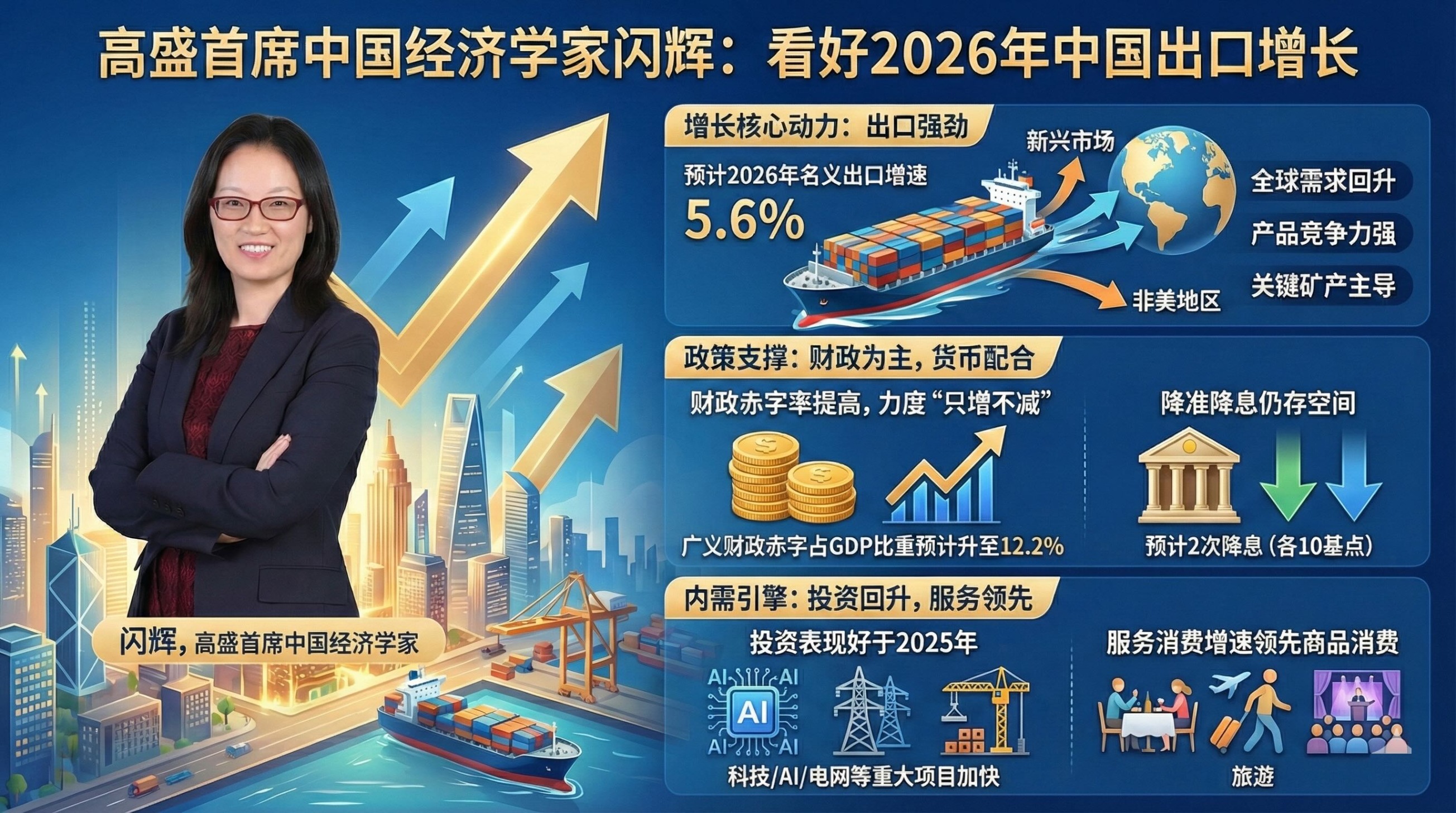
Monetary Policy - The People's Bank of China is expected to implement two interest rate cuts in 2026, each by 10 basis points, with room for further reductions in reserve requirements and interest rates [3][4] - The average reserve requirement ratio for financial institutions is currently 6.3%, indicating potential for a reduction [3] Fiscal Policy - The fiscal deficit rate is projected to increase from 11% of GDP in 2025 to 12.2% in 2026, with overall spending expected to increase in key areas [3][4] - The Ministry of Finance emphasizes that the total scale of fiscal deficits, debt, and expenditures will be maintained at necessary levels to ensure spending does not decrease [4] Economic Growth - China's exports are anticipated to remain strong in 2026, driven by global economic growth, expansion into emerging markets, and China's competitive product strength [5] - In 2025, China's total foreign trade reached 45.47 trillion yuan, a 3.8% increase year-on-year, maintaining its position as the world's largest goods trader [4][5] Investment Outlook - Investment performance in 2026 is expected to improve compared to 2025, with significant projects in technology, AI, and power grids likely to accelerate [5] Consumer Trends - Consumption is expected to show structural differentiation, with service consumption growth outpacing that of goods consumption in 2026 [6]

天正电气:公司在加大投入的同时,也在积极优化资源配置
Zheng Quan Ri Bao Wang· 2026-01-07 12:41
Core Viewpoint - The company, Tianzheng Electric (605066), has indicated that its sales expense ratio varies significantly based on the sales model, with distribution-focused companies averaging around 5% and direct sales companies around 10% [1] Group 1: Sales Expense Trends - The company's sales expenses have been on the rise in recent years due to increased investment in developing major industry clients and project business expansion [1] - The company has been investing more resources in various sectors such as new energy, electricity, communications, data centers, oil and petrochemicals, and industrial equipment, leading to a dual-driven model of major client development and distribution channels [1] - The proportion of direct sales has significantly increased, contributing to higher sales expenses and a higher sales expense ratio [1] Group 2: Resource Optimization and Future Goals - While increasing investments, the company is actively optimizing resource allocation by focusing on key industries such as computing power, energy storage, charging and swapping, power grids, and overseas markets [1] - In the first three quarters of 2025, the company aims for a year-on-year decrease of 5.05% in sales expenses and a 0.39 percentage point decrease in the sales expense ratio [1] - The company seeks to achieve significant breakthroughs in key industries and markets to enhance the effectiveness of sales expenses and establish a competitive advantage [1]

2026年铝品系期货行情展望:电解铝:需求“集腋成裘”,供给故事推涨弹性几何?氧化铝:基本面驱动VS估值的困境,何处是底?铝合金
Guo Tai Jun An Qi Huo· 2025-12-19 10:05
Report Industry Investment Rating - Not provided in the document Core Views of the Report - In 2026, the pricing logic of aluminum metals with imagination since the fourth quarter of this year will continue. Although the year - on - year growth rate of apparent demand for aluminum metals is expected to decline further, the report remains optimistic about the unilateral direction of aluminum prices, smelting profits of aluminum plants, and price volatility due to the likely low - growth global supply [1][54][315]. - For alumina, the market is likely to see over - supply. It is recommended to sell on rebounds. The profit - grabbing ability of alumina in the industrial chain will remain weak in 2026 [196][319]. - For recycled cast aluminum alloys, prices will generally follow aluminum prices and have a certain upward elasticity. The price - to - electrolytic aluminum ratio of ADC12 is expected to rise, and its price may exceed the 2025 high [7][324]. - In 2026, key structural strategies include cross - border arbitrage, calendar spread arbitrage, cross - variety arbitrage, and over - the - counter options [8][327]. Summary by Relevant Catalogs 1. Review of 2025 Market and Main Driving Logic of Three Aluminum Products 1.1 Electrolytic Aluminum (AL) - In 2025, the aluminum price showed a low - volatility and convergent pattern for most of the time, with the annual low higher than that in 2024 and the high failing to break through the 2024 high. By the end of 2025, the price increase was 11.0%, lower than that of copper and tin [11]. - The main reasons were the "double - weak" supply - demand pattern and the lack of a clear macro - trading theme. However, since October, with the positive impact of AI - driven power demand on the supply - demand pattern, combined with stock - futures linkage, the aluminum price broke through the convergent pattern [12][14]. 1.2 Alumina (AO) - In 2025, alumina prices fell by 41.1%. In the first half of the year, there was a unilateral decline, and in the second half, there were two "advance - to - retreat" style declines. The main reason was the over - supply and inventory accumulation [17]. 1.3 Recycled Cast Aluminum Alloy (AD) - In 2025, the price center of recycled cast aluminum alloy moved up, generally following the electrolytic aluminum price. The price was supported by the supply shortage of scrap aluminum, especially in the second half of the year after the futures listing [23][24]. 1.4 Strategy Review of Three Aluminum Products - Cross - border arbitrage: In 2025, the most profitable position was the long - LME aluminum and short - SHFE aluminum (positive arbitrage), with a maximum annualized return of over 20% [26][28]. - Cross - variety arbitrage: Copper - aluminum arbitrage, alumina - aluminum arbitrage, alumina - caustic soda arbitrage, and aluminum - aluminum alloy arbitrage provided many profitable strategies [31][34]. - Calendar spread arbitrage: The basis and calendar spread structure of aluminum were generally flat. The basis opportunities of alumina and aluminum alloy were stronger than the calendar spread opportunities [44][45]. 2. Electrolytic Aluminum: Can the "Gathering of Small Demands" and Supply Stories Boost Elasticity? 2.1 Resilience of Primary Aluminum Demand - AI - related industries such as computing centers, energy storage, the US power grid, and robots, as well as military applications and "aluminum replacing copper," are expected to contribute about 1.2 - 1.6 percentage points to China's primary aluminum demand growth rate in 2026 [56][156]. - "Light and vehicle" consumption growth contribution will decline to + 0.1 percentage points, mainly due to the decline in photovoltaic demand [107][114]. - Traditional "foundation, infrastructure, and electricity" and manufacturing industries are expected to contribute 0 - 1 percentage point to the demand growth rate [116][117]. - In 2026, China's exports of aluminum products and aluminum products are expected to increase slightly, contributing 0.5 - 1 percentage point to the demand growth rate [155][156]. 2.2 Key Risks for the Bullish View - China's electrolytic aluminum production capacity ceiling is approaching, and in 2026, the production growth rate is expected to be about + 1.7%. The main risk is the potential increase in production capacity if green - power smelting can break through the ceiling [157][158][163]. - Overseas supply, especially from Indonesia, is a major risk. Although the new production in 2026 is expected to be at a low - growth rate, the power supply conditions need to be closely monitored [165][173][179]. 2.3 Supply - Demand Balance of Primary Aluminum - In China, under the baseline and optimistic scenarios in 2026, the annual shortage is expected to be 12.4 - 25.8 tons, and the inventory accumulation pressure in the first quarter is controllable [2][316]. - Globally, the supply - demand balance is expected to be in a shortage range of 19 - 82 tons, with a median of about 50 tons. Considering the production cut of the Mozambique aluminum plant, the global shortage may exceed 50 tons [2][187][316]. 3. Alumina: Where is the Bottom in the Dilemma between Fundamental Drivers and Valuation? 3.1 Supply Rigidity Remains Unsolved, and the Over - Supply Pattern is Hard to Change - As of the end of 2025, the production of alumina remained rigid. Although high - cost producers have suffered losses for two months, the production has not decreased significantly. However, there may be large - scale production cuts or maintenance in January - February [197][198]. - In 2026, there is still a large - scale new investment in alumina production capacity. The annual average growth rate of alumina production is expected to be about 5.3%, and the production - demand gap will be large [204][205]. - Overseas alumina production capacity is also increasing. Although there is a risk of overseas supply impacting the Chinese market, the Chinese market's production increase is more certain, and exports may exceed 2025 [210][211]. - In 2026, the supply - demand balance of alumina in China and globally is expected to be in a serious over - supply situation, but there are uncertainties in the inventory accumulation in the second half of the year [228][229]. 3.2 Under the Over - Supply Pattern, the Cost - Based Pricing of AO Continues - In 2026, the supply of Guinea bauxite is expected to be abundant, with a potential increase of 3693 - 6300 tons. If the monthly arrival in China exceeds 1530 tons, the supply of bauxite in China will be stable [240][241]. - Alumina's profit - grabbing ability in the industrial chain is expected to remain weak in 2026, mainly due to the decline in bauxite prices and the optimization of production capacity structure [258]. 4. Recycled Cast Aluminum Alloy: The Contradiction at the Raw Material End is Prominent, and the Ratio Center Rises 4.1 The Ratio Center of Scrap Aluminum to Electrolytic Aluminum Tends to Rise - The actual shipment volume of scrap aluminum in 2025 was lower than expected. The increase in imports did not effectively alleviate the supply shortage. The main reason was the mismatch between the supply and demand growth rates of scrap aluminum [262][271]. - The cancellation of the tax rebate policy has increased the cost of recycled aluminum enterprises, and the EU's possible export tariff on scrap aluminum may exacerbate the global supply shortage [291][296]. 4.2 Assessment of Supply and Demand of Recycled Aluminum Alloys - In 2025, the expansion rate of recycled aluminum alloy production capacity slowed down, but the capacity utilization rate was still low. In 2026, the production capacity growth rate is expected to slow down, and some production capacity may exit [300][301]. - The demand for recycled aluminum alloys has certain resilience, but the industry is still in an over - capacity situation. ADC12 is a cost - based pricing product, and the cost - pricing logic will be more obvious [307]. 5. Trading Themes to Watch in 2026 5.1 Unilateral Judgment of Electrolytic Aluminum - In 2026, the pricing logic of aluminum with imagination will continue. Although the apparent demand growth rate is expected to decline, the report is optimistic about the price, smelting profit, and price volatility. The main risks are macro - economic recession and over - production in Indonesia [315][318]. 5.2 Unilateral Judgment of Alumina - It is recommended to sell on rebounds. The over - supply pattern is difficult to change in 2026. The profit - grabbing ability in the industrial chain will remain weak, and the main risks are the introduction of a "production capacity ceiling" policy and bauxite supply disruptions in Guinea [319][323]. 5.3 Unilateral Judgment of Recycled Cast Aluminum Alloy - The price will generally follow the electrolytic aluminum price and has a certain upward elasticity. The main risks are the continuous release of new production capacity and lower - than - expected automobile consumption growth [324][326]. 5.4 Structural Strategies - Cross - border arbitrage: Positive arbitrage in the first half of the year and possible reverse arbitrage in the second half [327]. - Calendar spread arbitrage: Selectively conduct positive arbitrage [327]. - Cross - variety arbitrage: Short caustic soda based on alumina production cuts; buy aluminum and short copper when the copper - aluminum ratio rises too fast; conduct spread arbitrage between electrolytic aluminum and recycled cast aluminum alloy [327]. - Over - the - counter options: Regularly implement the low - level buying strategy - enhanced accumulative purchase [327].
工控进一步复苏,电网景气度保持 | 投研报告
Zhong Guo Neng Yuan Wang· 2025-11-13 01:20
Core Viewpoint - The industrial control and power equipment industry shows strong growth in Q3 2025, with significant increases in revenue and net profit, indicating a high level of industry prosperity [1][2]. Group 1: Industry Performance - The industry reported a revenue of 480.9 billion yuan for Q1-Q3 2025, a year-on-year increase of 11%, and a net profit of 40 billion yuan, up 17% year-on-year [1][2]. - In Q3 2025, the revenue reached 171.5 billion yuan, reflecting a 9% year-on-year growth, while net profit was 14.5 billion yuan, up 15% year-on-year [1][2]. - The overall gross margin for the industry in Q3 2025 was 22.7%, showing a decrease of 0.8 percentage points year-on-year and 0.5 percentage points quarter-on-quarter [1][2]. Group 2: Cash Flow and Liabilities - The operating cash flow for Q3 2025 was a net inflow of 23.4 billion yuan, representing a 23% increase year-on-year [1][2]. - Contract liabilities and inventory increased by 9% and 24% respectively compared to the beginning of the year [1][2]. Group 3: Segment Analysis - The industrial control sector saw a revenue of 101.7 billion yuan for Q1-Q3 2025, with a 21% year-on-year increase, and a net profit of 8.8 billion yuan, also up 21% year-on-year [3]. - In Q3 2025, the industrial control segment achieved a revenue of 38.5 billion yuan, a 21% year-on-year increase, and a net profit of 2.95 billion yuan, up 14% year-on-year [3]. - The power cable segment experienced a revenue increase of 6.36% year-on-year, but net profit decreased by 42.46% [4]. - The ultra-high voltage/high voltage segment saw a revenue increase of 5.37% year-on-year, with net profit rising by 48.51% [4]. Group 4: Future Outlook - The second equipment segment is showing signs of accelerated growth, with Q3 2025 revenue reaching 26.9 billion yuan, a year-on-year increase of 18.5% [5]. - The gross margin for the second equipment segment in Q3 2025 was 26.4%, down 2.7 percentage points year-on-year, while the net profit margin was 10.3%, down 1.0 percentage point year-on-year [5].
ETF午评 | 创新药板块全线反弹,标普生物科技ETF涨3.8%
Ge Long Hui· 2025-11-12 13:05
Market Overview - The three major A-share indices collectively declined, with the Shanghai Composite Index down 0.24%, the Shenzhen Component Index down 1.07%, and the ChiNext Index down 1.58% [1] - The total trading volume in the Shanghai, Shenzhen, and Beijing markets reached 12,702 billion yuan, an increase of 22 billion yuan compared to the previous day [1] - Over 4,000 stocks in the market experienced declines [1] Sector Performance - The oil and gas extraction and services, insurance, brain-computer interface, banking, and influenza sectors saw the largest gains [1] - Conversely, the photovoltaic equipment, cultivated diamonds, controllable nuclear fusion, phosphorus chemical, battery, military equipment, and photolithography concept stocks faced the most significant declines [1] ETF Performance - The innovative drug sector rebounded across the board, with the S&P Biotechnology ETF, Hong Kong Stock Connect Innovative Drug ETF, and NASDAQ Biotechnology ETF rising by 3.87%, 2.94%, and 2.86% respectively [1] - The Hong Kong Stock Connect medical ETFs, including the Fidelity and Huatai-PineBridge Innovative Drug ETFs, both increased by 2.75% [1] - The petrochemical sector also saw a rebound, with the Harvest Fund S&P Oil and Gas ETF rising by 1.95% [1] Photovoltaic Sector - The photovoltaic sector experienced a significant downturn, with the Kexin New Energy ETF, Photovoltaic ETF Index Fund, and Kexin Board New Energy ETF dropping by 5.91%, 5.82%, and 5.68% respectively [2] - The power grid sector followed suit, with the power grid equipment ETF declining by 3.11% and the power grid ETF down by 2.87% [2]
A股午评 | 不惧利空突袭,沪指、创指强势翻红 海南自贸区、电网设备概念爆发
智通财经网· 2025-11-05 03:47
Core Viewpoint - The A-share market shows mixed performance with the Shanghai Composite Index slightly up by 0.05%, while the Shenzhen Component Index decreased by 0.15% and the ChiNext Index increased by 0.17% [1] Market Analysis - Three major positive factors are contributing to the relative strength of the A-share market: 1. The China Warehousing Index for October 2025 is at 50.6%, up by 1 percentage point from the previous month, indicating stable economic vitality [2] 2. The People's Bank of China announced continued release of mid-term market liquidity as of November 4 [2] 3. Active hot concept sectors, particularly the Hainan and Fujian sectors, are attracting market interest [2] Sector Performance - **Tourism and Hotel Sector**: - The sector is performing well with stocks like Caesar Travel hitting the daily limit, and others such as Tianfu Cultural Tourism and Yunnan Tourism also rising. The upcoming 2026 Spring Festival holiday, lasting nine days, has led to a 63% increase in flight bookings compared to the same period last year [6] - **Coal Mining and Processing Sector**: - This sector is notably active, with stocks like Antai Group hitting the daily limit. The demand is driven by unexpected cold weather in the north and increasing consumption in the south, leading to a significant need for inventory replenishment [4] - **Electric Grid and Energy Storage Sector**: - Stocks in this sector are rising, with companies like Shenneng Power and Jinpan Technology seeing substantial gains. The U.S. energy storage market is projected to grow significantly, with an expected installation of 76 GWh by 2026, marking a nearly 44% year-on-year increase [5] Institutional Perspectives - **Everbright Securities**: - The market's recent pullback aligns with historical patterns, suggesting a potential wide-ranging fluctuation phase in the short term [7][8] - **Oriental Fortune**: - The Shanghai Composite Index is fluctuating around the 4000-point mark, with a focus on sectors like artificial intelligence and biotechnology as the market transitions into a phase of risk preference enhancement [9] - **Zheshang Securities**: - The ChiNext Index is currently in a weak fluctuation pattern, with a focus on sectors like steel and consumption that are at relatively low levels [10]

铜价飙升,谁才是最大赢家?核心龙头股最全梳理,一文读懂产业链布局
Sou Hu Cai Jing· 2025-10-07 10:51
Group 1 - Recent surge in international copper prices driven by supply-demand imbalance and loose financial environment, with supply disruptions like the suspension of Indonesia's Grasberg copper mine being a direct trigger [2] - Long-term demand growth from sectors such as renewable energy, AI computing, and power grids provides ongoing support for copper prices [2] Group 2 - Upstream mining resource leaders directly benefit from rising copper prices due to high resource self-sufficiency and significant earnings elasticity [3] - Midstream processing and high-end material companies focus on deep processing of copper, producing high-value-added products, benefiting from rapid development in downstream sectors like renewable energy and electronics [4] - Companies embedded in the copper industry chain through services like mining development and engineering construction can release earnings elasticity despite not owning copper mines [5] Group 3 - Notable companies include: - Northern Copper Industry, the largest cathode copper supplier in North China, with a low production cost of 32,000 yuan per ton [5][6] - Tongling Nonferrous Metals, the world's largest copper foil producer, with a projected production capacity of 120,000 tons by 2024 and secured orders for high-frequency copper foil until 2026 [6] - Hailiang Co., holding a 35% market share in the global refrigeration copper tube market and successfully entering the electric vehicle thermal management sector [6]