产业链供应链

Search documents
从“腹地”到“前哨”:重庆如何交出内陆开放高能级答卷?
Zhong Guo Xin Wen Wang· 2026-01-30 06:44
Core Viewpoint - The article discusses Chongqing's strategic plan to enhance its role as an inland open highland, aiming to establish a logistics and trade hub connecting Europe, China, and ASEAN by 2030 [1]. Group 1: Development Goals - The Chongqing government aims to form a comprehensive industrial chain and logistics trade hub by 2030, connecting three major markets: Europe, China, and ASEAN [1]. - The focus is on creating a "raw material import - local processing - finished product export" model to facilitate global resource allocation and industrial chain collaboration [2]. Group 2: Infrastructure and Logistics - The region is developing a multi-modal transport system ("road, rail, water, air") to enhance logistics capabilities, with global reach to 127 countries and regions [1]. - The government plans to optimize transport connections and strengthen railway port facilities to accelerate the construction of international logistics corridors [2]. Group 3: Policy and Innovation - Institutional innovation and service optimization are emphasized as critical components for enhancing logistics efficiency, including the promotion of multi-modal transport systems [3]. - Financial incentives are being provided to support enterprises in international exhibitions and order acquisition, with subsidies reaching up to 40% [3]. Group 4: Future Projections - By 2030, the cargo volume through the Western Land-Sea New Corridor is projected to reach 500,000 TEUs, with the annual operation of the China-Europe Railway Express (Chongqing) expected to exceed 4,800 trains [3].
在建项目合同额超5000亿元 中国铁建公布“十四五”海外发展成果
Ke Ji Ri Bao· 2026-01-14 03:31
Core Insights - China Railway Construction Corporation (CRCC) has achieved significant overseas development during the 14th Five-Year Plan, with operations in 150 countries and a total contract value of 525 billion yuan for ongoing projects [1][2] - The company has constructed over 21,000 kilometers of railways and urban rail, more than 7,000 kilometers of roads, and built over 12 million square meters of housing, along with over 50 airports and ports [1] - CRCC has successfully completed several landmark projects globally, showcasing its ability to tackle complex engineering challenges and contribute to international standards [1][2] Group 1 - CRCC's overseas projects include the full operation of the Serbia section of the Hungary-Serbia railway, the completion of the Mekka light rail for pilgrimage services, and the opening of the world's tallest hotel, the Dubai Blue Sky Hotel [1] - The company has developed new collaborative models in Algeria, integrating railways with mineral resources and industrial parks, and has successfully listed the Bakut tungsten mine project in Kazakhstan [2] - CRCC has enhanced agricultural productivity in Mozambique, increasing rice yields fivefold and tripling farmers' annual income [2] Group 2 - For the 15th Five-Year Plan, CRCC aims to focus on high-quality development along the Belt and Road Initiative, emphasizing connectivity, bilateral cooperation, and major landmark projects [3] - The company plans to transition from being a participant to a coordinator and supply chain leader, promoting Chinese models, technologies, and standards in international markets [3] - CRCC intends to deepen its traditional strengths while exploring new markets and business models, contributing to the development of significant overseas cooperation corridors like the TAZARA railway [3]

高效国际贸易通道赋能产业竞争新优势
Xin Lang Cai Jing· 2026-01-08 23:08
Core Viewpoint - The article highlights the successful launch of a direct freight train service from Kazakhstan to Zigong, China, aimed at enhancing international logistics and trade efficiency, particularly for the local feed industry [1] Group 1: International Logistics Development - The first freight train from Kazakhstan carrying 1,643 tons of feed wheat flour has established a direct link to Zigong, significantly reducing logistics time to 11 days compared to traditional sea transport [1] - The new logistics channel is expected to lower transportation costs and improve the competitiveness of local feed enterprises, with prices for feed wheat flour decreasing by approximately 50 yuan per ton [1] Group 2: Regional Economic Impact - The establishment of this freight route is part of a broader strategy to enhance Zigong's role as a regional logistics hub, facilitating better integration into global supply chains [1] - Local companies are planning to invest in feed processing facilities in Zigong and expand imports of wheat and barley from Central Asia, as well as other products from Southeast Asia [1] Group 3: Future Prospects and Challenges - The company aims to normalize the operation of the "Zigong-Central Asia" freight service and explore export opportunities for local products, including chemicals and agricultural goods, to Central Asia and Europe [1] - Challenges remain in stabilizing bidirectional cargo flows and developing competitive export sources, necessitating improvements in logistics infrastructure and coordination with railway ports [1]


【冠通期货研究报告】芳烃日报:产业链边际虽有改善,但淡季存需求疲软预期-20251224
Guan Tong Qi Huo· 2025-12-24 11:59
Group 1: Industry Investment Rating - No relevant content provided Group 2: Core Views - The marginal improvement in the aromatics industry chain is observed, but there are expectations of weak demand during the off - season [1] - The pure benzene market is currently in a situation of strong supply and weak demand, and the subsequent inventory accumulation will gradually slow down [1] - The styrene market may experience seasonal inventory accumulation from January to March according to past industry rules [2] - The pure benzene futures market should be treated with a volatile mindset, and attention should be paid to the support near the previous lows [4] - The styrene futures market is expected to remain volatile in the short - term, and attention should be paid to the support near the previous lows [4] Group 3: Summary by Directory 1. Fundamental Analysis Pure Benzene - Production profits: Caprolactam production profit is - 350 yuan/ton (- 40), phenol - acetone production profit is - 927 yuan/ton (+0), aniline production profit is 789 yuan/ton (+178), and adipic acid production profit is - 1018 yuan/ton (- 11) [1] - Operating rates: Caprolactam operating rate is 69.20% (- 5.37%), phenol operating rate is 76.00% (- 3.50%), aniline operating rate is 61.35% (- 14.59%), and adipic acid operating rate is 59.60% (+0.40%) [1] - Supply and demand: Due to tariff issues, South Korea's exports of pure benzene to China increased, with concentrated imports arriving at ports. There is obvious pressure on port inventory, and the market shows a pattern of strong supply and weak demand [1] Styrene - Production and utilization: From December 12th to 18th, China's styrene factory production was 34.68 tons (+2.38% compared to the previous period), and the factory capacity utilization rate was 69.13% (+1.02% month - on - month) [2] - Downstream consumption: The consumption of styrene downstream products EPS, PS, and ABS was 26.18 tons (- 3.89% month - on - month) [2] - Inventory: Styrene factory inventory was 17.10 tons (- 4.23% compared to last week), as of December 22nd, the East China port inventory was 13.93 tons (+3.41% compared to last week), and the South China port inventory was 1.1 tons (- 26.67% compared to last week) [2] - Profits: As of December 17th, the non - integrated profit of styrene was - 203 yuan/ton, and the integrated profit was 421.08 yuan/ton [2] 2. Macroeconomic Analysis - The National Development and Reform Commission and the Ministry of Commerce issued the "Catalogue of Industries Encouraging Foreign Investment (2025 Edition)", which will come into effect on February 1st, 2026, aiming to guide foreign investment in advanced manufacturing and modern service industries [3] - In November, the total social electricity consumption was 835.6 billion kWh, a year - on - year increase of 6.2% [3] 3. Futures and Spot Market Analysis - Pure benzene futures continued to fluctuate during the day, with significant upward pressure. Due to inventory pressure from concentrated imports, it maintained a pattern of strong supply and weak demand, and attention should be paid to the support near the previous lows [4] - Styrene futures rebounded during the day, rising 0.87%, and tested the pressure of the 60 - day moving average on the daily K - line for the second time, with a certain possibility of breakthrough. Considering the seasonal inventory accumulation in the first quarter of next year, it is expected to remain volatile in the short - term, and attention should be paid to the support near the previous lows [4]
共筑协同新格局 2025陆海新通道国际工商会联盟年会在重庆举行
Sou Hu Cai Jing· 2025-12-11 10:23
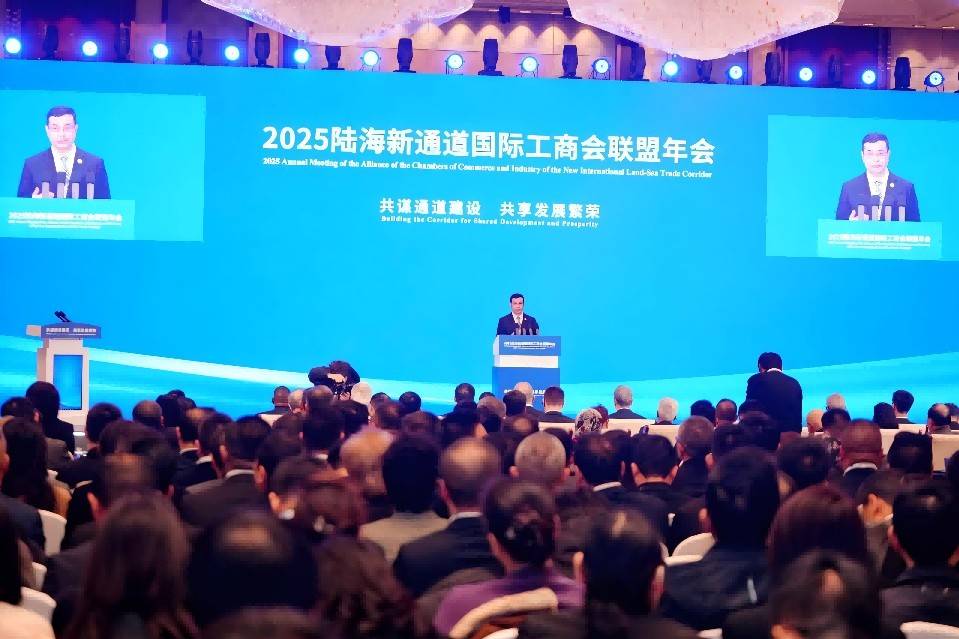
Group 1 - The annual meeting of the International Business Alliance for the New Land-Sea Corridor opened in Chongqing, focusing on "co-building corridor infrastructure and sharing development prosperity," attracting over 500 business representatives from 18 countries and regions [1] - The alliance, initiated by the China International Chamber of Commerce and 18 business organizations from 17 countries, aims to enhance trade and investment through a digital platform that has onboarded over 1,000 domestic and international companies since its launch in May 2025, facilitating transactions exceeding 20 billion [3] - The logistics network of the New Land-Sea Corridor has expanded to cover 581 ports in 127 countries and regions globally, with a trade volume of 780.79 billion in the first ten months of the year, marking a 17.3% increase [4] Group 2 - The annual meeting featured the launch of the "Land-Sea Link" alliance information-sharing platform to enhance cooperation among members, with 20 economic and trade cooperation projects signed, amounting to over 7 billion in intended investments [5] - The alliance has grown to 42 member units and 108 corporate partners by November 2025, becoming a key platform for promoting regional economic coordination and maintaining global industrial and supply chain stability [6]
广西优化关键金属产业布局
Jing Ji Ri Bao· 2025-11-22 06:25
Core Viewpoint - Guangxi is promoting high-quality development of the critical metals industry through a combination of measures, including mining rights integration and comprehensive governance of small and scattered enterprises, aiming to enhance competitiveness and sustainability in the sector [1][2]. Group 1: Industry Development Initiatives - Guangxi plans to reduce the number of mining rights from 2,612 to below 1,800 by the end of 2027, increasing the proportion of large and medium-sized enterprises from 43% to over 60% [1]. - The region has launched the "15th Five-Year" plan for the innovative development of the critical metals industry, aiming to establish a "nine chains and three clusters" industrial system [1]. Group 2: Strategic Goals and Projects - Guangxi is accelerating the construction of the Nandan Comprehensive Experimental Zone for high-quality development of critical metals, focusing on the high-end, intelligent, green, large-scale, and park-based development of non-ferrous and critical metals industries [1]. - Recently, 35 key projects in the non-ferrous and critical metals sectors have been signed, indicating a strong commitment to industrial growth [1]. Group 3: Collaborative Efforts - The regional government emphasizes collaboration in areas such as deep processing of non-ferrous metals, new material research and development, recycling of metals, and high-end equipment manufacturing [2]. - There is a focus on building a complete gradient of technological innovation platforms for non-ferrous and critical metals, promoting the application of artificial intelligence in mining and processing [2].
中欧班列东通道进口运量突破2700万吨
Zhong Guo Xin Wen Wang· 2025-10-18 14:20
Core Insights - The China-Europe Railway Express East Corridor has facilitated the import of 27.818 million tons of goods and 2,669 trains carrying 274,920 TEUs, injecting stable momentum into domestic and international supply chains [1] - The variety of imported goods, including iron ore, fertilizers, and automotive parts, has enhanced the quality of life for consumers and supported consumption upgrades in China [1] - The implementation of the "digital port" system at Manzhouli Station has improved the efficiency of cargo handling, providing 24/7 services to ensure quick processing of imported goods [1] Group 1 - The total volume of imported goods sent from Manzhouli Station has exceeded 16.25 million tons, with a year-on-year increase of 0.75% [1] - The completion of the Jiatong Railway renovation has improved transportation capacity, with 954 "point-to-point" direct trains operated, accounting for 81.3% of all trains [1] - The ongoing expansion of the Tongjiang North Station is expected to increase cargo throughput by 40%, enhancing the variety of import and export goods [1] Group 2 - Suifenhe Station has optimized the classification and handling of imported goods, ensuring a smooth process for cargo arrival, unloading, and dispatch [2]
中国家用机器人“出海”忙
Jing Ji Ri Bao· 2025-10-17 21:40
Core Insights - Chinese-made household robots are gaining significant global presence, dominating the market in various regions including North America, Europe, and Southeast Asia [1][2] Group 1: Market Performance - In the first half of this year, the global vacuum robot market shipped 11.263 million units, marking a year-on-year growth of 16.5% [1] - Chinese brands occupy four out of the top five positions in the global vacuum robot market, with Stone Technology leading at 20.7% market share, followed by Ecovacs, Dreame, and Xiaomi, collectively holding 57% of the market [1] - The lawn mower robot market is projected to grow from $2.2 billion in 2024 to $3.9 billion by 2029, with a compound annual growth rate (CAGR) of 11.5% [2] Group 2: Product Innovation and Technology - Chinese household robot brands are characterized by high performance and energy efficiency, with innovations tailored to meet diverse international needs [2][3] - The robust supply chain in China, particularly in regions like the Pearl River Delta and Yangtze River Delta, allows for rapid production and lower costs [3] - Chinese companies have seen a 20% annual increase in patent applications over the past decade, with 2024 projections indicating that they will account for two-thirds of global robot patent applications [3] Group 3: Competitive Pricing and Market Strategy - Chinese household robots typically offer higher specifications at more competitive prices, exemplified by vacuum robots in Europe being priced about 33% lower than similar products from iRobot [4] - The growth of cross-border e-commerce has made household robots one of the fastest-growing categories, with an annual growth rate exceeding 80% [4] Group 4: Future Outlook - The trend indicates that household robots will transition from luxury items to essential household appliances as technology advances and markets mature [5]


明确限制具体目标,严管军事敏感领域,涉稀土出口管制,中方接连出手
Huan Qiu Wang· 2025-10-09 23:08
Core Points - The Chinese government has announced significant upgrades to its export controls on rare earth materials and technologies, specifically targeting military applications and advanced semiconductor production [1][2][4] - The new regulations require overseas exporters using Chinese rare earths to obtain licenses, particularly for materials containing a minimum of 0.1% Chinese-origin rare earth elements [1][2] - Export applications for military users and those related to weapons of mass destruction will generally be denied, while applications for semiconductor-related technologies will be reviewed on a case-by-case basis [2][4] Group 1: Export Control Regulations - The Ministry of Commerce has issued two announcements detailing the new export controls, which include a requirement for licenses for any overseas export activities involving Chinese rare earths [1][2] - The regulations specifically target rare earth materials and technologies, including samarium-cobalt and neodymium-iron-boron magnets, and require licenses for their export [2][3] - The new rules aim to prevent overseas entities from using Chinese rare earths for military purposes, addressing national security concerns [4][5] Group 2: Implications for Global Supply Chains - Analysts suggest that these new restrictions could hinder efforts by the U.S. and other Western countries to establish independent supply chains, as they heavily rely on Chinese materials and processing technologies [6] - The restrictions may also impact the semiconductor industry, as they include case-by-case reviews for rare earth products used in the development of certain computer chips [6] - The Chinese government emphasizes the need for compliance and has set a reasonable transition period for stakeholders to adapt to the new regulations [4][5]
连续9年全国第一 广东凭什么稳坐“创新王座”?
2 1 Shi Ji Jing Ji Bao Dao· 2025-09-28 13:00
Core Viewpoint - Guangdong continues to rank first in the national innovation capability evaluation for nine consecutive years, showcasing strong performance in enterprise innovation and innovation environment, but faces challenges in maintaining its leading edge as other provinces catch up [1][3][7]. Summary by Sections Overall Performance - Guangdong ranks first in overall innovation capability, with enterprise innovation and innovation environment both at the top, knowledge creation at second, knowledge acquisition at fourth, and innovation performance at second [3][4]. Innovation Metrics - In 2023, Guangdong's R&D expenditure from large industrial enterprises reached 342.664 billion yuan, accounting for 16.34% of the national total, maintaining the top position [4][9]. - The province has a high number of patent applications and authorizations, with 143,141 invention patents granted and 164,853 applications filed, both ranking first nationally [4][9]. Industrial Strength - Guangdong's advanced manufacturing and high-tech manufacturing sectors are projected to increase their value-added shares to 56.7% and 31.6% respectively by 2024, with significant contributions from sectors like new energy vehicles and industrial robots [4][5]. Supportive Ecosystem - Approximately 77,000 high-tech enterprises form a robust support system, with a significant portion of R&D resources and patent applications originating from private enterprises [5][9]. - The province is enhancing its innovation infrastructure, with major investments in basic research and the establishment of key laboratories [9][10]. Future Directions - To transition from a "leader" to a "long-term frontrunner," Guangdong must improve its growth rate and address declining efficiency and potential [7][8]. - Recommendations include strengthening supply chains, improving market conditions for private enterprises, and enhancing talent acquisition strategies [8][10].