债券通

Search documents
东吴证券:维持香港交易所(00388)“买入”评级 IPO募资金额全球第一
智通财经网· 2026-02-27 01:27
衍生产品市场成交张数延续升势 2025年股本证券及金融衍生品分部收入69亿港元,同比+11%,增长主要是由于结构性产品交易及上市 活动增加,以及衍生品市场成交量创新高。衍生产品平均每日成交合约张数达166万张,同比增长7%。 联交所牛熊证及权证等日均交易额同比增长55%至183亿港元。期交所衍生品合约和联交所期权合约平 均每日成交张数分别-6%和+22%。新上市权证、牛熊证数分别+50%、+27%。 智通财经APP获悉,东吴证券发布研报称,维持香港交易所(00388)"买入"评级。香港市场交投活跃,预 计IPO发行有望延续升势,看好香港交易所α与β同步优化,进一步兑现发展前景。该行小幅调整此前盈 利预测,预计港交所2026-2027年股东应占溢利分别为189.66/205.12亿港元,估算公司2028年股东应占 溢利为224.15亿港元,对应增速分别为7%/8%/9%。当前股价对应PE估值分别为27.8x /25.7x /23.5x。 东吴证券主要观点如下: 事件 香港交易所发布2025年业绩:1)实现收入及其他收益292亿港元,同比+30%,归母净利润178亿港元, 同比+36%。全年业绩创历史新高,业绩高 ...


陈茂波:与内地研究加快落实在港推出国债期货
Qi Huo Ri Bao Wang· 2026-02-25 16:31
2月25日,香港特区政府财政司司长陈茂波发表2026—2027年度财政预算案。陈茂波表示,综合各种因 素,预计今年香港经济增长2.5%至3.5%,基本通胀率和整体通胀率分别为1.7%和1.8%。他预测香港经 济在2027—2030年平均每年实质增长3%,基本通胀率预计为平均每年2%。 他还表示,为丰富互联互通,特区政府会积极与内地研究加快落实在港推出国债期货,将房地产投资信 托基金纳入互联互通,将人民币交易柜台纳入港股通,以及探索持续优化债券通。 (文章来源:期货日报网) ...
央行副行长陆磊:今年以来 互换通交易净限额已由每日200亿元提升到每日450亿元
Sou Hu Cai Jing· 2025-11-04 02:27
Core Viewpoint - The People's Bank of China (PBOC) is actively enhancing the accessibility and efficiency of bond markets for foreign investors through various initiatives [1] Group 1: Bond Market Initiatives - The PBOC has supported various foreign institutional investors to engage in bond repurchase agreements within the mainland [1] - A new offshore bond repurchase business has been launched in Hong Kong, using bonds under the Bond Connect as collateral [1] - The Bond Connect bonds are becoming widely accepted as qualified collateral in the Hong Kong market [1] Group 2: Swap Connect Optimization - The PBOC is optimizing the Swap Connect by expanding the number of quoting firms [1] - The daily trading net limit has been increased from 20 billion to 45 billion [1] - These measures are aimed at facilitating foreign investors in managing interest rate risks [1]
债券通北向通9月成交5810亿元
Xin Hua Cai Jing· 2025-10-23 14:05
Core Insights - The Bond Connect reported a total northbound trading volume of 581 billion RMB in September 2025, with an average daily trading volume of 25.3 billion RMB [1] - Government bonds and policy financial bonds were the most actively traded, accounting for 49% and 33% of the monthly trading volume, respectively [1] - The Swap Connect facilitated 861 transactions totaling 431.8 billion RMB, with 83 foreign institutions participating [1] - The ePrime bond issuance system supported 14 offshore bond issuances in September, amounting to an equivalent of 18.324 billion RMB, including a successful issuance of 5 billion RMB in offshore RMB local government bonds by Hainan Province [1] - A total of 72 bond issuance information and results were published by the "New Bond Information Platform" in September [1]
“互换通”运行机制迎来优化 每日净限额提高至450亿元
Cai Jing Wang· 2025-10-13 11:05
Core Insights - The "Swap Connect" mechanism is being optimized to enhance the interconnectivity of the interest rate swap market between mainland China and Hong Kong, which is a significant step in China's financial market opening [1][2]. Group 1: Mechanism Optimization - The daily net limit for interest rate swaps will be increased from 20 billion to 45 billion yuan starting October 13, 2025, allowing greater participation from foreign investors and improving the attractiveness of RMB assets [1]. - A dynamic assessment mechanism for daily net limits will be implemented to adjust quota allocations based on market supply and demand, preventing trading interruptions due to insufficient quotas [1][3]. - The introduction of a dynamic adjustment mechanism for market makers will enhance pricing efficiency and reduce the market influence of any single institution, leading to fairer and more transparent pricing [3]. Group 2: Market Participation and Growth - Since its launch on May 15, 2023, "Swap Connect" has seen a steady increase in transaction volume and the number of participating investors, with 82 foreign investors from 15 countries and regions engaging in over 15,000 RMB interest rate swap transactions totaling a nominal principal of 8.15 trillion yuan by August 2025 [2]. - The increase in the daily net limit to 45 billion yuan is expected to meet the growing demand from foreign investors for RMB interest rate risk hedging, thereby enhancing market liquidity [1][2]. Group 3: Future Directions - Future optimization directions for the "Swap Connect" mechanism include expanding the variety of products offered, improving cross-border collaboration efficiency, and refining the evaluation standards for market makers [3][4].
互联网大厂“钱袋子”扩充,点心债成中企出海融资新宠
Di Yi Cai Jing· 2025-09-25 12:41
Core Viewpoint - The article highlights the increasing popularity of dim sum bonds among Chinese internet giants like Tencent, Baidu, and Alibaba, driven by cost advantages and policy support, as they seek to expand their financing options in the offshore RMB market [1][3]. Group 1: Market Trends - The issuance of dim sum bonds has transitioned from rapid expansion to a phase of stable growth, with a cumulative issuance of 771.4 billion RMB as of September 18 this year [1][4]. - The market is experiencing structural changes, with a diversification of issuers and an increase in the types of investment institutions involved, enhancing market depth and breadth [1][4]. Group 2: Major Issuers - Tencent issued three RMB bonds totaling 9 billion RMB on September 23, marking its first foray into the dim sum bond market [2]. - Baidu successfully issued 4.4 billion RMB in dim sum bonds on September 15, representing its second issuance this year [2]. - Alibaba previously issued 17 billion RMB in dim sum bonds in November last year and announced a 3.2 billion USD zero-coupon convertible bond issuance in September, with 80% of the funds allocated for cloud infrastructure and technology upgrades [2]. Group 3: Reasons for Preference - The primary reasons for the preference for dim sum bonds among internet companies include lower financing costs and supportive policies, as these companies enter a peak capital expenditure phase [3][5]. - The People's Bank of China and the Hong Kong Monetary Authority have announced measures to expand the "Bond Connect" program, enhancing the attractiveness of offshore RMB bonds for companies with significant overseas financing needs [3][7]. Group 4: Supply and Demand Dynamics - The supply of dim sum bonds is becoming more diversified, with significant contributions from various industries, while the existing stock remains concentrated in the banking and local government financing sectors [4][5]. - The demand for dim sum bonds is supported by low domestic interest rates and expanded cross-border investment channels, leading to increased interest from domestic institutions [6][8]. Group 5: Future Outlook - The dim sum bond market is expected to continue evolving, with potential for increased issuance from a wider range of issuers and improved structural diversity [7]. - The expansion of QDII quotas and the enhancement of the "Southbound Bond Connect" program are anticipated to boost demand for dim sum bonds, improving market liquidity [7][8].



8月债券通北向通成交7501亿元
Xin Hua Cai Jing· 2025-09-22 15:22
Core Insights - The Bond Connect Company reported that in August, the northbound trading volume reached 750.1 billion RMB, with an average daily trading volume of 35.7 billion RMB [1] - Government bonds and policy financial bonds were the most actively traded, accounting for 38% and 41% of the monthly trading volume, respectively [1] - The ePrime platform supported 20 offshore bond issuances in August, totaling 25.153 billion RMB, with underwriters including Agricultural Bank of China International, Bank of China, CITIC International, and Galaxy International [1] - In the northbound swap market, 793 transactions were completed in August, totaling 419.681 billion RMB; by the end of August, 82 foreign institutions had entered the market [1]
离岸人民币债券回购业务优化安排启动 首个交易日达成超60笔交易
Xin Hua Cai Jing· 2025-08-25 14:40
Group 1 - The offshore RMB bond repurchase business optimization officially launched on August 25, with over 60 transactions from at least 25 financial institutions, involving amounts exceeding 3 billion RMB equivalent [1] - The Hong Kong Monetary Authority (HKMA) announced the optimization measures to support collateral bond reuse and foreign currency settlement, receiving positive market feedback [1] - Bank of China Hong Kong reported multiple repurchase transactions under the new optimization arrangements, enhancing multi-currency financing efficiency for offshore investors [1] Group 2 - Standard Chartered highlighted an increase in client inquiries, believing the new measures will enhance the attractiveness of RMB bonds and solidify Hong Kong's status as an international financial center [2] - HSBC noted the growing participation of international investors in the offshore RMB bond repurchase business, facilitating the transition of the bond market towards international standards [2]
固定收益深度报告:债券“南向通”扩容下的投资机会
CMS· 2025-08-19 09:34
1. Report Industry Investment Rating No relevant content provided. 2. Core Viewpoints of the Report The regulatory authorities plan to optimize the Bond "Southbound Connect" mechanism and expand the investor access scope, providing institutional guarantees for domestic funds to allocate offshore bonds. The report systematically analyzes the development background, operation mechanism, and investment opportunities under the expansion of the Bond "Southbound Connect" to clarify the infrastructure for cross - border bond allocation for investors [1][8]. 3. Summary According to the Directory 3.1 Bond "Southbound Connect" Launch Background and Regulatory Policy Development Process - The Bond "Southbound Connect" aims to build an efficient offshore bond allocation channel for domestic institutional investors by deepening the cooperation between the bond market infrastructure institutions of the two regions. Before its launch, domestic institutions' participation in the overseas bond market was restricted by complex approval processes, limited investment quotas, and high transaction costs [2][9]. - The policy history can be divided into three phases: 2017 - 2020 was the policy foundation period with the priority launch of the Bond "Northbound Connect"; in 2021, the "Southbound Connect" mechanism was officially implemented; since October 2024, it has entered the expansion and deepening period, with plans to expand the investor scope to non - bank institutions such as securities firms, funds, insurance companies, and wealth management institutions, and optimize multi - currency settlement and repurchase mechanisms [2][10]. 3.2 Bond "Southbound Connect" Operation Mechanism 3.2.1 "Southbound Connect" Business Operation and Regulatory Mechanism - There are two custody modes for domestic investors: the multi - level direct connection custody mode relying on domestic bond registration and settlement institutions, and the global custody mode relying on domestic custody and clearing banks (also known as the "dual - custody" mode of domestic and overseas custodian banks). The global custody mode has a wider trading scope and more flexible currency support [17][19]. - The clearing mechanism varies according to the transaction currency. For RMB and Hong Kong dollar settlements, Delivery versus Payment (DVP) settlement is adopted, while for US dollar and euro settlements, Free of Payment (FOP) settlement is used. The settlement confirmation and processing have specific time requirements [20]. - The cross - border capital flow under the "Southbound Connect" is strictly regulated. The People's Bank of China is responsible for overall supervision, and the China Foreign Exchange Trade System (CFETS) monitors the transaction quota in real - time. Domestic investors can exchange RMB for foreign currencies through the inter - bank foreign exchange market and hedge exchange rate risks, and the funds are earmarked for bond investment [21][22]. - The "Southbound Connect" adopts a cross - border capital net outflow quota management mechanism, with an annual net outflow quota of 50 billion yuan equivalent and a daily quota of 20 billion yuan equivalent for all participating institutions. The actual investment scope needs to consider multiple factors [3][23]. 3.2.2 "Southbound Connect" Market Makers and Domestic Investor Scope - The current trading counterparties of the "Southbound Connect" are 22 market makers designated by the Hong Kong Monetary Authority, which provide liquidity support and trading services for the market [27]. - The current domestic investors mainly include two types: 41 bank institutions among the primary dealers of open - market operations, and institutional investors with Qualified Domestic Institutional Investor (QDII) and Renminbi Qualified Domestic Institutional Investor (RQDII) qualifications. In the future, the investor scope is expected to expand to non - bank institutions, which may change the investment preference in the overseas bond market [28]. 3.2.3 "Southbound Connect" Transaction Process - The participation in "Southbound Connect" transactions involves qualification approval, account opening, and transaction execution. The main trading mode is the Request for Quote (RFQ) mode, which is completed through the CFETS system and overseas platforms [32]. - For qualification approval and account opening, eligible domestic investment institutions need to submit application materials to the National Inter - bank Funding Center and complete the account configuration process. For transactions, investors send quote requests, market makers provide feedback, and the transaction is confirmed to be concluded [33][35]. 3.3 Investment Opportunities under the Expansion of the Bond "Southbound Connect" 3.3.1 Overall Situation of the Hong Kong Bond Market - The investable bond scope of the Bond "Southbound Connect" includes all bonds issued overseas and traded in the Hong Kong bond market, including offshore RMB bonds (dim - sum bonds), Hong Kong dollar bonds, and G3 currency (US dollar, euro, yen) bonds. In practice, offshore RMB bonds and Chinese - funded US dollar bonds are the main investment targets [4][22]. - As of the end of 2024, the outstanding balances of Hong Kong offshore RMB bonds, Hong Kong dollar bonds, and G3 currency bonds were 173.2 billion US dollars, 195.5 billion US dollars, and 565.6 billion US dollars respectively. The composition of each currency bond is different: Hong Kong dollar debt instruments include sovereign and corporate bonds; offshore RMB debt instruments are all dim - sum bonds; most of the G3 currency bonds issued in Hong Kong are Chinese - funded US dollar bonds [40][42]. 3.3.2 Key Sector of the "Southbound Connect": Dim - sum Bonds - As of August 3, 2025, there were 3,970 outstanding dim - sum bonds with a total scale of 277.252 billion US dollars. After excluding certificates of deposit, there were 2,936 outstanding bonds with a scale of 215 billion US dollars. The dim - sum bond market has shown a significant expansion trend since 2023, and the low - cost capital environment in the Hong Kong market is conducive to its issuance [43]. - Most of the remaining maturities of outstanding dim - sum bonds are less than 3 years, accounting for 73% of the total scale. In terms of industrial distribution, financial and government bonds have a large stock scale. Energy and industrial sectors have relatively high coupon rates [43][46]. - In the secondary market, the excess spread space of offshore RMB sovereign bonds is currently insufficient, while 1 - 3 - year financial dim - sum bonds, industrial dim - sum bonds within 3 years, and urban investment dim - sum bonds within 5 years have relatively high yields [49]. 3.3.3 Key Sector of the "Southbound Connect": Chinese - funded US dollar Bonds - As of August 1, 2025, there were 2,148 outstanding Chinese - funded US dollar bonds with a total scale of 647.6 billion US dollars. The issuance pace slowed down in 2023 but showed a recovery trend in 2024. From January to July 2025, the total issuance scale was 75.2 billion US dollars, a year - on - year increase of 22.5 billion US dollars [55]. - Most of the remaining maturities of outstanding Chinese - funded US dollar bonds are less than 3 years, accounting for 65% of the total scale. In terms of credit quality, investment - grade and high - yield bonds account for 31% and 1% respectively, and the rest are unrated bonds [58]. - In terms of industrial distribution, the financial, real estate, and communication sectors have a large stock scale. The industrial and urban investment sectors have relatively high coupon rates. The secondary market yields of Chinese - funded US dollar bonds are significantly higher than those of domestic bonds, and among investment - grade Chinese - funded US dollar bonds, the yields of urban investment US dollar bonds within 3 years are slightly higher than those of industrial and financial bonds [60][63].

中资离岸债风控双周报:一级市场发行平稳,二级市场多数上涨
Xin Hua Cai Jing· 2025-07-12 01:26
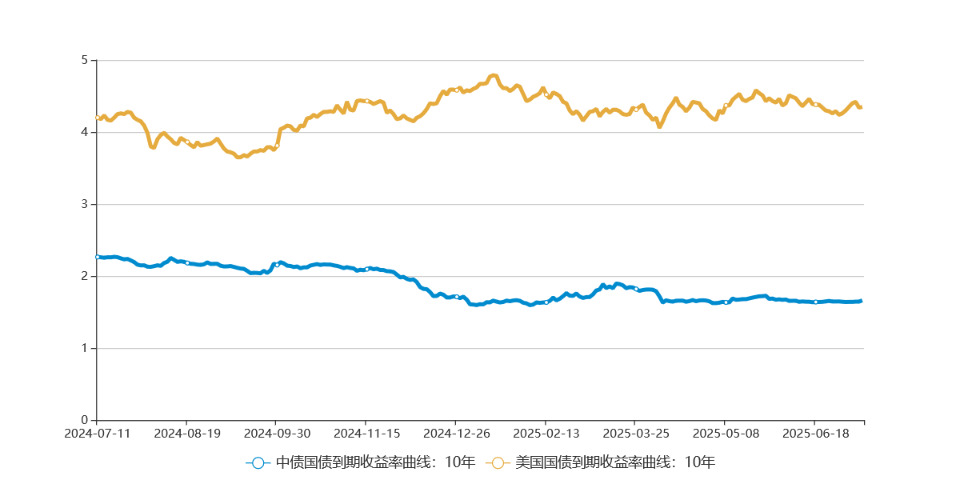
Primary Market - A total of 49 offshore bonds were issued in the past two weeks (from June 30 to July 11, 2025), including 8 offshore RMB bonds, 25 USD bonds, 6 HKD bonds, and 10 EUR bonds, with issuance scales of 6.687 billion RMB, 3.5652 billion USD, 3.25 billion HKD, and 2.124 billion EUR respectively [1] - The largest single issuance in the offshore RMB bond market was 3.5 billion RMB by Xiamen Xiangyu Group Co., Ltd. The highest coupon rate for RMB bonds was 7.5%, issued by Yichuan Caiyuan Industrial Investment Co., Ltd. [1] - In the USD bond market, the largest single issuance was 600 million USD by CITIC Securities International Co., Ltd., with the highest coupon rate of 6.9% issued by Tai'an High-tech Construction Group Co., Ltd. [1] Secondary Market Overview - The yield on most Chinese USD bonds increased this week, with the Markit iBoxx Chinese USD Bond Composite Index rising by 0.12% to 244.3 [2] - The investment-grade USD bond index increased by 0.14% to 236.96, while the high-yield USD bond index decreased by 0.03% to 239.29 [2] - The real estate USD bond index fell by 0.1% to 180.51, while the city investment USD bond index rose by 0.12% to 149.75, and the financial USD bond index increased by 0.07% to 284.41 [2] Benchmark Spread - As of July 11, 2025, the spread between the 10-year benchmark government bonds of China and the US widened to 268.43 basis points, an increase of 8.32 basis points compared to the previous two weeks [3] Rating Changes - On July 10, the credit rating of Guangdong Shenshan Investment Holding Group Co., Ltd. was downgraded to AA+ by China Chengxin International Credit Rating Co., Ltd. [5] - On July 11, the rating of Zhengzhou Coal Industry (Group) Co., Ltd. was downgraded to BB by Dagong Global Credit Rating Co., Ltd. [5] Market News - The first batch of 10 Sci-Tech Innovation Bond ETFs raised a total of 29.988 billion RMB in just one day [6][7] - The "Southbound Bond Connect" pilot program will be expanded to include non-bank institutions, allowing more domestic investors to invest in the offshore bond market [8] - The Ministry of Finance will issue 6 billion RMB in government bonds in Macau on July 16, 2025, marking the fourth consecutive year of such issuances [9] Offshore Bond Alerts - Chow Tai Fook Enterprises announced plans to issue 850 million HKD in 2.8% convertible bonds while repurchasing 780 million HKD in 4.0% convertible bonds due in 2025 [11] - Sunac China plans to issue 754 million shares to raise funds for repaying approximately 5.6 billion RMB in domestic bonds [12] - Longfor Group's restructuring plan for 21 domestic bonds has been approved by bondholders [13] - Vanke applied for a loan of up to 6.249 billion RMB from Shenzhen Metro Group to repay bond principal and interest [14]