
市场情绪指标

Search documents
2月第2周立体投资策略周报:活跃资金延续流出-20260224
Guoxin Securities· 2026-02-24 08:15
Group 1 - The core conclusion indicates that in the second week of February, a total net outflow of funds amounted to 72.3 billion yuan, an increase from the previous week's outflow of 52.2 billion yuan [1] - Short-term sentiment indicators are at a medium-high level since 2005, while long-term sentiment indicators are at a medium-low level since 2005 [1][2] - From an industry perspective, the highest transaction volume share in the past week was in the communication, semiconductor, and electric equipment sectors, with shares of 99%, 98%, and 97% respectively [2][15] Group 2 - In terms of fund inflows, the financing balance decreased by 74.7 billion yuan, public fund issuance increased by 43.6 billion yuan, ETF net redemptions were 23.1 billion yuan, and northbound funds estimated a net inflow of 3 billion yuan [8] - The long-term sentiment indicator shows that the recent A-share risk premium is 2.52%, placing it at the 45th percentile historically, while the dividend yield of the 300 index (excluding finance) is 1.23, at the 5th percentile historically [2][15] - The financing transaction share was highest in the machinery equipment, electric equipment, and social services sectors, with shares of 88%, 80%, and 78% respectively, while the lowest were in banking, coal, and real estate at 10%, 12%, and 17% respectively [2][15]
2月第2周立体投资策略周报:跃资金延续流出-20260224
Guoxin Securities· 2026-02-24 06:54
Core Conclusions - In the second week of February, a total net outflow of funds from the market amounted to 72.3 billion yuan, an increase from the previous week's outflow of 52.2 billion yuan [1] - Short-term sentiment indicators are at a medium-high level since 2005, while long-term sentiment indicators are at a medium-low level since 2005 [1] - From an industry perspective, the highest trading volume in the past week was seen in the telecommunications, semiconductor, and electrical equipment sectors [1] Fund Flow Analysis - In the second week of February, the total net outflow of funds was 72.3 billion yuan, compared to 52.2 billion yuan in the previous week. Fund inflows included a decrease in financing balance by 74.7 billion yuan, an increase in public fund issuance by 43.6 billion yuan, net redemptions of ETFs amounting to 23.1 billion yuan, and an estimated net inflow of 3 billion yuan from northbound funds. Fund outflows included an IPO financing scale of 800 million yuan, net reduction of industrial capital by 10.1 billion yuan, and transaction fees of 10.3 billion yuan [8] Short-term Sentiment Indicators - The short-term sentiment indicators are currently at a medium-high level since 2005, with the recent weekly turnover rate (annualized) at 430%, placing it in the 76th percentile historically. The recent weekly financing transaction ratio is 9.74%, placing it in the 72nd percentile historically [15] Long-term Sentiment Indicators - The long-term sentiment indicators are at a medium-low level since 2005. The recent weekly A-share risk premium (the inverse of the overall A-share PE minus the yield of ten-year government bonds) is 2.52%, placing it in the 45th percentile historically. The recent weekly dividend yield of the CSI 300 index (excluding financials) compared to the yield of ten-year government bonds is 1.23, placing it in the 5th percentile historically [15] Industry Performance - In terms of trading volume, the top three industries with the highest historical percentile for transaction volume in the past week were telecommunications (99%), semiconductors (98%), and electrical equipment (97%). The lowest were real estate (1%), food processing (1%), and transportation (1%) [15] - The highest financing transaction ratio by industry was seen in machinery equipment (88%), electrical equipment (80%), and social services (78%), while the lowest were banking (10%), coal (12%), and real estate (17%) [15]
策略周报:2 月第2 周立体投资策略周报:活跃资金延续流出-20260224
Guoxin Securities· 2026-02-24 06:51
Core Conclusions - In the second week of February, a total net outflow of funds from the market amounted to 72.3 billion yuan, an increase from the previous week's outflow of 52.2 billion yuan [1] - Short-term sentiment indicators are at a medium-high level since 2005, while long-term sentiment indicators are at a medium-low level since 2005 [1] - From an industry perspective, the highest trading volume share in the past week was seen in the telecommunications, semiconductor, and electrical equipment sectors [1] Fund Flow Analysis - In the second week of February, the total net outflow of funds was 72.3 billion yuan, compared to 52.2 billion yuan in the previous week. Fund inflows included a decrease in financing balance by 74.7 billion yuan, an increase in public fund issuance by 43.6 billion yuan, net redemptions of ETFs amounting to 23.1 billion yuan, and an estimated net inflow of northbound funds of 3 billion yuan. Fund outflows included an IPO financing scale of 800 million yuan, net reduction of industrial capital by 10.1 billion yuan, and transaction fees of 10.3 billion yuan [8] Short-term Sentiment Indicators - The short-term sentiment indicators, which primarily consider turnover rate and financing transaction ratio, show that the recent weekly turnover rate (annualized) was 430%, currently at the 76th percentile historically. The recent weekly financing transaction ratio was 9.74%, currently at the 72nd percentile historically [15] Long-term Sentiment Indicators - The long-term sentiment indicators, which mainly look at the price comparison of major asset classes, indicate that the recent weekly A-share risk premium (the inverse of the overall A-share PE minus the yield of ten-year government bonds) was 2.52%, currently at the 45th percentile historically. Additionally, the recent weekly dividend yield of the CSI 300 index (excluding financials) compared to the yield of ten-year government bonds was 1.23, currently at the 5th percentile historically [15] Industry Performance - In terms of trading volume share, the top three industries with the highest historical percentile in the past week were telecommunications at 99%, semiconductors at 98%, and electrical equipment at 97%. The lowest were real estate at 1%, food processing at 1%, and transportation at 1% [15] - The highest financing transaction ratio by industry was seen in machinery equipment at 88%, electrical equipment at 80%, and social services at 78%. The lowest were banking at 10%, coal at 12%, and real estate at 17% [15]
1 月第 4 周立体投资策略周报:ETF 净赎回规模收窄-20260202
Guoxin Securities· 2026-02-02 12:15
Group 1 - In the fourth week of January, the total net outflow of funds was 148.3 billion, compared to a net inflow of 173.9 billion in the previous week [1][8] - The short-term sentiment indicator is at a high level since 2005, with the recent weekly turnover rate (annualized) at 627%, placing it in the 90th percentile historically [1][12] - The long-term sentiment indicator is at a medium-low level since 2005, with the recent A-share risk premium at 2.48%, in the 46th percentile historically [2][12] Group 2 - The top three industries by trading volume in the past week were semiconductor (99%), non-ferrous metals (98%), and defense industry (97%), while the lowest were food processing (0%), transportation (0%), and real estate (1%) [2][14] - The highest financing transaction ratio industries were machinery equipment (86%), electric power equipment (82%), and social services (79%), while the lowest were banking (14%), non-bank financials (20%), and real estate (20%) [2][14]
策略周报:1 月第 4 周立体投资策略周报:ETF 净赎回规模收窄-20260202
Guoxin Securities· 2026-02-02 11:54
Group 1 - In the fourth week of January, the total net outflow of funds was 148.3 billion, compared to a net inflow of 173.9 billion in the previous week [1][8] - The short-term sentiment indicator is at a high level since 2005, with the recent weekly turnover rate (annualized) at 627%, placing it in the 90th percentile historically [1][12] - The long-term sentiment indicator is at a medium-low level since 2005, with the recent A-share risk premium at 2.48%, in the 46th percentile historically [2][12] Group 2 - The top three industries by trading volume percentage in the past week were semiconductor (99%), non-ferrous metals (98%), and defense industry (97%), while the lowest were food processing (0%), transportation (0%), and real estate (1%) [2][14] - The highest financing transaction percentage industries were machinery equipment (86%), electric power equipment (82%), and social services (79%), while the lowest were banking (14%), non-bank financials (20%), and real estate (20%) [2][14]
1月第4周立体投资策略周报:etf净赎回规模收窄-20260202
Guoxin Securities· 2026-02-02 09:20
Group 1 - In the fourth week of January, the total net outflow of funds was 148.3 billion, compared to a net inflow of 173.9 billion in the previous week [1][8] - The short-term sentiment indicator is at a high level since 2005, with the recent weekly turnover rate (annualized) at 627%, placing it in the 90th percentile historically [1][12] - The long-term sentiment indicator is at a medium-low level since 2005, with the recent A-share risk premium at 2.48%, in the 46th percentile historically [2][12] Group 2 - The top three industries by trading volume percentage in the past week were semiconductor (99%), non-ferrous metals (98%), and defense industry (97%), while the lowest were food processing (0%), transportation (0%), and real estate (1%) [2][14] - The highest financing transaction percentage industries were machinery equipment (86%), electric power equipment (82%), and social services (79%), while the lowest were banking (14%), non-bank financials (20%), and real estate (20%) [2][14]
1月第2周立体投资策略周:活跃资金流入,长线资金流出
Guoxin Securities· 2026-01-19 14:30
Group 1 - In the second week of January, the total net inflow of funds into the market was 7.2 billion, a significant decrease from the previous week's inflow of 71.5 billion [1][7] - The short-term sentiment indicator is at a high level since 2005, with the recent weekly turnover rate (annualized) at 682%, placing it in the 92nd percentile historically [1][13] - The long-term sentiment indicator is at a medium-low level since 2005, with the recent A-share risk premium at 2.45%, in the 46th percentile historically [2][13] Group 2 - The top three industries by transaction volume in the past week were defense and military industry (100%), semiconductors (97%), and electric power equipment (96%), while the lowest were real estate (0%), food processing (0%), and transportation (0%) [2][13] - The highest financing transaction ratio industries were electric power equipment (93%), machinery equipment (93%), and basic chemicals (92%), while the lowest were oil and petrochemicals (34%), coal (45%), and retail (46%) [2][13]
1月第1周立体投资策略周报:“十六连阳”背后是哪些资金在买-20260112
Guoxin Securities· 2026-01-12 15:25
Group 1 - In the first week of January, a total net inflow of funds into the market reached 721 billion, reversing a previous outflow of 104 billion [1][8] - The financing balance increased by 858 billion, public fund issuance rose by 70 billion, and estimated net inflow from northbound funds was 96 billion [1][8] - The short-term sentiment indicator is at a high level since 2005, with the recent weekly turnover rate (annualized) at 564%, placing it in the 87th percentile historically [1][12] Group 2 - The long-term sentiment indicator is at a medium-low level since 2005, with the recent A-share risk premium at 2.43%, which is in the 46th percentile historically [2][14] - The recent dividend yield of the CSI 300 index (excluding financials) compared to the ten-year government bond yield is 1.17, placing it in the 7th percentile historically [2][14] - The highest turnover rates among industries in the past week were in defense and military (100%), media (98%), and automotive (97%), while the lowest were in liquor (18%), utilities (56%), and beauty care (59%) [2][14] Group 3 - The highest financing transaction ratios were in power equipment (95%), beauty care (95%), and machinery (94%), while the lowest were in coal (32%), food and beverage (36%), and construction decoration (44%) [2][14] - The total market capitalization of A-shares is 101.25 trillion, with a circulating market value of 93.05 trillion [3]
中信建投:结构市能否转向全面牛?关键看资金、估值、风险溢价三大维度突破
智通财经网· 2025-12-15 23:48
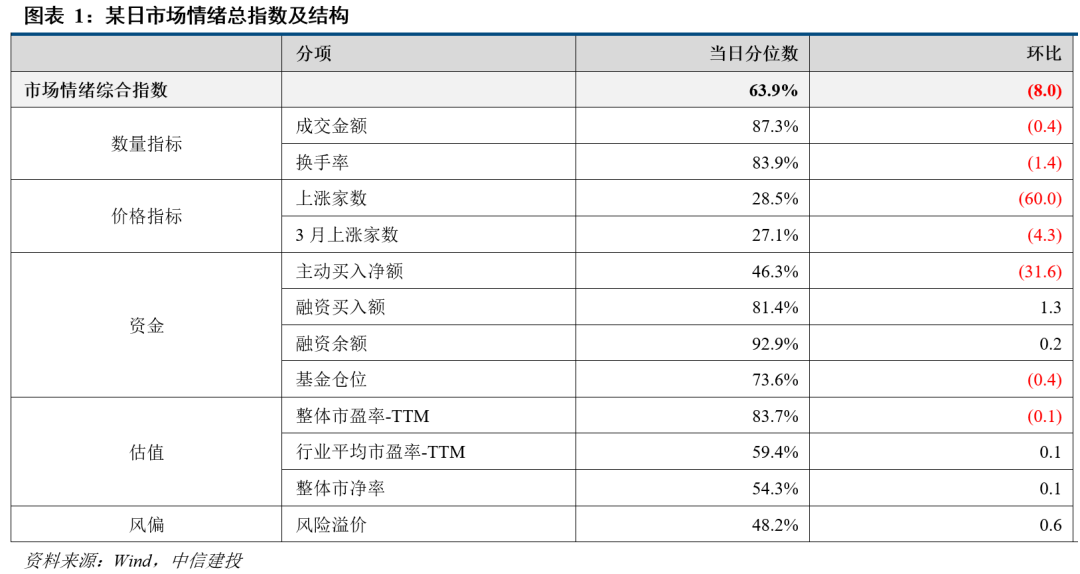
Group 1 - The report from CITIC Securities indicates that the current bull market from September 2024 has similarities and differences compared to the liquidity bull market from May 2014 to June 2015, particularly in market sentiment metrics [1] - The current bull market's trading volume and turnover rate are similar to the peak levels of the previous bull market, but indicators related to funds, valuation, and risk premium still show a gap [1][24] - A comprehensive sentiment index is constructed from five dimensions: volume, price, funds, valuation, and risk premium, with a total of 12 indicators used to measure market sentiment [1] Group 2 - The comprehensive market sentiment index currently stands at 63.9%, reflecting a decrease of 8.0% from the previous period [2] - The trading volume indicator is at 87.3% and turnover rate at 83.9%, both showing slight decreases [2] - The number of stocks rising on the day is at 28.5%, a significant drop of 60.0%, indicating weaker price sentiment [2] Group 3 - Historical backtesting shows that the sentiment index closely follows stock index trends and has leading characteristics, with the sentiment index peaking before the stock index in both the 2014-2015 and 2024 bull markets [6] - The first bull market's sentiment index peaked at 95.5%, while the current bull market has reached a maximum of 78.7% [17][18] Group 4 - The current bull market's sentiment indicators for volume are at levels comparable to the previous bull market's peak, while indicators for funds, valuation, and risk premium remain below previous highs [19][21][22] - The strong trading volume is attributed to declining yields in the bond market, deposits, and real estate, which have drawn significant capital into the equity market [24] Group 5 - The sentiment indicators suggest that the current bull market is structurally complex, with strong volume metrics but weaker indicators for funds, valuation, and risk premium [23] - The technology sector shows significantly higher sentiment compared to the overall market, indicating a structural shift within the current bull market [32]


量化择时周报:情绪指标结构性分化延续,部分指标呈现震荡修复-20251214
Shenwan Hongyuan Securities· 2025-12-14 13:09
Group 1 - Market sentiment score continued to decline, reaching 1.35 as of December 12, down from 2.4 the previous week, indicating a bearish outlook from a sentiment perspective [2][8] - The overall trading volume in the market increased significantly, with total trading volume for the week rising by 15.14% compared to the previous week, averaging 19,530.44 billion yuan per day, with a peak of 21,190.10 billion yuan on December 12 [14][16] - The industry score model indicates that sectors such as non-bank financials, communication, defense, and automotive are showing upward trends in short-term scores, with communication having the highest short-term score of 77.97 [40][41] Group 2 - The correlation between industry congestion and weekly price changes is strong, with a coefficient of 0.33, indicating that sectors with high congestion like communication and defense are leading in gains, while sectors with low congestion like steel and environmental protection are lagging [45][46] - The current model suggests a preference for large-cap and growth styles, with signals indicating that growth style may strengthen further in the future [40][51] - The financing balance ratio continues to rise, reaching a new high for the phase, indicating an increase in leveraged funds and a structural recovery in risk appetite [26][28]