市场风险管理

Search documents
全球贵金属市场调控升级:芝商所与上期所调整交易规则
Huan Qiu Wang· 2026-02-01 03:13
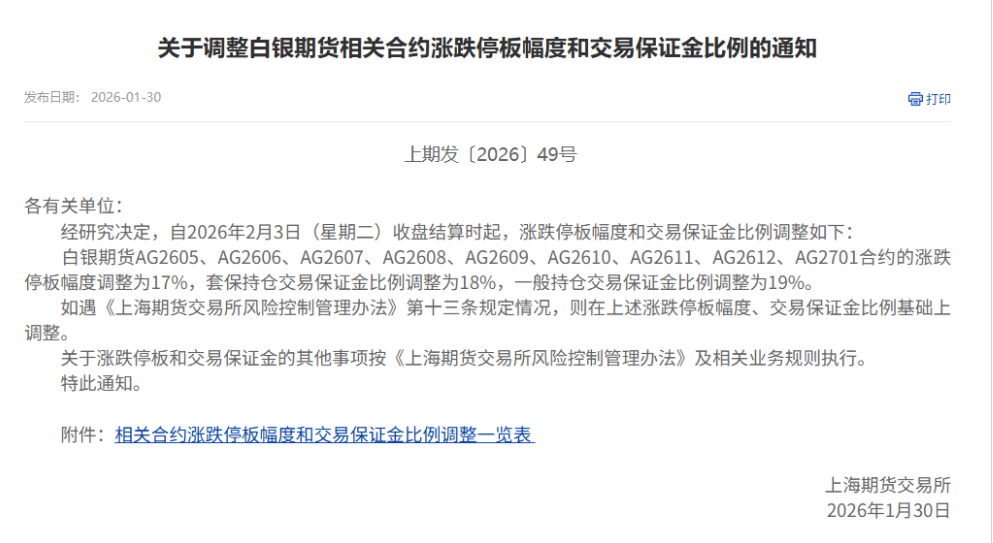
Core Viewpoint - The global precious metals market has experienced significant volatility, prompting both the Chicago Mercantile Exchange (CME) and the Shanghai Futures Exchange (SHFE) to implement new regulations aimed at strengthening market risk management [1] Group 1: CME Margin Adjustments - On January 31, CME announced an increase in margin requirements for gold and silver futures following substantial price declines, with non-high-risk margin for gold rising from 6% to 8% and high-risk margin from 6.6% to 8.8% [2] - For silver futures, the non-high-risk margin increased from 11% to 15%, and high-risk margin from 12.1% to 16.5% [2] - The margin increase is part of a "routine review" to ensure adequate collateral coverage and maintain market stability, potentially impacting smaller investors who may struggle to meet the new requirements [2] Group 2: SHFE Adjustments - On January 30, SHFE announced adjustments to trading rules for silver futures, effective February 3, 2026, increasing the price fluctuation limit from 16% to 17% and raising the margin requirements for both maintaining and general positions [3] - The maintenance margin for specific contracts increased from 17% to 18%, while the general margin rose from 18% to 19% [3] Group 3: Industry Analysis - Industry experts suggest that SHFE's adjustments are a response to heightened volatility in the silver market, aimed at increasing trading costs and limiting price fluctuations to prevent excessive speculation and protect investor interests [5] - The recent fluctuations in the global precious metals market are influenced by multiple factors, and the timely implementation of risk control measures by exchanges is expected to stabilize market expectations and promote healthy market development [5]

碳酸锂期价冲高回落,“强现实”已兑现?
Qi Huo Ri Bao· 2026-01-29 02:03
Core Viewpoint - Lithium carbonate futures prices have recently experienced a pullback after reaching a peak, indicating a market return to fundamental trading as previous bullish news has been digested [1] Group 1: Price Movements and Market Dynamics - On January 28, the main contract for lithium carbonate futures closed at 166,280 yuan/ton, down 3.9% [1] - The price drop is attributed to a decline in lithium ore prices, with the average price of Australian 6% spodumene reported at $2,355/ton, down $100/ton [1] - Analysts suggest that the rapid price increase lacked further supportive news, leading to a reduction in upward momentum and subsequent price correction [1][2] Group 2: Supply and Demand Factors - The lithium carbonate market remains stable, with supply at a high level but limited incremental growth, maintaining a weekly production of approximately 22,000 tons [1] - Demand is characterized by a "not-so-dull off-season," with energy storage batteries operating at full capacity and a "rush for exports" in the power battery sector due to export tax rebate policies [1] - Current weekly inventory reduction of lithium carbonate is around 800 tons, indicating a shift back to a destocking phase after a slight accumulation [1] Group 3: Market Sentiment and Future Outlook - The overall inventory level in the industry is low, with lithium salt plants and downstream industries showing low inventory levels, while futures traders hold higher inventories [2] - Strong demand may trigger replenishment needs, providing support for spot prices despite a cooling market sentiment and limited upward price movement [2] - Analysts express caution regarding potential price corrections, suggesting that while there is support for prices due to strong demand, the market is entering a phase of uncertainty regarding future supply-demand balance [3]
广期所:部分品种价格波动较大 提醒投资者依规、谨慎、理性参与交易
Zheng Quan Shi Bao Wang· 2026-01-26 12:01
Core Viewpoint - The Guangxi Futures Exchange has issued a market risk warning due to significant price fluctuations in certain products, urging member units to enhance risk management and compliance oversight [1] Group 1: Market Conditions - Recent price volatility in certain products is attributed to multiple factors, prompting the exchange to take action [1] - The exchange emphasizes the importance of investor caution and rational participation in trading to ensure market stability [1] Group 2: Regulatory Actions - The exchange will maintain a strict regulatory approach, reinforcing market supervision and addressing various violations [1] - There will be a focus on investigating and identifying actual control relationships in accounts to combat market manipulation [1] - The exchange aims to uphold market order through a collaborative regulatory effort [1]
热门品种又涨停!交易所已出手!什么信号?
Sou Hu Cai Jing· 2025-12-24 01:25
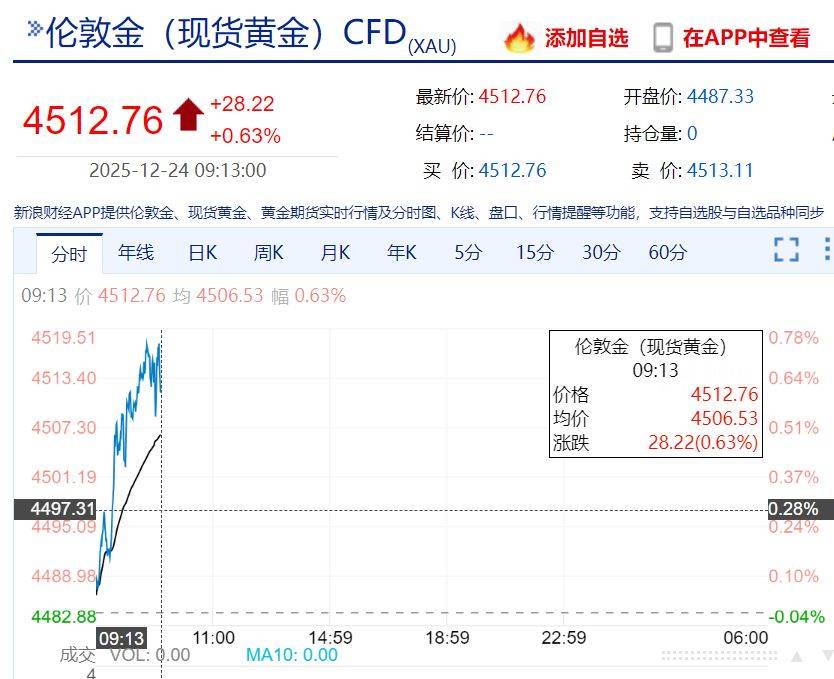
Group 1 - Gold and silver prices have surged, with silver closing up 3.42% to surpass $70 per ounce for the first time, while gold rose 0.92%, marking its largest single-day increase in over a month [1] - Year-to-date, gold prices have increased by over 70%, and silver prices have risen approximately 140%, driven by geopolitical tensions, a weakening dollar, and expectations of further interest rate cuts by the Federal Reserve [1] - As of December 24, gold prices reached $4500 per ounce, and silver peaked at $71.869 per ounce [1] Group 2 - Palladium futures rose by 5.58%, currently priced at 570.40 yuan per gram, while silver futures increased by over 6%, reaching 17250 yuan per kilogram, setting a new historical high [4] - The Dalian Commodity Exchange announced multiple risk control measures affecting platinum, palladium, lithium carbonate, and polysilicon, including adjustments to transaction fees, margin requirements, and trading limits [4] - Starting December 25, 2025, transaction fees for platinum and palladium futures will be adjusted to 0.025% of the transaction amount, with daily price limits set at 10% and margin requirements at 12% [4] Group 3 - The Dalian Commodity Exchange emphasized the need for market participants to strengthen risk prevention and investor education due to increased market volatility [5] - As of December 24, platinum futures hit the daily limit with a 7% increase, priced at 657.65 yuan per gram, marking the third consecutive trading day of limit-up [5] - Lithium carbonate futures surged by 2.75%, surpassing 120,000 yuan per ton, currently priced at 121,000 yuan per ton [5]
中信证券12月18日全情报分析报告:「中信证券为子公司票据发行担保」对股价有消极影响
3 6 Ke· 2025-12-18 14:35
Core Viewpoint - CITIC Securities experienced a slight decline of 1.52% in stock price, closing at 28.53, with a trading volume of 1.1359 million shares, indicating a decrease in market activity [2] Financial Performance - The company reported a total market capitalization of 422.83 billion, with a trading volume decrease of 0.99% compared to the average daily trading volume over the past year [2] - The company’s revenue and net profit for the first three quarters of 2022-2025 show positive trends, suggesting a favorable business development outlook [7] Event Analysis - CITIC Securities provided guarantees for its subsidiary's bond issuance, reflecting strong financial capability and support for its subsidiary, which may enhance investor confidence in the company's financial stability [7] - The total amount of external guarantees by the company and its subsidiaries is 71.66% of the latest audited net assets, indicating good risk management performance [8] Market Sentiment - The overall sentiment regarding the event is neutral to slightly negative, with 15.9% positive, 18.7% negative, and 65.4% neutral comments from a total of 6,802 online discussions [2][5] Competitive Position - CITIC Securities has shown strong performance in the Hong Kong IPO market, with its subsidiaries underwriting 83 companies and raising a total of 46.684 billion HKD, capturing a market share of 17.1% [11] - The company is positioned to benefit from the recovery in the equity market, with significant growth in net profit and revenue for listed securities firms in the first three quarters [12] Long-term Outlook - The company is expected to benefit from policies encouraging leading securities firms to strengthen their capabilities, with a balanced business structure and strong fundamentals [12]


市场风险管理需求变化 短期期权受到青睐
Qi Huo Ri Bao Wang· 2025-11-26 17:08
Core Insights - The global commodity market has experienced increased price volatility since 2025 due to geopolitical factors and supply-demand adjustments, leading to a growing preference for short-term options products for risk management [1][2] Group 1: Market Performance - In Q3 2025, CME Group's commodity futures and options trading volume declined, with the global average daily volume (ADV) dropping to 25.3 million contracts, a 10% year-over-year decrease, marking the lowest quarterly point of the year [1] - The first quarter of 2025 saw a global ADV of 29.8 million contracts, a 13% increase year-over-year, while the second quarter rose to 30.2 million contracts, a 16% increase, indicating a pattern of initial growth followed by a decline [1] Group 2: Regional Insights - The Asia-Pacific region demonstrated resilience, with Q3 ADV falling to 1.7 million contracts, a 7% year-over-year decline, which was less than the global market decline [2] - In the first two quarters of 2025, the Asia-Pacific market ADV grew significantly, with Q1 at 2 million contracts (20% increase) and Q2 at 2.2 million contracts (30% increase), outperforming the global market [2] - The demand for hedging from renewable energy companies in China and agricultural traders in Southeast Asia has driven this growth [2] Group 3: Product Innovations - CME Group has introduced short-term options covering all asset classes, with expiration dates from Monday to Friday, allowing investors to quickly hedge against price fluctuations caused by short-term events like OPEC meetings and U.S. non-farm payroll data [3] - The trading volume of short-term options has significantly increased, surpassing that of futures products, becoming a crucial tool for clients to manage short-term risks [3] Group 4: Strategic Focus on China - China is a core focus for CME Group, which has established a dual approach of "exchange cooperation + localized education" to connect global markets while lowering participation barriers for Chinese investors [4] - CME Group has formed bilateral product authorization agreements with the Shanghai Gold Exchange and is exploring product cooperation with other Chinese exchanges, enhancing tools for cross-border hedging for Chinese enterprises [4] - The company emphasizes financial knowledge dissemination among Chinese investors, conducting numerous online educational activities and producing localized educational materials [5] Group 5: Future Outlook - CME Group plans to continue focusing on the Asia-Pacific and Chinese markets, deepening cooperation with Chinese exchanges and enhancing localized education to improve Chinese investors' participation in international markets [5]
黄金火热!上海黄金交易所:调整部分合约保证金水平和涨跌停板
Sou Hu Cai Jing· 2025-09-03 08:26
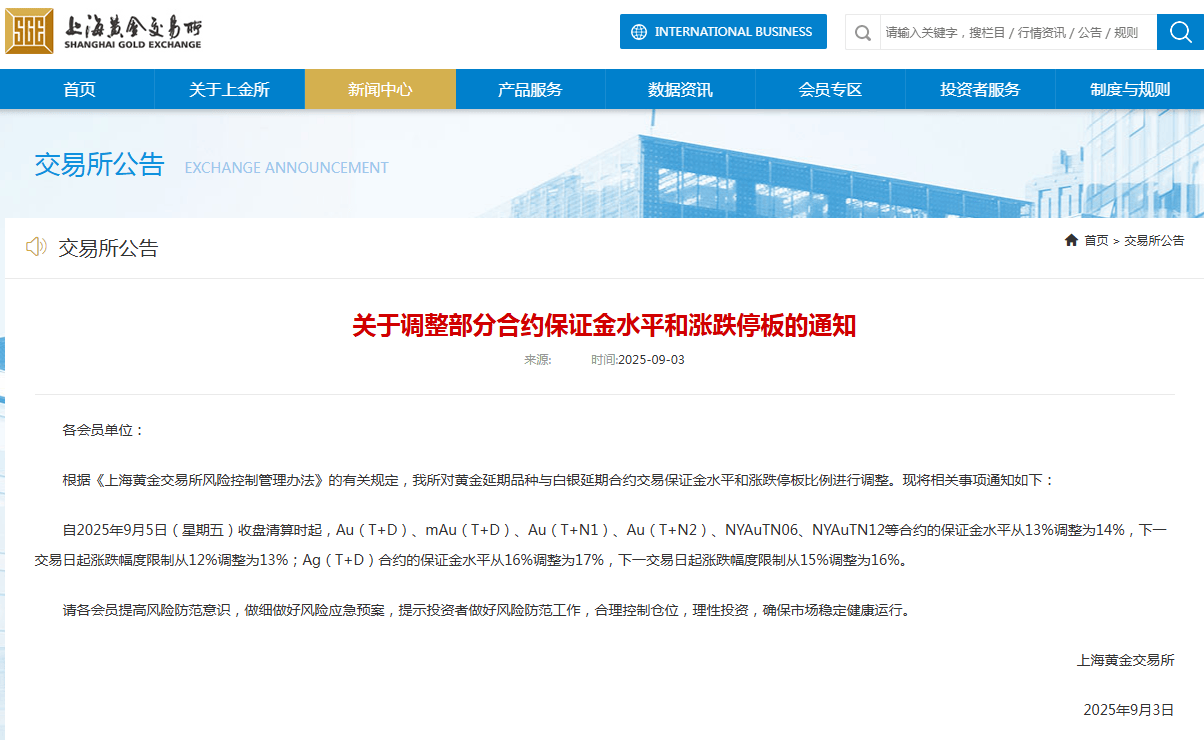
Core Viewpoint - The Shanghai Gold Exchange (SGE) has announced adjustments to margin levels and price fluctuation limits for certain gold and silver contracts, aiming to enhance market risk management and curb excessive speculation amid recent price volatility in precious metals [3][4]. Group 1: Margin Adjustments - Starting from the close of trading on September 5, 2025, the margin level for various gold contracts, including Au (T+D) and mAu (T+D), will increase from 13% to 14%, while the price fluctuation limit will rise from 12% to 13% [3]. - The margin level for the Ag (T+D) contract will be adjusted from 16% to 17%, with the price fluctuation limit increasing from 15% to 16% [3]. Group 2: Market Context and Implications - Recent market trends show a significant surge in gold prices, with London spot gold surpassing $3,500 per ounce and COMEX gold futures rising by 1.51% to $3,599.5 per ounce, reaching historical highs [4]. - Analysts believe that the increase in margin requirements and the relaxation of price fluctuation limits are intended to strengthen risk management and prevent systemic risks [4]. - Short-term effects may include increased margin requirements, reduced leverage, and higher costs for short-term speculation, while long-term effects could lead to more rational trading and improved market efficiency [4].
商业银行市场风险管理办法发布 有助于增强银行运营韧性
Zhong Guo Zheng Quan Bao· 2025-08-08 07:21
Core Viewpoint - The Financial Regulatory Administration has released the revised "Measures for Market Risk Management of Commercial Banks," focusing on risks from adverse changes in interest rates, exchange rates, stock prices, and commodity prices, while excluding bank book interest rate risks [1][2]. Group 1: Definition and Scope - The revised measures clarify the definition of market risk and specify its applicable scope, excluding bank book interest rate risks, thereby enhancing alignment with other regulations such as the "Measures for Capital Management of Commercial Banks" [1][2]. Group 2: Governance Structure - The measures emphasize the need for a robust market risk governance structure, defining the responsibilities of the board of directors, supervisory board, and senior management, and highlighting the importance of market risk management at the group consolidation level [1][2]. Group 3: Management Requirements - The measures detail comprehensive market risk management requirements, including risk identification, measurement, monitoring, control, and reporting, as well as internal model definitions and stress testing requirements to align with current market risk measurement frameworks [1][2].
申万宏源香港发盈喜,预期中期综合除税后溢利5500万港元至6500万港元 同比扭亏为盈
Zhi Tong Cai Jing· 2025-07-30 12:16
Core Viewpoint - The company expects a significant turnaround in its financial performance, projecting an unaudited consolidated profit after tax of between HKD 55 million and HKD 65 million for the six months ending June 30, 2025, compared to a loss of HKD 37 million in the same period last year [1] Financial Performance - The projected profit represents a substantial improvement from the previous year's loss, indicating a recovery in the company's financial health [1] - The company has effectively capitalized on market opportunities, leading to a notable increase in core business revenues, including institutional services, trading, wealth management, and corporate financing [1] Strategic Management - The company has optimized asset allocation and prudently managed market risk exposure, contributing to the enhanced financial results [1] - Active control of operating costs has also played a crucial role in driving profit growth for the first half of 2025 [1]

怎样交易股指期货:理性探索的进阶路径
Sou Hu Cai Jing· 2025-07-25 13:59
Group 1 - The core concept of trading index futures involves understanding the rules and market dynamics, akin to navigating a ship, requiring both foundational knowledge and strategic adjustments based on market trends [1] - Familiarity with contract details such as underlying index characteristics, contract multipliers, and expiration months is essential for formulating a trading plan [1] - Analyzing macroeconomic data, technical patterns, and market sentiment is crucial for determining market trends and making informed trading decisions [1] Group 2 - Risk management is highlighted through the establishment of position strategies that balance risk and opportunity, ensuring a stable trading approach [1] - The importance of timing entry points based on key breakout levels and volume signals is emphasized to enhance the probability of successful trades [1] - Setting profit and loss limits acts as a protective mechanism, allowing traders to manage risks effectively during unexpected market conditions [2] Group 3 - The ability to adjust positions in response to market changes is vital, allowing traders to capitalize on favorable conditions or mitigate risks when trends deviate from expectations [4] - Recognizing the right moments to close positions reflects an understanding of market trends, enabling traders to secure profits or avoid losses [4] - Continuous learning and reflection on past trades are essential for improving trading skills and adapting strategies based on market behavior [5]