
机器人主题

Search documents
基金双周报:ETF市场跟踪报告-20260323
Ping An Securities· 2026-03-23 07:26
1. Report Industry Investment Rating No information about the industry investment rating is provided in the content. 2. Core Viewpoints of the Report - The performance of ETF products in the past two weeks was poor. Among domestic major broad - based ETFs, CSI A50 had the smallest decline, and among industry and theme products, new energy theme ETFs had the largest increase [2][9]. - In the past two weeks, among domestic major broad - based ETFs, the net inflow of funds into Science and Technology Innovation 50, SSE 50, CSI 500, and SSE - SZSE 300 ETFs ranked among the top [2][9]. - The net outflow of funds from major broad - based ETFs in the past two weeks slowed down. The funds of SSE - SZSE 300, SSE 50, and CSI 500 ETFs turned into net inflow, the net outflow of funds from CSI 1000/CSI 2000 and Science and Technology Innovation/ChiNext ETFs slowed down, and the net outflow of funds from A - series ETFs accelerated [10]. - In 2025, the technology theme ETF had a large cumulative net inflow of funds. Since this year, the technology and cyclical theme ETFs have had a large net inflow of funds. In the past two weeks, the inflow of funds into pharmaceutical, military, and new energy ETFs slowed down, the funds of dividend, consumption, and other large - manufacturing ETFs turned into net inflow, and the funds of cyclical, financial real - estate, and technology ETFs turned into net outflow [15]. - Since 2025, the credit bond ETF has had a large net inflow of funds, followed by the treasury bond ETF. In the past two weeks, the short - term financing ETF's funds turned into net inflow, the local government bond ETF's funds accelerated net inflow, the convertible bond ETF's funds turned into net outflow, the credit bond and treasury bond ETF's funds accelerated outflow, and the net outflow of funds from the policy - financial bond ETF slowed down [15]. - The daily average trading volume of pharmaceutical and new energy ETFs increased significantly in the past two weeks, the daily average trading volume of consumption and financial real - estate ETFs increased, and the daily average trading volume of other large - manufacturing, military, technology, and cyclical ETFs decreased [18]. - As of March 20, 20 new ETFs were newly established in the market in the past two weeks, with a total issuance share of 6715 million, all of which were stock ETFs. Compared with the end of 2025, the scale of commodity ETFs, industry + dividend ETFs, and QDII - ETFs increased by 32.78%, 13.10%, and 2.11% respectively, while the scale of bond ETFs and broad - based ETFs decreased by 12.51% and 43.21% respectively [22]. - As of March 20, Huaxia Fund had the largest on - exchange ETF scale, reaching 70.3557 billion yuan; the ETF management scale of Guotai Fund has expanded by more than 2.7 billion yuan since the beginning of this year [23]. 3. Summary According to the Directory 3.1 ETF Market Review - **Performance and Fund Flow**: As of March 20, the performance of ETF products in the past two weeks was poor. Among domestic major broad - based ETFs, CSI A50 had the smallest decline, and among industry and theme products, new energy theme ETFs had the largest increase. In the past two weeks, among domestic major broad - based ETFs, the net inflow of funds into Science and Technology Innovation 50, SSE 50, CSI 500, and SSE - SZSE 300 ETFs ranked among the top. The inflow of funds into pharmaceutical, military, and new energy ETFs slowed down, the funds of dividend, consumption, and other large - manufacturing ETFs turned into net inflow, the funds of cyclical, financial real - estate, and technology ETFs turned into net outflow. For bond ETFs, the short - term financing ETF's funds turned into net inflow, the local government bond ETF's funds accelerated net inflow, the convertible bond ETF's funds turned into net outflow, the credit bond and treasury bond ETF's funds accelerated outflow, and the net outflow of funds from the policy - financial bond ETF slowed down [2][9][15]. - **Product Structure Distribution**: As of March 20, 20 new ETFs were newly established in the market in the past two weeks, with a total issuance share of 6715 million, all of which were stock ETFs. Compared with the end of 2025, the scale of commodity ETFs, industry + dividend ETFs, and QDII - ETFs increased by 32.78%, 13.10%, and 2.11% respectively, while the scale of bond ETFs and broad - based ETFs decreased by 12.51% and 43.21% respectively [22]. - **Fund Manager Scale Distribution**: As of March 20, Huaxia Fund had the largest on - exchange ETF scale, reaching 70.3557 billion yuan; the ETF management scale of Guotai Fund has expanded by more than 2.7 billion yuan since the beginning of this year [23]. 3.2 Classification - based ETF Tracking - **Technology Theme ETF**: Products tracking the Hang Seng Technology Index had the highest net inflow of funds in the past two weeks, while products tracking the Hong Kong Stock Connect Internet Index had a net outflow of funds [29]. - **Dividend Theme ETF**: Products tracking the Dividend Low - Volatility Index had the highest net inflow of funds in the past two weeks, while products tracking the Guoxin Hong Kong Stock Connect Central Enterprise Dividend Index had a net outflow of funds [31]. - **Consumption Theme ETF**: Products tracking the S&P 500 Consumer Select Index had a relatively high premium rate; ETFs tracking the CSI Agriculture Index had the highest net inflow of funds in the past two weeks, while products tracking the CSI 800 Consumption Index had a net outflow of funds [34]. - **Pharmaceutical Theme ETF**: ETFs tracking the CSI Medical Index had the highest net inflow of funds in the past two weeks, while products tracking the medical device index had a net outflow of funds [36]. - **Large - Manufacturing Theme ETF**: Products tracking the power index had the highest net inflow of funds in the past two weeks, while products tracking the CS Battery Index had a net outflow of funds [39]. - **QDII ETF**: Products tracking the Hang Seng Technology Index had the highest net inflow of funds in the past two weeks, while ETF products tracking the Hang Seng China Enterprises Index had a net outflow of funds [42]. 3.3 Popular Theme ETF Tracking - **AI Theme ETF**: The average return of AI theme products in the past two weeks was - 2.89%, and the funds had a net outflow of 4.218 billion yuan. The products with a relatively high proportion of AI - themed stocks were those tracking the Hong Kong Stock Connect Internet, Hang Seng Internet Technology, CS Artificial Intelligence, etc. [48][53]. - **Robot Theme ETF**: The average return of robot theme products in the past two weeks was - 6.81%, and the funds had a net outflow of 488 million yuan. The products with a relatively high proportion of robot - themed stocks were those tracking the robot and robot industry [55][56]. - **New Energy Theme ETF**: The average return of new energy theme products in the past two weeks was 3.27%, and the funds had a net inflow of 1.126 billion yuan. The products with a relatively high proportion of new - energy - themed stocks were those tracking new energy batteries, CS batteries, etc. [58][59]. - **Satellite and Commercial Space Theme ETF**: The average return of satellite and commercial space theme products in the past two weeks was - 9.35%, and the funds had a net outflow of 661 million yuan. The products tracking satellite communication, satellite industry, and Guozheng Aerospace had such characteristics [60][64]. - **Commodity ETF**: The average return of commodity ETFs in the past two weeks was - 0.89%, and the funds had a net inflow of 6.011 billion yuan. Products tracking gold, non - ferrous metal futures, etc. were included. Since the beginning of this year, gold ETFs have had a large net inflow of funds, with a large net outflow on February 3 [65][70]. - **Central Huijin, Guoxin, and Chengtong Holdings ETF**: As of the middle of 2025, the scale of ETFs held by Central Huijin, Guoxin, and Chengtong was 39.1336 billion shares in total; in the past two weeks, the funds had a net outflow of 2.3474 billion yuan [73].
基金双周报:ETF市场跟踪报告-20260309
Ping An Securities· 2026-03-09 06:08
Report Industry Investment Rating - Not provided in the content Core Viewpoints of the Report - As of March 6, the performance of ETF products in the past two weeks varied. Among domestic major broad-based ETFs, CSI 2000 had the largest increase, and among industry and theme products, cyclical theme ETFs had the largest increase. In the past two weeks, among domestic major broad-based ETFs, CSI 500, CSI 1000, and SSE 300 ETFs had the highest net outflows of funds. [2][9] - In the past two weeks, the inflow of funds into pharmaceutical and military ETFs accelerated, the inflow of funds into financial real estate and technology ETFs slowed down, the funds of cyclical and new energy ETFs turned into net inflows, and the funds of dividend, consumption, and other large manufacturing ETFs turned into net outflows. In terms of bond ETFs, the net inflow of convertible bond and local bond ETFs accelerated, the funds of policy financial bond, short-term financing, and treasury bond ETFs turned into net outflows, and the net outflow of credit bond ETFs slowed down. [2] - As of March 6, two new ETFs were established in the market in the past two weeks, with a total issuance share of 1.37 billion, both being stock ETFs. Compared with the end of 2025, the scales of commodity ETFs, industry + dividend ETFs, and QDII-ETFs increased by 42.38%, 20.42%, and 3.21% respectively, while the scales of bond ETFs and broad-based ETFs decreased by 11.04% and 40.92% respectively. [2][24] Summary by Relevant Catalogs ETF Market Review 1.1 Main Types of ETF Fund Flows Overview - The performance and fund flows of different types of ETFs are detailed, including broad-based, industry, and strategy ETFs. For example, among broad-based ETFs, CSI 2000 had a 0.83% return, while SSE 50 had a -1.37% return. In terms of fund flows, SSE 300 had a net outflow of 11.315 billion yuan in the past two weeks. [8] 1.2 Main Types of ETF Cumulative Fund Flows - For broad-based ETFs, in 2025, the fund trend of major broad-based ETFs changed from outflow to inflow and then to outflow, with a significant inflow at the end of the year. In 2026, the funds of major broad-based ETFs continued to have a net outflow, with the net outflow of SSE 300, SSE 50, and A-series ETFs slowing down, and the net outflow of CSI 500, CSI 1000/CSI 2000 ETFs accelerating. [10] - For industry and theme ETFs, in 2025, the cumulative net inflow of technology theme ETFs was significantly ahead, and all industry theme ETFs except military theme ETFs had a cumulative net inflow. Since this year, technology and cyclical theme ETFs have had a significant net inflow. In the past two weeks, the inflow of funds into pharmaceutical and military ETFs accelerated, the inflow of funds into financial real estate and technology ETFs slowed down, the funds of cyclical and new energy ETFs turned into net inflows, and the funds of dividend, consumption, and other large manufacturing ETFs turned into net outflows. [15] - For bond ETFs, since 2025, the net inflow of credit bond ETFs has been significantly ahead, followed by treasury bond ETFs. In the past two weeks, the net inflow of convertible bond and local bond ETFs accelerated, the funds of policy financial bond, short-term financing, and treasury bond ETFs turned into net outflows, and the net outflow of credit bond ETFs slowed down. [15] 1.3 ETF Product Structure Distribution - Two new stock ETFs were established in the past two weeks, with a total issuance share of 1.37 billion. Compared with the end of 2025, the scales of commodity ETFs, industry + dividend ETFs, and QDII-ETFs increased, while the scales of bond ETFs and broad-based ETFs decreased. [24] 1.4 Manager Scale Distribution - As of March 6, Huaxia Fund had the largest on-exchange ETF scale of 72.9052 billion yuan, and the ETF management scale of Guotai Fund has expanded by more than 4 billion yuan since the beginning of the year. [25] Classification of ETF Tracking 2.1 Tracking of Technology Theme ETFs in the Past Two Weeks - Products tracking the Hang Seng Technology Index had the highest net inflow of funds in the past two weeks, while products tracking the CSI Media Index had a net outflow of funds. [30] 2.2 Tracking of Dividend Theme ETFs in the Past Two Weeks - Products tracking the S&P China A-Share Large Cap Dividend Low Volatility 50 Index had the highest net inflow of funds in the past two weeks, while products tracking the Dividend Index had a net outflow of funds. [32] 2.3 Tracking of Consumption Theme ETFs in the Past Two Weeks - Products tracking the China Education and S&P 500 Consumer Select Index had a relatively high premium rate. ETFs tracking the CSI Liquor Index had the highest net inflow of funds in the past two weeks, while products tracking the CSI Tourism Index had a net outflow of funds. [35] 2.4 Tracking of Pharmaceutical Theme ETFs in the Past Two Weeks - ETFs tracking the CSI Medical Index had the highest net inflow of funds in the past two weeks, while products tracking the Medical Device Index had a net outflow of funds. [37] 2.5 Tracking of Large Manufacturing Theme ETFs in the Past Two Weeks - Products tracking the Power Grid Equipment Theme had the highest net inflow of funds in the past two weeks, while products tracking the Robot Index had a net outflow of funds. [40] 2.6 Tracking of QDII ETFs in the Past Two Weeks - Products tracking the Hang Seng Technology Index had the highest net inflow of funds in the past two weeks, while ETF products tracking the Hang Seng China Enterprises Index had a net outflow of funds. [43] Tracking of Popular Theme ETFs 3.1 Tracking of AI Theme ETFs in the Past Two Weeks - AI theme products performed poorly in the past two weeks, with an average return of -5.68%. The products tracking the CS Artificial Intelligence Index had the smallest decline. The funds have been in a net inflow overall since 2025, with a significant inflow from mid-to-late February to April, a continuous outflow from May to August, a significant inflow since mid-to-late August, and a net inflow of 311 million yuan in the past two weeks. [52] 3.2 Tracking of Robot Theme ETFs in the Past Two Weeks - Robot theme products performed poorly in the past two weeks, with an average return of -6.49%. The products tracking the Robot Index had a relatively small decline. The funds have been in a rapid inflow trend since February 2025, and there was a net outflow of 3.099 billion yuan in the past two weeks. [55] 3.3 Tracking of New Energy Theme ETFs in the Past Two Weeks - New energy theme products had mixed performance in the past two weeks, with an average return of 0.27%. The products tracking the Green Power Index had the largest increase. The funds continued to flow out before August 2025, had a significant inflow from August to October, and a significant outflow since late October. There was a net outflow of 3.611 billion yuan in the past two weeks. [60] 3.4 Tracking of Satellite and Commercial Space Theme ETFs in the Past Two Weeks - Satellite and commercial space theme products performed well in the past two weeks, with an average return of 1.68%. The products tracking the Satellite Industry Index had a relatively large increase. The funds had a small inflow in late August 2025 and a significant inflow since mid-to-late December. There was a net inflow of 2.956 billion yuan in the past two weeks. [65] 3.5 Tracking of Commodity ETFs in the Past Two Weeks - Commodity ETFs performed well in the past two weeks, with an average return of 4.52%. The products tracking the Yisheng Energy Chemical A Index had the largest increase. The funds had a significant inflow in April and mid-to-late October 2025, and a net inflow of 16.894 billion yuan in the past two weeks. Since the beginning of this year, gold ETFs have had a significant net inflow, with a significant net outflow on February 3. [73] 3.6 Tracking of ETFs Held by Central Huijin, Guoxin, and Chengtong in the Past Two Weeks - As of June 30, 2025, the scale of ETFs held by Central Huijin, Guoxin, and Chengtong totaled 39.1336 billion shares. In the past two weeks, there was a net outflow of 52.658 billion yuan. The net outflows of Southern CSI 500 ETF, Southern CSI 1000 ETF, and Huatai-PineBridge SSE 300 ETF were among the highest. [76]
特斯拉与新势力 12 月销量跟踪报告:4Q25 特斯拉交付低于预期,2026E 以旧换新补贴延续或提振销量
EBSCN· 2026-01-03 15:10
Investment Rating - The report maintains a "Buy" rating for the automotive and auto parts industry, indicating an expected investment return exceeding 15% over the next 6-12 months [5]. Core Insights - In Q4 2025, Tesla's global deliveries fell short of expectations, decreasing by 15.6% year-on-year and 15.9% quarter-on-quarter to 418,000 units, primarily due to the cancellation of the IRA subsidy in the U.S. [2] - NIO regained the top position among new energy vehicle manufacturers in December, with deliveries increasing by 54.6% year-on-year and 32.7% quarter-on-quarter to 48,135 units [2]. - The continuation of the vehicle trade-in subsidy policy for 2026 is expected to boost market performance in Q1 2026, with a focus on optimizing the growth structure of the automotive market [4]. Summary by Sections Delivery Performance - Tesla's Q4 2025 deliveries were 418,000 units, down 15.6% year-on-year and 15.9% quarter-on-quarter, with Model 3 and Model Y deliveries at 407,000 units, down 13.8% year-on-year and 15.5% quarter-on-quarter [2]. - NIO's December deliveries reached 48,135 units, with a year-on-year increase of 54.6% and a quarter-on-quarter increase of 32.7% [2]. - Li Auto's deliveries were 44,246 units, down 24.4% year-on-year but up 33.3% quarter-on-quarter [2]. - Xpeng's deliveries were 37,508 units, reflecting a slight increase of 2.2% year-on-year and 2.1% quarter-on-quarter [2]. New Year Promotions - Tesla will continue its 0% financing policy for five years on Model 3 and Model Y, with specific delivery timelines set for February 2026 [3]. - NIO and other new energy vehicle manufacturers are offering various promotional incentives, including cash subsidies and extended delivery timelines for certain models [3]. Policy Impact - The 2026 vehicle trade-in subsidy policy will extend the scope of eligible vehicles and adjust the subsidy method to a percentage of the new vehicle sales price, which is expected to positively impact the automotive market [4]. - The report recommends focusing on NIO and Xpeng for vehicle manufacturers, and on Fuyao Glass and other component manufacturers for investment opportunities [4].

基金双周报:ETF市场跟踪报告-20251124
Ping An Securities· 2025-11-24 05:08
1. Report Industry Investment Rating No relevant content provided. 2. Core Viewpoints of the Report - As of November 21, ETF products declined overall in the past two weeks. Among domestic major broad - based ETFs, the Shanghai Composite 50 had the smallest decline, and among industry and theme products, the consumption - themed ETF had the smallest decline [2]. - In the past two weeks, among domestic major broad - based ETFs, the Science and Technology Innovation Board 50, CSI 500, ChiNext Index, and CSI 1000 ETFs had the highest net inflows of funds. On November 21, major broad - based and technology - themed ETFs had significant net inflows [2]. - In the past two weeks, funds in cycle, military, and new energy ETFs changed from net outflows to net inflows; funds in technology, dividend, and other large - manufacturing ETFs accelerated their inflows; while the inflow speed of funds in pharmaceutical, consumption, and financial real - estate ETFs slowed down [2]. 3. Summary by Related Catalogs 3.1 ETF Market Review 3.1.1 Main Types of ETF Fund Flows Overview - In terms of broad - based ETFs, the Science and Technology Innovation Board 50, CSI 500, ChiNext Index, and CSI 1000 ETFs had relatively high net inflows in the past two weeks. For example, the Science and Technology Innovation Board 50 had a net inflow of 90.66 billion yuan in the past two weeks [9]. - Among industry - themed ETFs, technology ETFs had an accelerated inflow of funds in the past two weeks, with a net inflow of 322.73 billion yuan. New energy ETFs changed from net outflows to net inflows, with a net inflow of 28.34 billion yuan [9]. 3.1.2 Cumulative Fund Flows of Main Types of ETFs - For broad - based ETFs, since 2025, the fund trend of major broad - based ETFs has changed from outflows to inflows and then back to outflows. In the past two weeks, the overall funds of major broad - based ETFs turned into net inflows [11]. - For industry and theme ETFs, technology ETFs turned to net inflows since March after a large - scale outflow at the beginning of the year, and the inflow speed accelerated in the past two weeks. Cycle, military, and new energy ETFs changed from net outflows to net inflows [17]. - For bond ETFs, since 2025, credit - bond and treasury - bond ETFs have had the highest net inflows. In the past two weeks, convertible - bond ETFs changed from net outflows to net inflows, and treasury - bond ETFs accelerated their net inflows [17]. 3.1.3 ETF Product Structure Distribution - As of November 21, a total of 13 new ETFs were established in the market in the past two weeks, with a total issuance share of 5.828 billion shares. Among them, 12 were stock ETFs and 1 was a QDII - ETF [26]. - Compared with the end of 2024, the scale of various types of ETFs has increased. The scales of bond ETFs, commodity ETFs, industry + dividend ETFs, QDII - ETFs, and broad - based ETFs increased by 313.15%, 204.80%, 105.82%, 52.50%, and 9.24% respectively [26]. 3.1.4 Fund Manager Scale Distribution - As of November 21, China Asset Management had the largest on - exchange ETF scale, reaching 88.8558 billion yuan. The ETF management scale of E Fund expanded by more than 22 billion yuan compared with a year ago [27]. 3.2 Classification of ETF Tracking 3.2.1 Technology - Themed ETF Tracking in the Past Two Weeks - Products tracking the Hang Seng Tech Index had the highest net inflows of funds in the past two weeks, while products tracking semiconductor materials and equipment had net outflows [32]. 3.2.2 Dividend - Themed ETF Tracking in the Past Two Weeks - Products tracking the Hang Seng Hong Kong Stock Connect High - Dividend Low - Volatility Index had the highest net inflows of funds in the past two weeks, while products tracking the A500 Dividend Low - Volatility Index had net outflows [35]. 3.2.3 Consumption - Themed ETF Tracking in the Past Two Weeks - Products tracking the S&P 500 Consumer Select Index had a relatively high premium rate. ETFs tracking the Hang Seng Consumption Index had the highest net inflows of funds in the past two weeks, while products tracking the CSI Tourism Index had net outflows [37]. 3.2.4 Pharmaceutical - Themed ETF Tracking in the Past Two Weeks - ETFs tracking the Hong Kong Stock Connect Innovative Drugs had the highest net inflows of funds in the past two weeks, while products tracking the CSI Traditional Chinese Medicine Index had net outflows [40]. 3.2.5 Large - Manufacturing - Themed ETF Tracking in the Past Two Weeks - Products tracking the Robot Index had the highest net inflows of funds in the past two weeks, while products tracking the CSI National Defense Index had net outflows [43]. 3.2.6 QDII ETF Tracking in the Past Two Weeks - Products tracking the Hang Seng Tech Index had the highest net inflows of funds in the past two weeks, while ETF products tracking the Hang Seng Index had net outflows [46]. 3.3 Popular - Themed ETF Tracking 3.3.1 AI - Themed ETF Tracking in the Past Two Weeks - AI - themed products performed poorly in the past two weeks, with an average return rate of - 7.70%. Products tracking cloud computing had the smallest decline. Since 2025, funds have had an overall net inflow, and in the past two weeks, the net inflow of funds was 9.172 billion yuan [57]. 3.3.2 Robot - Themed ETF Tracking in the Past Two Weeks - Robot - themed products performed poorly in the past two weeks, with an average return rate of - 7.30%. Products tracking the Robot Index had the smallest decline. Since February 2025, funds have shown a rapid inflow trend, and in the past two weeks, the net inflow of funds was 3.556 billion yuan [61].
924一周年:最牛和最菜的10只基金名单一览
Sou Hu Cai Jing· 2025-09-24 16:51
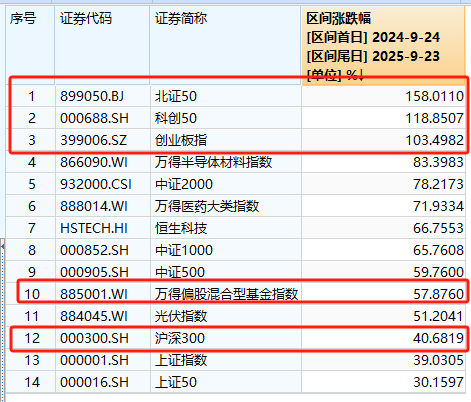
Market Overview - The bull market has lasted for a year, with major indices showing significant gains: the North Exchange 50 Index increased by 158%, the Sci-Tech 50 Index rose by 118%, and the ChiNext Index gained 103.49% [1] - Over 1,400 stocks in the A-share market have doubled in price, representing more than 26% of the 5,324 stocks listed, with notable sectors including electronics, machinery, power equipment, computers, and automobiles [1] Fund Performance - A total of 1,276 fund products have doubled in value, with the top 10 performing funds all being actively managed, indicating the strength of fund managers [2] - The best-performing fund, Debon Xinxing Value, achieved a return of 279.93%, with themes including CPO (4 funds), North Exchange (3 funds), and robotics (3 funds) [2][3] Underperforming Funds - Among over 20,000 funds, only 216 reported negative returns, with the worst performer being Dongcai Value Qihang C, which declined by 10.78% [4] - Notably, seven of the worst-performing funds belong to GF Fund, all managed by the same manager, Wang Mingxu [5] Investment Insights - The analysis suggests that during a bull market, holding onto key investments without frequent trading is a wise strategy, as significant profits are made through holding rather than trading [8] - Investors are encouraged to focus on market conditions rather than personal returns when making decisions [8] - Common investment pitfalls include selling too early or buying into losing positions, emphasizing the need for a well-defined strategy [8] - Maintaining a consistent presence in the market allows investors to better navigate fluctuations and refine their trading systems [8]

基金双周报:ETF市场跟踪报告-20250922
Ping An Securities· 2025-09-22 07:12
ETF Market Overview - As of September 19, the overall performance of ETF products in the past two weeks has been good, with the Sci-Tech 50 showing the highest increase among major broad-based ETFs, while technology sector ETFs had the largest gains among industry and thematic products [3][10] - In the past two weeks, major broad-based ETFs, except for the ChiNext Index, experienced net outflows, with the Sci-Tech 50 ETF having the largest net outflow [3][10] Fund Flow Analysis - In the past two weeks, the military industry ETF shifted from net inflow to net outflow, while funds accelerated into dividend, pharmaceutical, large manufacturing, financial real estate, and new energy ETFs, with inflow speeds for cyclical, consumer, and technology ETFs slowing down [16] - For bond ETFs, there was a significant inflow into credit bond ETFs, while convertible bonds, short-term financing, and government bond ETFs shifted from net inflow to net outflow, with policy financial bonds experiencing accelerated net outflows and local government bonds seeing slowed net inflows [16] ETF Product Structure - As of September 19, a total of 27 new ETFs were established in the past two weeks, with a total issuance of 48.362 billion units, consisting of 14 pure bond ETFs and 13 stock ETFs [19] - Compared to the end of 2024, the scale of various ETFs has increased, with bond ETFs, commodity ETFs, industry + dividend ETFs, QDII ETFs, and broad-based ETFs increasing by 237.50%, 111.89%, 94.45%, 46.09%, and 11.03% respectively [19] Thematic ETF Tracking - In the past two weeks, products tracking semiconductor-related indices, such as the China-Korea Semiconductor, performed well, while funds tracking the National Chip Index experienced net outflows [25][28] - The AI-themed ETFs, which have a high proportion of AI stocks, had an average return of 6.67% in the past two weeks, with a net outflow of 1.557 billion yuan [3] - The robotics-themed ETFs showed an average return of 8.30% in the past two weeks, with a net inflow of 8.473 billion yuan [3] Fund Manager Scale Distribution - As of September 19, Huaxia Fund had the largest ETF on-market scale at 863.966 billion yuan, while E Fund's ETF management scale expanded by over 370 billion yuan compared to one year ago [20]
奥比中光(688322):强劲的消息面支撑
Jian Yin Guo Ji· 2025-09-19 06:07
Investment Rating - The report maintains an "Outperform" rating for several companies in the high-end manufacturing sector, particularly those involved in robotics [5]. Core Insights - The market is currently experiencing a strong upward trend driven by positive news flow, particularly in the robotics sector, with the Wind Robotics Index rising by 18.2% in September [1]. - There is a notable divergence between current valuations and financial conditions, suggesting that while the market remains optimistic, the potential for correction exists as the sector approaches previous highs [2][3]. - The report emphasizes the cyclical nature of the robotics theme, indicating that short-term trading strategies should include profit-taking rather than simple holding [3]. Summary by Sections Market Performance - The robotics theme stocks have shown strong performance, with significant gains in various companies, such as Hanwei Technology up 27.5% and Wolong Electric up 39.8% [1]. - The report notes that many high-end manufacturers have not yet surpassed their March peaks, indicating potential for further gains [2]. Financial Analysis - The financial conditions of robotics manufacturers have shown resilience, with actual order acquisition and technological advancements driving recent market increases [2]. - The report highlights that the current market valuation may not be sustainable without further financial improvements, as the sector is experiencing high premiums [2][3]. Long-term Outlook - The long-term prospects for the robotics industry remain positive, driven by strong policy support, talent influx, and significant R&D investments [3]. - The report suggests that the emergence of fully autonomous humanoid robots and a new robotics industry could occur in the future, although current applications are limited to industrial and logistics sectors [3].

多只机器人主题ETF走强
Xin Lang Cai Jing· 2025-09-02 06:43
Core Viewpoint - Multiple robotics-themed ETFs have shown strong performance, indicating growing investor interest in the robotics sector [1] Group 1: ETF Performance - E Fund Robotics ETF (159530) increased by 1.8% with a trading volume exceeding 800 million [1] - Penghua Robotics ETF (159278) and the Robotics 50 ETF (159559) both rose by over 1.5% [1]

分化加剧!金融周期承压,科技消费成市场新主线!
Sou Hu Cai Jing· 2025-07-16 05:30
Group 1 - The current market is in a period of policy dividend release and industrial transformation, with significant characteristics of volume fluctuations and hot topic rotations [1][3] - Short-term focus can be on the film and entertainment sector (performance catalysts + summer consumption), AI computing power industry chain (chip supply recovery + domestic substitution), innovative pharmaceuticals (optimized collection policies), and robotics themes for trading opportunities [1][3] - The A-share communication industry leads with a 1.76% increase, driven by Nvidia's resumption of H20 chip supply to China and rising expectations for domestic computing power industry chain [2][3] Group 2 - The A-share market shows mixed performance, with the Shanghai Composite Index slightly down by 0.13% to 3500.62 points, while the Shenzhen Component, ChiNext Index, and STAR Market Index show increases of 0.11%, 0.36%, and 0.39% respectively [2] - The Hong Kong stock market remains stable, with the Hang Seng Index up by 0.28% to 24658.55 points, and the Hang Seng Technology Index rising by 0.61% to 5464.40 points, indicating a focus on technology and healthcare sectors [2][3] - The durable consumer goods index dropped by 5.38%, reflecting market caution regarding consumer profit-taking pressures and the recovery strength of the real estate chain [3] Group 3 - Mid-term recommendations suggest focusing on the pan-technology sector, capturing AI-driven computing power, applications, and data elements as the main line [3] - New consumption sectors should pay attention to domestic brands catering to Generation Z needs, interactive entertainment, and smart home products [3] - Investors are advised to be cautious of traditional cyclical industry fluctuations and high valuation risks, prioritizing targets with clear industrial logic, strong policy support, and solid performance backing [3]
基金双周报:ETF市场跟踪报告-20250428
Ping An Securities· 2025-04-28 04:41
ETF Market Overview - The performance of ETFs has been generally positive in the last two weeks, with the exception of the Sci-Tech 100 and Sci-Tech 50 ETFs. The largest gains were seen in ETFs tracking the Hang Seng Index and the CSI 2000, while the manufacturing sector ETFs showed the highest increase among industry and thematic products [3][11]. - In terms of fund flows, major broad-based ETFs experienced significant net inflows, particularly the CSI 300 and the SSE 50 ETFs. After a substantial outflow at the beginning of the year, technology ETFs have shifted to net inflows since March, although the inflow rate has slowed in the last two weeks [3][11]. Fund Flow Analysis - As of April 25, 2025, a total of 15 new ETFs were launched, with a combined issuance of 8.99 billion shares, all of which are stock ETFs. Compared to the end of 2024, the scale of various ETFs has increased, with commodity ETFs, bond ETFs, industry + dividend ETFs, QDII ETFs, and broad-based ETFs rising by 120.33%, 38.17%, 14.44%, 7.58%, and 1.14% respectively [21][22]. - The cumulative fund flow for broad-based ETFs has shown a trend of inflows since early April 2025, particularly for the CSI 300, CSI 1000, and CSI 2000 ETFs, with the CSI 300 ETF seeing a net inflow exceeding 130 billion [12][14]. Thematic ETF Performance - The technology-themed ETFs have shown strong performance, particularly those tracking the new exchange's Southeast Asia Technology Index, with overseas technology ETFs outperforming domestic ones. In terms of fund flows, ETFs tracking the Hang Seng Technology Index have seen significant net inflows, while those tracking 5G communications have experienced outflows [27][28]. - The healthcare-themed ETFs have also performed well, with those tracking innovative drug indices seeing notable gains. However, funds have shifted from inflows to outflows for medical, military, dividend, and consumer ETFs in the last two weeks [16][28]. ETF Product Structure - The structure of newly launched ETFs indicates a growing trend towards thematic and sector-specific investments, with a notable increase in the issuance of stock ETFs. The overall market for ETFs is expanding, reflecting a shift in investor preferences towards diversified and thematic investment strategies [21][22].