
牛市第二阶段

Search documents
集体拉升,涨停潮来了
Zhong Guo Ji Jin Bao· 2026-02-25 05:51
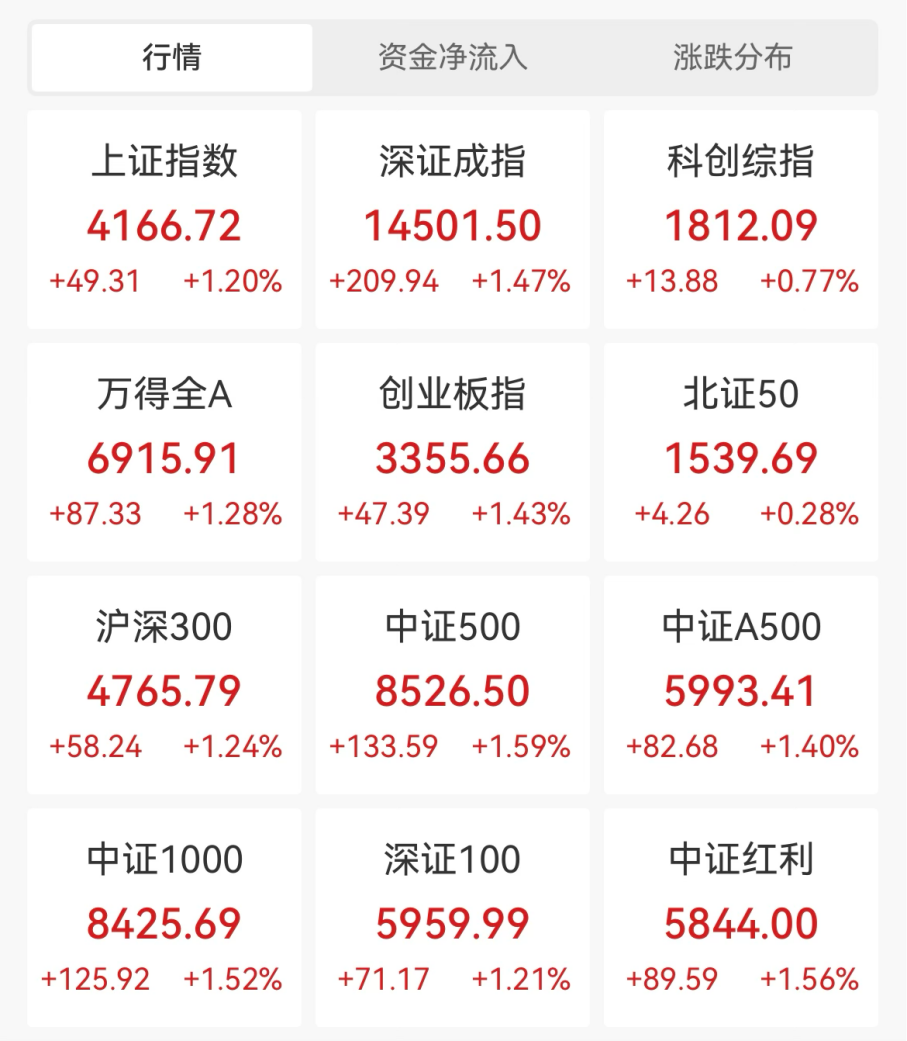
Market Overview - The A-share market saw all three major indices rise collectively, with gains exceeding 1%, and nearly 4,000 stocks in the market increased in value [1] - The Shanghai Composite Index closed at 4166.72 points, up 1.2%, while the Shenzhen Component Index rose by 1.47% and the ChiNext Index increased by 1.43% [2] Sector Performance - The rare earth, phosphorus chemical, shipping, and oil and gas sectors showed strong performance, with the non-ferrous metals sector experiencing a "limit-up" trend [1][4] - The phosphorus chemical sector surged over 8%, with stocks like Chengxing Co. and Chuanjin Nuo hitting the daily limit [10][12] - The steel sector also performed well, with multiple companies such as Baotou Steel and Linggang Steel reaching their daily limit [14] Notable Stocks - In the non-ferrous metals sector, over 20 stocks hit the daily limit, including Northern Rare Earth and Huaxi Nonferrous [4] - Key stocks in the oil and gas sector, such as Tongyuan Petroleum and Zhongyuan Shipping, recorded significant gains, with Tongyuan Petroleum rising over 18% [7][8] - The phosphorus chemical stocks saw notable increases, with Chuanjin Nuo and Qingshuiyuan both achieving gains of around 20% [10][11] Investment Insights - According to research from Zhongyin Securities, the market is expected to enter a "profit-driven growth phase" by 2026, with the strong cyclical nature of non-ferrous metals likely to be highlighted [5] - The U.S. has been working to reduce dependence on Chinese phosphorus resources, which may lead to increased demand and price appreciation for phosphorus-related stocks [12]




白金分析师广发郭磊前瞻2026:市场具备第二阶段牛市的有利条件
Xin Lang Cai Jing· 2025-12-08 14:19
Economic Outlook - The economy is expected to become more balanced in 2026, with fixed asset investment in major provinces recovering and driving overall investment [10][11][12] - There is potential for improvement in consumer spending, particularly in the service sector, as emphasized in the "14th Five-Year Plan" [12][51] A-Share Market Analysis - The logic for the revaluation of A-shares remains valid, contingent on two conditions: first, that market pricing is rational and aligns with fundamentals; second, that economic and corporate earnings can sustain themselves [15][16] - Current market pricing is still within a reasonable range, with historical nominal GDP growth averaging around 5.7% and the composite growth rate of the entire A-share market at approximately 6% over the past six years [18][56] - If the Producer Price Index (PPI) continues to show positive signs, corporate earnings are likely to rebound, supporting the conditions for a second phase bull market [22][59] AI Market Perspective - AI is currently in the technology introduction phase and has not yet reached a bubble stage, although its pricing may partially reflect expectations [26][36] - The narrative surrounding AI is linked to broader themes of a weakening dollar and the restructuring of global supply chains, which could impact market dynamics [28][34][66] - The industry is expected to have significant future potential, but the current phase requires patience as it is still developing foundational applications [38][73] Global Financial Risks - There is a need to be cautious about the potential impact of yen fluctuations on global financial markets, as rising interest rate expectations could increase financing costs and lead to cross-market volatility [40][42][80] - The yen has historically been a key currency for carry trades, and changes in its valuation could affect asset valuations across various markets, including commodities and equities [41][78]

机构研究周报:牛市或步入第二阶段,配置力量有望推动利率下行
Wind万得· 2025-11-16 22:35
Focus Review - The People's Bank of China (PBOC) will conduct a 6-month reverse repurchase operation of 800 billion yuan to maintain liquidity in the banking system, resulting in a net injection of 500 billion yuan after accounting for maturing operations [3] - The PBOC has established a pattern of monthly liquidity injections, indicating a continued focus on maintaining a loose monetary environment amid increased growth demands [3] Equity Market - CITIC Securities suggests that China's capital market is transitioning from an emerging market to a mature market, with an increasing global business exposure for listed companies, which is foundational for a low-volatility bull market [5] - Huatai Securities predicts that the A-share profit cycle will likely recover in the first half of 2026, driven by positive signals from capacity inventory cycles and overseas expansion [6] - Galaxy Securities warns of a potential decline in market risk appetite as the year-end approaches, suggesting a focus on cyclical sectors and dividend stocks that may benefit from improved Sino-U.S. trade relations [7] Industry Research - HSBC Jintrust Fund highlights the storage industry as a sector with multiple opportunities, driven by policy shifts and increased demand, particularly from AI data centers, suggesting a strategic opportunity for high growth [12] -招商证券 identifies investment potential in sectors experiencing supply clearing, particularly in resources, consumer goods, and traditional machinery, recommending focus on quality leaders and low-inventory industries [13] - 嘉实基金 sees significant long-term growth potential in China's innovative pharmaceutical sector, suggesting that recent corrections are a market adjustment rather than an end to the growth trend [14] Asset Allocation - Guosen Securities indicates that the bull market may be entering its second phase, with economic conditions improving and a broadening market trend, particularly in technology and undervalued sectors like liquor and real estate [22]




9月底公募基金资产净值合计36.74万亿元
Guo Ji Jin Rong Bao· 2025-10-29 14:27
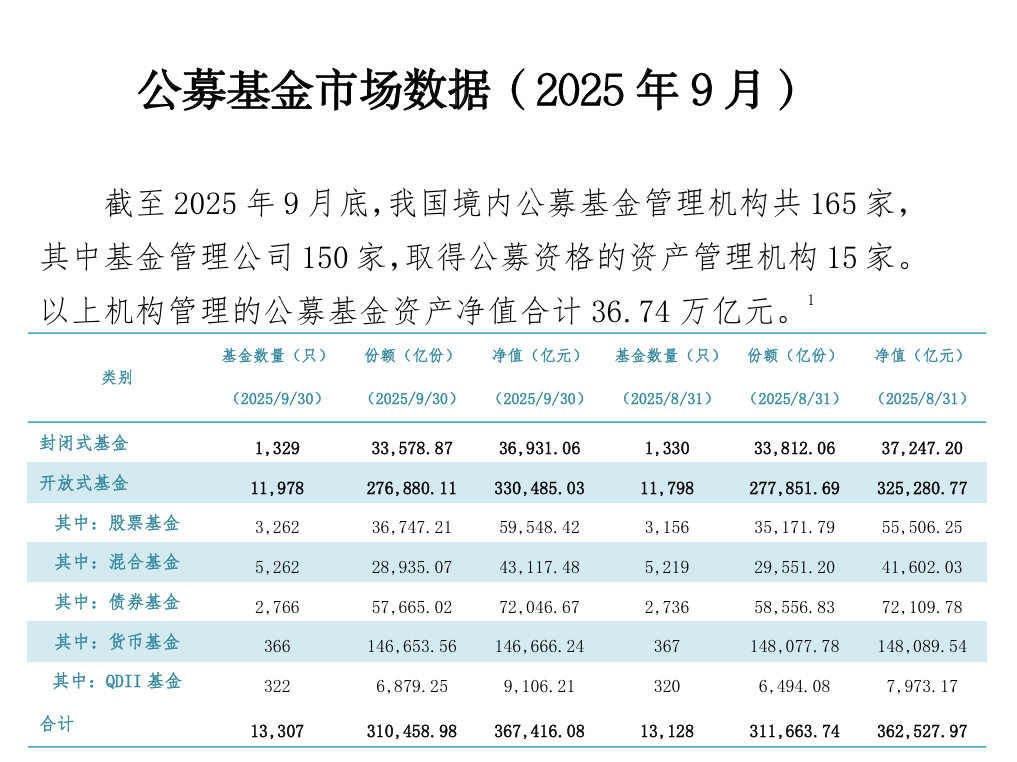
Core Insights - As of September 30, 2025, there are 165 public fund management institutions in China, including 150 fund management companies and 15 asset management institutions with public qualifications, managing a total net asset value of 36.74 trillion yuan [1] Fund Categories Summary - Closed-end funds: 1,329 funds with 33,578.87 million shares and a net value of 369.31 billion yuan as of September 30, 2025, compared to 1,330 funds with 33,812.06 million shares and a net value of 372.47 billion yuan as of August 31, 2025 [3] - Open-end funds: 11,978 funds with 276,880.11 million shares and a net value of 330.49 billion yuan as of September 30, 2025, compared to 11,798 funds with 277,851.69 million shares and a net value of 325.28 billion yuan as of August 31, 2025 [3] - Stock funds: 3,262 funds with 36,747.21 million shares and a net value of 59.55 billion yuan as of September 30, 2025, compared to 3,156 funds with 35,171.79 million shares and a net value of 55.51 billion yuan as of August 31, 2025 [3] - Mixed funds: 5,262 funds with 28,935.07 million shares and a net value of 43.12 billion yuan as of September 30, 2025, compared to 5,219 funds with 29,551.20 million shares and a net value of 41.60 billion yuan as of August 31, 2025 [3] - Bond funds: 2,766 funds with 57,665.02 million shares and a net value of 72.05 billion yuan as of September 30, 2025, compared to 2,736 funds with 58,556.83 million shares and a net value of 72.11 billion yuan as of August 31, 2025 [3] - Money market funds: 366 funds with 146,653.56 million shares and a net value of 146.67 billion yuan as of September 30, 2025, compared to 367 funds with 148,077.78 million shares and a net value of 148.09 billion yuan as of August 31, 2025 [3] - QDII funds: 322 funds with 6,879.25 million shares and a net value of 9.11 billion yuan as of September 30, 2025, compared to 320 funds with 6,494.08 million shares and a net value of 7.97 billion yuan as of August 31, 2025 [3] Market Performance - Major A-share indices collectively rose, with the Shanghai Composite Index closing above the 4,000-point mark, up 0.7% to 4,016.33 points, and the Shenzhen Component Index rising 1.95% to 13,691.38 points as of the latest close [4] - The breakthrough of the Shanghai Composite Index at 4,000 points is viewed as a milestone event, driven by both policy and capital market support, indicating a sustained inflow of incremental capital [7]
10月开门红,沪指站上3900点创十年新高,机构:市场有望延续9月向上趋势 | 华宝3A日报(2025.10.9)
Xin Lang Ji Jin· 2025-10-09 11:40
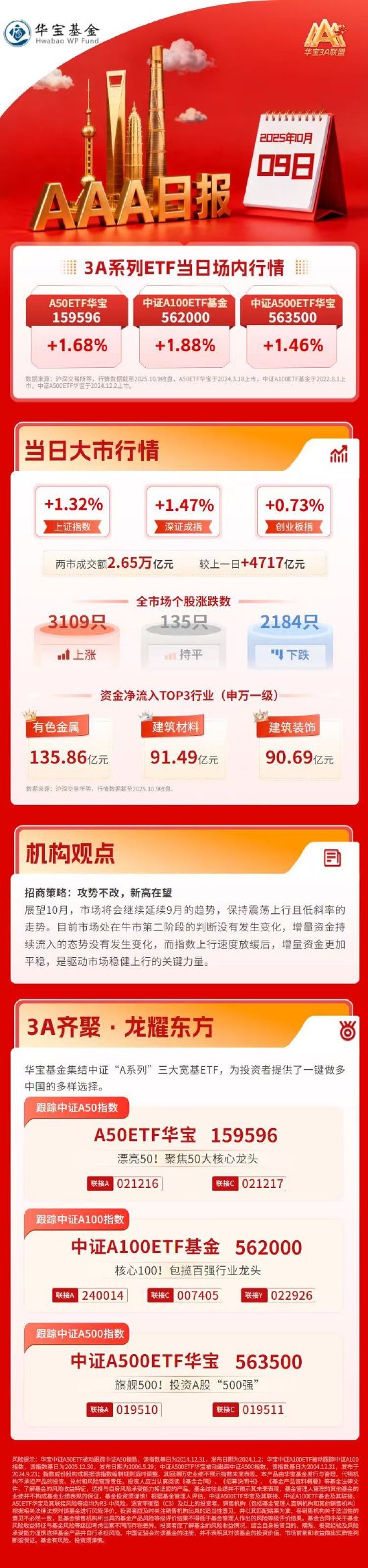
Group 1 - The Shanghai Composite Index has reached 3900 points, marking a ten-year high, indicating a bullish market trend that is expected to continue into October [1][3] - The market is currently in the second phase of a bull market, with a steady inflow of incremental capital, which is crucial for the market's stable upward movement [3] - The top three industries with net capital inflow are Non-ferrous Metals (9.149 billion), Building Materials (13.586 billion), and Building Decoration (9.069 billion) [3] Group 2 - The MACD golden cross signal has formed, suggesting that certain stocks are experiencing a strong upward trend [4]
ETF资金出手!杠杆资金出逃。。
Sou Hu Cai Jing· 2025-09-05 09:18
Market Overview - The Shanghai Composite Index rose by 1.24%, ending a three-day decline, while the ChiNext Index surged by 6.55%, reaching a new high since January 2022 [1] - Over 4,800 stocks in the market saw gains, with 105 stocks hitting the daily limit up [1] ETF Performance - Several ETFs related to new energy and batteries showed significant gains, with the top performers being: - ChiNext New Energy ETF by Guotai with a rise of 10.98% - ChiNext New Energy ETF by Huaxia with a rise of 10.90% - ChiNext New Energy ETF by Penghua with a rise of 10.86% [3] - The overall trend indicates a strong interest in new energy and battery sectors, as evidenced by the performance of related ETFs [3] Fund Flows - Leveraged funds saw a net sell-off of 9.703 billion yuan, while stock-type ETFs experienced a net inflow of 7.383 billion yuan [4] - The top three ETFs attracting capital were: - CSI 1000 ETF with a net inflow of 2.656 billion yuan - CSI 300 ETF with a net inflow of 1.718 billion yuan - Chemical ETF with a net inflow of 750 million yuan [5] Market Sentiment - The market is currently experiencing emotional fluctuations, with analysts suggesting that the bull market has entered its second phase [6] - Historical patterns indicate that adjustments in this phase typically last 2-3 trading days with declines of 3-5% [6][7] Global Market Context - The U.S. stock market saw all three major indices rise, with the S&P 500 closing at a record high [8] - Recent employment data showed a lower-than-expected increase in ADP employment numbers, influencing market expectations for a potential interest rate cut by the Federal Reserve [9] Investment Insights - Notable investors, including Ray Dalio, have expressed concerns about the current political and economic climate in the U.S., drawing parallels to historical crises [10] - Dalio predicts a potential debt crisis in the U.S. within three years, prompting some investors to shift from U.S. bonds to gold [11][12] Gold Market Dynamics - Gold prices have surged, with COMEX gold reaching over $3,600 per ounce, marking a year-to-date increase of over 36% [15] - The inflow into gold ETFs in the A-share market has reached 51.8 billion yuan this year, reflecting a strong demand for gold as a hedge against inflation and economic uncertainty [17][20]
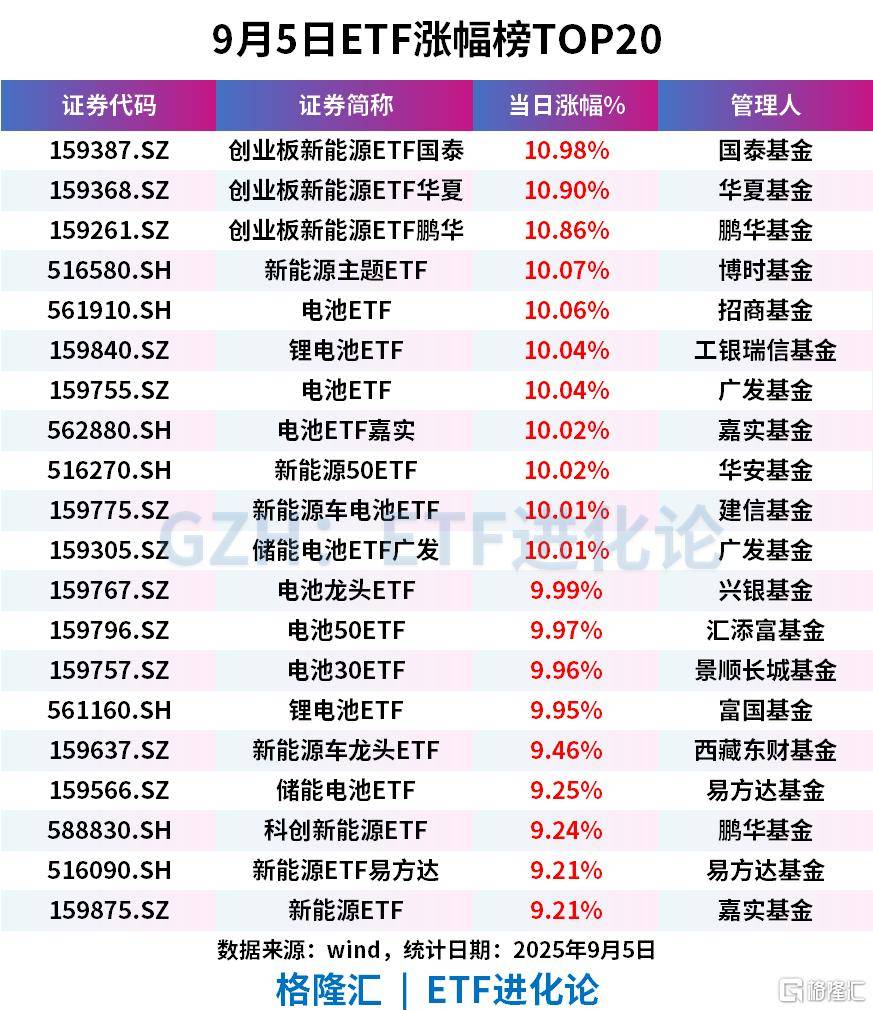
73.83亿元资金流入ETF!中证1000ETF、沪深300ETF、化工ETF等强势吸金
Ge Long Hui· 2025-09-05 08:35
Group 1 - The core viewpoint of the article highlights a significant inflow of funds into ETFs, with a total of 7.383 billion yuan entering stock ETFs, indicating strong market interest despite recent volatility [1] - The China Securities report suggests that the market has entered the second phase of a bull market, characterized by a positive feedback mechanism of incremental capital since July [1][2] - Historical patterns indicate that adjustments in the second phase of a bull market are common, typically lasting 2-3 trading days with declines of 3-5%, and that sustained declines beyond four trading days are unlikely [1][2] Group 2 - Huazhang Securities emphasizes that the core drivers supporting the current upward trend in the market remain unchanged, including the government's increasing focus on capital markets and the ongoing influx of micro liquidity [3] - The report notes that the "asset shortage" phenomenon persists, with attractive returns in A-shares and continued foreign investment interest, suggesting that the trend of liquidity entering the stock market is not over [3] - The potential for proactive macro and industrial policies to be introduced is highlighted, with expectations of monetary easing and the need for policy support in areas like consumption and investment [3] Group 3 - The article advises focusing on sectors with the highest elasticity, particularly in growth technology and performance-supported areas, as these are expected to provide better investment opportunities during market adjustments [4] - It is noted that strong main lines in a trend-driven market exhibit high elasticity, with growth technology naturally having high elasticity and sectors with performance support likely to attract consensus among investors [4] - The presence of catalysts in certain sectors is also mentioned as a factor that can enhance investment attractiveness during upward trends [4]


苍原资本炒股-开户:A股市场或逐步转入震荡盘整格局
Sou Hu Cai Jing· 2025-09-05 05:54
Group 1 - A-shares experienced a volatile decline, with notable performance in sectors such as consumption, photovoltaic equipment, banking, and securities, while aerospace, communication equipment, semiconductors, and electronic chemicals lagged behind [1][3] - The market is currently benefiting from favorable internal and external policy conditions, with significant improvements in market liquidity, as evidenced by trading volumes exceeding 2 trillion yuan for several consecutive days [1] - Global capital is flowing into the A-share market, with an acceleration of household savings moving towards capital markets, creating a continuous source of incremental funds [1] Group 2 - The A-share market showed a significant volume pullback, with all three major indices closing lower, and a notable increase in risk-averse sentiment among investors [3] - The technology growth sector mostly declined, while retail, food, and other defensive sectors performed well, indicating a divergence in market performance [3] - The outlook suggests that the market may gradually transition into a period of consolidation, with key variables to monitor including improvements in macroeconomic data, changes in overseas market conditions, and institutional repositioning following half-year earnings disclosures [3]

招商证券:如果下跌超过4个交易日,就要审视牛市第二阶段是否可能结束了
Xin Lang Cai Jing· 2025-09-05 04:08
Core Viewpoint - The Shanghai Composite Index has shown a slight recovery after three consecutive days of decline, indicating a potential continuation of the bull market's second phase, supported by a positive feedback mechanism of incremental capital [1] Group 1: Market Performance - The Shanghai Composite Index closed up 0.35% at 3778 points after three days of decline [1] - Historical patterns suggest that adjustments in the second phase of a bull market typically involve a decline of 3-5% over 2-3 trading days or a single-day drop within the same range [1] Group 2: Incremental Capital Mechanism - The report from China Merchants Securities indicates that the market has established a positive feedback mechanism for incremental capital since July [1] - Continuous declines exceeding four trading days are considered unlikely as long as the positive feedback mechanism remains intact [1] Group 3: Indicators of Phase Transition - The end of the second phase of a bull market is often marked by policy changes aimed at cooling rapid market increases or tightening monetary policies [1] - Historical examples include increased transaction taxes in 2007, regulatory changes in 2015, and tightening real estate policies in 2010 [1] - Currently, there are no signals indicating strict regulation on the incremental capital mechanism, suggesting that capital continues to flow into the market [1]
8月PMI三大指数均回升,A500ETF基金(512050)红盘向上,成交额超47亿居同类第一
Xin Lang Cai Jing· 2025-09-01 05:54
Group 1 - The core viewpoint is that the A500 index and its associated ETFs are experiencing positive momentum, with significant increases in key constituent stocks and overall market activity [1][2] - The A500 index has shown a rise of 0.38%, with notable gains in stocks such as QianDao Intelligent (+13.66%) and ZhongJi XuChuang (+11.57%) [1] - The A500 ETF fund has seen a trading volume of 47.15 billion yuan, indicating active market participation, with a weekly average trading volume of 57.45 billion yuan [1][2] Group 2 - The manufacturing and non-manufacturing PMIs have shown slight improvements, indicating a continued expansion in China's economic activity [1] - East China Securities highlights that abundant liquidity remains a key foundation for the current market trend, with expectations of a potential interest rate cut by the Federal Reserve [2] - The A500 index is designed to reflect the performance of the 500 most representative listed companies across various industries, selected based on market capitalization and liquidity [2][3] Group 3 - The top ten weighted stocks in the A500 index account for 19.83% of the index, with major companies including Kweichow Moutai and CATL [3] - The A500 ETF and its enhanced versions closely track the A500 index, providing investors with options for exposure to this index [3]