十五五规划预期

Search documents
南华期货钢材周报:暂无驱动,成材底部震荡-20260118
Nan Hua Qi Huo· 2026-01-18 13:28
1. Report Industry Investment Rating No industry investment rating information is provided in the report. 2. Core Viewpoints of the Report - The fundamentals of finished steel products are neutral, lacking driving forces, and are in a range - bound state. The current core contradiction lies in the furnace charge end. In the short term, finished steel products are supported by the cost end, with limited downside space but lacking upward driving forces. Steel prices are expected to maintain a volatile trend. The price range of the main rebar contract 2605 may be between 3050 - 3200, and that of the main hot - rolled coil contract 2605 may be between 3200 - 3350 [1]. 3. Summary by Relevant Catalogs 3.1 Core Contradictions and Strategy Recommendations 3.1.1 Core Contradictions - Rebar production recovery has slowed down marginally, apparent consumption has rebounded unexpectedly, and inventory has turned to destocking, but the change is small. In the future, inventory may enter a restocking trend again. Overall, rebar inventory is at a low level and is in a destocking trend compared to the same period seasonally. - The destocking speed of hot - rolled coils has accelerated marginally. Although the inventory base is large compared to the same period, it is in a destocking state seasonally. However, the recent increase in hot - rolled coil warehouse receipts is significant, with a 58% week - on - week increase [1]. - For iron ore, steel mills' inventory is low, with restocking expectations supporting prices. But the decline in molten iron production and the continuous restocking of port inventory make it difficult for prices to rise significantly. - For coking coal, the customs clearance volume at the Ganqimao Port is at a relatively high level in recent years, and port inventory is increasing. The recovery of mine开工率 and the accumulation of mine coking coal inventory will suppress prices. Although winter storage supports prices, the large inventory base limits the upside space [1]. 3.1.2 Trading Strategy Recommendations - The driving force for steel production cuts is weakening, and the production of rebar and hot - rolled coils has increased month - on - month, but demand is weak in the off - season. - The coil and plate segment is still in a high - inventory situation, with the highest inventory level in the past five years, and the destocking pressure is high. - The low inventory of steel mills' iron ore at ports supports iron ore prices, while the restocking of port iron ore inventory may affect the price of finished steel products. - Winter storage supports the price of furnace charge [1][5]. 3.1.3 Industrial Customer Operation Recommendations - **Price Range Forecast**: The 05 - contract price range forecast for rebar is 2900 - 3300, with a current volatility of 11.13% and a volatility percentile of 14.3%; for hot - rolled coils, it is 3100 - 3500, with a current volatility of 9.84% and a volatility percentile of 5.83% [7]. - **Risk Management Strategy**: - **Inventory Management**: For enterprises with high finished - product inventory, they can short rebar or hot - rolled coil futures to lock in profits and make up for production costs. They can also sell call options to reduce capital costs. - **Procurement Management**: For enterprises with low procurement inventory, they can buy rebar or hot - rolled coil futures to lock in procurement costs. They can also sell put options to collect premiums and reduce procurement costs [7]. 3.2 Important Information and Next - Week Concerns 3.2.1 Important Information - **Positive Information**: Winter storage supports the price of furnace charge; the profits of blast furnaces and electric furnaces have rebounded; the low inventory of steel mills at ports supports iron ore prices; the destocking speed of hot - rolled coils has improved marginally [14]. - **Negative Information**: The driving force for steel production cuts is weakening, and production has increased month - on - month; the restocking of port iron ore inventory may affect the price of finished steel products; the coil and plate segment is still in a high - inventory situation, and there is no driving force on the consumption side; export controls have taken effect [15]. 3.2.2 Next - Week Important Events - Next Monday, China will announce the GDP growth rate for 2025. - Next Thursday, the United States will announce the number of initial jobless claims for the week [22]. 3.3 Disk Interpretation 3.3.1 Price, Volume, and Capital Interpretation - **Basis**: Analyzed the basis seasonality of rebar and hot - rolled coil 05 contracts in Shanghai [16][17]. - **Coil - to - Rebar Spread**: Analyzed the seasonal changes in the spot coil - to - rebar spread in Shanghai and Beijing, as well as the seasonal changes in 01, 05, and 10 coil - to - rebar spreads [18][19][20]. - **Term Structure**: Analyzed the term structure spread diagrams of rebar, hot - rolled coils, iron ore futures, and coking coal [24][25][26]. - **Month - to - Month Spread Structure**: Analyzed the seasonal changes in the month - to - month spreads of rebar and hot - rolled coil futures (01 - 05, 05 - 10, 10 - 01) [27][28][29]. 3.4 Valuation and Profit Analysis 3.4.1 Upstream and Downstream Profit Tracking in the Industry Chain - The profitability rate of steel mills has declined significantly, falling below 40%, but the profits of blast furnaces and electric furnaces have improved marginally, and the motivation for the five major steel products to cut production may gradually weaken [31]. 3.4.2 Export Profit Tracking - Analyzed the seasonal changes in hot - rolled coil export profit estimates, the relationship between hot - rolled coil export profit and export volume, and the relationship between the difference between overseas and Chinese hot - rolled coils and steel export orders [46][48][49]. 3.5 Supply - Demand and Inventory Deduction 3.5.1 Supply - Demand Balance Sheet Deduction - As of January 16, 2026, the cumulative consumption and production of the five major steel products have decreased year - on - year, and the current inventory has also decreased compared to the beginning of the year [65]. 3.5.2 Supply - Side and Deduction - Analyzed the relationship between steel production, profits, and inventory, as well as the impact of blast furnace and electric furnace production and maintenance on supply [66][70][71]. 3.5.3 Demand - Side and Deduction - Analyzed the predicted seasonality of the apparent demand for crude steel, the consumption of the five major steel products, and the inventory and sales ratio of various steel products [82][91][101].

南华煤焦产业风险管理日报-20251201
Nan Hua Qi Huo· 2025-12-01 03:21
1. Report Industry Investment Rating - No industry investment rating is provided in the report. 2. Core Views of the Report - The supply of coking coal has limited marginal changes, but the terminal steel mills are under profit pressure, and the molten iron production continues to decrease, resulting in a slight oversupply of coking coal. The supply of coke is expected to increase, and there may be a pressure of inventory accumulation. The coking coal 01 contract has a clear short - term bearish trend, while the far - month 05 contract has medium - to - long - term long - allocation value. The current valuation of the coke main contract is reasonable, and it is not recommended to blindly participate in the downward market [4]. - There is still a rigid demand for winter storage, and the price decline will stimulate restocking demand. The macro - policy expectations of the first year of the "15th Five - Year Plan" and the "anti - deflation" policy will provide bottom support for the far - month contracts. However, the expectation of coke price cuts is increasing, and coke enterprises are cautious in purchasing, leading to marginal accumulation of upstream mine inventories. The 01 contract is suppressed by warehouse receipts, and a short - term bearish trend has formed [8]. 3. Summary by Relevant Catalogs 3.1. Double - Coking Price Range Forecast - **Price Range and Volatility**: The price range forecast for coking coal (01) in the month is 1000 - 1200, with a current 20 - day rolling volatility of 24.37% and a historical percentile of 41.27%. The price range forecast for coke (01) in the month is 1500 - 1750, with a current 20 - day rolling volatility of 23.45% and a historical percentile of 40.92% [3]. - **Risk Management Strategies**: - **Procurement for Coking Plants**: With the rapid decline of the coking coal main contract on the futures market and the relatively slow adjustment of spot prices in Shanxi, the basis is still high. Terminal users with coking coal procurement plans can wait for the spot price to decline before purchasing [3]. - **Management for Steel Mills**: As the first round of spot price cuts for coke is imminent and the futures market has already priced in 5 rounds of cuts, the space for further price cuts is limited. Steel mills should control coke arrivals and sell coke put options [3][4]. - **Sales Management for Coking Plants**: After the fourth round of spot price increases for coke is implemented, the futures price follows the decline of coking coal, the basis of coke strengthens, and the valuation is moderately high. Coking plants holding coke spot are advised to speed up sales [3]. 3.2. Black Warehouse Receipt Daily Report - **Warehouse Receipt Data**: The warehouse receipt data of various black commodities such as rebar, hot - rolled coil, iron ore, coking coal, coke, ferrosilicon, and ferromanganese on different dates are provided, showing their day - on - day and week - on - week changes [4]. - **Core Logic and Strategy Suggestions**: - **Core Logic**: The supply of coking coal has limited marginal changes, and the demand decreases, resulting in a slight oversupply. The supply of coke is expected to increase, and there may be inventory accumulation pressure. The spot price of coke may face more than 2 rounds of price cuts [4]. - **Strategy Suggestions**: Hold short positions in the coking coal 01 contract, and wait for a clear stabilization signal to layout long positions in the 05 contract. It is not recommended to blindly participate in the downward market of coke [4]. 3.3. Coal - Coking Futures and Spot Price Data - **Futures Price Spread**: The price spreads between different contracts of coking coal and coke on different dates are provided, including 09 - 01, 05 - 09, and 01 - 05 [6]. - **Spot Price and Profit**: The spot prices of various coking coal and coke products, as well as import and export profits, coking profits, and price ratios are provided [7]. 3.4. Factors Affecting Coal - Coking Prices - **Positive Factors**: There is still a rigid demand for winter storage, and the macro - policy expectations of the first year of the "15th Five - Year Plan" and the "anti - deflation" policy will provide bottom support for the far - month contracts [8]. - **Negative Factors**: The expectation of coke price cuts is increasing, and coke enterprises are cautious in purchasing, leading to marginal accumulation of upstream mine inventories. The 01 contract is suppressed by warehouse receipts, and a short - term bearish trend has formed [8].
锰硅月报:短期现实压力仍压制盘面,对于重要会议预期交易仍旧可期-20251010
Wu Kuang Qi Huo· 2025-10-10 15:06
Report on Manganese Silicon 1. Report Industry Investment Rating No information provided in the report. 2. Core Viewpoints - In the short - term, real - world pressure still suppresses the market, but trading based on expectations of important meetings is still promising. The price of the black sector may first decline to release bearish sentiment and then rise with the expectations of the "Fourth Plenary Session". It is more cost - effective to find retracement points to go long rather than shorting. The black sector may gradually have the value of long - term allocation around mid - October [15]. - Manganese silicon's fundamentals are not ideal with high supply and weak demand in the building materials sector. It may follow the black sector's trend and is difficult to have an independent strong market without major contradictions [15]. 3. Summary by Directory 3.1 Monthly Assessment and Strategy Recommendation - **Market Data**: As of 2025/10/09, Tianjin 6517 manganese silicon spot price was 5670 yuan/ton, down 30 yuan/ton month - on - month and up 70 yuan/ton from the beginning of last month; futures price was 5768 yuan/ton, up 10 yuan/ton month - on - month and up 32 yuan/ton from the beginning of last month; basis was 92 yuan/ton, down 40 yuan/ton week - on - week, with a basis rate of 1.58% [14][20]. - **Profit and Cost**: Manganese silicon's estimated immediate profit remained low. Inner Mongolia was - 321 yuan/ton, Ningxia was - 438 yuan/ton, and Guangxi was - 621 yuan/ton. The estimated immediate cost in Inner Mongolia was 6001 yuan/ton, Ningxia was 6058 yuan/ton, and Guangxi was 6321 yuan/ton [14][23][30]. - **Supply and Demand**: Weekly output of manganese silicon was 20.42 tons, down 0.22 tons week - on - week. In September 2025, the output was 89.84 tons, down 1.08 tons month - on - month. Weekly output of rebar was 203.4 tons, down 3.62 tons week - on - week. Daily average hot metal output was 241.54 tons, down 0.27 tons week - on - week [14][44][60]. - **Inventory**: The estimated visible inventory of manganese silicon was 51.42 tons, down 0.34 tons month - on - month, still at a high level in the same period [14][72]. 3.2期现市场 - As of 2025/10/09, Tianjin 6517 manganese silicon spot price was 5670 yuan/ton, futures price was 5768 yuan/ton, basis was 92 yuan/ton, with a basis rate of 1.58%, at a relatively neutral level in historical statistics [20]. 3.3 Profit and Cost - **Profit**: As of 2025/10/09, manganese silicon's estimated immediate profit remained low. Inner Mongolia was - 321 yuan/ton, Ningxia was - 438 yuan/ton, and Guangxi was - 621 yuan/ton [23]. - **Cost**: As of 2025/10/09, South African ore was 34.2 yuan/ton - degree, Australian ore was 39.8 yuan/ton - degree, Gabonese ore was 40 yuan/ton - degree, and off - grade metallurgical coke was 1190 yuan/ton. The estimated immediate cost in Inner Mongolia was 6001 yuan/ton, Ningxia was 6058 yuan/ton, and Guangxi was 6321 yuan/ton [26][30]. - **Manganese Ore Import**: In August, manganese ore imports were 348.6 tons, up 74.24 tons month - on - month and up 87.53 tons year - on - year. From January to August, cumulative imports were 2068.88 tons, up 181.7 tons or 9.63% year - on - year [33]. - **Manganese Ore Inventory**: As of 2025/09/26, manganese ore port inventory was 447.8 tons, up 20.6 tons month - on - month. Australian manganese ore port inventory was 66.6 tons, up 1.3 tons month - on - month, and high - grade manganese ore port inventory was 121.9 tons, up 9.2 tons month - on - month [36][39]. 3.4 Supply and Demand - **Output**: As of 2025/10/09, weekly output of manganese silicon was 20.42 tons, down 0.22 tons week - on - week. In September 2025, the output was 89.84 tons, down 1.08 tons month - on - month [44]. - **Steel Tendering**: In September 2025, HeSteel Group's manganese silicon tender volume was 17000 tons, up 900 tons month - on - month and up 6500 tons year - on - year; the tender price was 6000 yuan/ton, down 200 yuan/ton month - on - month [57]. - **Consumption**: As of 2025/10/09, weekly apparent consumption of manganese silicon was 12.21 tons, down 0.04 tons week - on - week. Weekly output of rebar was 203.4 tons, down 3.62 tons week - on - week. Daily average hot metal output was 241.54 tons, down 0.27 tons week - on - week. In August 2025, national crude steel output was 7737 tons, down 233 tons month - on - month and down 53 tons year - on - year [60][63]. 3.5 Inventory - **Visible Inventory**: As of 2025/10/09, the estimated visible inventory of manganese silicon was 51.42 tons, down 0.34 tons month - on - month, still at a high level in the same period [72]. - **Sample Enterprise Inventory**: As of 2025/10/09, the inventory of 63 sample enterprises was 24.25 tons, up 0.37 tons month - on - month [75]. - **Steel Mill Inventory**: In September, the average available days of manganese silicon in steel mills was 15.93 days, up 0.95 days month - on - month, still at a relatively low level in the same period [78]. 3.6 Graphical Trends - In September, manganese silicon's disk price fluctuated within a range, with a monthly decline of 20 yuan/ton or 0.35%. On the daily - line level, it was still in the range of 5600 - 6000 yuan/ton, and its recent trend was weak, close to the lower limit of the range. Attention should be paid to the support around 5600 yuan/ton [81]. Report on Ferrosilicon 1. Report Industry Investment Rating No information provided in the report. 2. Core Viewpoints - In the short - term, real - world pressure still suppresses the market, but trading based on expectations of important meetings is still promising. The price of the black sector may first decline to release bearish sentiment and then rise with the expectations of the "Fourth Plenary Session". It is more cost - effective to find retracement points to go long rather than shorting. The black sector may gradually have the value of long - term allocation around mid - October [98]. - Ferrosilicon's supply - demand fundamentals have no obvious contradictions and drivers, and it is likely to follow the black sector's trend, with low operational cost - effectiveness [98]. 3. Summary by Directory 3.1 Monthly Assessment and Strategy Recommendation - **Market Data**: As of 2025/10/09, Tianjin 72 ferrosilicon spot price was 5700 yuan/ton, futures price was 5472 yuan/ton, basis was 228 yuan/ton, with a basis rate of 4.00%, at a relatively high level in historical statistics [97][103]. - **Profit and Cost**: Ferrosilicon's estimated immediate profit declined significantly. Inner Mongolia was - 581 yuan/ton, Ningxia was - 497 yuan/ton, and Qinghai was - 584 yuan/ton. The estimated production cost in main producing areas was basically stable [97][108][114]. - **Supply and Demand**: Weekly output of ferrosilicon was 11.58 tons, basically stable week - on - week. In September 2025, the output was 48.82 tons, down 0.51 tons month - on - month. Daily average hot metal output was 241.54 tons, down 0.27 tons week - on - week. From January to September 2025, cumulative output of magnesium metal was 62.09 tons, down 3.13 tons year - on - year. From January to August 2025, cumulative exports of ferrosilicon were 27.1 tons, down 1.89 tons or 6.52% year - on - year [97][119][131]. - **Inventory**: The estimated visible inventory of ferrosilicon was 14.96 tons, up 0.23 tons month - on - month, at a relatively high level in the same period [97][142]. 3.2期现市场 - As of 2025/10/09, Tianjin 72 ferrosilicon spot price was 5700 yuan/ton, futures price was 5472 yuan/ton, basis was 228 yuan/ton, with a basis rate of 4.00%, at a relatively high level in historical statistics [103]. 3.3 Profit and Cost** - **Profit**: As of 2025/10/09, ferrosilicon's estimated immediate profit declined significantly. Inner Mongolia was - 581 yuan/ton, Ningxia was - 497 yuan/ton, and Qinghai was - 584 yuan/ton [108]. - **Cost**: As of 2025/10/09, the price of silica in the northwest region was 210 yuan/ton, and the price of semi - coke small materials was 750 yuan/ton, both stable month - on - month. The estimated production cost in main producing areas was basically stable [111][114]. 3.4 Supply and Demand - **Output**: As of 2025/10/09, weekly output of ferrosilicon was 11.58 tons, basically stable week - on - week. In September 2025, the output was 48.82 tons, down 0.51 tons month - on - month [119]. - **Steel Tendering**: In September 2025, HeSteel Group's 75B ferrosilicon alloy tender volume was 3151 tons, up 316 tons month - on - month and up 650 tons year - on - year; the tender price was 5800 yuan/ton, down 230 yuan/ton month - on - month [125]. - **Steel Consumption**: As of 2025/10/09, daily average hot metal output was 241.54 tons, down 0.27 tons week - on - week. In August 2025, national crude steel output was 7737 tons, down 233 tons month - on - month and down 53 tons year - on - year [128]. - **Non - steel Consumption**: From January to September 2025, cumulative output of magnesium metal was 62.09 tons, down 3.13 tons year - on - year. As of 2025/10/09, the price of magnesium metal in Fugu area was 16450 yuan/ton, down 200 yuan/ton month - on - month. From January to August 2025, cumulative exports of ferrosilicon were 27.1 tons, down 1.89 tons or 6.52% year - on - year. As of 2025/10/09, the estimated export profit of ferrosilicon was - 15 yuan/ton, at a relatively low level in the same period. From January to August 2025, the total output of overseas crude steel was 5.57 billion tons, down 300 million tons or 0.54% year - on - year [131][134][135]. 3.5 Inventory - **Visible Inventory**: As of 2025/10/09, the estimated visible inventory of ferrosilicon was 14.96 tons, up 0.23 tons month - on - month, at a relatively high level in the same period [142]. - **Steel Mill Inventory**: In September, the average available days of ferrosilicon in steel mills was 15.52 days, up 0.85 days month - on - month, still at a relatively low level in the same period [145]. 3.6 Graphical Trends - In September, ferrosilicon's disk price fluctuated within a range, with a monthly decline of 62 yuan/ton or 1.12%. On the daily - line level, it was still in the range of 5400 - 5800 yuan/ton, and its recent trend was weak, with five consecutive negative daily lines and once breaking through the support at 5400 yuan/ton to reach a new low. Attention should be paid to the support around 5400 yuan/ton [150].
黑色建材日报-20251009
Wu Kuang Qi Huo· 2025-10-09 01:15
Report Industry Investment Rating No relevant content provided. Core Viewpoints of the Report - During the National Day holiday, the actual demand for steel continued to be weak, but with the macro - environment turning more accommodative, market expectations for the recovery of steel demand are rising. In the short term, the pattern of weak reality is hard to reverse, and as the Fourth Plenary Session approaches, the market may enter a stage of "strong expectation, weak reality" again. Steel prices still face some downward risks from the fundamental perspective, and policy signals and the dynamics related to the Fourth Plenary Session need to be closely monitored [2]. - For the black sector, in the current demand and supply environment, prices may first decline to release the bearish sentiment in the market, and then rise with the expectations of the "Fourth Plenary Session". Although the current profit rate of steel mills is better than in 2023, the black sector may gradually become more cost - effective for long - positions in the future, and it may be better to look for long - entry opportunities after price corrections around mid - October [8]. Summary by Related Catalogs Steel Market Information - On September 30, the closing price of the rebar main contract was 3072 yuan/ton, down 25 yuan/ton (- 0.80%) from the previous trading day. The registered warehouse receipts were 285,846 tons, a daily increase of 15,608 tons. The main contract's open interest was 1.873832 million lots, a daily decrease of 52,807 lots. In the spot market, the aggregated rebar price in Tianjin was 3200 yuan/ton, down 20 yuan/ton, and in Shanghai was 3230 yuan/ton, down 10 yuan/ton [1]. - The closing price of the hot - rolled coil main contract was 3253 yuan/ton, down 36 yuan/ton (- 1.09%) from the previous trading day. The registered warehouse receipts were 28,314 tons, with no daily change. The main contract's open interest was 1.349868 million lots, a daily decrease of 34,602 lots. In the spot market, the aggregated hot - rolled coil price in Lecong was 3310 yuan/ton, down 10 yuan/ton, and in Shanghai was 3330 yuan/ton, down 20 yuan/ton [1]. Strategy Viewpoints - During the National Day holiday, steel demand was significantly weaker than last year. For rebar, terminal demand hit a new low, inventory continued to accumulate, and the inventory - to - sales ratio rose significantly. For hot - rolled coils, production decreased slightly, but apparent demand declined more significantly, and inventory increased notably. The post - holiday demand recovery needs to be monitored [2]. Iron Ore Market Information - On September 30, the iron ore main contract (I2601) closed at 780.50 yuan/ton, with a change of - 0.45% (- 3.50), and the open interest changed by - 26,627 lots to 447,400 lots. The weighted open interest of iron ore was 746,300 lots. The spot price of PB fines at Qingdao Port was 779 yuan/wet ton, with a basis of 47.43 yuan/ton and a basis ratio of 5.73%. During the National Day holiday, the TSI iron ore continuous contract closed at 104.15 US dollars/ton, up 1.46% from before the holiday [4]. Strategy Viewpoints - During the holiday, steel mill production remained stable, and overseas ore shipments were on a steady pace. In terms of supply, the end - of - third - quarter shipment rush by mines ended, and the latest overseas iron ore shipments remained high but decreased month - on - month. In terms of demand, the average daily pig iron output announced before the holiday was 2.4181 million tons, a decrease of 0.055 million tons month - on - month. If the situation of finished products weakens after the holiday, iron ore prices may adjust downward [5]. Manganese Silicon and Ferrosilicon Market Information - On September 30, the manganese silicon main contract (SM601) closed down 1.07% at 5758 yuan/ton. The spot price of 6517 manganese silicon in Tianjin was 5700 yuan/ton, equivalent to 5890 yuan/ton on the futures basis, down 100 yuan/ton from the previous day, with a premium of 132 yuan/ton over the futures. The ferrosilicon main contract (SF511) closed down 2.07% at 5494 yuan/ton. The spot price of 72 ferrosilicon in Tianjin was 5700 yuan/ton, down 50 yuan/ton from the previous day, with a premium of 206 yuan/ton over the futures [7]. Strategy Viewpoints - Affected by short - term realistic demand, the black sector has a downward correction risk, especially around the National Day holiday. The high pig iron output above 2.4 million tons puts pressure on prices. The price trend may be similar to that around the National Day holiday in 2023, first falling and then rising with the expectations of the "Fourth Plenary Session". For manganese silicon, its fundamentals are not ideal, but if the black sector strengthens, attention should be paid to potential disturbances in the manganese ore segment. Ferrosilicon is likely to follow the black sector's trend, with relatively low trading cost - effectiveness [8][9]. Industrial Silicon and Polysilicon Market Information - On September 30, the industrial silicon futures main contract (SI2511) closed at 8640 yuan/ton, up 0.35% (+ 30). The weighted contract's open interest changed by - 42,731 lots to 399,733 lots. The spot price of 553 non - oxygenated industrial silicon in East China was 9300 yuan/ton, unchanged from the previous day, with a basis of 660 yuan/ton for the main contract; the price of 421 was 9700 yuan/ton, unchanged, with a basis of 260 yuan/ton [11]. - The polysilicon futures main contract (PS2511) closed at 51,360 yuan/ton, up 0.16% (+ 80). The weighted contract's open interest changed by - 2957 lots to 226,349 lots. The average spot price of N - type granular silicon was 50.5 yuan/kg, unchanged; the average price of N - type dense material was 51.05 yuan/kg, unchanged; the average price of N - type re - feeding material was 52.55 yuan/kg, unchanged, with a basis of 1190 yuan/ton for the main contract [14]. Strategy Viewpoints - For industrial silicon, its supply and demand have not changed significantly. Although there is an expectation of production cuts during the dry season, the start - up rate of large northwest plants has not yet peaked, and downstream demand has limited upward space. If production cuts occur in the southwest during the dry season and downstream demand remains stable, the high - level inventory may be reduced, and the valuation of far - month contracts may increase. For polysilicon, the current market lacks upward drivers, and there is a risk of short - term price decline. Attention should be paid to the maintenance of leading enterprises and policy changes [12][15]. Glass and Soda Ash Market Information - On the Tuesday before the holiday at 15:00, the glass main contract closed at 1210 yuan/ton, down 1.47% (- 18). The price of large - size glass in North China was 1230 yuan, up 10 yuan from the previous day; the price in Central China was 1220 yuan, unchanged. The weekly inventory of float glass sample enterprises was 59.355 million cases, down 1.553 million cases (- 2.55%) [17]. - The soda ash main contract closed at 1255 yuan/ton, down 1.80% (- 23). The price of heavy soda ash in Shahe was 1165 yuan, down 23 yuan from the previous day. The weekly inventory of soda ash sample enterprises was 1.6515 million tons, down 0.1041 million tons (- 2.55%), including 0.9224 million tons of heavy - soda ash inventory, down 0.0837 million tons, and 0.7291 million tons of light - soda ash inventory, down 0.0204 million tons [19]. Strategy Viewpoints - The glass futures market showed a wide - range shock pattern before the holiday. Terminal demand was weak, and downstream procurement was cautious. Supply was relatively abundant, and inventory performance varied by region. It is recommended to pay attention to policy trends and take a slightly bullish view in the short term. The domestic soda ash market was generally stable with minor fluctuations. Production was stable, and demand was flat. The market is expected to continue the shock - consolidation pattern in the short term [18][20].
黑色建材日报-20250930
Wu Kuang Qi Huo· 2025-09-30 01:34
Report Industry Investment Rating No information provided regarding the report industry investment rating. Core Viewpoints of the Report - The overall atmosphere in the commodity market was fair, but prices continued to fluctuate weakly. The Politburo meeting determined the date of the Fourth Plenary Session, and the National Development and Reform Commission is actively promoting a new policy - based financial instrument worth 500 billion yuan, which boosted market sentiment. In the black - series market, trading volume declined slightly near the holiday, and the market remained cautious about holiday - period demand. Although there was a slight rebound in exports this week, the market remained in a weak oscillation. The demand for both hot - rolled coils and rebar was weak, showing prominent characteristics of a non - booming peak season. With the approach of the Fourth Plenary Session, the futures market will maintain a weakly oscillating pattern, and steel prices still face a risk of decline. Attention should be paid to the policy trends of the Fourth Plenary Session [2]. - For iron ore, short - term hot - metal production is expected to remain strong. After the end of steel mills' restocking, demand contradictions will mainly be reflected in the downstream. If the situation of finished products weakens after the holiday, ore prices may adjust downward. It is necessary to focus on downstream demand and inventory conditions after the holiday [5]. - For manganese silicon and ferrosilicon, in the current demand and supply environment, the market may first experience a downward adjustment to release bearish sentiment, and then prices may rise following the expectations of the "Fourth Plenary Session". Manganese silicon may follow the black - series market, and its price may be driven by potential disruptions in the manganese ore market. Ferrosilicon is also likely to follow the black - series market, with relatively low trading value [9][10]. - For industrial silicon, it is expected to oscillate in the short term. After the holiday, attention should be paid to whether there are improvements in the supply - demand structure. If production cuts occur in Southwest China during the dry season and downstream demand remains stable, the high - level inventory may decrease, and the valuation of far - month contracts may increase [14]. - For polysilicon, the current futures price has fallen below the spot price. There has been no progress in capacity integration and downstream price - passing, and the market lacks upward momentum. There is still pressure on the fundamentals, and attention should be paid to the maintenance of leading enterprises [16]. - For glass, the futures market showed wide - range oscillations. Terminal demand remained weak, and downstream purchasing was cautious. Some regions saw inventory reduction, while others faced inventory accumulation. It is advisable to take a slightly bullish view in the short term and focus on subsequent policy trends [19]. - For soda ash, the domestic market remained stable with minor oscillations. Production was generally stable, and demand was tepid. It is expected that the market will continue to oscillate in the short term with limited price fluctuations [21]. Summary by Category Steel (Rebar and Hot - Rolled Coils) Market Information - Rebar: The closing price of the main contract was 3097 yuan/ton, down 17 yuan/ton (- 0.54%) from the previous trading day. The registered warehouse receipts decreased by 2412 tons to 270238 tons, and the main - contract open interest decreased by 49906 lots to 1.926639 million lots. The Tianjin and Shanghai spot prices decreased by 0 and 20 yuan/ton respectively [1]. - Hot - rolled coils: The closing price of the main contract was 3289 yuan/ton, down 24 yuan/ton (- 0.72%) from the previous trading day. The registered warehouse receipts remained unchanged at 28314 tons, and the main - contract open interest decreased by 6738 lots to 1.38447 million lots. The Le Cong and Shanghai spot prices decreased by 30 and 20 yuan/ton respectively [1]. Strategy Viewpoints - Near the holiday, trading volume declined slightly, and the market was cautious about holiday - period demand. Rebar production was basically the same as last week, pre - holiday apparent demand increased, and inventory pressure was marginally relieved. Hot - rolled coil production declined, apparent demand was moderate, and inventory slightly accumulated. Overall, demand for both was weak, and the market was in a weakly oscillating pattern. Steel prices still faced a risk of decline, and attention should be paid to the policy trends of the Fourth Plenary Session [2]. Iron Ore Market Information - The main contract (I2601) closed at 784.00 yuan/ton, down 0.76% (- 6.00 yuan), with an open - interest change of - 34937 lots to 474000 lots. The weighted open interest was 784200 lots. The spot price of PB fines at Qingdao Port was 779 yuan/wet ton, with a basis of 43.93 yuan/ton and a basis ratio of 5.31% [4]. Strategy Viewpoints - Supply: Overseas iron - ore shipments remained stable at a high level. Australian shipments increased slightly, Brazilian shipments decreased slightly, and shipments from non - mainstream countries increased slightly. The near - term arrival volume decreased. - Demand: The average daily hot - metal production was 242.36 tons, up 1.34 tons. Steel mills' profitability declined further. - Inventory: Port inventory increased, and steel mills' imported - ore inventory increased significantly. Before the National Day, steel mills' restocking was almost over. - In the short term, hot - metal production is expected to remain strong. After restocking ends, demand contradictions will mainly be in the downstream. If finished - product conditions weaken after the holiday, ore prices may adjust downward. It is recommended to operate with light positions before the holiday and focus on downstream demand and inventory after the holiday [5]. Manganese Silicon and Ferrosilicon Market Information - Manganese silicon: The main contract (SM601) closed down 0.48% at 5820 yuan/ton. The Tianjin spot price was 5800 yuan/ton, with a basis of 170 yuan/ton. - Ferrosilicon: The main contract (SF511) closed down 0.88% at 5610 yuan/ton. The Tianjin spot price was 5800 yuan/ton, with a basis of 190 yuan/ton [8]. Strategy Viewpoints - The black - series market may first experience a downward adjustment to release bearish sentiment and then rise following the expectations of the "Fourth Plenary Session". Manganese silicon's fundamentals are not ideal, but low manganese - ore port inventory and relatively strong prices may drive its price if the black - series market strengthens. Ferrosilicon is likely to follow the black - series market, with relatively low trading value [9][10]. Industrial Silicon Market Information - The main contract (SI2511) closed at 8610 yuan/ton, down 3.91% (- 350 yuan). The weighted open - interest decreased by 39748 lots to 442464 lots. The spot prices of 553 and 421 in East China remained unchanged, with bases of 690 and 290 yuan/ton respectively [12]. Strategy Viewpoints - Before the holiday, some funds left the market, weakening the futures price. If production cuts occur in Southwest China during the dry season and downstream demand remains stable, the high - level inventory may decrease, and the valuation of far - month contracts may increase. It is expected to oscillate in the short term, and attention should be paid to supply - demand improvements after the holiday [13][14]. Polysilicon Market Information - The main contract (PS2511) closed at 51280 yuan/ton, down 0.36% (- 185 yuan). The weighted open - interest decreased by 10968 lots to 229306 lots. The average spot prices of N - type granular silicon, N - type dense material, and N - type re - feed material remained unchanged, with a basis of 1270 yuan/ton [15]. Strategy Viewpoints - The futures price has fallen below the spot price. There has been no progress in capacity integration and downstream price - passing, lacking upward momentum. There is still pressure on the fundamentals, and attention should be paid to the maintenance of leading enterprises [16]. Glass and Soda Ash Market Information - Glass: The main contract closed at 1228 yuan/ton, down 1.92% (- 24 yuan). The spot prices in North China and Central China remained unchanged. The weekly inventory of float - glass sample enterprises decreased by 1553000 cases (- 2.55%) to 59355000 cases. The top 20 long - position holders reduced their positions by 64705 lots, and the top 20 short - position holders reduced their positions by 43782 lots [18]. - Soda ash: The main contract closed at 1278 yuan/ton, down 1.16% (- 15 yuan). The spot price in Shahe decreased by 15 yuan. The weekly inventory of soda - ash sample enterprises decreased by 104100 tons (- 2.55%) to 1651500 tons. The top 20 long - position holders reduced their positions by 14607 lots, and the top 20 short - position holders reduced their positions by 24990 lots [20]. Strategy Viewpoints - Glass: The futures market oscillated widely. Terminal demand was weak, and downstream purchasing was cautious. Some regions saw inventory reduction, while others faced accumulation. It is advisable to take a slightly bullish view in the short term and focus on policy trends [19]. - Soda ash: The domestic market remained stable with minor oscillations. Production was generally stable, and demand was tepid. It is expected to continue oscillating in the short term with limited price fluctuations [21].
73.83亿元资金流入ETF!中证1000ETF、沪深300ETF、化工ETF等强势吸金
Ge Long Hui· 2025-09-05 08:35
Group 1 - The core viewpoint of the article highlights a significant inflow of funds into ETFs, with a total of 7.383 billion yuan entering stock ETFs, indicating strong market interest despite recent volatility [1] - The China Securities report suggests that the market has entered the second phase of a bull market, characterized by a positive feedback mechanism of incremental capital since July [1][2] - Historical patterns indicate that adjustments in the second phase of a bull market are common, typically lasting 2-3 trading days with declines of 3-5%, and that sustained declines beyond four trading days are unlikely [1][2] Group 2 - Huazhang Securities emphasizes that the core drivers supporting the current upward trend in the market remain unchanged, including the government's increasing focus on capital markets and the ongoing influx of micro liquidity [3] - The report notes that the "asset shortage" phenomenon persists, with attractive returns in A-shares and continued foreign investment interest, suggesting that the trend of liquidity entering the stock market is not over [3] - The potential for proactive macro and industrial policies to be introduced is highlighted, with expectations of monetary easing and the need for policy support in areas like consumption and investment [3] Group 3 - The article advises focusing on sectors with the highest elasticity, particularly in growth technology and performance-supported areas, as these are expected to provide better investment opportunities during market adjustments [4] - It is noted that strong main lines in a trend-driven market exhibit high elasticity, with growth technology naturally having high elasticity and sectors with performance support likely to attract consensus among investors [4] - The presence of catalysts in certain sectors is also mentioned as a factor that can enhance investment attractiveness during upward trends [4]


创纪录!国防军工ETF(512810)单周成交额创历史天量!航天科技4天3板,长城军工巨振10%继续新高!
Xin Lang Ji Jin· 2025-08-08 11:59
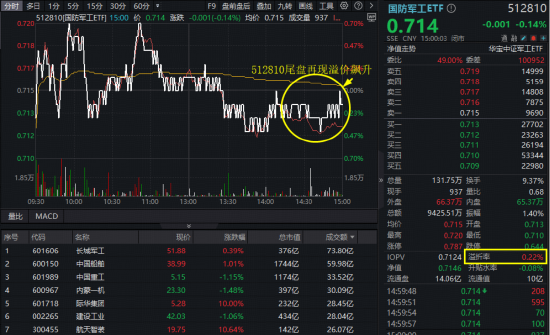
Group 1 - The defense and military industry sector experienced a volatile trading day on August 8, with the high-profile defense military ETF (512810) showing mixed performance, ultimately closing down 0.14% with a trading volume of 92.26 million yuan [1] - Despite a slight short-term adjustment in the defense military sector, trading activity remained robust, indicating sustained interest and activity within the market [4] - The defense military ETF (512810) saw a significant weekly increase of 5.78%, outperforming the broader market and reaching its highest trading volume since its inception in August 2016, with a total of 656 million yuan traded [3] Group 2 - Historical data suggests that the defense military sector tends to experience a surge in activity around significant events such as military parades, with the current period being critical ahead of an upcoming parade [2][4] - The fundamental outlook for the defense military sector is optimistic, driven by the 14th Five-Year Plan and the opening of military trade, which is expected to create a favorable supply-demand dynamic [5] - The defense military ETF (512810) is positioned as an efficient investment tool, covering a range of themes including commercial aerospace, low-altitude economy, large aircraft, deep-sea technology, military AI, and controllable nuclear fusion [5]