生成式人工智能(GenAI)

Search documents
2025年中国企业级AI应用行业研究报告
艾瑞咨询· 2026-02-28 00:06
企业级AI应用行业 丨研究报告 前言: 应用现状: 随着"百模大战"逐渐落幕,行业竞争重心转变,企业级AI从技术探索期全面转向规模化应用期。得益于大语言模型能力的快速跃升,新一代AI应用已在智能客 服、知识库问答、内容生成等知识密集且交互相对开放的场景中率先取得规模化突破。 关键问题: 在新一代AI应用的规模化落地过程中,企业也面临着更加复杂的挑战。其应用成果不仅依赖于单一的技术突破,更在于构建系统性、端到端的落地能力。 应 用层 : Agent成为当前企业级AI应用落地的核心载体,拆解最小任务单元,利用Function Call、MCP、Skills等方式,促进Agent与企业业务流程的深度整合。 支撑层: 以场景为中心进行模型选型,构建Data+AI的数据底座与面向AI的数据安全体系。 基础设施层: AI算力基建向多元异构演进,国产替代背景下软硬件深度协同优化重要性凸显。 组织层: 高 层推动的顶 层设计、员工维度的角色升级共同推动企业的AI转型。 厂商落位: 目前企业级AI应用领域主要有应用软件、技术服务及解决方案、云服务和AI模型四类厂商,部分深耕垂直场景,部分聚集平台能力,形成分层协作、动态竞合 的 ...


Chewy, Inc. (CHWY) Strengthens Long-Term Value Case Amid Shifting Internet Sector Dynamics
Yahoo Finance· 2026-02-05 15:41
Core Insights - Morgan Stanley raised its price target on Chewy to $51 from $48 while maintaining an Overweight rating, indicating confidence in the company's growth potential and operational leverage [1] - Chewy reported net sales of $3.12 billion for Q3 2025, reflecting an 8.3% year-over-year growth, surpassing management's guidance [3] - The company is diversifying its offerings, with Chewy Vet Care emerging as a significant growth driver, supported by the opening of two additional veterinary practices [3][4] Company Overview - Chewy, Inc. is a leading online retailer of pet food and related products, founded in 2011 and headquartered in Plantation, Florida [4] - The company's expanding ecosystem now includes healthcare services, positioning it to capture a larger share of pet spending and enhance customer loyalty [4] Market Context - The North America Internet sector is expected to favor companies demonstrating meaningful returns on invested capital, particularly those utilizing GenAI or GPU technologies [1] - Chewy stands out in this context as it shows improving operational leverage and clearer pathways to value creation amidst competitive pressures in other internet subsectors [1]

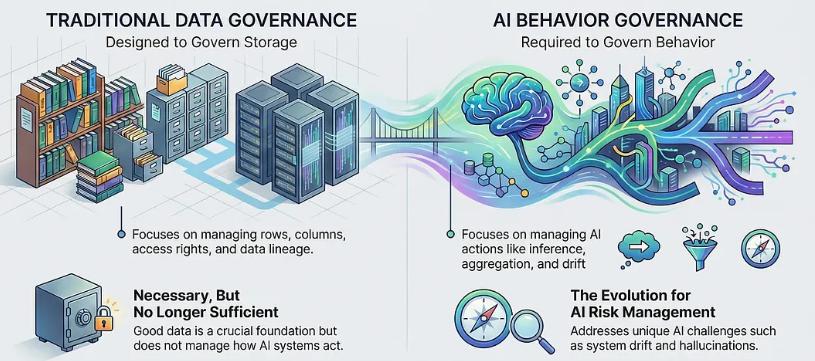
为什么传统数据治理模式不再适用于人工智能/机器学习
3 6 Ke· 2026-01-26 07:32
Overview - The article discusses the inadequacy of traditional data governance in managing AI/ML systems, emphasizing the need for a shift towards AI governance frameworks that address the dynamic and probabilistic nature of these technologies [2][3]. Core Friction: Deterministic vs. Probabilistic - Traditional governance models are designed for static, structured data, assuming data can be managed through controlled creation, storage, access, and modification [4]. - AI governance must focus on the behavior of AI systems, which are dynamic and can interpret and infer information in non-programmatic ways, leading to risks even when underlying data is accurate [5]. Key Implementation Failure Points - The article identifies specific failure points in traditional governance when applied to AI systems, such as "vector blind spots" and "mosaic effects" [11]. - "Vector blind spots" occur when personal identifiable information (PII) is embedded in vector databases, making it invisible to traditional data loss prevention tools [12]. - The "mosaic effect" refers to the risk of AI models synthesizing information from fragmented data, potentially leaking sensitive information even when direct access is restricted [14]. - The "time freeze" issue highlights that AI models may operate on outdated information until retrained, leading to governance challenges [17]. Enhanced Governance Framework - The article proposes an "enhanced governance" framework that integrates existing data investments with new AI control standards, such as the NIST AI RMF and ISO 42001 [3][18]. - Key components of this framework include: 1. Input Governance: Protecting unstructured data before it interacts with models [19]. 2. Feature and Fairness Governance: Ensuring fairness and preventing implicit bias during feature transformation [20]. 3. Model Transparency Governance: Ensuring model decisions are interpretable and defensible [24]. 4. Model Governance: Treating models as black boxes requiring external validation [26]. 5. Model Lifecycle Governance: Monitoring model performance and managing concept drift [28]. Alignment with Industry Frameworks - The article emphasizes the necessity of transitioning from data-centric to model-centric governance, aligning with frameworks like NIST AI RMF and ISO/IEC 42001 [45][46]. - NIST highlights the importance of measuring trustworthiness features such as interpretability and fairness, which are often absent in traditional governance [46]. - ISO/IEC 42001 mandates continuous improvement and transparency, requiring organizations to document not only the data used but also the rationale behind parameter choices [47]. Conclusion - The future of AI governance lies in enhancing rather than replacing traditional data governance, focusing on behavior-driven governance models that ensure compliance and trust while fostering innovation [49].
再见了, OpenAI!三年老用户忍痛卸载ChatGPT
猿大侠· 2026-01-26 04:11
可以上下滚动的图片 毫无疑问,现在判断谁是最后赢家,还为时过早。 编辑:KingHZ 【导读】 从ChatGPT惊艳问世到如今广告缠身,OpenAI乌托邦梦碎!谷歌和Anthropic强势反 扑,达沃斯论坛上互怼升级,这不是AGI的星辰大海,而是残酷的商业战场。 OpenAI全球首家实现AGI! 只不过,这个AGI可能要贻笑大方了。 奥特曼口中的「口袋里的博士级」AGI,不是星辰大海般的「通用人工智能」(Artificial General Intelligence),而是「广告生成收入」(Ad-Generated Income)。 当前,AI竞赛空前激烈,赌注之高前所未有,而OpenAI在ChatGPT里塞广告,未免操之过急,被普 遍认为是昏招: 但不可否认,OpenAI这次无疑成了硅谷AI巨头中的「眼中钉」。 10多年从业经验的科技记者、The Verge前副主编Alex Heath,在达沃斯与多名AI领袖的交谈之 后,他留下了一个印象: 整个行业似乎已集体决定联合起来对付OpenAI。 不过,OpenAI的投资人、Khosla Ventures合伙人Ethan Choi深度复盘了2026开年 AI行业的 ...

没有人类参与的AI音乐才会趋于平庸|破晓访谈
腾讯研究院· 2026-01-23 08:48
Core Insights - The core value of GenAI in the music industry is the significant enhancement of creative efficiency, applicable in lyric writing, composition, and singing, with the potential to create new music forms and genres through a "production-consumption-feedback" loop [7][11] - The phenomenon of "super individuals" in the music field is becoming more pronounced, empowering independent musicians and ordinary users to take control of the entire creative process, shifting from consumers to creators [7][12] - GenAI presents both opportunities and challenges, enhancing productivity while complicating content management and copyright protection, necessitating a collective effort to establish clear rules [7][16][18] Group 1: GenAI's Impact on Music Creation - GenAI has drastically improved production efficiency, with independent musicians increasing content supply by 2 to 3 times, while established labels also see significant efficiency gains [10] - AI's role in music creation includes lyric writing, composition, and vocal adaptation, with the potential for AI to innovate beyond mere imitation if a feedback loop is established [10][11] - The current quality of AI-generated music is still developing, with strict management standards in place to protect original content [10] Group 2: The Rise of Super Individuals - The emergence of "super individuals" allows independent musicians to manage the entire creative process, while ordinary users can now create and publish music without professional training [12][13] - Key competencies for these super individuals include advanced aesthetic judgment, effective communication with AI models, and emotional expression in their work [13] Group 3: Structural Changes in the Music Industry - The music industry is likely evolving into an "olive-shaped" structure, where top creators remain irreplaceable, but the middle tier of creators is expanding due to AI's influence [15] - The ability to operate and promote oneself is becoming increasingly important, as the core barrier to success shifts from creation to distribution and audience engagement [15] Group 4: Challenges in Content Management and Copyright - The influx of AI-generated music increases pressure on platforms for effective content management and compliance with regulatory standards [16] - The complexity of AI's involvement in music creation complicates copyright management, necessitating new models for licensing and revenue sharing [17][18] Group 5: The Future of AI in Music - AI-generated music is expected to evolve, with the potential for creating unique styles and enhancing user experiences through personalized and real-time generated music [21][23] - The success of AI singers will depend on the human teams behind them, emphasizing the importance of storytelling and emotional connection in building virtual idols [20]


从颠覆到融合:银行业“下半场”的竞争逻辑
科尔尼管理咨询· 2026-01-15 09:41
Core Insights - The banking industry is undergoing a profound transformation driven by technological advancements, particularly generative AI, which complicates the landscape for both digital and traditional banks [1] - Digital banks are disrupting traditional financial models with innovative, customer-centric solutions, while traditional banks are adapting to meet changing customer expectations and defend their market share [1] Group 1: Digital Banking Challenges - Digital banks must establish trust from scratch, as consumers are often hesitant to deposit large sums with purely digital institutions due to concerns over security and reliability [4] - Regulatory constraints pose significant challenges for digital banks, such as limits on deposit acceptance and requirements to demonstrate profitability [2] - Many digital banks struggle with profitability, as their primary revenue sources often do not cover high customer acquisition costs and compliance expenses [9] Group 2: Customer Acquisition and Retention - Digital banks face high customer churn rates as many users view them as secondary accounts rather than primary financial institutions [13] - To retain customers, digital banks must focus on providing comprehensive services and building customer loyalty through value propositions beyond just pricing [14] - Successful digital banks are leveraging partnerships and innovative services to attract and retain customers, such as tailored financial products for underserved markets [12] Group 3: Regulatory and Competitive Landscape - As digital banks expand, they encounter stricter regulatory scrutiny, which increases operational complexity and costs [15] - Competition from traditional banks and fintech giants remains fierce, necessitating digital banks to innovate and utilize advanced technologies like AI for personalized services [15] - Traditional banks are also evolving by streamlining operations and enhancing customer experiences to compete effectively with digital banks [17] Group 4: Strategies for Traditional Banks - Traditional banks can counter the threat from digital banks by optimizing their branch networks and adopting a digital-first approach to customer engagement [17] - Investing in modern IT infrastructure is crucial for traditional banks to overcome legacy system limitations and enhance operational efficiency [18] - Building on existing customer relationships and utilizing AI for personalized financial services can help traditional banks maintain their competitive edge [21][22] Group 5: Future Outlook - The future of banking is not a zero-sum game between digital and traditional banks; rather, it will depend on their ability to adapt, innovate, and collaborate [23] - Banks that embrace change, invest in technology, and prioritize customer-centric strategies are likely to emerge as leaders in their respective domains [24]

学术探讨|生成式人工智能驱动高校网络育人体系调适研究
Xin Lang Cai Jing· 2026-01-12 22:07
Core Viewpoint - Generative Artificial Intelligence (GenAI) is significantly expanding the boundaries of cultural education in universities, reshaping operational methods and educational forms in the digital age [1] Group 1: Value Guidance - The introduction of GenAI into the university cultural education system requires a firm grasp of the correct political direction and value orientation [2] - Universities should integrate socialist core values and excellent traditional Chinese culture into all aspects of network culture construction to ensure that technology applications align with the fundamental task of moral education [2] Group 2: Subject Construction - The core goal of university cultural education is to promote comprehensive development through a human-machine collaborative education model [3] - Maintaining the subjectivity of teachers and students in the application of intelligent technology is essential, guiding them to form a cognitive and action path that enhances their comprehensive abilities and innovative awareness [3] Group 3: Content Restructuring - Content construction is fundamental to the effectiveness of network cultural education, requiring the use of GenAI to creatively transform the narrative and presentation of mainstream values [4] - Data analysis and intelligent recommendation technologies should be employed to create multidimensional "student portraits" and "ideological maps" that enhance the relevance and effectiveness of network cultural education [4] Group 4: Mechanism Support - A robust institutional framework is crucial for the sustainable development of university network cultural education, necessitating a collaborative governance system that aligns with educational goals [5][6] - The integration of GenAI into the educational process should be supported by a clear regulatory framework covering content generation, dissemination management, and data usage [6]
数智时代的文脉赓续:中华优秀传统文化的保护与活化
腾讯研究院· 2026-01-08 09:03
Core Viewpoint - The intersection of traditional culture and digital transformation is leading to profound changes in cultural heritage preservation and innovation, emphasizing the importance of technology in safeguarding and revitalizing cultural assets [2][3][4]. Group 1: Digital Transformation in Cultural Heritage - Digital technology is effectively integrated into archaeology, restoration, and revitalization processes, creating a "digital gene bank" for endangered cultural memories [2]. - Examples include AI-driven restoration of artifacts and the digital revival of intangible cultural heritage, demonstrating that new information technologies are enhancing cultural heritage protection [2][4]. Group 2: Cultural Transmission and Public Engagement - True cultural transmission goes beyond mere digital archiving; it involves engaging people and ensuring cultural rights, promoting cultural inclusivity [3]. - Initiatives like Beijing's "Digital Central Axis" and the game "Honor of Kings" illustrate how technology can bridge the gap between the public and cultural essence, fostering interest in traditional culture among younger audiences [3]. Group 3: Economic Integration of Cultural Heritage - Traditional cultural resources are being efficiently transformed into productive elements, creating new business models in cultural tourism and consumption [4]. - The success of projects like the game "Black Myth: Wukong" highlights how cultural value can empower economic development and enhance public cultural satisfaction [4]. Group 4: Challenges and Opportunities in Cultural Data - The transition from cultural resources to industry faces challenges such as data silos and insufficient digital collection standards, necessitating a collaborative cultural technology ecosystem [5]. - There is a need for industry-level infrastructure and technology platforms to unlock cultural resources and stimulate societal cultural creativity [5]. Group 5: The Role of Generative AI - The rise of Generative AI (GenAI) is transforming the landscape of cultural heritage by enabling machines to understand and generate complex creative work, thus expanding the possibilities for cultural narrative and restoration [6]. - The collaboration between human creativity and AI presents a new paradigm for cultural storytelling, raising questions about the ethical frameworks needed to guide this evolution [6].

GenAI浪潮中,“气宗”为何比“剑宗”更重要|破晓访谈
腾讯研究院· 2025-12-29 08:34
Core Insights - Generative AI (GenAI) is igniting a profound paradigm shift in content production, breaking barriers in high-quality dynamic content generation and pushing complex creative work into the realm of machines [2] - The cultural industry faces both "strategic anxiety" and "opportunity desire" due to the disruptive potential of GenAI, prompting a comprehensive reshaping of existing value chains, business models, and content ecosystems [2] Group 1: GenAI Applications and Industry Transformation - GenAI technology is expected to reduce the production cycle of animated films from three to four years to about one year, and large advertising projects from two to three months to around two weeks, significantly lowering production costs while maintaining or improving quality [9] - The animation industry is transitioning from a labor-intensive model relying on large teams to a new model of lightweight, small teams collaborating with AI, leading to the emergence of new business forms characterized by "AI + high immersion + high sensory experience" [9] - AI-driven animation and short drama markets are anticipated to flourish, with the ability to adapt vast amounts of web literature and comic IPs into diverse styles at unprecedented speeds and lower costs, unlocking significant IP potential [10] Group 2: Structural Evolution of the Animation Ecosystem - A new breed of highly skilled "super individuals" will emerge, possessing top-notch aesthetic and narrative abilities, capable of leveraging AI tools for high-quality creation, replacing traditional large-scale collaborative teams with small, agile groups [11] - Major companies will evolve into "ecosystem builders" providing technology, tools, IP, and channels, while numerous small teams and super individuals will become creative content producers, enhancing overall content supply and quality [11] - The IP industry will see a multidimensional evolution, with GenAI increasing derivative efficiency and market validation speed, while the core standard for enduring IP remains the ability to "occupy user minds" and possess "cross-media narrative capabilities" [12][13] Group 3: Market Dynamics and Content Quality - The market value of real-time generated interactive content varies by application scenario, with gaming being the most promising area due to its non-linear narrative driven by player actions [14] - The acceptance of AI-generated content hinges on quality rather than origin, with the ultimate goal being "technical invisibility," where consumer judgment returns to the content itself [15] - The industry must be vigilant against potential risks posed by GenAI, including over-reliance on AI leading to diminished critical thinking and the risk of creating echo chambers for consumers [16] Group 4: Talent Development and Industry Challenges - Talent cultivation in the industry should focus on foundational skills rather than blind "AI-ification," emphasizing literary, aesthetic, and creative method training to produce individuals who can effectively express ideas using AI [17] - The industry is witnessing a shift towards smaller teams, with a typical configuration of 6-8 members, including specialized roles such as writers, directors, and AI animators, supported by AI technology [25] - The emergence of super individuals and small studios is a mainstream trend, with companies like "With Light and Dust" exploring industrial standards for AI film processes [26] Group 5: Future of IP and Content Creation - The core of IP remains the ability to "occupy minds" and "cross time," with AI facilitating rapid validation of concepts, but the potential for classic IP still relies on deep cultural connections with users [27] - The rise of AI-driven content, particularly in the form of interactive and real-time generated IP, is expected to gain market acceptance as quality improves and becomes indistinguishable from human-created content [29][30] - Companies are actively exploring the integration of AI in content creation, with successful projects demonstrating the commercial viability of AI-assisted original IPs [31]

AMD Strix Halo对线Nvidia DGX Spark,谁最强?
半导体行业观察· 2025-12-26 01:57
Core Insights - The article discusses the comparison between Nvidia's DGX Spark and AMD's Strix Halo systems, highlighting their capabilities in AI workloads and performance metrics [1][57]. System Overview - Nvidia's DGX Spark, launched in October, features a built-in AI lab with 128GB of memory, capable of running various AI workloads, although it is not the cheapest option on the market [1]. - AMD's Strix Halo, priced significantly lower than Spark, offers a competitive alternative with a similar software stack, making it appealing for developers and enthusiasts [1][13]. Performance Comparison - The HP Z2 Mini G1a workstation was tested against the Spark to evaluate performance across various AI workloads, including single-user inference and image generation [2]. - The physical design of the HP G1a is larger than Spark, with integrated power supply and better cooling solutions, although Spark has superior build quality [4][5]. Technical Specifications - The DGX Spark features a 20-core Arm CPU and 6,144 CUDA cores, while the Strix Halo has a 16-core Zen 5 CPU and 2,560 stream processors [11]. - In terms of memory bandwidth, Spark offers 273 GB/s compared to Strix Halo's 256 GB/s, which may impact performance in memory-intensive tasks [26]. GenAI Performance - Nvidia claims Spark can achieve up to 1 petaFLOPS, but practical performance is closer to 500 teraFLOPS for most users, depending on workload types [18]. - Strix Halo's performance is estimated at 126 TOPS, but actual application performance may not fully utilize this potential due to software limitations [19]. LLM Inference - In single-batch processing, both systems perform similarly in token generation, but Spark's GPU speed is approximately 2-3 times faster than Strix Halo for shorter prompts [24][27]. - For batch processing, Spark outperforms G1a, but the performance advantage may not be significant for users running non-interactive tasks [31][32]. Fine-tuning and Image Generation - Both systems support up to 128 GB of memory, making them suitable for fine-tuning models, although Spark completes tasks faster [34][38]. - In image generation tasks, Spark demonstrates a significant performance advantage, achieving around 120 teraFLOPS compared to G1a's 46 teraFLOPS [42]. NPU Capabilities - Strix Halo includes a neural processing unit (NPU) that can provide an additional 50 TOPS, but software support for maximizing its performance is still limited [44]. - The NPU's integration into applications is still developing, with some success in specific use cases, but overall performance remains below expectations [46]. Software Compatibility - Nvidia's CUDA ecosystem remains a strong advantage over AMD's ROCm and HIP, although AMD has made significant progress in recent months [48][49]. - The older RDNA 3.5 architecture of Strix Halo limits its support for low-precision data types, impacting performance in certain AI applications [50]. Conclusion - The choice between DGX Spark and Strix Halo depends on the user's specific needs, with Spark being more suitable for dedicated AI tasks and Strix Halo offering a versatile option for general computing and AI workloads [54][57].