量化多头策略

Search documents
全市场重点私募基金跟踪周报0204
私募排排网· 2026-02-05 01:40
排排⽹全市场 重点私募基⾦跟踪周报 2026年02⽉04⽇ 统计区间:2026-01-23⾄ 2026-01-30 上周涨跌总览:(2026-01-26-2026-01-30) 均涨幅 2.38% 均跌幅 -2.31% 涨39.0% 跌60.3% 每类策略本周的表现分布图如下,具体每类策略业绩表现详⻅下⽂: 数据截⽌:2026-01-30 | | 本周收益正负占⽐分布 | | 今年以来收益正负占⽐分布 | | 近⼀年收益正负占⽐分布 | | | --- | --- | --- | --- | --- | --- | --- | | 主观选股 | 41.10% | 58.90% | 88.95% | 11.05% | 95.73% | 4.27% | | 沪深300指增 | 47.69% | 52.31% | 98.46% | 1.54% | 100.00% | 0.00% | | 中证500指增 | 4.15% | 95.85% | 98.81% | 1.19% | 99.69% | 0.31% | | 中证1000指增 | 1.37% | 98.63% | 99.45% | 0.55% | 99.37% | ...
全球资本“迁徙”进行时:对中国资产态度转为“计划布局”
Shang Hai Zheng Quan Bao· 2026-01-19 18:45
Group 1: Global Capital Migration - The global capital migration is underway, with Asian tech stocks significantly outperforming US tech stocks as of early 2026, indicating a shift in international capital allocation due to the Federal Reserve entering a rate-cutting phase and reduced attractiveness of dollar assets [1][2] - Emerging markets, particularly in Asia, are becoming the next focus for foreign investment as the trend of capital flowing predominantly to the US is beginning to reverse [2][3] Group 2: Performance of Emerging Markets - As of January 16, 2026, the Korean Composite Index rose by 14.87%, followed by the Nikkei Index at 7.14%, Shenzhen Component Index at 5.59%, and Hang Seng Index at 4.74%, while the Nasdaq Index only increased by 1.18% during the same period [2] - Emerging markets have shown superior performance compared to developed markets, driven by the Federal Reserve's rate cuts, favorable reforms in several emerging economies, and the concentration of AI supply chains in these markets [2] Group 3: Foreign Investment in China - Foreign institutions are increasingly shifting their strategies from "long-short" to "long only," indicating a growing interest in long-term investments in Chinese assets [4][5] - The number of mainland private equity fund managers holding a Hong Kong license has reached 133, with 63 managing over 5 billion yuan, reflecting a trend of private equity firms seeking better connections with overseas capital [6] Group 4: Chinese Stock Market and Technology Sector - The Chinese stock market is experiencing a strong performance, with valuations remaining attractive compared to other major global markets, and this trend is expected to continue [7] - Foreign investors are particularly interested in Chinese tech stocks, viewing them as undervalued compared to US tech giants, with a focus on sectors like semiconductors and electronic devices [8][9]
2025年近九成私募盈利 股票策略平均收益率29.99%
Zhong Guo Jing Ying Bao· 2026-01-09 09:20
Core Insights - In 2025, out of 9,934 private equity securities products with performance records, 8,915 products achieved positive returns, resulting in a positive return rate of nearly 90% (89.74%) with an average return of 25.68% and a median return of 18.78% [1] Group 1: Overall Market Performance - The overall market saw a significant number of private equity securities products, with 8,915 out of 9,934 achieving positive returns [1] - The average return across all products was reported at 25.68%, while the median return stood at 18.78% [1] Group 2: Stock Strategy Performance - The stock strategy emerged as the clear leader in returns, with 6,298 products, of which 5,680 achieved positive returns, resulting in a positive return rate of 90.19% [1] - The average return for stock strategy products reached 29.99%, and the median return was 24.2% [1] Group 3: Quantitative Long-Only Strategy - Within the stock strategy, the quantitative long-only strategy excelled, with 1,360 products achieving a remarkable positive return rate of 95.81% [1] - The average return for this sub-strategy was 39.51%, and the median return was 42.04%, making it the top performer among sub-strategies [1]
2023年来各年收益排名均居上游有多难?明汯、茂源、翰荣等私募旗下产品做到了!
私募排排网· 2025-12-28 03:04
Core Viewpoint - The article emphasizes the challenges of consistently outperforming in the private equity market, particularly in the context of the rapidly changing capital market environment since 2023, highlighting the importance of fund managers' research capabilities and strategy adaptation [2]. Summary by Strategy Quantitative Long-Only - A total of 16 quantitative long-only products have consistently ranked in the top tier from January to November 2023, 2024, and 2025, with notable contributions from firms like Minghong, Maoyuan, and Hanrong [2]. - As of November 2025, there are 640, 462, and 325 quantitative long-only products reported for the years 2023, 2024, and 2025 respectively, with only 16 products making it to the top 30% in all three years [3]. - The top five cumulative return products since 2023 are from firms including Huijing Asset, Shanghai Zijie Private Equity, and Abama Investment [3]. Subjective Long-Only - There are 14 subjective long-only products that have maintained top-tier rankings across the same periods, with notable firms like Kaishi Private Equity and Yidian Najin included [7]. - The number of subjective long-only products reported as of November 2025 is 1,089, 979, and 838 for the years 2023, 2024, and 2025 respectively, with only 14 products achieving top 30% rankings in all three years [7]. - The top five cumulative return products since 2023 are from Beiheng Fund, Ding Tai Sifang (Shenzhen), and Guangdong Guangjin [8]. CTA (Commodity Trading Advisor) - A total of 12 CTA products have consistently ranked in the top tier from January to November 2023, 2024, and 2025, with leading products from Guanjing Fund and other firms [13]. - The number of CTA products reported as of November 2025 is 256, 226, and 187 for the years 2023, 2024, and 2025 respectively, with only 12 products making it to the top 40% in all three years [13]. - The top five cumulative return products since 2023 are from Guanjing Fund, Gongqingcheng Guangju Xinghe Private Equity, and Caoben Investment [14]. Multi-Asset - There are 22 multi-asset products that have consistently ranked in the top tier from January to November 2023, 2024, and 2025, with significant contributions from firms like Luyuan and Junfu [18]. - The number of multi-asset products reported as of November 2025 is 414, 337, and 265 for the years 2023, 2024, and 2025 respectively, with only 22 products achieving top 40% rankings in all three years [18]. - The top five cumulative return products since 2023 are from Luyuan Private Equity, Henan Zhi Ying Private Equity, and Junfu Investment [18].


看懂这些,把握跨年行情
私募排排网· 2025-12-28 00:00
Group 1 - The core viewpoint of the article emphasizes that the "cross-year market" period is characterized by significant industry rotation and style switching rather than a straightforward market trend, with historical patterns indicating mixed performance across indices [2][4]. - Over the past decade, major broad-based indices have shown an average decline during the cross-year period, with the average returns for the CSI 500, CSI 1000, and National 2000 indices in January being -4.71%, -6.67%, and -6.68% respectively, indicating a win rate below 50% [2][4]. - The Shanghai Composite 50 and CSI 300 indices have shown average returns of -0.72% and -1.54% in January, with a win rate of 50% over the last ten years, suggesting a relatively stronger performance compared to smaller indices [2][4]. Group 2 - The article highlights that the characteristics of the cross-year market are not indicative of a general beta market trend, but rather a "defensive December and strong differentiation in January" structure, with defensive sectors performing better in December [7][12]. - In January, the banking sector has consistently outperformed other sectors, maintaining a position among the top five in terms of monthly returns, except for 2020 and 2023 [7][12]. - The average returns for most sectors in January have been negative, with many sectors showing win rates of only 30-40%, indicating a lack of broad-based gains and a tendency for performance differentiation [7][12]. Group 3 - Historical statistics suggest that the cross-year phase is not a favorable period for quantitative long strategies to achieve excess returns, but rather exposes differences in strategy concentration, drawdown control, and volatility adaptation [12]. - For investors holding quantitative long private equity funds, the focus during the cross-year period should be on assessing the ability of their products to maintain net value stability in a volatile and differentiated environment [12]. - From an asset allocation perspective, it is advisable to consider complementary configurations of styles and assets to smooth out portfolio volatility, particularly given the banking sector's relative strength in January [12].

主观多头今年为何再度跑输量化?
私募排排网· 2025-12-13 03:05
Core Viewpoint - The A-share market in 2025 has shown distinct characteristics of a structural bull market, driven by policy support for the economy and technological transformation, leading to an upward trend in indices and significant returns for investors [2] Group 1: Market Performance - As of November 28, 2025, the private equity stock strategy index has achieved a return of 23.67%, while the CSI All Share Index has returned 18.30% during the same period [2] - The quantitative long strategy index has outperformed the subjective long strategy index, with returns of 34.67% and 22.75% respectively [2] Group 2: Strategy Analysis - The market environment this year was expected to favor subjective long strategies, yet quantitative strategies have leveraged their systematic advantages to capture opportunities [2] - The average performance of subjective long strategies has not matched that of quantitative strategies, attributed to the internal dispersion of returns and decreased effectiveness of timing strategies [12][18] Group 3: Future Outlook - The current environment for subjective long strategies is expected to improve compared to 2022-2024, with enhanced liquidity and a shift in market risk appetite [18] - Investors are encouraged to focus on subjective long managers who emphasize shareholder returns and sectors with high growth potential, such as AI and related industries [18]

“尴尬”的市场中性策略
Shang Hai Zheng Quan Bao· 2025-11-24 18:03
Core Insights - The average return of market-neutral strategies has been disappointing at 9.8% year-to-date, significantly lower than long/short strategies at 18.96% and enhanced index strategies at 38.76% [2][4] - The volatility of market-neutral products has increased to 158.62%, compared to 102.89% for the previous year, indicating a challenging environment for these strategies [2][4] Group 1: Performance Analysis - As of November 14, 689 market-neutral strategy products have shown an average return of only 9.8% this year, which is underwhelming compared to other strategies [2][4] - The volatility of these products has surged, with a standard deviation of returns exceeding 150%, leading to a poor investor experience [2][5] Group 2: Market Dynamics - The influx of capital into market-neutral strategies at the beginning of the year, driven by risk aversion, has led to increased strategy crowding [6][7] - A decline in margin financing has forced market-neutral strategies to rely solely on index futures for hedging, exacerbating basis volatility [6][7] Group 3: Investor Sentiment - Many investors have misinterpreted market-neutral strategies as substitutes for fixed-income products, leading to disappointment as these strategies have not performed as expected [7][10] - The perception of market-neutral strategies as "chicken ribs" reflects a growing dissatisfaction among investors, prompting some to redeem their investments [5][7] Group 4: Future Considerations - The industry is exploring multi-strategy or multi-asset products to better meet the stable return expectations of investors [9][10] - There is a need for clearer communication regarding the risk-return profiles of market-neutral strategies to align investor expectations with actual performance [10]

精细化比拼升温 量化多头策略迎大考
Zhong Guo Zheng Quan Bao· 2025-11-22 01:44
Core Insights - The A-share market is experiencing high volatility with a decline in the performance of technology growth stocks, leading to reduced profitability for individual stocks [1][2] - Quantitative long strategies are facing significant challenges, with performance divergence among leading institutions due to factor decay, rising costs, and stricter regulations [2][4] - The industry is evolving towards platformization, AI integration, and multi-strategy approaches to adapt to the increasingly complex market environment [1][7] Performance Challenges - The market has entered a phase of index volatility and stock differentiation, putting pressure on quantitative long strategies [2] - In October, quantitative long products achieved an average return of approximately 0.93% and an excess return of 1.5%, outperforming subjective long strategies [2] - Since the fourth quarter, there has been a noticeable divergence in excess returns among leading and mid-tier quantitative institutions [2][6] Strategy Adjustments - Some quantitative firms are shifting towards defensive strategies, focusing on risk management and reducing exposure to short-term market trends [3] - The challenges faced include declining factor effectiveness, rising trading costs, and the need for compliance with regulatory requirements [4] - Institutions are adopting multi-dimensional iterations to address these challenges, including improving algorithms and incorporating alternative data [4][5] Competitive Landscape - The quantitative industry is experiencing significant growth, with a nearly 90% increase in the number of private equity securities products registered this year, and quantitative products accounting for 44.30% of this growth [7] - The competition is shifting from single-point algorithm breakthroughs to comprehensive system engineering [7][8] - The application of AI and machine learning is becoming a standard practice in the industry, enhancing factor discovery and risk management [7][8] Future Outlook - The trend towards multi-strategy and multi-asset approaches is expected to continue, with a focus on improving capital efficiency and stabilizing net asset values [8] - There is an increasing concentration of resources towards leading institutions that demonstrate stable performance and robust product lines [8] - The industry consensus suggests that the framework and style of quantitative long strategies are now largely established, with future efforts focused on fine-tuning existing systems rather than radical changes [8]
资管信托政策出台,债券产品回暖,中诚信托收大额罚单
2 1 Shi Ji Jing Ji Bao Dao· 2025-11-18 12:32
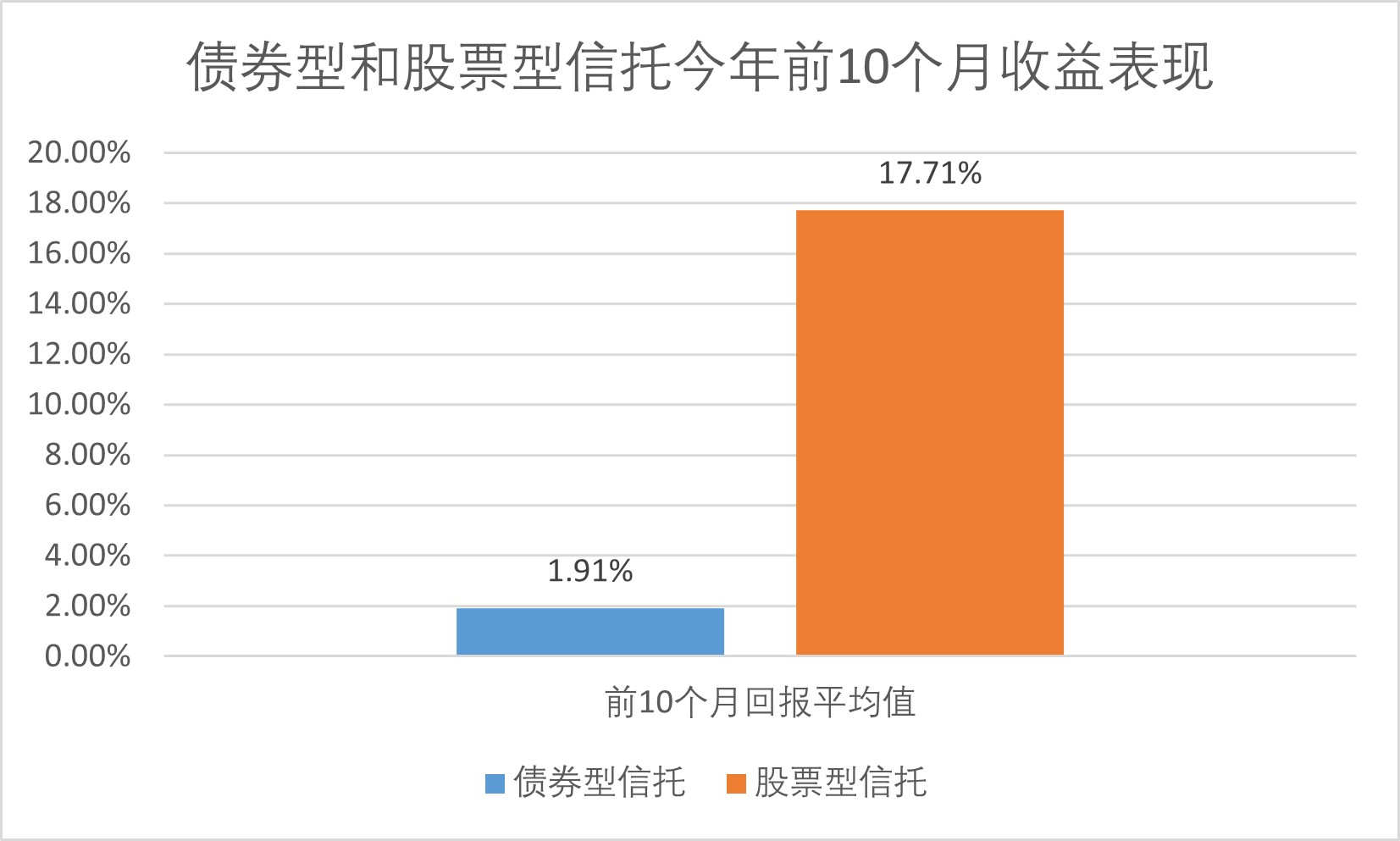
Group 1: Trust Product Issuance - In October, the issuance of trust products decreased by 15.87% month-on-month, totaling 1,124 products [1] - Securities investment trusts accounted for 78.02% of the total issuance, with a slight increase of 0.24 percentage points from September [1] - The scale proportion of securities investment trusts rose from 36.43% in September to 42.37% in October [1] Group 2: Performance of Securities Investment Products - The stock market showed mixed results in October, with the STAR 50 Index down by 5.33% while the Shanghai Composite Index rose by 1.85% [2] - Bond-type trusts saw an average return of 1.91% over the first ten months of the year, while stock-type trusts had an average return of 17.71%, down from 18.58% in the previous nine months [3] Group 3: Strategy Performance - Macro strategies continued to perform best with an average return of 25.89% over the first ten months, while stock strategies had an average return of 20.51% [5] - In October, stock strategies had a negative average return of -0.8%, with quantitative long strategies showing the highest average return of 34.67% [5] Group 4: Trust Company Performance - BaiRui Trust's bond-type trusts had the highest average return over the first ten months, while National Trust and Jilin Trust ranked lower [9] - Huaxin Trust's bond-type trusts improved their ranking due to a 1.39% average return in October [9] Group 5: Regulatory Developments - The National Financial Supervision Administration released a draft for the Asset Management Trust Management Measures, emphasizing the positioning of asset management trusts as private asset management products [13] - The draft prohibits channel business, fund pool business, and rigid payment, aiming to enhance the regulatory framework of the trust industry [13] Group 6: Industry Penalties - Zhongcheng Trust was fined 6.6 million yuan for various violations, highlighting ongoing regulatory scrutiny in the trust industry [14] - The penalties reflect a continued high-pressure regulatory environment focusing on business violations and poor management [14] Group 7: Industry Growth - The total asset management scale of the trust industry reached 32.43 trillion yuan as of June, marking a 9.7% increase from the previous year [15] - This milestone positions the trust industry as the third largest in the asset management sector, following insurance and public funds [15]
量化多头私募公司榜出炉!鸣石、平方和、蒙玺位居前3!
私募排排网· 2025-11-16 03:04
Core Viewpoint - The A-share market has shown a strong upward trend in 2023, with significant internal style differentiation, particularly between small and large-cap stocks, leading to varying performances among quantitative long strategies [2][3]. Group 1: Market Performance - As of the end of October 2023, the Shanghai Composite Index, Shenzhen Component Index, and ChiNext Index have increased by approximately 17.99%, 28.46%, and 48.84% respectively [2]. - In the first half of the year, small-cap stocks outperformed large-cap stocks, but a style switch occurred in late August, with the CSI 300 Index outperforming small-cap stocks in August and September [2]. Group 2: Quantitative Long Strategy Performance - Quantitative long strategy products faced negative excess returns in the months of August and September, marking the worst monthly performance of the year [2]. - However, since October, the excess returns of quantitative long strategies have begun to recover as institutional investors loosened their collective positions [2]. Group 3: Top Performing Private Equity Firms - For firms with over 10 billion in assets, the top three in terms of average excess returns for quantitative long products are Ming Shi Fund, Ping Fang He Investment, and Meng Xi Investment [3][4]. - Ming Shi Fund leads with four qualifying quantitative long products and a total product scale of approximately 5.62 billion, achieving an average excess return of ***% [4]. - Ping Fang He Investment and Meng Xi Investment follow, with their best-performing products achieving excess returns of ***% [5]. Group 4: Mid-Sized Private Equity Firms - In the 50-100 billion category, Bei Yang Quantitative topped the list with five qualifying products and an average excess return of ***% [7][8]. - The firm is noted for its AI-driven quantitative investment approach, led by a team with significant academic credentials [8][9]. Group 5: Smaller Private Equity Firms - In the 20-50 billion category, Han Rong Investment and Lu Xiu Investment ranked first and second, respectively, with average excess returns of ***% [10][11]. - Han Rong Investment focuses on short-cycle price-volume predictions, while Lu Xiu Investment employs a strategy of diversified holdings to achieve stable excess returns [11][12]. Group 6: Smallest Private Equity Firms - In the 0-20 billion category, Shanghai Zi Jie Private Equity ranked fourth, with three qualifying products and an average excess return of ***% [13][15]. - The firm primarily focuses on small-cap strategies, particularly targeting stocks that have experienced significant declines [15].