量子科技等

Search documents
“十五五”规划中的能源要点全梳理!
国家能源局· 2026-03-14 05:11
Core Viewpoint - The article outlines the key energy development goals and strategies for the 14th Five-Year Plan period, emphasizing high-quality development, technological self-reliance, and ecological progress in energy systems [2][4]. Group 1: Major Goals - Significant achievements in high-quality development are expected, with a unified national market and advantages of a super-large-scale market becoming more evident [4]. - The level of technological self-reliance will see substantial improvements, with breakthroughs in key core technologies and an increase in original and leading technological achievements [4]. - Progress in building a beautiful China will be marked by the formation of green production and lifestyle patterns, achieving carbon peak targets, and reducing carbon emissions per unit of GDP by 17% [4][6]. Group 2: Energy Production Capacity - The comprehensive energy production capacity is projected to reach 5.8 billion tons of standard coal [5]. Group 3: Industrial Upgrading - Key industries such as steel, petrochemicals, and shipbuilding will undergo structural adjustments to enhance quality and competitiveness [7]. - The focus will be on developing high-end products and accelerating breakthroughs in critical components and materials [7]. Group 4: Emerging Industries - The development of strategic emerging industries such as new information technology, new energy, and high-end equipment will be accelerated, with an emphasis on creating industry clusters with unique advantages [14][15]. - The article highlights the importance of advancing technologies like quantum science, hydrogen energy, and artificial intelligence as future economic growth points [16]. Group 5: Energy Infrastructure - The construction of a new energy infrastructure will be prioritized, focusing on clean, low-carbon, and efficient energy systems, with a significant push for non-fossil energy sources [20]. - The article mentions the implementation of a ten-year doubling action for non-fossil energy and the establishment of clean energy bases [20]. Group 6: Carbon Neutrality Goals - The plan includes a comprehensive approach to achieving carbon peak and neutrality, with specific measures to control carbon emissions and promote energy efficiency [77][79]. - The goal is to reduce energy consumption per unit of GDP by approximately 10% and to ensure that new electricity consumption is covered by clean energy [80].


两会速览︱“十五五”109项重大工程项目 涉及能源有哪些?
国家能源局· 2026-03-06 03:58
Core Viewpoint - The article emphasizes the importance of major engineering projects as a key driver for the implementation of the Five-Year Plan, highlighting their role in strengthening China's economic foundation and promoting sustainable development. Group 1: Major Engineering Projects - Major engineering projects are crucial for the implementation of the Five-Year Plan, serving as a backbone for China's economy from the First to the Fourteenth Five-Year Plan [4] - The focus is on enhancing industrial capabilities and competitiveness through significant technological advancements and the development of new industries [5][11] Group 2: New Energy Systems - Development of new energy systems is prioritized, including major hydropower and integrated wind-solar bases, offshore wind power, and coastal nuclear power [7][19] - The construction of a modern energy infrastructure is essential for achieving carbon peak and carbon neutrality goals [6][32] Group 3: Green and Low-Carbon Transition - The article outlines initiatives for promoting a green and low-carbon transition, including energy-saving measures in key industries and the clean substitution of coal consumption [34] - Emphasis is placed on the construction of zero-carbon parks and transportation corridors, as well as the reduction of non-CO2 greenhouse gas emissions [8][34] Group 4: Safety and Security in Key Areas - Enhancing safety and security capabilities in critical sectors is highlighted, including food security, oil and gas exploration, and the establishment of coal-to-oil and gas bases [40] - The article discusses the importance of strategic resource reserves and emergency response systems to ensure national security [38][40]

中央企业2025年成绩单发布 呈现哪些新变化?
Ren Min Ri Bao· 2026-01-28 23:08
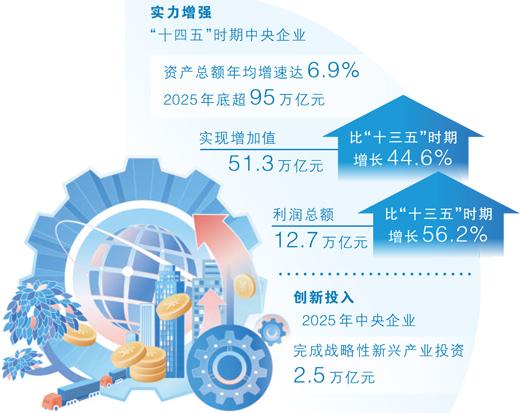
Core Insights - The State-owned Assets Supervision and Administration Commission (SASAC) announced that central enterprises achieved a total profit of 2.5 trillion yuan, fixed asset investment of 5.1 trillion yuan, and tax contributions of 2.5 trillion yuan by 2025, with total assets exceeding 95 trillion yuan by the end of 2025 [2] Group 1: Scale and Performance - During the 14th Five-Year Plan period, the total assets of central enterprises increased significantly, with an average annual growth rate of 6.9%, reaching over 90 trillion yuan [3] - The added value of central enterprises reached 51.3 trillion yuan, a 44.6% increase compared to the previous five-year period, while total profits grew by 56.2% to 12.7 trillion yuan [3] - Key product outputs, such as crude oil production, electricity generation, and electricity sales, saw substantial growth of 24.7%, 38.2%, and 40.7% respectively [3] Group 2: Investment in Innovation - Central enterprises invested over 5 trillion yuan in R&D during the 14th Five-Year Plan, with R&D intensity increasing by 0.27 percentage points and the number of technology talents rising by nearly 50% [3] - By 2025, R&D investment is projected to reach 1.1 trillion yuan, with significant achievements including the addition of 22 academicians and the formation of 23 innovation consortia involving over 100 entities [4] Group 3: Strategic Emerging Industries - In 2025, revenue from strategic emerging industries exceeded 12 trillion yuan, with a continuous annual growth of 1 trillion yuan, and their share of total revenue increased by over 10 percentage points compared to 2022 [6] - Investment in strategic emerging industries reached 2.5 trillion yuan, accounting for 41.8% of total investments [6] Group 4: Traditional Industry Transformation - Central enterprises are focusing on upgrading traditional industries, establishing 70 advanced intelligent factories and 39 projects recognized as national green low-carbon technology demonstration projects [8] - The integration of AI technology is being actively pursued, with significant investments in new infrastructure and the development of large models to support various industries [9] Group 5: Future Directions - In 2026, central enterprises will enhance procurement of first sets and batches of products, aiming for continuous growth in value added and alignment with national GDP growth [10][11] - The focus will be on increasing high-quality technological supply, improving foundational research investment, and accelerating the transformation of innovative achievements into productive forces [11]
航空航天具身智能等领域再传利好:国家再拿一笔钱投向核心技术攻关
Xin Lang Cai Jing· 2025-12-27 03:17
Core Viewpoint - The National Venture Capital Guidance Fund has officially launched, focusing on early and small investments in the technology sector, which inherently involves high risks [1] Group 1: Fund Characteristics - The Guidance Fund emphasizes strategic emerging industries and future industries, supporting original and disruptive technological innovations and key core technology breakthroughs [1] - Unlike other market-oriented funds, the Guidance Fund prioritizes national strategic service over investment return rates [1] - The fund aims to allocate resources to areas that are "more in need of funding," ensuring that necessary investments for innovation are fully realized [1] Group 2: Institutional Innovations - The Guidance Fund introduces institutional innovations in funding allocation, duration, execution processes, and exit mechanisms, designed to encourage social capital to invest more confidently and profitably [1] - The goal is to leverage a small amount of government funding to attract larger investments from private sectors, enabling more extensive and impactful projects [1] Group 3: Focus Areas - The fund will accelerate the development of strategic emerging industry clusters such as new energy, new materials, aerospace, and low-altitude economy, while also laying the groundwork for future industries [1] - It aims to promote new economic growth points in areas like quantum technology, biomanufacturing, hydrogen energy, nuclear fusion energy, brain-computer interfaces, embodied intelligence, and sixth-generation mobile communication [1] Group 4: Long-term Commitment - National capital is prepared to support technology companies in the long run, allowing social capital to focus on incubating disruptive technologies [2]
聚焦6个关键领域 加快制造业中试平台高水平建设
Ren Min Ri Bao· 2025-12-24 03:22
Core Viewpoint - The article emphasizes the importance of high-level construction of manufacturing pilot platforms to accelerate the transformation and application of major scientific and technological achievements in China. Group 1: Manufacturing Pilot Platforms - The Chengdu High-tech Zone's pilot base has successfully assisted over 300 products in reaching mass production by providing a full-chain service for product finalization, process optimization, and reliability verification [3] - The Ministry of Industry and Information Technology (MIIT) aims to establish a modern pilot platform system by the end of 2027, with a focus on multi-entity participation and multi-level service networks [3][4] - Currently, over 2,400 pilot platforms have been established in China, with 241 selected as key cultivation platforms by MIIT, which have undertaken 25,000 pilot service projects [5] Group 2: Importance of Pilot Testing - Pilot testing is identified as a critical link connecting the innovation chain, technology chain, and industrial chain, with an 80% success rate for industrialization when pilot testing is conducted, compared to only 30% without it [4] - The MIIT has released guidelines to address key issues in pilot platform construction, focusing on strategic positioning, basic capabilities, and future potential [6] Group 3: Development Strategies - The MIIT's strategy includes strengthening, activating, and supplementing pilot platforms to enhance their development and competitiveness, with a focus on key industries such as artificial intelligence, quantum technology, and biomedicine [6][7] - To avoid redundant construction and competition, the guidelines emphasize the need for complementary functions, resource sharing, and business promotion based on actual industrial development conditions [7]

加快制造业中试平台高水平建设(政策速递)
Ren Min Ri Bao· 2025-12-23 22:31
Core Viewpoint - The establishment and enhancement of manufacturing pilot testing platforms are crucial for accelerating the transformation and application of major scientific and technological achievements in China, with a focus on improving the success rate of industrialization through systematic support and development strategies [1][2][3]. Group 1: Manufacturing Pilot Testing Platforms - The Chengdu High-tech Zone's pilot testing base has successfully assisted over 300 products in reaching mass production by providing comprehensive services for product finalization, process optimization, and reliability verification [1]. - As of now, more than 2,400 pilot testing platforms have been established in China, with 241 selected as key cultivation platforms by the Ministry of Industry and Information Technology (MIIT), which have undertaken 25,000 pilot service projects [2]. - The success rate of industrialization for technologies that undergo pilot testing is 80%, compared to only 30% for those that do not [1]. Group 2: Guidelines for High-level Construction - The MIIT has released guidelines addressing key issues in the construction of pilot testing platforms, focusing on what to build, who will build it, and how to build it [3]. - The guidelines emphasize a systematic approach to strengthen, activate, and supplement pilot testing platforms, targeting strategic positioning, basic capabilities, and future potential [3]. - Specific sectors and industries have been identified for the development of pilot testing platforms, including raw materials, equipment manufacturing, consumer goods, information technology, and emerging industries [3]. Group 3: Avoiding Redundant Construction - To prevent redundant construction and "involution" competition, the guidelines advocate for a resource-based approach that considers local conditions and industry foundations [4]. - The aim is to achieve functional complementarity, resource sharing, and business promotion among pilot testing platforms, avoiding blind and hasty advancements [4].
利好!工业和信息化部发文
Shang Hai Zheng Quan Bao· 2025-11-11 13:03
Core Viewpoint - The Ministry of Industry and Information Technology (MIIT) of China has issued a notice to accelerate the systematic layout and high-level construction of manufacturing pilot platforms, emphasizing the importance of these platforms in connecting the innovation chain, technology chain, and industrial chain, and supporting the integration of technological and industrial innovation by 2027 [1][3]. Summary by Sections Overall Requirements - The initiative is guided by Xi Jinping's thoughts and aims to implement the spirit of the 20th National Congress of the Communist Party of China, focusing on new industrialization tasks with principles of scientific layout, local adaptation, standard guidance, and gradient cultivation [3]. Main Tasks - The plan includes three main strategies: strengthening a batch of pilot platforms, activating another batch, and supplementing a batch of pilot platforms [4][5]. - **Strengthening a Batch**: This involves guiding pilot platforms to develop based on strategic positioning, foundational capabilities, technological advantages, operational mechanisms, service effectiveness, and future potential [4]. - **Activating a Batch**: This focuses on enhancing the internal development dynamics and competitiveness of pilot platforms through targeted support and improvement activities [5]. - **Supplementing a Batch**: This aims to establish new pilot platforms in key industries such as artificial intelligence, quantum technology, and biomedicine, addressing supply shortages in critical sectors [5][6]. Work Arrangement - Local industrial and information departments are required to mobilize eligible pilot platforms to submit applications by specific deadlines, ensuring a structured approach to the development of these platforms [7]. Work Requirements - Emphasis is placed on establishing a stable investment mechanism, a scientific operational mechanism, and an efficient support mechanism to enhance the effectiveness of pilot platforms [8]. - The initiative encourages collaboration between pilot platform construction and existing technological innovation platforms to create synergistic effects [8].
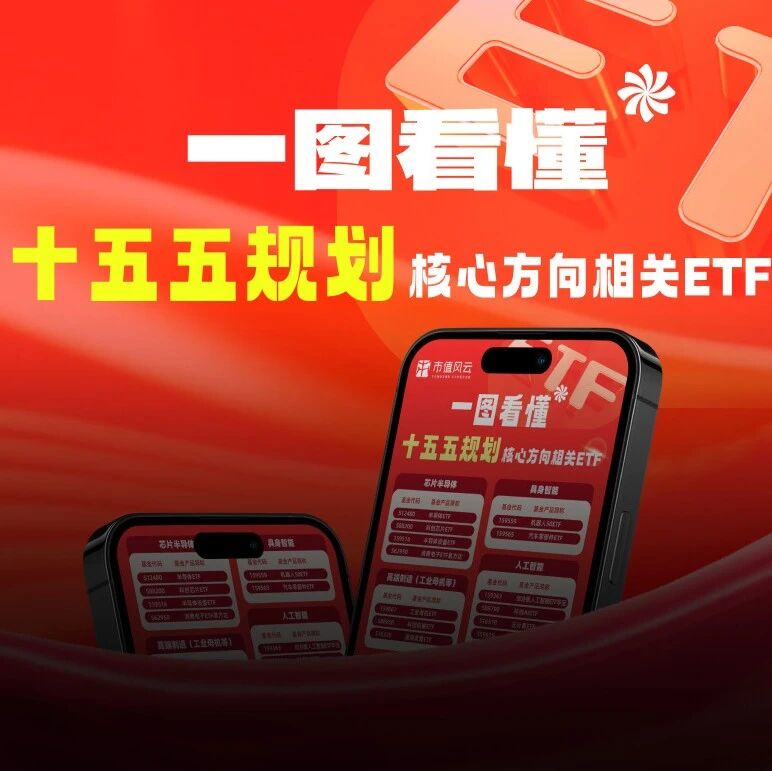
一图看懂“十五五规划”核心方向相关ETF
市值风云· 2025-11-07 10:09
Core Insights - The "14th Five-Year Plan" emphasizes accelerating high-level technological self-reliance and building a modern industrial system centered on advanced manufacturing, providing strong momentum for China's high-tech industry [3]. ETF Investment Opportunities - The technology sector, as a policy focus, has historically outperformed most other sectors in the 1-3 years following policy announcements [3]. - Various ETFs related to key sectors under the "14th Five-Year Plan" are highlighted, including: - **Semiconductors**: Semiconductor ETF (512480), Sci-Tech Chip ETF (588200), Semiconductor Equipment ETF (159516), Consumer Electronics ETF (562950) [4]. - **High-end Manufacturing**: Industrial Mother Machine ETF (159667), Sci-Tech Machinery ETF (588850), High-end Equipment ETF (516320) [5]. - **Basic Software**: Software ETF (159852) [5]. - **Biomanufacturing**: Hong Kong Innovative Drug ETF (513120), Innovative Drug ETF (159992) [5]. - **Artificial Intelligence**: AI ETFs including Startup Board AI ETF (159363), Sci-Tech AI ETF (588790), Cloud Computing ETF (516510), and others [7]. - **New Energy**: Photovoltaic ETF (515790), New Energy ETF (516160), Solid-State Battery ETF (159566), and Energy Storage Battery ETF [8]. - **Aerospace and Communication**: Aerospace ETF (159227), Communication ETF (515880) [9].
首期510亿,又一超级基金落地北京!
Sou Hu Cai Jing· 2025-11-04 04:26
Core Viewpoint - The Central Enterprise Strategic Emerging Industry Development Fund has been officially launched in Beijing with an initial scale of 51 billion yuan, aiming to support strategic emerging industries and enhance the resilience of industrial chains [4][5]. Fund Structure and Management - The fund has an investment period of 5 years, a management and exit period of 8 years, and can be extended by 2 years, with a maximum total duration of 15 years, characterized as "patient capital" [5]. - It will adopt a "government guidance + market-oriented operation" model, balancing policy objectives with investment returns, and emphasizes early, small, and hard technology investments [5]. - The fund will utilize a "mother fund + direct investment + co-investment" combination model, allowing for both independent investments and collaborations with social capital, local governments, and industrial funds to amplify financial leverage [5]. Funding Sources - The fund is initiated by the State-owned Assets Supervision and Administration Commission (SASAC) and managed by China Reform Holdings Corporation, which plans to contribute 15 billion yuan, accounting for 34.88% of the total [5]. - Other major contributors include Beijing Financial Street Capital Operation Group (11.86 billion yuan, 23.26%), China Mobile Capital (7.12 billion yuan, 13.95%), and Sinopec Capital (5.93 billion yuan, 11.63%) [5]. - Additional contributions come from various central enterprises and their capital platforms, including China National Offshore Oil Corporation, China Unicom, and China Electronics Technology Group [5]. Investment Focus - The fund will primarily support strategic emerging industries such as artificial intelligence, aerospace, high-end equipment, and quantum technology, as well as future energy, future information, and future manufacturing [6]. - Specific areas of investment include: 1. Artificial Intelligence: covering large models, AI chips, and intelligent perception and decision-making systems [6]. 2. Aerospace: focusing on commercial aerospace, satellite internet, and low-altitude economy [6]. 3. High-end Equipment: including smart manufacturing equipment, industrial mother machines, and robots [6]. 4. Quantum Technology: encompassing quantum communication, quantum computing, and quantum measurement [6]. 5. Future Energy: focusing on hydrogen energy, new energy storage, and controllable nuclear fusion [6]. 6. Future Information: covering 6G communication, brain-like computing, and optoelectronic integration [6]. 7. Future Manufacturing: including flexible manufacturing, digital twins, and additive manufacturing [6]. 8. Future Materials: focusing on superconducting materials, two-dimensional materials, and metamaterials [7].

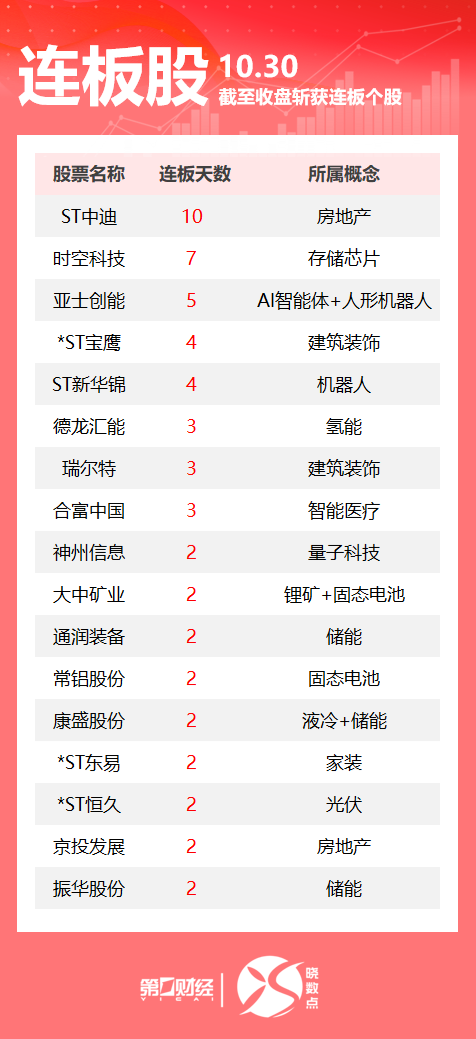
连板股追踪丨A股今日共62只个股涨停 这只存储芯片股7连板
Di Yi Cai Jing· 2025-10-30 08:35
Group 1 - The core point of the news highlights the performance of various stocks in the A-share market, with a focus on the significant gains of certain sectors, particularly the storage chip and robotics sectors [1][2]. - A total of 62 stocks reached their daily limit up on October 30, indicating a strong bullish sentiment in the market [1]. - Notable stocks include ST Zhongyou with 10 consecutive limit-ups in the real estate sector, and Shikong Technology achieving 7 consecutive limit-ups in the storage chip sector [2]. Group 2 - Yashichuangneng, a robotics concept stock, has recorded 5 consecutive limit-ups, reflecting growing investor interest in AI and humanoid robotics [2]. - Other stocks with notable consecutive limit-ups include *ST Baoying and ST Xinhua Jin, both related to construction decoration and robotics, respectively [2]. - The report also mentions several other sectors experiencing consecutive limit-ups, such as hydrogen energy, smart medical, and quantum technology, indicating a diverse range of investment opportunities [2].