
AI主题

Search documents
基金双周报:ETF市场跟踪报告-20260323
Ping An Securities· 2026-03-23 07:26
1. Report Industry Investment Rating No information about the industry investment rating is provided in the content. 2. Core Viewpoints of the Report - The performance of ETF products in the past two weeks was poor. Among domestic major broad - based ETFs, CSI A50 had the smallest decline, and among industry and theme products, new energy theme ETFs had the largest increase [2][9]. - In the past two weeks, among domestic major broad - based ETFs, the net inflow of funds into Science and Technology Innovation 50, SSE 50, CSI 500, and SSE - SZSE 300 ETFs ranked among the top [2][9]. - The net outflow of funds from major broad - based ETFs in the past two weeks slowed down. The funds of SSE - SZSE 300, SSE 50, and CSI 500 ETFs turned into net inflow, the net outflow of funds from CSI 1000/CSI 2000 and Science and Technology Innovation/ChiNext ETFs slowed down, and the net outflow of funds from A - series ETFs accelerated [10]. - In 2025, the technology theme ETF had a large cumulative net inflow of funds. Since this year, the technology and cyclical theme ETFs have had a large net inflow of funds. In the past two weeks, the inflow of funds into pharmaceutical, military, and new energy ETFs slowed down, the funds of dividend, consumption, and other large - manufacturing ETFs turned into net inflow, and the funds of cyclical, financial real - estate, and technology ETFs turned into net outflow [15]. - Since 2025, the credit bond ETF has had a large net inflow of funds, followed by the treasury bond ETF. In the past two weeks, the short - term financing ETF's funds turned into net inflow, the local government bond ETF's funds accelerated net inflow, the convertible bond ETF's funds turned into net outflow, the credit bond and treasury bond ETF's funds accelerated outflow, and the net outflow of funds from the policy - financial bond ETF slowed down [15]. - The daily average trading volume of pharmaceutical and new energy ETFs increased significantly in the past two weeks, the daily average trading volume of consumption and financial real - estate ETFs increased, and the daily average trading volume of other large - manufacturing, military, technology, and cyclical ETFs decreased [18]. - As of March 20, 20 new ETFs were newly established in the market in the past two weeks, with a total issuance share of 6715 million, all of which were stock ETFs. Compared with the end of 2025, the scale of commodity ETFs, industry + dividend ETFs, and QDII - ETFs increased by 32.78%, 13.10%, and 2.11% respectively, while the scale of bond ETFs and broad - based ETFs decreased by 12.51% and 43.21% respectively [22]. - As of March 20, Huaxia Fund had the largest on - exchange ETF scale, reaching 70.3557 billion yuan; the ETF management scale of Guotai Fund has expanded by more than 2.7 billion yuan since the beginning of this year [23]. 3. Summary According to the Directory 3.1 ETF Market Review - **Performance and Fund Flow**: As of March 20, the performance of ETF products in the past two weeks was poor. Among domestic major broad - based ETFs, CSI A50 had the smallest decline, and among industry and theme products, new energy theme ETFs had the largest increase. In the past two weeks, among domestic major broad - based ETFs, the net inflow of funds into Science and Technology Innovation 50, SSE 50, CSI 500, and SSE - SZSE 300 ETFs ranked among the top. The inflow of funds into pharmaceutical, military, and new energy ETFs slowed down, the funds of dividend, consumption, and other large - manufacturing ETFs turned into net inflow, the funds of cyclical, financial real - estate, and technology ETFs turned into net outflow. For bond ETFs, the short - term financing ETF's funds turned into net inflow, the local government bond ETF's funds accelerated net inflow, the convertible bond ETF's funds turned into net outflow, the credit bond and treasury bond ETF's funds accelerated outflow, and the net outflow of funds from the policy - financial bond ETF slowed down [2][9][15]. - **Product Structure Distribution**: As of March 20, 20 new ETFs were newly established in the market in the past two weeks, with a total issuance share of 6715 million, all of which were stock ETFs. Compared with the end of 2025, the scale of commodity ETFs, industry + dividend ETFs, and QDII - ETFs increased by 32.78%, 13.10%, and 2.11% respectively, while the scale of bond ETFs and broad - based ETFs decreased by 12.51% and 43.21% respectively [22]. - **Fund Manager Scale Distribution**: As of March 20, Huaxia Fund had the largest on - exchange ETF scale, reaching 70.3557 billion yuan; the ETF management scale of Guotai Fund has expanded by more than 2.7 billion yuan since the beginning of this year [23]. 3.2 Classification - based ETF Tracking - **Technology Theme ETF**: Products tracking the Hang Seng Technology Index had the highest net inflow of funds in the past two weeks, while products tracking the Hong Kong Stock Connect Internet Index had a net outflow of funds [29]. - **Dividend Theme ETF**: Products tracking the Dividend Low - Volatility Index had the highest net inflow of funds in the past two weeks, while products tracking the Guoxin Hong Kong Stock Connect Central Enterprise Dividend Index had a net outflow of funds [31]. - **Consumption Theme ETF**: Products tracking the S&P 500 Consumer Select Index had a relatively high premium rate; ETFs tracking the CSI Agriculture Index had the highest net inflow of funds in the past two weeks, while products tracking the CSI 800 Consumption Index had a net outflow of funds [34]. - **Pharmaceutical Theme ETF**: ETFs tracking the CSI Medical Index had the highest net inflow of funds in the past two weeks, while products tracking the medical device index had a net outflow of funds [36]. - **Large - Manufacturing Theme ETF**: Products tracking the power index had the highest net inflow of funds in the past two weeks, while products tracking the CS Battery Index had a net outflow of funds [39]. - **QDII ETF**: Products tracking the Hang Seng Technology Index had the highest net inflow of funds in the past two weeks, while ETF products tracking the Hang Seng China Enterprises Index had a net outflow of funds [42]. 3.3 Popular Theme ETF Tracking - **AI Theme ETF**: The average return of AI theme products in the past two weeks was - 2.89%, and the funds had a net outflow of 4.218 billion yuan. The products with a relatively high proportion of AI - themed stocks were those tracking the Hong Kong Stock Connect Internet, Hang Seng Internet Technology, CS Artificial Intelligence, etc. [48][53]. - **Robot Theme ETF**: The average return of robot theme products in the past two weeks was - 6.81%, and the funds had a net outflow of 488 million yuan. The products with a relatively high proportion of robot - themed stocks were those tracking the robot and robot industry [55][56]. - **New Energy Theme ETF**: The average return of new energy theme products in the past two weeks was 3.27%, and the funds had a net inflow of 1.126 billion yuan. The products with a relatively high proportion of new - energy - themed stocks were those tracking new energy batteries, CS batteries, etc. [58][59]. - **Satellite and Commercial Space Theme ETF**: The average return of satellite and commercial space theme products in the past two weeks was - 9.35%, and the funds had a net outflow of 661 million yuan. The products tracking satellite communication, satellite industry, and Guozheng Aerospace had such characteristics [60][64]. - **Commodity ETF**: The average return of commodity ETFs in the past two weeks was - 0.89%, and the funds had a net inflow of 6.011 billion yuan. Products tracking gold, non - ferrous metal futures, etc. were included. Since the beginning of this year, gold ETFs have had a large net inflow of funds, with a large net outflow on February 3 [65][70]. - **Central Huijin, Guoxin, and Chengtong Holdings ETF**: As of the middle of 2025, the scale of ETFs held by Central Huijin, Guoxin, and Chengtong was 39.1336 billion shares in total; in the past two weeks, the funds had a net outflow of 2.3474 billion yuan [73].
基金双周报:ETF市场跟踪报告-20260309
Ping An Securities· 2026-03-09 06:08
Report Industry Investment Rating - Not provided in the content Core Viewpoints of the Report - As of March 6, the performance of ETF products in the past two weeks varied. Among domestic major broad-based ETFs, CSI 2000 had the largest increase, and among industry and theme products, cyclical theme ETFs had the largest increase. In the past two weeks, among domestic major broad-based ETFs, CSI 500, CSI 1000, and SSE 300 ETFs had the highest net outflows of funds. [2][9] - In the past two weeks, the inflow of funds into pharmaceutical and military ETFs accelerated, the inflow of funds into financial real estate and technology ETFs slowed down, the funds of cyclical and new energy ETFs turned into net inflows, and the funds of dividend, consumption, and other large manufacturing ETFs turned into net outflows. In terms of bond ETFs, the net inflow of convertible bond and local bond ETFs accelerated, the funds of policy financial bond, short-term financing, and treasury bond ETFs turned into net outflows, and the net outflow of credit bond ETFs slowed down. [2] - As of March 6, two new ETFs were established in the market in the past two weeks, with a total issuance share of 1.37 billion, both being stock ETFs. Compared with the end of 2025, the scales of commodity ETFs, industry + dividend ETFs, and QDII-ETFs increased by 42.38%, 20.42%, and 3.21% respectively, while the scales of bond ETFs and broad-based ETFs decreased by 11.04% and 40.92% respectively. [2][24] Summary by Relevant Catalogs ETF Market Review 1.1 Main Types of ETF Fund Flows Overview - The performance and fund flows of different types of ETFs are detailed, including broad-based, industry, and strategy ETFs. For example, among broad-based ETFs, CSI 2000 had a 0.83% return, while SSE 50 had a -1.37% return. In terms of fund flows, SSE 300 had a net outflow of 11.315 billion yuan in the past two weeks. [8] 1.2 Main Types of ETF Cumulative Fund Flows - For broad-based ETFs, in 2025, the fund trend of major broad-based ETFs changed from outflow to inflow and then to outflow, with a significant inflow at the end of the year. In 2026, the funds of major broad-based ETFs continued to have a net outflow, with the net outflow of SSE 300, SSE 50, and A-series ETFs slowing down, and the net outflow of CSI 500, CSI 1000/CSI 2000 ETFs accelerating. [10] - For industry and theme ETFs, in 2025, the cumulative net inflow of technology theme ETFs was significantly ahead, and all industry theme ETFs except military theme ETFs had a cumulative net inflow. Since this year, technology and cyclical theme ETFs have had a significant net inflow. In the past two weeks, the inflow of funds into pharmaceutical and military ETFs accelerated, the inflow of funds into financial real estate and technology ETFs slowed down, the funds of cyclical and new energy ETFs turned into net inflows, and the funds of dividend, consumption, and other large manufacturing ETFs turned into net outflows. [15] - For bond ETFs, since 2025, the net inflow of credit bond ETFs has been significantly ahead, followed by treasury bond ETFs. In the past two weeks, the net inflow of convertible bond and local bond ETFs accelerated, the funds of policy financial bond, short-term financing, and treasury bond ETFs turned into net outflows, and the net outflow of credit bond ETFs slowed down. [15] 1.3 ETF Product Structure Distribution - Two new stock ETFs were established in the past two weeks, with a total issuance share of 1.37 billion. Compared with the end of 2025, the scales of commodity ETFs, industry + dividend ETFs, and QDII-ETFs increased, while the scales of bond ETFs and broad-based ETFs decreased. [24] 1.4 Manager Scale Distribution - As of March 6, Huaxia Fund had the largest on-exchange ETF scale of 72.9052 billion yuan, and the ETF management scale of Guotai Fund has expanded by more than 4 billion yuan since the beginning of the year. [25] Classification of ETF Tracking 2.1 Tracking of Technology Theme ETFs in the Past Two Weeks - Products tracking the Hang Seng Technology Index had the highest net inflow of funds in the past two weeks, while products tracking the CSI Media Index had a net outflow of funds. [30] 2.2 Tracking of Dividend Theme ETFs in the Past Two Weeks - Products tracking the S&P China A-Share Large Cap Dividend Low Volatility 50 Index had the highest net inflow of funds in the past two weeks, while products tracking the Dividend Index had a net outflow of funds. [32] 2.3 Tracking of Consumption Theme ETFs in the Past Two Weeks - Products tracking the China Education and S&P 500 Consumer Select Index had a relatively high premium rate. ETFs tracking the CSI Liquor Index had the highest net inflow of funds in the past two weeks, while products tracking the CSI Tourism Index had a net outflow of funds. [35] 2.4 Tracking of Pharmaceutical Theme ETFs in the Past Two Weeks - ETFs tracking the CSI Medical Index had the highest net inflow of funds in the past two weeks, while products tracking the Medical Device Index had a net outflow of funds. [37] 2.5 Tracking of Large Manufacturing Theme ETFs in the Past Two Weeks - Products tracking the Power Grid Equipment Theme had the highest net inflow of funds in the past two weeks, while products tracking the Robot Index had a net outflow of funds. [40] 2.6 Tracking of QDII ETFs in the Past Two Weeks - Products tracking the Hang Seng Technology Index had the highest net inflow of funds in the past two weeks, while ETF products tracking the Hang Seng China Enterprises Index had a net outflow of funds. [43] Tracking of Popular Theme ETFs 3.1 Tracking of AI Theme ETFs in the Past Two Weeks - AI theme products performed poorly in the past two weeks, with an average return of -5.68%. The products tracking the CS Artificial Intelligence Index had the smallest decline. The funds have been in a net inflow overall since 2025, with a significant inflow from mid-to-late February to April, a continuous outflow from May to August, a significant inflow since mid-to-late August, and a net inflow of 311 million yuan in the past two weeks. [52] 3.2 Tracking of Robot Theme ETFs in the Past Two Weeks - Robot theme products performed poorly in the past two weeks, with an average return of -6.49%. The products tracking the Robot Index had a relatively small decline. The funds have been in a rapid inflow trend since February 2025, and there was a net outflow of 3.099 billion yuan in the past two weeks. [55] 3.3 Tracking of New Energy Theme ETFs in the Past Two Weeks - New energy theme products had mixed performance in the past two weeks, with an average return of 0.27%. The products tracking the Green Power Index had the largest increase. The funds continued to flow out before August 2025, had a significant inflow from August to October, and a significant outflow since late October. There was a net outflow of 3.611 billion yuan in the past two weeks. [60] 3.4 Tracking of Satellite and Commercial Space Theme ETFs in the Past Two Weeks - Satellite and commercial space theme products performed well in the past two weeks, with an average return of 1.68%. The products tracking the Satellite Industry Index had a relatively large increase. The funds had a small inflow in late August 2025 and a significant inflow since mid-to-late December. There was a net inflow of 2.956 billion yuan in the past two weeks. [65] 3.5 Tracking of Commodity ETFs in the Past Two Weeks - Commodity ETFs performed well in the past two weeks, with an average return of 4.52%. The products tracking the Yisheng Energy Chemical A Index had the largest increase. The funds had a significant inflow in April and mid-to-late October 2025, and a net inflow of 16.894 billion yuan in the past two weeks. Since the beginning of this year, gold ETFs have had a significant net inflow, with a significant net outflow on February 3. [73] 3.6 Tracking of ETFs Held by Central Huijin, Guoxin, and Chengtong in the Past Two Weeks - As of June 30, 2025, the scale of ETFs held by Central Huijin, Guoxin, and Chengtong totaled 39.1336 billion shares. In the past two weeks, there was a net outflow of 52.658 billion yuan. The net outflows of Southern CSI 500 ETF, Southern CSI 1000 ETF, and Huatai-PineBridge SSE 300 ETF were among the highest. [76]
中东局势升级,“卖美国、买亚洲”的策略要逆转了?
华尔街见闻· 2026-03-05 09:46
Group 1 - The Middle East situation is forcing investors to reassess the most profitable stock strategies of the year, with the "sell America, buy Asia" trade facing a critical turning point [2] - The MSCI Asia-Pacific index has dropped 6% this week, while the S&P 500 index has only slightly decreased by 0.1%, indicating a global capital flow reversal from Asia back to the US [2] - The core reason for the pressure on Asian markets is their heavy reliance on oil supply from the Strait of Hormuz, raising concerns about supply disruptions impacting global economic slowdown [2][6] Group 2 - Despite a technical rebound in the Asia-Pacific market, macroeconomic pressures have not eased, with Brent crude oil rising for the fifth consecutive day [4] - Goldman Sachs estimates that a 20% increase in Brent oil prices could reduce Asian corporate profits by approximately 2% [6] - The chief economist for Natixis SA highlights that over 60% of oil imports for Japan and South Korea pass through the Strait of Hormuz, making them particularly vulnerable [6] Group 3 - The strong dollar is compressing the monetary policy space for Asian central banks, limiting their ability to implement easing measures and negatively impacting corporate profit expectations [7] - Market expectations for South Korea's central bank rate hikes have increased from about 25 basis points to approximately 50 basis points over the next 12 months [10] - Emerging market investors' overly optimistic sentiment is fading as the narrowing of monetary easing space is expected to dampen stock market sentiment [10] Group 4 - The crowded trades in Asian equities are facing significant outflow pressure, with the MSCI Asia-Pacific index having outperformed the S&P 500 by the largest margin since 2017, despite recent pullbacks [10] - The current sell-off is driven by multiple factors, not just geopolitical shocks, with markets like South Korea being particularly vulnerable due to high valuations [11] - UBS Global Wealth Management has upgraded its rating on South Korean stocks, suggesting that the recent historical pullback reflects technical positioning rather than fundamental deterioration [11]


美联储理事沃勒:加密市场乐观情绪正在消退 机构去杠杆与不确定性加剧波动
智通财经网· 2026-02-09 22:33
Core Viewpoint - The recent sell-off in the cryptocurrency market has diminished the optimism that followed Trump's election, as highlighted by Federal Reserve Governor Waller, who attributes the volatility to regulatory uncertainties and risk management adjustments by major financial institutions [1] Group 1: Cryptocurrency Market Dynamics - The cryptocurrency market is experiencing significant volatility, with Bitcoin dropping over 40% from its October peak, reaching a low of $60,033, the lowest since October 2024, and triggering the largest volatility spike since the FTX collapse in 2022 [1] - Institutional involvement, including hedge funds and ETFs, indicates that the cryptocurrency market is no longer solely retail-driven, leading to increased policy attention [1] - The funding rate for Bitcoin perpetual contracts remains in negative territory, reflecting traders' defensive positioning against downside risks, and the open interest has decreased by about 50% from its peak, indicating a lack of strong consensus in the recent rebound [1] Group 2: Options Market Sentiment - The options market shows a cautious stance, with Bitcoin implied volatility dropping from approximately 83% to around 60%, indicating reduced expectations for short-term volatility, while the skew remains tilted towards put options, reflecting high demand for downside protection [2] - The reduction in leverage is helping to stabilize prices but also suggests that many investors are choosing to take profits or cut losses at lower levels, leading to a more cautious market environment [2] - Macro uncertainties, including political changes in Japan and fluctuations in precious metal prices, are contributing to a prevailing cautious sentiment, with analysts suggesting that the market is more likely to enter a phase of consolidation rather than a rapid upward reversal [2]
大行评级丨小摩:维持三大电信运营商“增持”评级,预计中国移动受增值税调整影响最小
Ge Long Hui A P P· 2026-02-03 04:00
Core Viewpoint - Morgan Stanley's report indicates that the three major telecom operators in mainland China will adjust their value-added tax rates from 6% to 9%, which is expected to impact net profits for China Mobile, China Telecom, and China Unicom by 7.1%, 12.6%, and 11.9% respectively [1] Group 1: Tax Adjustment Impact - The tax adjustment will affect mobile data, SMS/MMS, and internet broadband services [1] - China Mobile is expected to experience the smallest impact among the three operators due to its higher gross margins [1] - The actual profit impact may be milder than estimated, as the telecom operators are undergoing state-owned enterprise reforms with financial KPIs set by authorities [1] Group 2: Mitigation Measures - Telecom operators are expected to offset the impact of the tax adjustment through various measures, including optimizing operating expenses, price increases, and controlling capital expenditures [1] Group 3: Market Performance and Dividend Yield - The stock prices of the three major telecom operators have significantly declined since the fourth quarter of last year, primarily due to capital rotation towards AI-themed stocks and concerns over slowing growth in traditional telecom services [1] - Expected dividend yields for China Mobile, China Telecom, and China Unicom in 2026 are 7%, 5.7%, and 6.8% respectively, which remain attractive compared to the Hang Seng Index [1] - The report maintains an "overweight" rating for all three telecom operators [1]



美联储开启沃什时代:简析主席提名对大类资产的影响
Ping An Securities· 2026-01-31 14:43
Core Insights - The report discusses the implications of Kevin Warsh's nomination as the next Federal Reserve Chairman, highlighting a shift in monetary policy towards a more flexible stance on interest rates and a firm commitment to balance sheet reduction [1][3][4] - Warsh's historical and recent policy positions indicate a transition from a hawkish to a more dovish approach, aligning with Trump's calls for interest rate cuts while emphasizing the need for systemic reforms within the Federal Reserve [3][5] Policy Dimensions - **Monetary Policy Stance**: Historically, Warsh held a hawkish position focused on inflation control during his tenure as a Fed governor from 2006 to 2011. Recently, he has shown a flexible attitude, supporting Trump's push for rate cuts, particularly opposing Powell's rate hikes in 2018 and endorsing cuts in 2025 [5][6] - **Balance Sheet Management**: Warsh opposes unlimited quantitative easing (QE) and advocates for reducing the Fed's balance sheet, attributing current inflation to fiscal expansion and excessive money supply. He believes that the Fed should first absorb excess liquidity through balance sheet reduction before considering interest rate cuts to effectively support the real economy [3][5] - **Independence of the Fed**: Warsh has historically supported the independence of the Federal Reserve, emphasizing the importance of adhering to its dual mandate of price stability and full employment. However, he has also called for reforms in the Fed's decision-making framework, suggesting a shift from data dependency to trend dependency [5][6] - **Financial Regulation**: Warsh has highlighted the need for disciplined regulation under market-oriented principles and supports the Trump administration's stance on easing bank regulations [5][6] Market Reactions - Following the announcement of Warsh's nomination, there was a notable tightening in liquidity across major asset classes, with commodities and U.S. equities declining, while the dollar strengthened and U.S. Treasury yields exhibited mixed performance. For instance, gold prices fell by 8.35%, the S&P 500 dropped by 0.43%, and the dollar index rose by 0.99% to 97.1 [3][4] - The report anticipates that the path for further rate cuts may face constraints, as the current Federal Open Market Committee (FOMC) composition suggests significant resistance to aggressive rate reductions. The focus will likely shift to potential reforms in the Fed's decision-making process and communication strategies [4][7] Long-term Outlook - The report projects a moderate growth outlook for the U.S. economy in 2026, which is expected to support corporate earnings and overall market performance. It suggests a rotation in market styles between AI themes and macroeconomic trends, recommending a focus on the AI sector while also considering cyclical recovery [7] - The dollar is expected to face pressures from deteriorating U.S. sovereign credit narratives and rate cut expectations, but its growth advantage over Europe may provide some support [7] - Gold prices are anticipated to remain supported by ongoing U.S. debt issues, weakening dollar credit, and increasing global central bank demand [7]
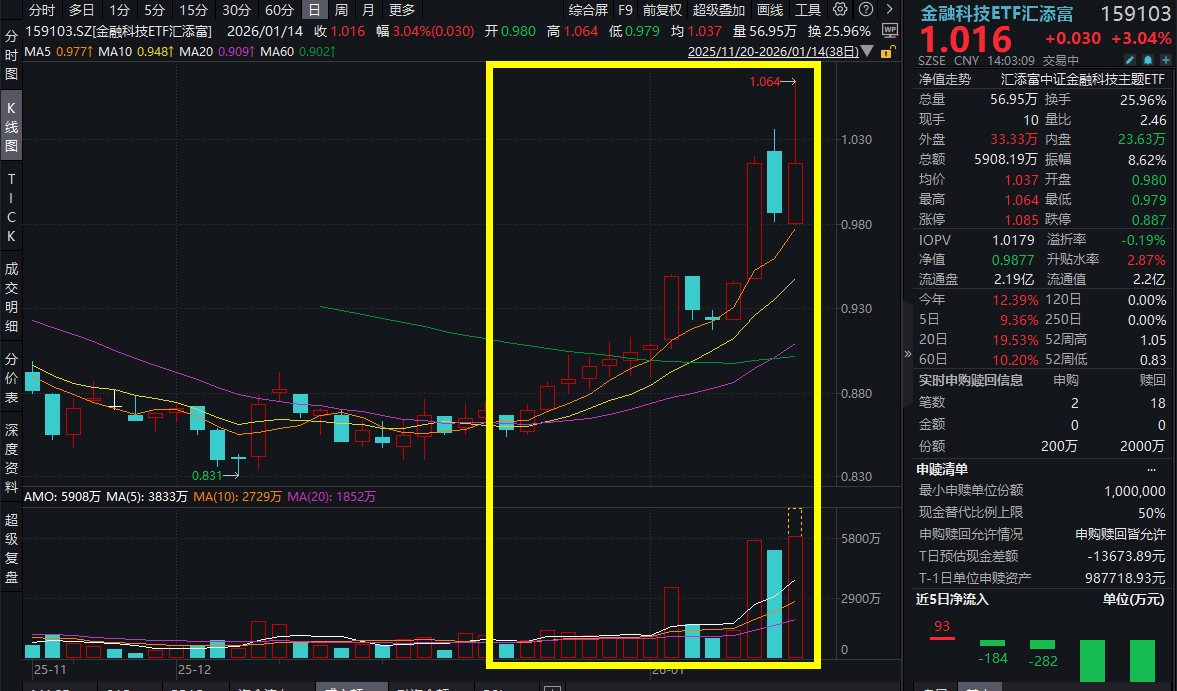
恒生电子飙涨超5%,“旗手2.0”金融科技ETF汇添富(159103)盘中涨超3%!“春季躁动”来袭,金融科技抢先爆发?
Xin Lang Cai Jing· 2026-01-14 06:42
Core Viewpoint - The A-share market experienced a brief surge followed by a decline, with the financial technology sector remaining strong, particularly highlighted by the performance of the Huatai-PineBridge Financial Technology ETF [1] Group 1: Market Performance - The A-share market saw the Shanghai Composite Index rise over 1% before turning negative, while the financial technology ETF Huatai-PineBridge (159103) surged over 3% and peaked at a 7.1% increase during early trading [1] - The trading volume in the A-share market has been robust, with total trading exceeding 30 trillion yuan for four consecutive days, indicating heightened market activity [8] Group 2: Investor Sentiment - Individual investor activity has increased significantly, with net inflows of 155.7 billion yuan, marking a 64.1 billion yuan increase from the previous period, the second-highest net inflow in nearly a year [8] - Retail investors are increasingly participating in the market through direct stock purchases and indirectly via funds and ETFs, with a shift from net outflows to net inflows in retail ETF investments [8] Group 3: Financial Technology Sector Outlook - The financial technology sector is expected to benefit from both short-term market activity and mid-term policy support, with internet brokerages likely to see significant performance improvements due to increased trading volumes [2][8] - The financial IT companies with strong positions in securities IT systems, cross-border payments, and AI financial applications are anticipated to be the core beneficiaries of the evolving market landscape [2][8] Group 4: Policy and Growth Projections - The Chinese financial technology policy framework from 2021 to 2025 aims to promote innovation and enhance risk control across various sectors, with market size projected to grow to 651.5 billion yuan by 2028 [8] - The financial technology sector is poised for growth driven by AI applications, with historical performance indicating that it has outperformed other sectors during significant AI market trends [8][11]



杰富瑞:日本股市2026年前景具有强劲吸引力
Ge Long Hui· 2025-12-12 03:51
Core Viewpoint - Japanese stock market shows strong attractiveness before 2026 due to bottom-up corporate reforms and top-down growth-promoting political leadership [1] Group 1: Market Outlook - Jefferies quantitative strategist Shrikant Kale predicts a 13% upside for the Tokyo Stock Exchange's Topix index by 2026, driven by earnings growth [1] - The Bank of Japan is expected to advance monetary policy normalization, but concerns over the U.S. economy may increase expectations for a loosening of policies by the Federal Reserve, potentially putting upward pressure on the yen [1] Group 2: Earnings and Market Trends - Despite the market's focus on AI themes, there are risks to earnings under high expectations [1]
贝莱德智库:劳动力市场降温成美联储12月降息关键推力
Sou Hu Cai Jing· 2025-12-04 15:04
Core Insights - The article highlights the challenges faced by the Federal Reserve in assessing the economic situation due to delays in data releases caused by the prolonged U.S. government shutdown [1] - The Federal Reserve is concerned about a potential further weakening of the labor market, which necessitates a "risk management" approach to interest rate cuts [1] - BlackRock believes that the U.S. labor market is currently in a state of "no hiring, no layoffs," indicating a stagnation in employment growth since the beginning of the year [1] Labor Market Analysis - Employment growth in the U.S. has slowed down, with both labor demand and supply decreasing, primarily due to a sharp decline in immigration [1] - The equilibrium level of job growth required to maintain a stable unemployment rate has decreased, which explains the steady wage growth and only a slight increase in the unemployment rate, which remains historically low [1] Interest Rate Outlook - Given the data indicating a cooling labor market, BlackRock anticipates that the Federal Reserve is likely to cut interest rates this month [1] - The combination of this backdrop and the momentum from AI themes supports a risk-on stance in the market [1]

贝莱德智库:美联储12月要降息了?劳动力市场降温成关键推力
Zhi Tong Cai Jing· 2025-12-04 13:05
Group 1 - The core viewpoint of BlackRock's research is that the U.S. labor market is cooling, leading to expectations of a Federal Reserve interest rate cut this month, supported by AI themes [1] - The market has largely priced in a 25 basis point rate cut by the Federal Reserve next week, with BlackRock agreeing that a "no hiring, no firing" stagnation will provide room for further cuts in 2026 [2] - The U.S. inflation remains significantly above the 2% target, but the Federal Reserve has clarified its rate cut path, reducing the likelihood of policy conflicts that were present earlier this year [2] Group 2 - BlackRock maintains a neutral view on UK government bonds in the short term but is more optimistic in the long term due to the lower neutral interest rate compared to other developed markets [3] - The UK government is attempting to reduce its fiscal deficit and aims for a budget surplus within five years, which has surprised the market and indicates a balance between market credibility and political trust [2] - The recent UK budget plan frontloads spending while the effects of tax increases will be delayed, leading to a neutral stance on UK bonds in the immediate term [3]