
TACO

Search documents
Trump Keeps TACOing. What If Markets Stop Caring?
Bloomberg Television· 2026-01-29 17:07
Let's talk about a couple recent moves that the president has made. We'll start with Greenland. So, we have President Trump putting Europe on edge.He says he wants to acquire Greenland. He announces new tariffs on countries that sent military personnel to Greenland. He delivers a speech in Davos where he doubles down on that.And then a couple of hours later, he meets with >> the NATO Secretary General Mark Ruda >> and and seems to walk that back at least in part. >> Basic question to you, simple question to ...

X @Bloomberg
Bloomberg· 2026-01-29 15:56
What happens when markets stop believing the president? Bloomberg Opinion’s @johnauthers and @rbrtrmstrng who coined the term, “TACO,” join host @davidgura on the Big Take podcast https://t.co/e1vy03yNRW https://t.co/mzf0YElwr7 ...
从4周到几天:华尔街读懂“TACO”,特朗普政策试探期明显缩短
华尔街见闻· 2026-01-23 09:42
Core Viewpoint - Investors on Wall Street are adapting to the rapid shifts in Trump's policy threats, with the latest Greenland tariff controversy showcasing a much quicker turnaround from threat to concession than in previous instances, indicating a deep integration of the "TACO" (Trump Always Chickens Out) mentality into market pricing mechanisms [1][4]. Group 1: Market Reactions and Policy Changes - On January 21, Trump announced a framework agreement with NATO Secretary General Jens Stoltenberg regarding Greenland, temporarily halting the planned tariffs on European countries that were set to take effect on February 1 [2]. - Following a significant market drop where over $1 trillion was lost in a single day, Trump quickly abandoned the tariff plan, highlighting the influence of market volatility on his decision-making [6][2]. - The rapid response to market pressures is changing investor behavior, with a growing belief that Trump will compromise under market stress, while also adapting to more extreme policy threats [4][5]. Group 2: Historical Context and Investor Sentiment - Investors have become accustomed to the pattern of Trump's policy announcements, typically made during market closures, which previously followed a 4 to 6-week cycle of shock, market decline, and eventual resolution [8]. - The recent Greenland incident was resolved much faster, possibly due to heightened risks for all parties involved [9]. - Concerns have been raised that the widespread expectation of TACO may weaken the market's responsiveness to economic or political shocks [10]. Group 3: Strategic Adjustments by Investors - In response to the new normal, some cross-market investors are tactically reducing positions before high-risk speeches and events, while maintaining long positions in commodities like gold that may benefit from increased uncertainty [12]. - Gold prices have continued to rise, nearing $5,000 per ounce, even after Trump's policy shift regarding Greenland [13]. - Investors are increasingly buying gold as a hedge against the risks posed by Trump's potential extreme policies, such as limiting the independence of the Federal Reserve [16].
TACO又现!“股市驯服了特朗普”
Guan Cha Zhe Wang· 2026-01-23 08:24
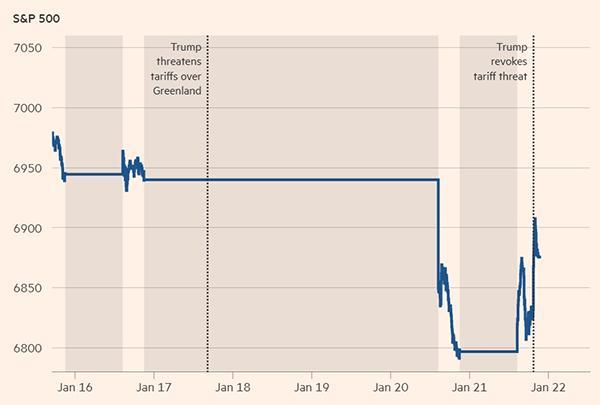
【文/观察者网 王一】"TACO又现""特朗普和TACO搅动达沃斯""2026年可能会有更多TACO"美国总统 特朗普周中突然撤回就格陵兰问题发出的关税威胁,让这个"特朗普总是退缩"的英文缩写(Trump Always Chickens Out)再次被国际媒体热议。 英国《金融时报》1月23日报道称,此次急转弯,被视为金融市场"驯服"特朗普的又一例证,凸显出即 便特朗普对美国的主要盟友态度强硬,金融市场仍具备对他施加实际约束的力量。 20日,美国股市市值蒸发逾1万亿美元,成为自特朗普去年4月抛出"解放日"关税以来最严重的一次抛 售。最初,特朗普对市场下跌不以为意,称这与过去一年股市的涨幅相比只是"小意思"。 但到了21日下午,他宣布,已与北约秘书长吕特就格陵兰岛乃至整个北极地区的未来合作框架达成了一 致,不会对英法德等欧洲8国加征原定于2月1日生效的关税。 特朗普就格陵兰问题发出关税威胁后,标普500指数变化 《金融时报》制图 "政府内部显然对股市表现高度敏感,"对冲基金曼氏集团首席市场策略师克里斯蒂娜·胡珀分析称,"这 一点在此次选择退让的决定中体现得非常明显。"Corpay首席市场策略师沙莫塔也认为,特朗 ...
Trump's tariff reversal sparked a market rally — but the violent swing in stocks is a warning of what lies ahead for investors
MarketWatch· 2026-01-22 00:46
Investors are getting accustomed to a familiar pattern known on Wall Street as 'TACO' — the assumption that the president eventually reverses policies that threaten to sink the market ...
'This is sell America' — U.S. dollar, Treasury prices tumble and gold spikes as globe flees U.S. assets
CNBC· 2026-01-20 13:51
A trader works at the New York Stock Exchange (NYSE) next to a U.S. flag, after Republican Donald Trump won the U.S. presidential election, in New York City, U.S., November 6, 2024. Andrew Kelly | ReutersStock Chart IconStock chart iconThe dollar index, 1-dayThe latest flare-up in Sell America positioning follows Trump's threats for tariffs on European countries as part of his push to take over Greenland. Representatives from the European Union gathered for an emergency meeting in response to Trump's call f ...

华尔街交易主题从“TACO”转向“Big MAC”:2026中期选举大戏开锣,特朗普政策扰动成头号风险
智通财经网· 2026-01-14 13:55
智通财经APP获悉,华尔街最爱用首字母缩写词来描述交易主题,包括FANG、FOMO/YOLO和TACO 等。现在,Ned Davis Research首席美国策略师Ed Clissold提出一个新的交易概念——"Big MAC",这是 对"中期选举大戏即将到来"(Big Midterms Are Coming)的巧妙运用。Clissold旨在捕捉他认为2026年的投 资主题:今年秋季国会选举前后政策的影响。 特朗普年初发布的一系列准政策声明——大多通过社交媒体发布,几乎没有任何立法效力——表明他专 注于改善共和党在11月大选中的政治前景。这位美国总统正着力迎合精英阶层对美国"负担能力问题"的 解读。 这对股市的影响可能非常深远。以过去一周为例,特朗普要求信用卡发行商将利率上限设定在10%,甚 至不到当前平均利率的一半,此举导致银行股暴跌。特朗普还要求军工承包商停止派发股息并将资金投 入生产,也令这些公司遭受重创。周一,在特朗普政府再次攻击美联储独立性之后,美国股市震荡。 Clissold说:"特朗普总统在中期选举前将重点放在了民众的负担能力上,这导致了一系列针对油价、抵 押贷款利率、信用卡利率和联邦基金利率的 ...
当“TACO”变成“Big MAC”,华尔街如何在政策“混乱”与中期选举前夜寻找避风港
Hua Er Jie Jian Wen· 2026-01-14 12:26
随着2026年中期选举的临近,华尔街正在转向一个被称为"Big MAC"的新交易主题——"中期选举大戏 即将上演"(Big Midterms Are Coming),以应对日益加剧的政策不确定性。 特朗普近期通过社交媒体发布了一系列密集的"准政策"声明,意在为共和党在11月的选举中争取优势。 这些举措已在市场引发震荡:银行股因被要求将信用卡利率上限设定在10%而重挫,军工承包商则因总 统要求暂停分红并投资生产而遭受打击。与此同时,行政当局对美联储独立性的持续抨击,令整个金融 界感到不安。 这种政策层面的"混乱"已被视为2026年市场的核心风险,迫使投资者在"完美定价"的市场环境中重新审 视估值逻辑。尽管大盘指数表现相对平稳,但个股和板块层面的波动性显著上升,摩根大通等机构已发 出警告,鉴于美联储面临的压力,美股近期可能表现不佳。 在距离中期选举还有42周之际,这种"推特治国"带来的不可预测性,正使得坚持传统交易策略变得愈发 艰难。市场参与者担忧,白宫可能随时引入针对其他行业的特定风险,从而打破现有的市场平衡。 "Big MAC"交易浮现 华尔街向来热衷于用首字母缩略词来概括交易逻辑。在经历了"TACO"交易( ...
芦哲:备战中选,迎接双宽——2026年度展望海外政策
Sou Hu Cai Jing· 2025-11-11 03:40
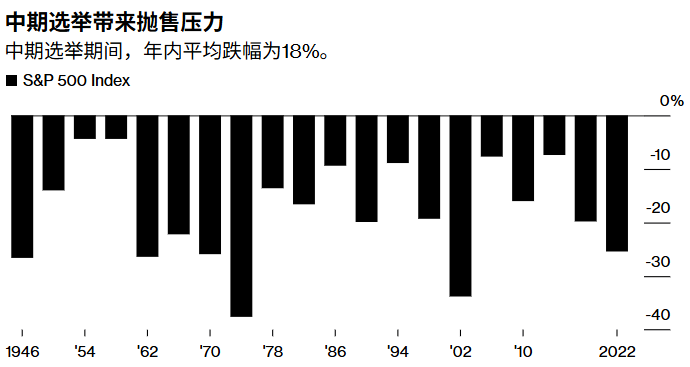
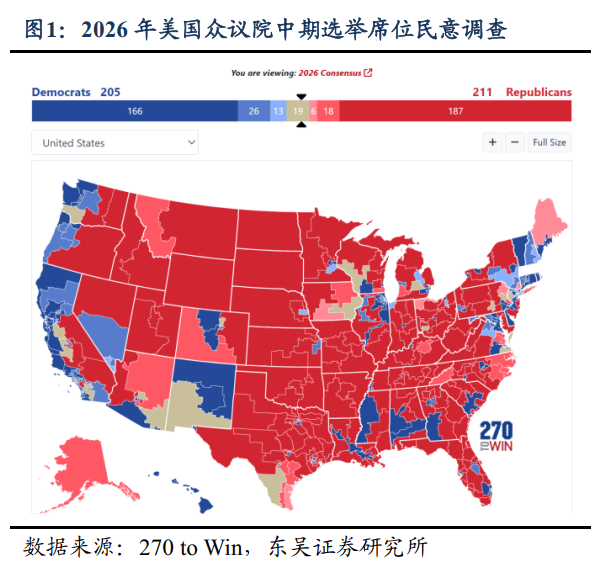
Core Viewpoint - The global market trading focus will shift from Trump's election victory to preparations for the midterm elections, with the outcome of the 2026 midterm elections directly impacting the political landscape for Trump and the Republican Party [2]. Group 1: Midterm Elections - Trump's 2026 Policy Line - The midterm elections are crucial for Trump, as they may represent the last significant electoral battle of his political career, with a high likelihood of increased political resistance if he loses [4][22]. - Historical data shows that the president's party typically loses seats in midterm elections, with an average loss of 25.7 seats in the House and 3.3 seats in the Senate over the last 20 elections [16][20]. - The significance of the midterm elections is heightened for Trump, as a defeat could severely limit his political ambitions during the final years of his presidency [21][22]. Group 2: Trade Policy - Continued Uncertainty and Conflict - Trump's trade policy is expected to remain unpredictable, with potential for renewed tariff conflicts as a means to rally voter support and shift internal political pressures outward [4][33]. - The Supreme Court's upcoming decision on Trump's use of the International Emergency Economic Powers Act (IEEPA) to impose tariffs may lead to alternative legal strategies for implementing tariffs if the ruling is unfavorable [34][38]. - The anticipated increase in tariff revenue could help alleviate fiscal pressures and support Trump's broader economic agenda leading up to the midterm elections [47]. Group 3: Monetary Policy - More Rate Cuts and Lower Credit Quality - The new Federal Reserve chair, expected to take office in May 2026, is likely to implement more aggressive rate cuts than the market anticipates, with projections of at least four rate cuts by the end of next year [5][61]. - Lower interest rates are seen as essential for stimulating economic growth and supporting stock markets, particularly in light of the negative impacts of tariffs [49][51]. - The anticipated shift in monetary policy could lead to a weaker dollar and increased credit challenges, impacting overall market sentiment [48][56]. Group 4: Fiscal Policy - Necessity and Feasibility of Expansion - There is a pressing need for expanded fiscal policies to stimulate demand and counteract the negative effects of tariffs as the midterm elections approach [66][68]. - Increased tariff revenues and reduced fiscal pressure from lower interest rates could provide the necessary funding for expanded fiscal measures without resorting to excessive borrowing [68]. - The experience from the 2018 midterm elections suggests that failure to maintain fiscal expansion could lead to adverse market reactions [68]. Group 5: Foreign Policy - Return to "America First" and Strong Geopolitical Stance - Trump's foreign policy is expected to focus on pragmatic interest exchanges, emphasizing "America First" while managing geopolitical conflicts with limited intervention [69][79]. - Efforts to mediate conflicts such as the Russia-Ukraine situation and the Middle East will continue, with a strong emphasis on leveraging economic and military pressure to achieve peace [70][73]. - The approach to foreign policy will likely involve a mix of negotiation and coercion, potentially increasing geopolitical tensions and impacting market risk appetite [79].
美元第二次尝试破100,有何不同?
Minsheng Securities· 2025-11-04 11:51
Group 1: Dollar Index Analysis - The dollar index attempted to break 100 for the second time, with the first attempt occurring at the end of July 2025, followed by a significant drop due to disappointing non-farm payroll data on August 1[3] - The current macroeconomic environment differs significantly from July, with a lack of economic data and a hawkish stance from Powell leading to a "self-driving" market[4] - In July, the British pound experienced the largest decline among G7 currencies due to ongoing economic weakness in the UK, while this time the Japanese yen is leading the decline following Japan's monetary easing policies[4] Group 2: Future Outlook - The current attempt to break 100 is expected to be more successful than in July, with potential for higher rebound points and longer duration[5] - However, the dollar is not entering a long-term appreciation cycle; it is merely experiencing a rebound[5] - Short-term market expectations are pricing in a greater than 30% probability of no interest rate cuts in December, indicating significant room for policy expectation adjustments[5] - The upcoming announcement of the Federal Reserve chair by the White House is anticipated to negatively impact the dollar[5] - Long-term, the Fed is still in a rate-cutting cycle, and ongoing U.S. debt issues alongside European fiscal measures remain critical concerns[5] - The dollar's rebound may assist in stabilizing gold and silver prices and help equity markets adjust to high valuations[5] - Risks include significant changes in U.S. trade policies and unexpected tariff expansions that could lead to a global economic slowdown[5]