政策不确定性

Search documents
清华大学田轩:超级创业者一定是特立独行离经叛道的人
Xin Lang Cai Jing· 2025-11-14 10:14
Core Insights - The sixteenth Caixin Summit highlighted the importance of embracing unconventional traits in entrepreneurs, suggesting that true innovation requires a more inclusive attitude towards those who are different [1] - From a macro perspective, the impact of policy on the market is significant, with the uncertainty surrounding policies having a greater effect than the policies themselves [1] Group 1: Entrepreneurial Traits - Super entrepreneurs possess traits that are often unappealing to the general public, indicating a need for a more accepting environment for innovation and entrepreneurship [1] Group 2: Policy Impact - The study revealed that while policies do not have a substantial direct impact, the uncertainty associated with them leads entrepreneurs to adopt a wait-and-see approach, hindering long-term investments [1] - The continuity, stability, and consistency of policies are crucial for fostering a conducive environment for business decisions [1]

美国政府停摆真相,背后深层逻辑,影响与启示
Sou Hu Cai Jing· 2025-11-12 04:20
Core Insights - The U.S. federal government shutdown is perceived as a strategic maneuver rather than a mere administrative halt, with implications for economic data and policy decisions [1][5] - The shutdown has disrupted the release of key economic indicators, leading to uncertainty in market predictions and policy formulation [2][3] Economic Impact - The shutdown resulted in the immediate closure of various departments, halting critical data collection processes, including payroll systems and employment statistics, which are essential for assessing economic trends [2][3] - Non-government sources reported significant job losses, with over 100,000 layoffs in small businesses in October, contrasting sharply with official non-farm payroll figures suggesting only 1,200 jobs added [2][3] - Inflation data, such as the Consumer Price Index (CPI), has also been delayed, complicating the Federal Reserve's potential interest rate decisions [2][3] Market Reactions - The absence of reliable data has led to increased speculation and volatility in financial markets, with investors reacting to incomplete information [3][5] - The Federal Reserve is likely to rely on alternative signals, such as market interest rates and sporadic wage data, to guide its decisions, although these indicators may introduce additional noise and uncertainty [3][5] Political Dynamics - The political stalemate in Congress has created an environment where the government may manipulate information to manage public perception and delay the release of unfavorable data [2][5] - The ongoing shutdown has resulted in a strategic delay, allowing stakeholders to reassess their positions and gather more information before making critical decisions [5]


“持币观望”情绪蔓延 英国消费者推迟支出致零售放缓
Xin Hua Cai Jing· 2025-11-11 01:50
Group 1 - The core viewpoint of the articles indicates that UK retail sales growth has significantly slowed down in October, with a year-on-year increase of only 1.6%, marking the slowest growth since May and below the average of the past 12 months [1][2] - Same-store sales, which exclude the impact of new openings, grew by 1.5% year-on-year, reflecting a cautious consumer sentiment ahead of the upcoming fiscal budget announcement [1][2] - Non-food sales have been particularly weak, with categories such as toys, electronics, and clothing showing almost no growth, which has been a major drag on overall retail performance [1] Group 2 - The British Retail Consortium highlights a clear "wait-and-see" consumer behavior, as shoppers are postponing non-essential spending in anticipation of discounts during the upcoming Black Friday sales [1][2] - Concerns have been raised by major supermarkets, including Tesco and Sainsbury's, regarding potential tax increases that could further suppress already weak consumer demand, especially in the context of high living costs [1] - The current economic environment in the UK is characterized by policy uncertainty and low consumer willingness to spend, indicating that the retail sector's future performance will heavily depend on the details of the forthcoming budget and the actual outcomes of the year-end sales season [2]
美国财政宽松叠加通胀担忧共振 时隔两周黄金重返4100美元 机构看高至5300美元
智通财经网· 2025-11-10 22:25
Group 1 - Gold prices experienced a strong rebound, rising over $100 to surpass $4,110, marking the first time since October 27 that prices reached this level, driven by expectations of fiscal stimulus and potential government actions [1] - The proposed plan by President Trump to distribute at least $2,000 to each American and hints from Treasury Secretary Mnuchin about possible tax cuts have contributed to the bullish sentiment in the market [1] - Analysts suggest that the current economic environment, characterized by rising government spending and persistent inflation, is prompting investors to hedge against inflation risks and policy uncertainties through gold [1] Group 2 - Year-to-date, gold futures have increased by approximately 57%, potentially achieving the best annual performance since 1979, driven by central bank purchases, increased inflows into gold ETFs, and strong demand for physical gold [2] - Despite some forecasts predicting a peak of $4,350 in October, many Wall Street institutions remain bullish on gold, with UBS setting a 12-month target of $4,200 per ounce, and potential for prices to reach $4,700 if political and financial risks escalate [3] - JPMorgan's private bank is even more optimistic, projecting gold prices could rise to between $5,200 and $5,300 by the end of 2026, driven by continued purchases from emerging market central banks [3]
DLS MARKETS:美银发布鹰派预测,美联储降息或需等待至2026年
Sou Hu Cai Jing· 2025-11-10 03:47
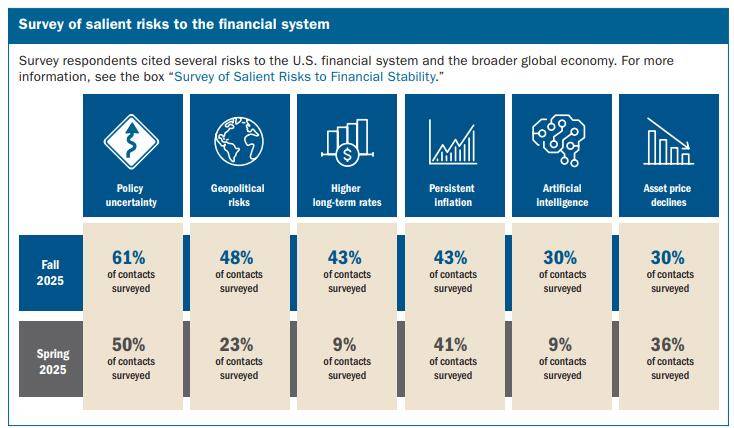
Group 1 - The core viewpoint of the reports indicates that the Federal Reserve is unlikely to lower interest rates again before the end of Chairman Powell's term in May 2026, contrasting with market expectations for a rate cut in December [2] - The delay in the release of key economic data, such as the October Consumer Price Index (CPI), due to the government shutdown, complicates decision-making for the Federal Reserve [3] - Recent statements from Federal Reserve officials reflect a more cautious approach, with a consensus that inflation has not fully returned to target levels, requiring clearer evidence for policy easing [4] Group 2 - The latest financial stability report from the Federal Reserve highlights rising concerns over "policy uncertainty" as a major risk factor, alongside high asset valuations and elevated leverage among some financial institutions [5] - The risk survey indicates that market sentiment regarding artificial intelligence-related fluctuations has gained attention, suggesting emerging technologies may impact asset price volatility [6] Group 3 - The U.S. market liquidity is under pressure due to increased Treasury bond issuance and a significant rise in the Treasury's general account balance, leading to tighter available liquidity and fluctuations in short-term interest rates [7] - Analysts warn that if liquidity pressures persist, there could be a risk of chain reactions in the short-term funding markets similar to past volatility periods [7]


国元证券晨会纪要-20251110
Guoyuan Securities2· 2025-11-10 02:24
Core Insights - The report highlights that policy uncertainty has emerged as the primary financial stability risk according to the Federal Reserve [4] - China's core CPI has expanded for six consecutive months, while PPI has seen its first month-on-month increase of the year [4] - In October, China's exports decreased by 0.8% year-on-year, while imports increased by 1.4% when measured in RMB [4] - The current account surplus for China in Q3 was reported at 1.3948 trillion yuan [4] - The Ministry of Finance is committed to continuing actions aimed at boosting consumption [4] - The People's Bank of China has increased its gold reserves for the 12th consecutive month [4] Economic Data - The Baltic Dry Index closed at 2104.00, reflecting a 1.99% increase [5] - The CME Bitcoin futures price rose by 2.91% to 104,160.00 [5] - ICE Brent crude oil closed at 63.70, up by 0.50% [5] - The London gold spot price was reported at 4000.29, an increase of 0.59% [5] - The US dollar index decreased by 0.15% to 99.55 [5] - The Hang Seng Index closed at 26,241.83, down by 0.92% [5] - The Shanghai Composite Index closed at 3997.56, reflecting a decrease of 0.25% [5]
懂王胜选一周年 “川普2.0”与“1.0”市场走势高度相似 坏消息是第二年美股走势通常最差
智通财经网· 2025-11-09 09:49
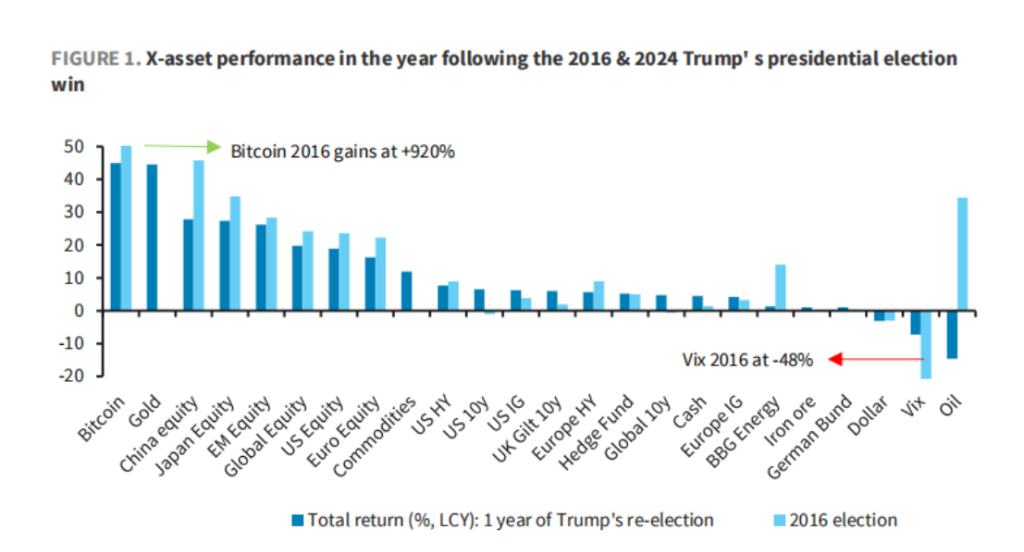
Core Viewpoint - The market performance in the first year of Trump's second term closely mirrors that of his first term, with significant increases in risk assets, particularly Bitcoin, and emerging markets outperforming the U.S. market, while the dollar weakened [1][4]. Market Performance - The past 12 months have shown similarities to 2017, with Bitcoin being the best-performing asset in both periods [4]. - Stocks have outperformed bonds during this time [5]. - Emerging markets, particularly China and Japan, have outperformed U.S. stocks, while European markets lagged [6]. - The dollar has declined in both periods [7]. Notable Differences - Gold prices have surged significantly this time, contrasting with the muted response during Trump's first term, while oil prices have dropped, reversing the trend of being one of the best-performing assets in 2016-2017 [8]. - There is a notable sector divergence this time, with technology stocks leading in the U.S., while materials, real estate, and energy sectors have declined. In Europe, financial and utility sectors performed well, but healthcare, real estate, and materials saw declines [8]. Historical Context - Historical data indicates that the second year of a presidential term is typically the worst for U.S. stocks, with the average and median returns for the S&P 500 being the lowest [13]. - The experience from Trump's first term supports this pattern, as assets that performed well in the first year, such as Bitcoin and emerging markets, saw declines in the second year, accompanied by increased market volatility [16].
降息突变,美联储重磅来袭
Zheng Quan Shi Bao· 2025-11-09 09:13
Group 1 - The core viewpoint of the article is that Bank of America predicts the Federal Open Market Committee (FOMC) will not lower interest rates again during Chairman Powell's term, which ends in May 2026, contrasting with market expectations for a rate cut in December [1][3][5] - The ongoing U.S. government shutdown has delayed the release of key economic data, including the October CPI report, creating uncertainty for the Federal Reserve and investors [1][4] - According to CME's FedWatch tool, the probability of a 25 basis point rate cut in December is 66.9%, while the probability of maintaining the current rate is 33.1% [1] Group 2 - Bank of America believes that the cautious statements made by Powell after the October rate cut indicate that the threshold for a December rate cut has been raised, requiring data to "prove" its necessity [3][4] - The report highlights that the labor market is cooling but not deteriorating sharply, providing a rationale for the Fed to pause rate cuts [4] - Recent comments from various Federal Reserve officials reflect a hawkish sentiment, with concerns about inflation and reluctance to support further rate cuts [4][5] Group 3 - Bank of America has updated its core economic forecast, predicting that the federal funds rate will remain in the range of 3.75% to 4.0% until late 2025, with potential cuts beginning in mid-2026 under a new chair [5] - The Fed's latest financial stability report warns that policy uncertainty is the primary risk facing the U.S. financial system, with 61% of surveyed market participants identifying it as a major concern [7][8] - The report also notes a significant increase in concerns about geopolitical risks and the rising perception of AI as a financial stability risk [8]
美联储报告:政策不确定性和人工智能风险影响金融稳定
Sou Hu Cai Jing· 2025-11-09 04:31
Core Insights - The Federal Reserve's latest Financial Stability Report highlights global trade, central bank independence, and geopolitical risks as significant factors affecting U.S. financial stability [1] - Concerns regarding global trade have diminished, while worries about artificial intelligence have increased [1] Group 1: Policy Uncertainty - Approximately 61% of respondents now view overall policy uncertainty as the primary factor impacting financial stability, which includes uncertainties in trade, central bank independence, and availability of economic data [1] - Central bank independence has emerged as a risk factor for the first time, influenced by political pressures, including the dismissal of a Federal Reserve governor [1] Group 2: Economic Data and AI Risks - The lack of official economic data has been highlighted as a new risk factor due to the federal government shutdown, which has interrupted the release of economic data [1] - 30% of market contacts believe that artificial intelligence could pose potential shocks within the next 12 to 18 months, with concerns centered on how the AI boom may affect recent stock market gains and lead to significant losses [1] Group 3: Other Stability Risks - Ongoing inflation, high long-term interest rates, and government debt sustainability are also noted as significant stability risks [2]
美联储报告:政策不确定性成头号金融稳定风险,央行独立性首次被点名,关注金融杠杆
Sou Hu Cai Jing· 2025-11-07 23:01
Core Viewpoint - The Federal Reserve's Financial Stability Report highlights policy uncertainty as the primary risk facing the U.S. financial system, with concerns shifting from specific trade policies to broader uncertainties, including central bank independence and the availability of economic data [1][2][3] Group 1: Policy Uncertainty - Over 61% of surveyed market participants identified policy uncertainty as the top financial stability risk, up from 50% in the spring survey [3] - The report marks the first time central bank independence has been explicitly mentioned as a risk factor, reflecting recent political pressures on the Fed [1][3] - Geopolitical risks have also gained attention, with 48% of respondents highlighting this concern, a significant increase from 23% in the previous survey [3] Group 2: Interest Rate Concerns - Concerns about rising long-term interest rates have increased, with 43% of respondents mentioning this risk, compared to just 9% in the spring survey [4] - Higher long-term rates could lead to unrealized losses for banks and impact fixed-income investors [4] Group 3: AI-Related Risks - The perception of AI-related asset valuation risks has risen sharply, with 30% of respondents viewing it as a potential shock in the next 12 to 18 months, up from 9% previously [4] Group 4: Leverage in Financial Institutions - The report emphasizes high leverage levels in non-bank financial institutions, particularly hedge funds, which have reached their highest levels since tracking began over a decade ago [7] - Hedge funds' leverage has steadily increased across various strategies, raising concerns about systemic risk [7] - Life insurance companies also exhibit high leverage, although their use of non-traditional liabilities remains limited [7] Group 5: Asset Valuation - Asset valuations are noted to be high, with stock price-to-earnings ratios nearing historical highs and corporate bond yield spreads at low levels compared to long-term averages [9] - The real estate market shows signs of vulnerability, particularly with upcoming refinancing needs in commercial real estate [9] Group 6: Debt Levels - Corporate and household debt vulnerabilities are assessed as moderate, with total debt as a percentage of GDP declining to a two-decade low [11] - While overall debt levels are manageable, certain consumer groups face repayment pressures, particularly in credit card and auto loans [11] Group 7: Financing Risks - Financing risks remain moderate, with government money market funds driving asset growth [12] - The commercial real estate market is showing signs of stabilization, but significant debt maturities in the coming year could increase volatility [12]