核心通胀

Search documents
日本央行行长植田和男:日本的核心通胀上升不仅受到疫情后经济复苏和紧缩的劳动力市场的推动,还受到供应冲击的影响,这些因素共同推升了国内价格和工资水平。
news flash· 2025-05-27 00:14
Core Insights - The Bank of Japan's Governor Kazuo Ueda stated that Japan's core inflation is rising due to a combination of post-pandemic economic recovery, a tightening labor market, and supply shocks [1] Group 1 - The increase in core inflation is influenced by the economic recovery following the pandemic [1] - A tightening labor market is contributing to the rise in domestic prices and wage levels [1] - Supply shocks are also impacting the inflationary pressures in Japan [1]
日本央行行长植田和男:鉴于基础通胀水平比几年前更接近2%,我们需要谨慎评估食品价格上涨将对核心通胀产生的影响。
news flash· 2025-05-27 00:14
Core Viewpoint - The Governor of the Bank of Japan, Kazuo Ueda, emphasizes the need for cautious evaluation of the impact of rising food prices on core inflation, as the underlying inflation level is now closer to the 2% target compared to a few years ago [1] Group 1 - The current level of underlying inflation is approaching the 2% target, indicating a shift in economic conditions [1] - The Bank of Japan is focusing on the effects of food price increases on core inflation metrics [1]
新加坡的核心通胀在今年剩余时间可能保持温和
news flash· 2025-05-23 07:42
Core Inflation Outlook - Singapore's core inflation is expected to remain moderate for the remainder of the year, according to a report by DBS Bank's senior economist Chua Han Teng [1] - The expectation reflects DBS Bank's outlook on curbing input inflation and reducing the pass-through of corporate costs to consumer prices [1] - There are anticipated downward risks to Singapore's inflation, aligning with the Monetary Authority of Singapore's moderate assessment [1] Economic Context - A slowdown in global trade may adversely affect Singapore's export-dependent economy, potentially weakening domestic labor demand and wage growth [1]
核心通胀继续“狂飙”!日本央行加息倒计时?
Jin Shi Shu Ju· 2025-05-23 02:45
Group 1 - Japan's core inflation rose at its fastest pace in over two years in April, with the core consumer price index (CPI) increasing by 3.5% year-on-year, surpassing market expectations of 3.4% and up from 3.2% in March, indicating persistent inflation above the Bank of Japan's 2% target for over three years [1][2] - The inflation rate for food accelerated from 6.2% in March to 7.0% in April, driven by significant price increases in various food items, including a 98.6% rise in rice prices and a 31% increase in chocolate prices [2] - The Bank of Japan is expected to consider another interest rate hike by October, despite market skepticism due to the impact of U.S. trade tensions, with a slight majority of economists predicting a 25 basis point increase by year-end [1][3] Group 2 - A separate inflation index, excluding fuel and fresh food, rose by 3.0% year-on-year in April, up from 2.9% in March, indicating strong underlying demand-driven price pressures [2] - Service sector inflation was more subdued at 1.3% in April, down from 1.4% in March, suggesting companies are slow to pass on rising labor costs [2] - The potential for further increases in consumer prices in May is anticipated as the effects of government measures to curb inflation wane, with ongoing global weather patterns and rice supply shortages likely to keep food prices elevated [2]
日本央行审议委员野口旭:日本央行可能会继续调整政策利率,同时谨慎评估核心通胀是否有望稳定在2%左右。
news flash· 2025-05-22 01:33
Core Viewpoint - The Bank of Japan may continue to adjust its policy interest rates while cautiously assessing whether core inflation can stabilize around 2% [1] Group 1 - The Bank of Japan is considering further adjustments to its monetary policy [1] - There is a focus on evaluating core inflation trends and their potential stability [1] - The target for core inflation is set at approximately 2% [1]
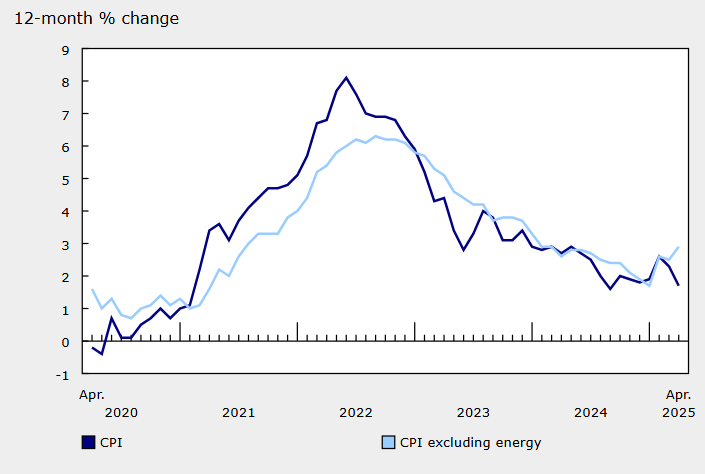
加拿大4月通胀率降至1.7%:能源价格暴跌与核心通胀隐忧并存
Xin Hua Cai Jing· 2025-05-20 13:40
Core Insights - The Consumer Price Index (CPI) in Canada decreased from 2.3% in March to 1.7% in April, slightly above market expectations of 1.6% and the Bank of Canada's forecast of 1.5% [1] - The decline in CPI was primarily driven by a significant drop in energy prices, with gasoline prices falling by 18.1% and natural gas prices by 14.1% [1][4] - Core inflation, excluding energy, rose to 2.9% from 2.5% in March, indicating persistent structural inflationary pressures [2][4] Inflation Data Overview - Year-on-year inflation rate: 1.7% (down from 2.3% in March), mainly due to a 12.7% drop in energy prices [1] - Monthly inflation rate: decreased by 0.1%, better than analysts' expectations of a 0.2% decline [1] - Core CPI median increased from 2.8% in March to 3.2%, the highest since March 2024 [3] Structural Inflation Dynamics - CPI excluding extreme values rose from 2.9% to 3.1%, reaching a 13-month high [4] - Food prices in stores increased by 3.8% year-on-year, with fresh beef (+16.2%), coffee and tea (+13.4%), and fresh vegetables (+3.7%) being significant contributors [4] - Restaurant food prices rose by 3.6%, reflecting persistent inflation in the service sector [4] Tourism and Service Prices - Travel prices increased by 6.7% year-on-year, rebounding by 3.7% month-on-month, indicating a seasonal demand recovery [5] Policy Implications - The Bank of Canada has paused its interest rate cuts, with core inflation becoming a focal point ahead of the June 4 rate decision [5] - The central bank has cut rates seven times since June 2024 and emphasized the need to act decisively to control inflation if necessary [5] - The impact of tariffs on inflation has been embedded in final prices, with ongoing monitoring of international trade policies [5]

日本央行审议委员中村豊明:食品价格上涨可能影响核心通胀水平,因此必须保持警惕。
news flash· 2025-05-16 04:07
日本央行审议委员中村豊明:食品价格上涨可能影响核心通胀水平,因此必须保持警惕。 ...
墨西哥央行:预测2025年第四季度核心通胀年均水平为3.4%,此前预测为3.3%;预计2026年第四季度核心通胀年均水平为3.0%,与此前预测持平。
news flash· 2025-05-15 19:13
墨西哥央行:预测2025年第四季度核心通胀年均水平为3.4%,此前预测为3.3%;预计2026年第四季度 核心通胀年均水平为3.0%,与此前预测持平。 ...
巨富金业:贸易局势与债务风险影响下,黄金白银技术面操作指南
Sou Hu Cai Jing· 2025-05-08 09:03
Group 1 - The geopolitical risks have eased somewhat due to the resumption of US-China trade talks and a temporary ceasefire agreement between Israel and Hamas, but ongoing conflicts such as the Russia-Ukraine war and military confrontations in the Middle East continue to support gold as a safe-haven asset [2] - The Federal Reserve has maintained interest rates, and Powell indicated that there is still a lot of uncertainty, which has cooled expectations for a rate cut in June, leading to a rebound in the US dollar index that has somewhat suppressed the attractiveness of gold priced in dollars [2] - The US national debt has surpassed $36 trillion, and Trump's tariff policies may push core inflation to 3%, which supports gold's anti-inflation properties and keeps long-term funds interested in gold, providing support for gold prices in the Asian market [2] Group 2 - The spot gold price opened at $3366.20 per ounce in the Asian market, initially rising to a high of $3414.79 before a significant drop to a low of $3320.35, indicating weakened bullish momentum [5] - On the hourly chart, gold has broken below the recent trading range, indicating a bearish direction, with strong downward momentum observed on the 15-minute chart suggesting potential for new lows [5] - The trading strategy for today suggests short positions on rallies with a take-profit target at $3310.00 and a stop-loss based on the 15-minute moving average [5] Group 3 - Silver opened at $32.365, showing a similar pattern of initial gains followed by a decline, with only short-term trading opportunities available on the 5-minute chart [7] - The price has fallen below the 20-period moving average, indicating further weakening of bullish momentum and a bearish outlook [7] - The trading strategy for silver suggests short positions on rallies with a stop-loss based on the moving average and a take-profit target at $32.000 [7]