汽车出口

Search documents
【周度分析】车市扫描(2025年12月8日-12月14日)
乘联分会· 2025-12-17 08:38
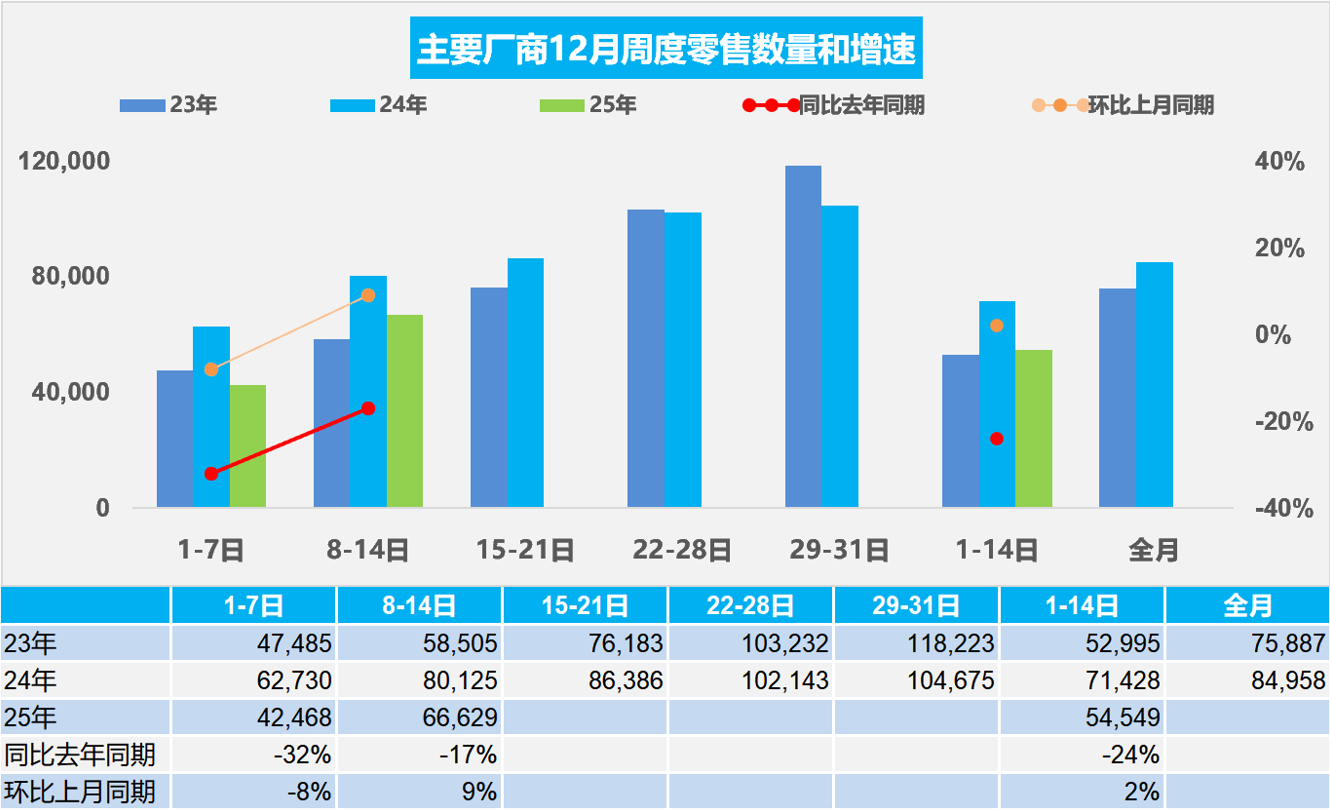
Group 1: Market Overview - From December 1 to 14, the national retail sales of passenger cars reached 764,000 units, a year-on-year decrease of 24%, but a month-on-month increase of 2%. Cumulative retail sales for the year reached 22.247 million units, a year-on-year increase of 5% [2][5] - During the same period, wholesale sales of passenger cars were 734,000 units, down 31% year-on-year and down 15% month-on-month. Cumulative wholesale sales for the year reached 27.499 million units, a year-on-year increase of 9% [2][9] - The retail penetration rate of new energy vehicles (NEVs) in the passenger car market reached 62.3% in the first two weeks of December, with retail sales of NEVs at 476,000 units, a year-on-year decrease of 4% [2][6] Group 2: Production and Sales Trends - In the first two weeks of December, production of pure fuel light vehicles was 457,000 units, down 24% year-on-year, while production of hybrid and plug-in hybrid vehicles was 275,000 units, down 14% year-on-year [3] - The average daily retail sales in the first week of December were 42,000 units, down 32% year-on-year, while in the second week, it increased to 67,000 units, down 17% year-on-year [5][6] - The production of passenger cars in November was 3.52 million units, a year-on-year increase of 2%, with NEVs accounting for 1.84 million units, a year-on-year increase of 17% [11] Group 3: Economic and Policy Impact - The macroeconomic environment remains stable, but the tightening of trade-in and scrapping subsidy policies has led to a decline in retail sales in November [6][10] - The expectation of a strong year-end sales push is influenced by the expiration of tax exemptions for NEVs, prompting consumers to purchase vehicles before the end of the year [6][10] - The government is expected to announce new trade-in policies for 2026, which could stimulate demand and support sales in early 2026 [7] Group 4: Industry Challenges and Compliance - The automotive industry faces intensified competition and price disorder, with 52.6% of dealers reporting losses and 74.4% experiencing price discrepancies [12] - The introduction of the "Automotive Industry Price Behavior Compliance Guidelines" aims to stabilize the market and protect the interests of dealers and suppliers [12][13] - The industry is encouraged to adopt measures to reduce price wars and ensure fair competition, which is crucial for the sustainability of dealerships [12][13] Group 5: Pickup Truck Market Analysis - In November 2025, the pickup truck market saw sales of 56,000 units, a year-on-year increase of 18.8%, with a cumulative sales of 537,000 units for the year, up 12.1% [14][15] - The export of pickups reached 32,000 units in November, a year-on-year increase of 54%, with exports accounting for 57% of total sales in November [14][15] - The market for new energy pickups is growing rapidly, with sales increasing by 152% year-on-year in November [15]


乘联分会:12月前两周全国乘用车新能源市场零售47.6万辆 同比下降4%
智通财经网· 2025-12-17 08:15
Group 1: New Energy Vehicle Market Performance - From December 1 to December 14, the retail sales of new energy vehicles in the passenger car market reached 476,000 units, a year-on-year decrease of 4%, but a month-on-month increase of 1% [1] - Cumulative retail sales for the year reached 11.948 million units, representing an 18% year-on-year growth, with a penetration rate of 62.3% in the new energy segment [1] - Wholesale figures for new energy vehicles during the same period were 457,000 units, down 15% year-on-year and 14% month-on-month, with a cumulative wholesale of 14.213 million units for the year, up 26% [1] Group 2: Overall Passenger Car Market Trends - Total retail sales of passenger cars from December 1 to December 14 were 764,000 units, down 24% year-on-year but up 2% month-on-month, with cumulative retail sales for the year at 22.247 million units, a 5% increase [4][5] - Wholesale sales for the same period were 734,000 units, a 31% year-on-year decline and a 15% month-on-month decrease, with cumulative wholesale for the year at 27.499 million units, up 9% [9] Group 3: Market Dynamics and Consumer Behavior - The market is experiencing a cautious sentiment among dealers due to tightened trade-in and scrapping subsidy policies, leading to a negative growth in retail sales in November [5] - The end of the year is marked by a strong urgency among consumers to purchase vehicles due to the impending expiration of tax exemptions for new energy vehicles [5] - The expectation of a new trade-in policy for 2026 could stimulate demand, but the current retail growth is considered weak compared to the previous year [4][5] Group 4: Production and Export Trends - In the first two weeks of December, production of pure fuel light vehicles was 457,000 units, down 24% year-on-year, while production of hybrid and plug-in hybrid vehicles was 275,000 units, down 14% year-on-year [1] - The export market for Chinese vehicles has shown positive trends, particularly in the new energy segment, with significant growth in overseas markets [10] - The overall production of vehicles in November was 3.52 million units, with new energy vehicle production at 1.84 million units, reflecting a 17% year-on-year increase [11]

16家车企仅四成有望达成全年销量目标,新能源汽车与出口成关键因素
Xin Lang Cai Jing· 2025-12-17 03:49
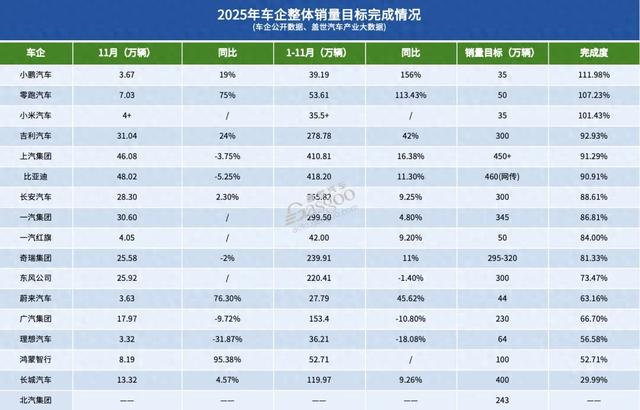
Core Viewpoint - As the end of the year approaches, major automotive companies are reporting their sales for November, allowing for predictions on whether they will meet their sales targets for 2025. The total sales targets set by these companies exceed the overall market forecast, indicating that some may not achieve their goals due to intensified competition and fluctuating pricing dynamics [1][3]. Group 1: Sales Performance of Key Companies - Three companies, Leap Motor, Xiaomi Auto, and Xpeng Motors, have already met their 2025 sales targets ahead of schedule, showcasing strong performance in a competitive market [3][4]. - Leap Motor achieved a cumulative sales volume of 536,000 units from January to November, exceeding its target by 7.23% [4]. - Xiaomi Auto delivered over 355,000 units in the same period, surpassing its target of 350,000 units, despite facing production and delivery challenges [5]. - Xpeng Motors reported cumulative deliveries of 392,000 units, achieving a year-on-year growth rate of 156% and exceeding its target of 350,000 units [5][6]. Group 2: Overall Market Trends - The overall automotive market is experiencing pressure on traditional fuel vehicle sales, while the growth of new energy vehicles continues to outpace the market, driving structural transformation in the industry [3][6]. - Major companies like BYD, SAIC, Geely, Changan, and FAW have completion rates above 80%, indicating a relatively stable performance [7][10]. - However, companies with higher sales targets face significant challenges in the final month, needing to sell tens of thousands of vehicles to meet their goals [8][12]. Group 3: Challenges Faced by Other Companies - Companies such as NIO, Great Wall Motors, and Dongfeng have completion rates below 70%, making it unlikely for them to meet their annual targets [14][17]. - NIO, for instance, has a target of 440,000 units but has only delivered about 280,000 units, requiring a significant increase in December sales [14]. - The challenges faced by these companies include overly ambitious targets, lack of competitive new products, and insufficient progress in their new energy segments [14][17]. Group 4: Factors Contributing to Success - Successful companies share common traits, including realistic target setting, clear growth engines, and robust systemic capabilities that enhance their resilience during the year-end push [13][17]. - For example, Geely's Galaxy series has significantly contributed to its sales, while BYD benefits from a comprehensive product matrix supported by its entire supply chain [11][13].





中银国际:汽车行业明年稳内需基调明确 出口增长或胜预期
Zhi Tong Cai Jing· 2025-12-16 06:43
中银国际表示,11月乘用车出口同比增48.7%至62.4万辆,明显胜于预期。该行预计,明年将延续强劲 的出口增长趋势,并可能胜于预期。另外,注意到部分投资者忧虑关税等贸易或非贸易壁垒对明年中国 乘用车出口的潜在不利影响,该行认为,去年第四季至今年上半年整体出口放缓确实受到欧盟反补贴关 税等贸易保护主义蔓延及重点市场需求下滑的干扰,但中国品牌迅速对出口车型、区域、方式等进行适 应性调整,带动乘用车出口量自年中起重回快速增长轨道,这也充分体现了中国车企出海能力的全面提 升与多元出口市场的需求韧性。 中银国际发布研报称,11月乘用车批发量同比及环比均小幅增长,但终端零售延续10月以来的下降趋 势,库存进一步攀升。该行考虑到去年基数效应和两新政策进一步收紧,预计12月零售同比跌幅或进一 步扩大。但认为因政策扰动导致第四季的零售终端数据"异常"降温并不能反映当前国内消费者真实的购 车意愿与购车需求。该行相信,如果"两新"政策优化尽快落地,年底缺乏"翘尾"效应或将有利于明年车 市实现开门红。此外,考虑到明年内需主导基调明确,认为市场对明年汽车消费政策不宜过度悲观。 该行预计,今年全年乘用车销量预计将同比增长10%,首次突 ...
11月国内乘用车销量同比下滑,一汽大众重回第三
3 6 Ke· 2025-12-15 04:14
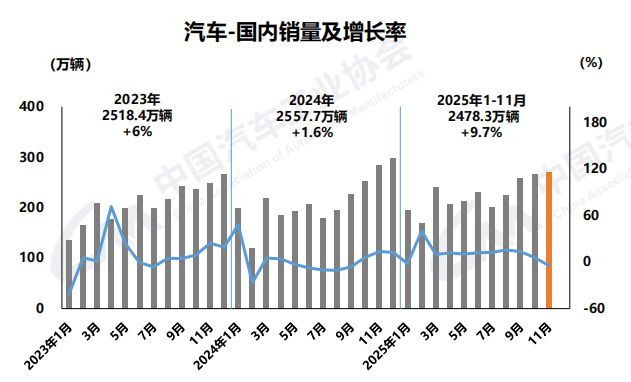
作为汽车市场年底冲刺销量的关键期,今年11月的国内乘用车销量同比下滑。 不过,在12月5日的股东大会上,比亚迪集团董事长王传福对比亚迪销量表现进行回应。他称:"今年比 亚迪国内市场销量出现下滑,一方面由于比亚迪当前技术领先度不及前几年,技术成果的市场惊艳度有 所下降,叠加行业同质化特征渐显,这一变化符合产品及技术发展的周期性规律。另一方面,低温充电 速度慢等用户需求痛点,也亟待通过技术突破予以解决。" 12月11日,中国汽车工业协会(下称"中汽协")发布最新一期的汽车工业产销情况,今年11月,乘用车 国内销量241.4万辆,环比增长1%,同比下降6.5%。作为参考,去年同期,乘用车国内销量环比增长 12.8%、同比增长17.5%;2023年11月该数据亦录得同、环比双增。 此外,根据此前乘联会披露的数据,今年11月,国内狭义乘用车市场零售销量达222.5万辆,同比下降 8.1%,环比下降1.1%。 乘联会秘书长崔东树指出:"今年国内车市零售累计增速从1-2月增长1.2%,3-6月增长15%,7-9月增速 徘徊在6%左右,10-11月回落到偏低状态,呈现4季度高基数的减速特征,基本符合年初判断的'前低中 高后平 ...

11月国内乘用车销量同比下滑,一汽大众重回第三
凤凰网财经· 2025-12-13 13:05
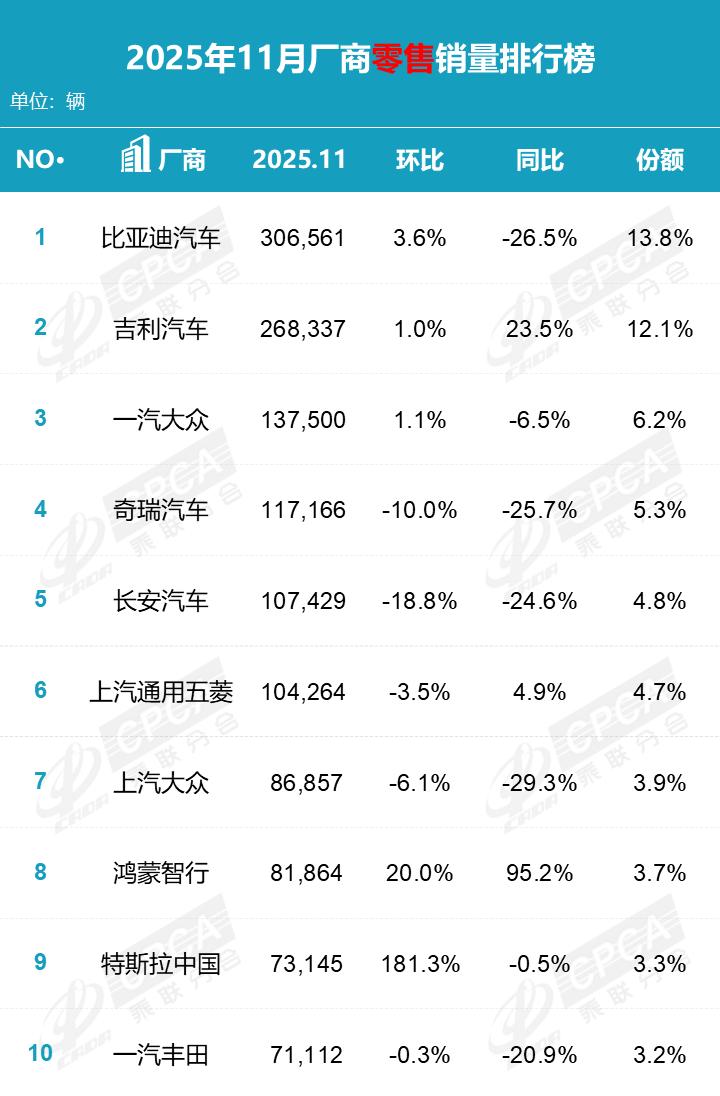
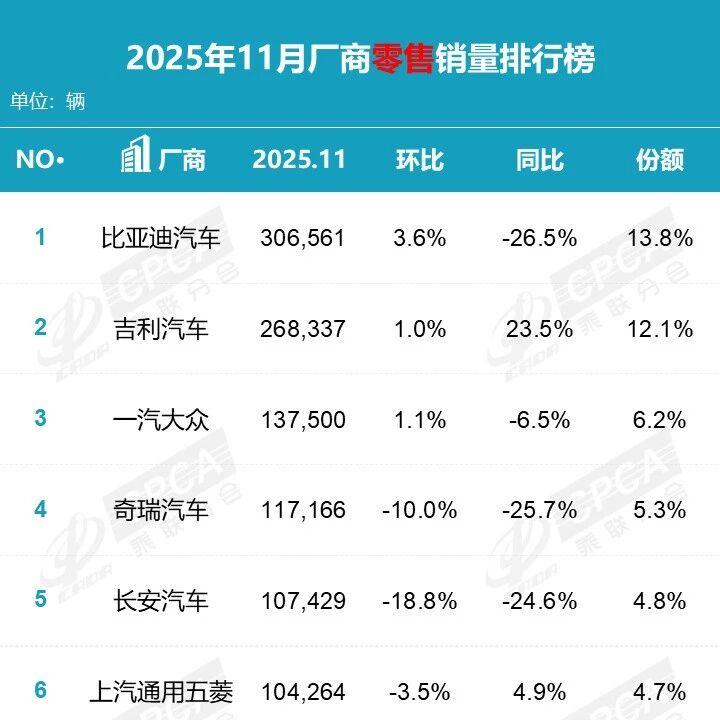
Core Viewpoint - The domestic passenger car sales in China experienced a decline in November, with a year-on-year decrease of 6.5%, indicating a slowdown in the market during a critical sales period [2][3]. Group 1: Sales Performance - In November, the domestic passenger car sales reached 2.414 million units, showing a month-on-month increase of 1% but a year-on-year decline of 6.5% [2]. - The retail sales in the narrow passenger car market were 2.225 million units, reflecting a year-on-year decrease of 8.1% and a month-on-month decrease of 1.1% [3]. - The overall sales decline is attributed to factors such as policy withdrawal, reduced stimulus effects, and increased comparison bases [4]. Group 2: Manufacturer Rankings - BYD maintained the top position in retail sales with 306,600 units in November, a month-on-month increase of 3.6% but a year-on-year decline of 26.5% [5]. - Geely Automotive ranked second with sales of 268,300 units, showing a year-on-year increase of 23.5% and a month-on-month increase of 1% [5]. - FAW-Volkswagen returned to the top three with sales of 137,500 units, surpassing Chery [7]. Group 3: Export Growth - November marked a historic milestone with total automobile exports exceeding 700,000 units, reaching 728,000 units, a month-on-month increase of 9.3% and a year-on-year increase of 48.5% [9]. - Passenger car exports were 624,000 units, with a year-on-year growth of 48.7%, indicating a strong performance in overseas markets [9]. - The export of new energy vehicles reached 300,000 units, representing a year-on-year increase of 2.6 times, highlighting the growing acceptance of Chinese electric vehicles in international markets [10]. Group 4: Future Outlook - The automotive industry anticipates challenges in 2026 due to the upcoming reduction of new energy vehicle purchase tax, which may pressure market growth [11]. - Despite short-term caution regarding domestic demand and price competition, long-term growth is expected to be driven by continuous technological innovation and global expansion [11].

11月汽车出口创单月新高 “两新”政策优化将利好2026年车市
Zhong Guo Jing Ying Bao· 2025-12-12 17:28
Core Insights - In November, China's total automobile sales reached 3.429 million units, a year-on-year increase of 3.4% [1] - Exports accounted for 728,000 units, with a month-on-month increase of 9.3% and a year-on-year increase of 48.5%, marking the first time monthly exports exceeded 700,000 units [1] - Domestic sales, however, saw a decline of 4.4% year-on-year, totaling 2.701 million units [1] Export Market Performance - The export market is experiencing significant growth, primarily driven by new energy vehicles (NEVs) [2] - In November, traditional fuel vehicle exports were 427,000 units, with a month-on-month increase of 4.3% and a year-on-year increase of 5% [2] - NEV exports reached 300,000 units, with a month-on-month increase of 17.3% and a year-on-year increase of 260% [2] - Cumulatively, from January to November, total automobile exports were 6.343 million units, a year-on-year increase of 18.7% [2] NEV Export Growth - In November, pure electric vehicle exports were 177,000 units, with a month-on-month increase of 6.5% and a year-on-year increase of 200% [3] - Plug-in hybrid vehicle exports were 124,000 units, with a month-on-month increase of 37.3% and a year-on-year increase of 400% [3] - Cumulatively, pure electric vehicle exports from January to November reached 1.473 million units, a year-on-year increase of 64.6% [3] Domestic Market Outlook - Despite the decline in domestic sales in November, the overall market performance for the year remains strong [4] - From January to November, automobile production and sales reached 31.231 million and 31.127 million units, respectively, with year-on-year growth of 11.9% and 11.4% [4] - The automotive industry is expected to achieve record production and sales for the year, supported by policy measures and improved market conditions [4] Future Projections - The automotive export market is anticipated to be a significant highlight in the 2025 automotive landscape, with expectations of exports surpassing 7 million units [3] - Upcoming policies aimed at boosting consumer confidence and stabilizing market expectations are expected to positively impact the automotive sector in 2026 [5] - The end of the year may see increased urgency among consumers to purchase NEVs due to the impending expiration of tax exemptions, potentially driving sales further [5]
中国汽车出口单月首破70万辆,全年朝700万辆出口冲刺
Xin Jing Bao· 2025-12-12 10:17
Core Insights - The Chinese automotive market continues to show steady growth, with November production exceeding 3.5 million vehicles for the first time, setting a historical record [1][2] - For the first eleven months of the year, both production and sales surpassed 31 million units, with year-on-year growth rates exceeding 10% [1][2] - The export of vehicles in November reached 728,000 units, marking a significant year-on-year increase of 48.5%, also a historical high [1][4] Production and Sales Performance - In November, automotive production and sales were 3.532 million and 3.429 million units, reflecting year-on-year growth of 2.8% and 3.4% respectively [2] - For the first eleven months, production totaled 31.231 million units, with a year-on-year increase of 11.9%, while sales reached 31.127 million units, growing by 11.4% [2] - Passenger vehicle production and sales for the same period were 27.388 million and 27.256 million units, with year-on-year growth of 12% and 11.5% respectively [2] Market Segmentation - Traditional fuel passenger vehicle sales declined by 1.1% year-on-year in the first eleven months, ending a previous growth trend [2] - Chinese brand passenger vehicles maintained a high market share, with a year-on-year sales increase of 19.4% and a market share of 69.6% [2] - In November, the market share of Chinese brands reached 71.4%, consistently around 70% throughout the year [2] Commercial Vehicle Market - The commercial vehicle sector also showed positive growth, with production and sales of 3.843 million and 3.87 million units respectively, reflecting year-on-year increases of 11.6% and 10.4% [3] - November saw commercial vehicle sales of 392,000 units, a year-on-year increase of 24.4% [3] - The domestic market for commercial vehicles is recovering rapidly, with significant growth in exports [3] Electric Vehicle Trends - New energy vehicles (NEVs) continue to experience rapid growth, with November sales accounting for 53.2% of total new vehicle sales [4] - For the first eleven months, NEV production and sales reached 14.907 million and 14.78 million units, with year-on-year growth of 31.4% and 31.2% respectively [4] - NEV exports also surged, with 2.315 million units exported in the first eleven months, a year-on-year increase of 100% [4] Export Performance - Overall vehicle exports for the first eleven months reached 6.343 million units, growing by 18.7% year-on-year [4] - November exports alone were 728,000 units, marking a historical high and a year-on-year increase of 48.5% [4] - Passenger vehicle exports in November grew by 48.7%, maintaining over 20% growth for six consecutive months [4]
两个“历史首次”!前11个月我国汽车产销量双超3100万辆
Mei Ri Jing Ji Xin Wen· 2025-12-12 02:42
Core Viewpoint - The Chinese automotive market is experiencing an unexpected downturn in November 2023, marking the first year-on-year decline in domestic sales for that month since 2023, with a total of approximately 2.701 million vehicles sold, a decrease of 4.4% compared to the previous year [1][3]. Group 1: Domestic Market Performance - In November 2023, domestic automotive sales reached approximately 2.701 million units, reflecting a year-on-year decline of 4.4%, which is the first negative growth in November since 2023 [1][3]. - Despite the downturn in November, the overall performance from January to November remains strong, with production and sales reaching 31.231 million and 31.127 million units respectively, representing year-on-year growth of 11.9% and 11.4% [3][4]. - The decline in November sales is attributed to the withdrawal of subsidy policies, leading consumers to wait for new policies in the upcoming year [3]. Group 2: Export Performance - In November 2023, China's automotive production reached 3.532 million units, a historical high, with a year-on-year increase of 2.8% [4]. - Automotive exports in November totaled 728,000 units, marking a year-on-year increase of 48.5%, and this is the first time exports exceeded 700,000 units in a month [4][6]. - For the first eleven months of 2023, total automotive exports reached 6.343 million units, an increase of 18.7% year-on-year, with traditional fuel vehicle exports declining by 4.1% to 4.029 million units, while new energy vehicle exports surged by 102.9% to 2.315 million units [6][7]. Group 3: New Energy Vehicles (NEVs) - In November 2023, sales of new energy vehicles reached 1.823 million units, a year-on-year increase of 20.6%, accounting for 53.2% of total new vehicle sales [7][8]. - From January to November, new energy vehicle sales totaled 14.78 million units, reflecting a year-on-year growth of 31.2%, with a market penetration rate of 47.5% [7][9]. - The market penetration of new energy vehicles is expected to exceed 50% by 2025, with projections indicating a potential 70% penetration by 2030 [11].

两个“历史首次”!前11个月我国汽车产销量双超3100万辆,今年出口规模有望蝉联全球第一
Mei Ri Jing Ji Xin Wen· 2025-12-12 00:57
Core Viewpoint - The Chinese automotive market is experiencing an unexpected downturn in November 2023, with domestic sales declining for the first time in the month since 2023, attributed to the withdrawal of subsidy policies and consumer anticipation for new policies in 2024 [1][3]. Group 1: Domestic Sales Performance - In November 2023, domestic automotive sales reached approximately 2.701 million units, a year-on-year decrease of 4.4% [1]. - Despite the November decline, the overall performance from January to November remains strong, with production and sales reaching 31.231 million and 31.127 million units respectively, reflecting year-on-year growth of 11.9% and 11.4% [3]. - The sales of traditional fuel vehicles showed signs of recovery, with domestic sales of approximately 12.318 million units from January to November, a slight decline of 1.2% compared to the previous year [10]. Group 2: Export Performance - In November 2023, automotive exports reached 728,000 units, marking a year-on-year increase of 48.5%, and this is the first time exports exceeded 700,000 units in a month [4][6]. - The total automotive exports for the first 11 months of 2023 amounted to 6.343 million units, a year-on-year increase of 18.7%, with traditional fuel vehicle exports at 4.029 million units (down 4.1%) and new energy vehicle exports at 2.315 million units (up 102.9%) [8]. - The monthly average export volume of new energy vehicles has doubled from approximately 10,000 units last year to about 20,000 units this year [6]. Group 3: New Energy Vehicle Market - In November 2023, new energy vehicle sales reached 1.823 million units, representing a year-on-year increase of 20.6%, and accounted for 53.2% of total new vehicle sales [9]. - From January to November 2023, new energy vehicle sales totaled 14.78 million units, reflecting a year-on-year growth of 31.2% [9]. - The market penetration rate of new energy vehicles is expected to exceed 50% by 2025, with projections indicating a potential penetration rate of 70% by 2030 [12].