
内需升级

Search documents
从春节消费图景看内需升级亮点
2 1 Shi Ji Jing Ji Bao Dao· 2026-02-25 23:23
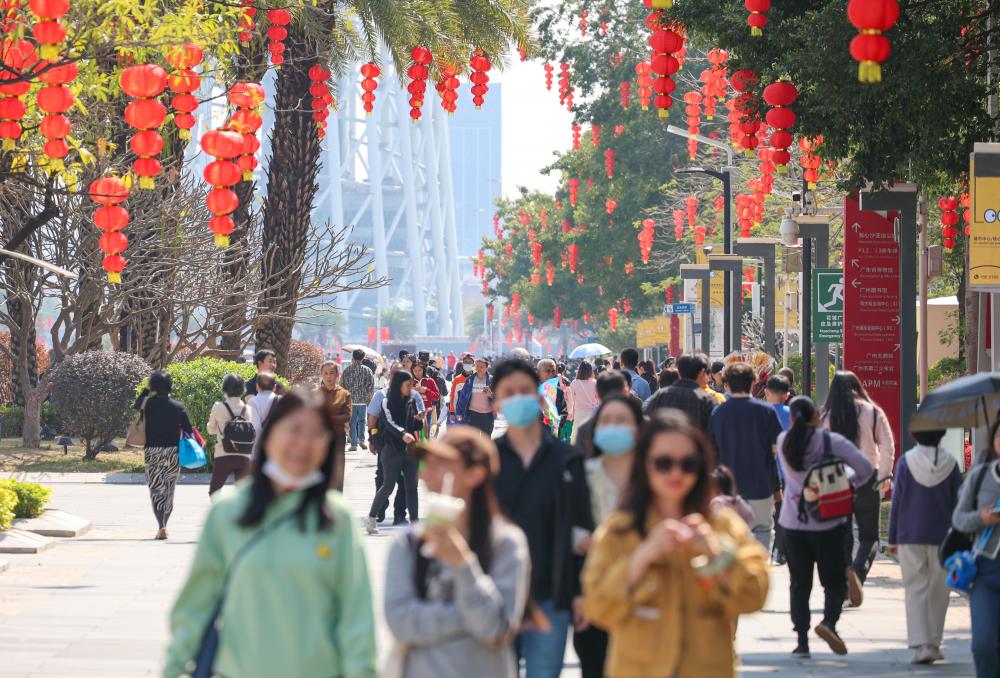
Core Insights - The 2026 Spring Festival holiday marked a significant increase in domestic travel and spending, with 596 million trips taken and total expenditures reaching 803.48 billion yuan, both setting historical records [1] Travel Pattern Changes - The Spring Festival saw a shift from traditional homecoming to segmented vacations, driven by factors such as a longer holiday, favorable weather, and supportive policies [3] - The peak travel day recorded 320 million trips, a 9.7% increase from the previous year, indicating a preference for "reunion first, then travel" [3] - The demand for self-driving trips surged, particularly for new energy vehicles, reflecting advancements in charging infrastructure [3] Technological Innovations - The Spring Festival showcased significant technological advancements, particularly in robotics and AI, with major companies presenting innovative products during the festival [4] - The global shipment of humanoid robots is projected to grow by 508% in 2025, with Chinese manufacturers leading the market due to a robust supply chain [4] - AI models have gained substantial traction, with domestic models significantly influencing global trends and user engagement [4] Supply and Demand Matching - Despite high travel numbers, the film box office underperformed, generating 5.752 billion yuan, highlighting a mismatch in supply quality and consumer demand [5] - The lack of blockbuster films indicates that improving content quality is essential for converting potential demand into actual consumption [5] - The promotion of flexible holiday systems, such as spring and autumn breaks, could enhance consumer spending opportunities and address the imbalance in consumption experiences [5]

21评论丨从春节消费图景看内需升级亮点
2 1 Shi Ji Jing Ji Bao Dao· 2026-02-25 23:04
Core Insights - The 2026 Spring Festival holiday marked a significant increase in domestic travel and spending, with 596 million trips taken and total expenditures reaching 803.48 billion yuan, both setting historical records [1] Travel Patterns - The travel pattern shifted towards a segmented vacation model, with a notable "second peak" in travel after the second day of the Lunar New Year, indicating a change in consumer behavior [2] - The average number of travel days per user increased to 5.9 days, reflecting a growing preference for extended travel experiences [2] - The surge in bookings for new energy vehicles, which increased sixfold, highlights advancements in charging infrastructure and evolving consumer preferences [2] Technological Innovations - The Spring Festival showcased significant technological advancements, particularly in robotics, with companies like Yushutech and Galaxy General demonstrating innovative capabilities during the Spring Festival Gala [3] - The release of several AI models around the holiday period indicates a growing influence of domestic AI technologies, with substantial increases in usage and demand for these models [4] - The integration of AI and robotics into consumer experiences suggests a shift in the technology landscape, providing new growth opportunities for domestic consumption [4] Supply and Demand Dynamics - Despite high travel numbers, the film box office underperformed, generating 5.752 billion yuan, attributed to a lack of blockbuster films, emphasizing the importance of quality content in meeting consumer demand [5] - The disparity between high travel demand and lower film revenues suggests that enhancing supply quality and innovation is crucial for converting potential demand into actual consumption [5] - The promotion of flexible holiday arrangements, such as spring and autumn breaks, could alleviate congestion and improve consumer experiences, thereby enhancing overall spending [5]
这些消费股获机构密集调研且融资资金大幅加仓(名单)
Zheng Quan Shi Bao Wang· 2025-12-23 01:20
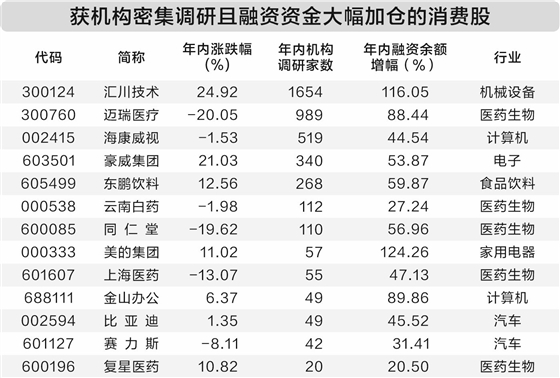
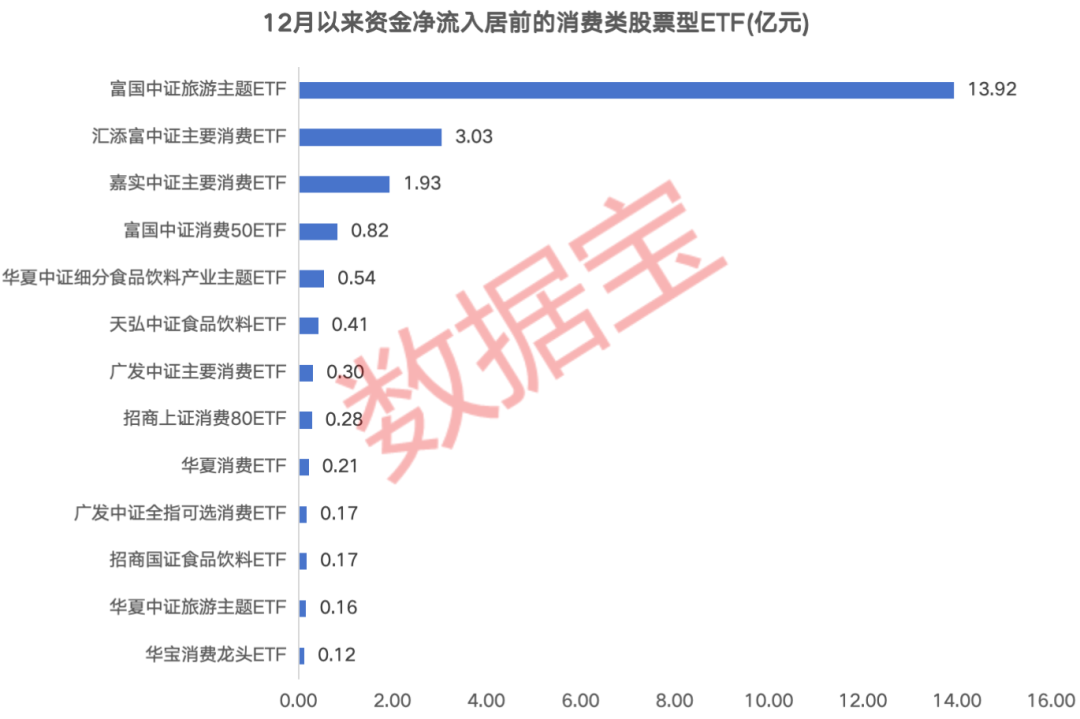
Group 1 - The consumer sector shows signs of stabilization and rebound, with the Wind Consumer Index rising by 1.33% last Friday and continuing to increase by 0.13% on Monday [1] - The retail and dairy sectors have seen significant increases, with the Wind Retail Index up 7.44% and the Wind Dairy Index up 5.35% since December [2] - Over 20 ETFs related to consumption themes have seen a net inflow of over 2.2 billion yuan since December, with the Fortune CSI Tourism Theme ETF receiving nearly 1.4 billion yuan [2] Group 2 - The long-term growth resilience of China's consumer market is evident, with retail sales expected to rise from 39.1 trillion yuan in 2020 to 48.3 trillion yuan in 2024, averaging a growth rate of 5.5% [3] - The Wind Consumer Index has underperformed this year, with a year-to-date increase of only 5.34%, significantly lower than other popular indices [3] - The average price-to-earnings ratio of the Wind Consumer Index is 23.31, well below the 10-year average of 28.56 [3] Group 3 - Institutions predict that the total net profit of the Wind Consumer Index constituents will reach nearly 460 billion yuan in 2025, an increase of 8.63% from the previous year, with growth rates expected to exceed 14% in 2026 and 2027 [4] - The Wind Consumer Index and the Wind Domestic Demand Upgrade Index consist of 87 stocks across 12 industries, including pharmaceuticals, automotive, electronics, and food and beverage [4] - The average year-to-date increase for the 87 constituent stocks is over 29%, driven primarily by high-performing electronics and pharmaceuticals stocks [4] Group 4 - As of December 19, the total financing balance for the 87 constituent stocks is close to 320 billion yuan, an increase of over 45% from the end of last year, with more than 70% of the stocks seeing increased financing [4] - Thirteen stocks with a financing balance increase of at least 20%, over 20 institutional surveys, and a year-to-date increase of less than 25% are primarily in the pharmaceuticals, food and beverage, and home appliance sectors [4] Group 5 - Huichuan Technology, Mindray Medical, and Hikvision have received the highest number of institutional surveys this year, with Huichuan Technology's stock price increasing nearly 25% [5] - Mindray Medical has been surveyed by nearly 1,000 institutions, while Hikvision has received over 500 surveys [5] - Dongpeng Beverage has been surveyed by nearly 270 institutions, with a stock price increase of around 12% [5]






机构扎堆调研的大消费+内需升级潜力股出炉,融资客重点埋伏
Zheng Quan Shi Bao Wang· 2025-12-22 00:13
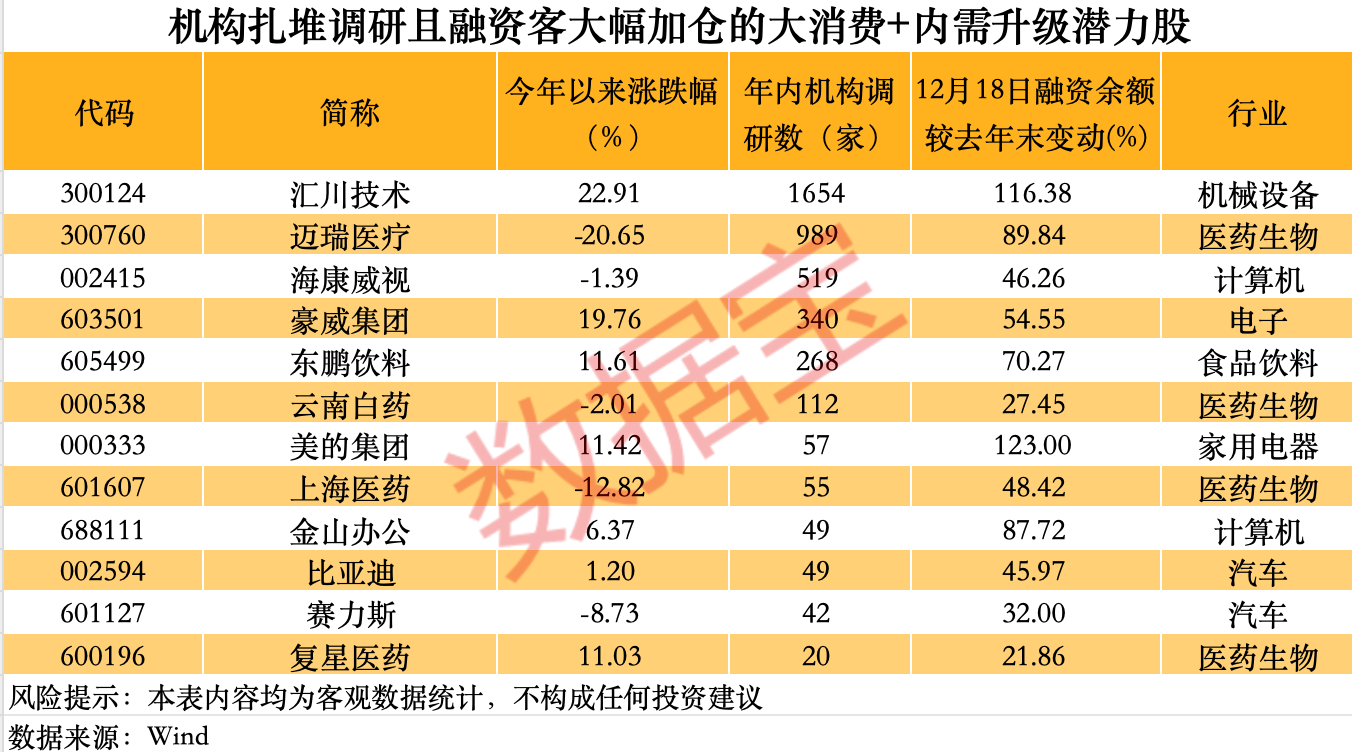
Core Viewpoint - The article highlights the recent measures taken by various regions to boost consumer spending ahead of the traditional consumption peak season, leading to a rebound in the large consumer sector in the capital market [1] Group 1: Market Performance - The large consumer index rose by 1.33% on December 19, significantly outperforming the Shanghai Composite Index [1] - Sub-sectors such as dairy, retail, and beverage manufacturing saw substantial increases, with Kweichow Moutai, a representative of large consumption, achieving a cumulative increase of 2.36% since December 10 [1] Group 2: Financing and Investment Trends - As of December 18, the total financing balance for the 87 constituent stocks of the large consumer index approached 320 billion yuan, representing an increase of over 45% compared to the end of last year, with over 70% of the financing targets seeing increased investment [1] - Notable stocks such as Rongchang Biologics, Sanhua Intelligent Control, and Sunshine Power experienced financing balance increases exceeding 100% [1] Group 3: Institutional Research and Stock Performance - There are 12 stocks with a financing balance increase of no less than 20%, having received research from 20 or more institutions this year, and with a year-to-date increase of less than 25% [1] - The leading companies in terms of institutional research are Huichuan Technology, Mindray Medical, and Hikvision, with the number of institutional research counts being 1654, 989, and 519 respectively [2]
企稳反弹,有望迎双位数增长!机构扎堆调研的大消费+内需升级潜力股出炉,融资客重点埋伏
Zheng Quan Shi Bao· 2025-12-21 23:40
Group 1 - The core viewpoint of the articles highlights the recovery and growth potential of the consumer sector, driven by policy support and increasing consumer demand during the traditional consumption peak season [1][5][6] - The consumer sector index showed signs of stabilization and rebound, with a 1.33% increase on December 19, outperforming the Shanghai Composite Index [2] - The consumer market is expected to see double-digit growth over the next two years, with retail sales projected to rise from 39.1 trillion yuan in 2020 to 48.3 trillion yuan by 2024, reflecting an average annual growth rate of 5.5% [5][6] Group 2 - The consumer sector is currently experiencing a valuation adjustment, with the consumer index's latest price-to-earnings ratio at 23.29, significantly below the 10-year average of 28.56 [6] - Institutional predictions indicate that the net profit growth for the consumer sector index constituents is expected to exceed 14% in 2026 and 2027, with a projected total net profit of nearly 460 billion yuan for 2025 [6] - A total of 87 stocks in the consumer sector have seen an average increase of over 28% this year, with significant contributions from the electronics and biopharmaceutical sectors [8] Group 3 - Notable stocks such as 汇川技术 (Inovance Technology) and 迈瑞医疗 (Mindray) have received substantial institutional attention, with the former seeing a 22.91% increase in stock price and over 1,600 institutional surveys this year [9][11] - The financing balance for the consumer sector stocks has increased by over 45% compared to the end of last year, with more than 70% of the stocks receiving additional financing [8][11] - Companies like 东鹏饮料 (Eastroc Beverage) are expanding their product lines and exploring overseas markets, indicating a strategic focus on growth and market penetration [10]
中银国际:汽车行业明年稳内需基调明确 出口增长或胜预期
Zhi Tong Cai Jing· 2025-12-16 06:43
Group 1 - The core viewpoint of the reports indicates that while wholesale passenger car volumes saw a slight increase both year-on-year and month-on-month in November, terminal retail sales continued to decline since October, leading to a further rise in inventory [1] - The company anticipates that the year-on-year decline in retail sales may further widen in December due to the base effect from last year and tightening of new policies, but believes that the current retail data does not accurately reflect consumer purchasing intentions and demand [1] - The company expresses confidence that if the optimization of the "two new" policies is implemented quickly, the lack of a year-end "tail effect" could benefit the automotive market's performance at the beginning of next year [1] Group 2 - The company reports that passenger car exports in November increased by 48.7% year-on-year to 624,000 units, significantly exceeding expectations, and forecasts a continuation of strong export growth next year [1] - Concerns from some investors regarding potential negative impacts on passenger car exports due to tariffs and trade barriers are noted, but the company believes that Chinese brands have quickly adapted to changes in export models, regions, and methods, leading to a rebound in export volumes since mid-year [1] - The company projects that total passenger car sales for the year will grow by 10% year-on-year, surpassing 30 million units for the first time, with exports expected to increase by over 20% to 6 million units [2] - Looking ahead to next year, the company expects the industry to demonstrate resilience under supportive policies and a focus on expanding domestic demand, with a dual drive from "export leadership" and "domestic demand upgrade" [2] - The automotive industry may enter a phase of systematic and organized deep rectification as part of the "14th Five-Year Plan," promoting supply-demand balance through policy-driven capacity clearance and self-regulation in the market [2]
指数继续震荡寻求机会!跨年行情要注意,还有哪些投资机会?
Sou Hu Cai Jing· 2025-12-09 08:36
Group 1 - The market is expected to maintain a high risk appetite due to policy expectations from the "14th Five-Year Plan," with technology growth likely to continue outperforming in Q4 [1] - The main sectors attracting net inflows include PCB, LED, OLED, photovoltaic, and charging piles, indicating strong investor interest in these areas [1] - The domestic embodied intelligence sector has surpassed a total market value of 3 trillion yuan, with significant growth potential as capital accelerates for domestic new forces [3] Group 2 - The dairy market is stabilizing post-holidays, with milk prices entering a bottoming phase, while deep processing and overseas markets show rapid growth potential [5] - The price of beef cattle is expected to experience upward pressure due to a projected decline in supply by over 10% since 2024, indicating a potential price rebound [5] - The global investment community is regaining confidence in AI, with storage chips being favored as a critical material, leading to anticipated price increases that may last until mid-next year [5] Group 3 - The A-share market is expected to enter a "structural market second half" focused on high-quality development, with long-term funds likely to concentrate on industries with strategic support value [9] - The ability of the ChiNext index to stabilize above 3200 points will be crucial for determining whether new highs can be achieved by year-end, with ongoing positive sentiment in technology stocks [9] - Investors are advised to maintain a medium to high position structure, focusing on advanced manufacturing, technology hardware, green energy, and digital economy sectors driven by policy [9]

“十五五”聚焦科技和内需,把握逢低布局窗口
Haitong Securities International· 2025-10-26 13:33
Investment Focus - The main goals for economic and social development during the "15th Five-Year Plan" period are achieving significant progress in high-quality development and substantial improvement in technological self-reliance [1][7] - Macro policy will focus on two main directions: building a modern industrial system through technological innovation and driving long-term growth through domestic-demand upgrading [1][7] Technological Innovation - Emphasis on enhancing self-sufficiency in key technologies and accelerating the development of globally competitive emerging pillar industries [2][8] - Priority areas include new energy, new materials, aerospace, and low-altitude economy, as well as future industries like quantum technology, biomanufacturing, hydrogen and fusion energy, brain-computer interfaces, embodied intelligence, and sixth-generation mobile communications [2][8] - The "AI+" initiative will lead in accelerating the application of new productivity forms and business models, enhancing the national innovation system's efficiency [2][8] Domestic Demand - Policy priorities are shifting from aggregate stimulus to endogenous growth, with a focus on launching a "boost consumption" program to generate new demand [2][9] - Improving the social safety net aims to release consumption potential, including measures for livelihood support, employment stabilization, social welfare enhancement, and family support [2][9] - New growth drivers such as green consumption, the silver economy, and the childcare economy will be cultivated to enhance domestic circulation's momentum and resilience [2][9] Real Estate Sector - The meeting called for promoting high-quality development in the real estate sector, regulating local governments' economic promotion behaviors, and expanding effective investment [2][10] - The overall strategy aims to stabilize the property market and mitigate cut-throat competition, ensuring macro stability under a dual-engine structure powered by technology and domestic demand [2][10] Market Outlook - After recent corrections, market lows are beginning to offer attractive entry opportunities, with a modest rebound in Chinese equities under policy boosts [3][11] - The performance gap between the CSI 300 and CSI 500 has narrowed, indicating upside potential for large caps, particularly in consumption and property sectors benefiting from domestic-demand policies [3][12] - Investors may also consider increasing exposure to the non-bank financial sector to capture opportunities from subsequent market expansion [3][12] - For technology stocks, a secondary pullback may present a re-entry opportunity, especially for Hong Kong tech stocks that have corrected significantly since October [3][12]
中美贸易战的祸首在美国,但突围策略可能在这个国家
创业家· 2025-10-24 10:12
Core Viewpoint - The article discusses the evolution of Japan's economy and its ability to adapt to challenges such as trade wars, aging population, and low consumption, drawing parallels to China's current situation and suggesting lessons that can be learned from Japan's experience [3][6][10]. Group 1: Economic Context - China, as the world's factory, is facing trade wars, financial conflicts, and technological competition, which may force it to upgrade its technology and domestic demand [3]. - Japan experienced a similar situation in the 1980s and 1990s, leading to a significant transformation in its economy, resulting in a dual economic engine: one focused on globalization and the other on domestic consumption [3][5][10]. Group 2: Lessons from Japan - Japan's response to economic challenges involved creating new service industries to meet the needs of its aging population, which is referred to as "internal demand Japan" [4][6]. - The article emphasizes the importance of understanding consumer needs and adapting business strategies accordingly, as demonstrated by successful Japanese companies [14][15]. Group 3: Business Strategies - Japanese brands have thrived by focusing on customer experience and meeting real demands rather than following trends, as seen in companies like 7-11 and WORKMAN [15][17]. - The concept of "grounded logic" is highlighted, where businesses engage directly with consumers to understand their needs, leading to innovative product development and effective supply chain management [14][16][18]. Group 4: Event and Learning Opportunity - The article promotes a learning trip to Japan, scheduled from November 30 to December 5, aimed at exploring the operational strategies of leading Japanese brands during low-growth periods [10][11][19]. - Participants will gain insights into how Japanese companies have navigated economic challenges and adapted their business models to sustain growth [11][20].

近3000股上涨,商业航天股批量涨停,有新股半日涨近400%
2 1 Shi Ji Jing Ji Bao Dao· 2025-10-24 04:00
Market Performance - The A-share market experienced a morning rally on October 24, with the Shanghai Composite Index breaking the previous high of 3936.58 points, reaching a new high of 3946.16 points during the session [1] - By midday, the Shanghai Composite Index rose by 0.42%, the Shenzhen Component Index increased by 1.3%, and the ChiNext Index gained 2.09%, with a total trading volume of 1.24 trillion yuan [1] Sector Highlights - The storage chip sector saw significant gains, with companies like Changjiang Storage and Puran Co. hitting new highs [1] - The commercial aerospace sector experienced a strong surge, with multiple stocks, including Dahua Intelligent, achieving consecutive gains and over ten stocks hitting the daily limit [1][2] - The computing hardware sector also showed upward movement, with Zhongji Xuchuang reaching a new high [1] Investment Opportunities - The commercial aerospace sector is expected to accelerate with the increasing frequency of domestic commercial rocket launches and a faster IPO process for related companies, indicating a growing market [2] - The storage chip market is on an upward cycle, driven by increased capital expenditure from major internet companies like Alibaba and ByteDance, which is expected to boost domestic manufacturers' market share [3] Institutional Outlook - Zhongyin Securities noted that a resonance between policy and economic bottoms is forming, which may support the upward movement of A-share indices [4] - Long-term capital, particularly from public funds and insurance, is expected to concentrate on industries with strategic support value [4] - Foreign institutional investors are showing increased interest in A-shares, with QFII becoming a significant shareholder in multiple companies [4] Foreign Investment Sentiment - Major foreign investment firms like Goldman Sachs and Morgan Stanley have expressed optimism about the Chinese market, predicting a slow bull market with a potential 30% increase in major indices by the end of 2027 [5][6] - Morgan Stanley highlighted that global investors' allocation to Chinese equities remains low, suggesting room for growth in investment [6]