耐心资本

Search documents
政府投资基金投向“路线图”出炉 投向哪、怎么投首次得到系统性规范
Mei Ri Jing Ji Xin Wen· 2026-01-13 12:57
Core Viewpoint - The recent issuance of the "Work Method" and "Management Method" by the National Development and Reform Commission aims to systematically regulate the layout and investment direction of government investment funds, shifting the focus from quantity to quality and effectiveness in fund management [1][3]. Group 1: Government Investment Fund Regulations - The "Work Method" establishes rules for investment behavior, including a "negative list" to delineate prohibited actions [1]. - The "Management Method" introduces a detailed evaluation system consisting of three primary indicators and thirteen secondary indicators to enhance the operability of investment assessments [1][6]. - The evaluation focuses on supporting new productive forces, traditional industry upgrades, and the development of the digital economy [1]. Group 2: Policy Support and Implementation - Starting in 2025, national policies will increasingly support government investment funds, with a comprehensive approach covering fundraising, investment, management, and exit strategies [2]. - Local governments are responding to national guidelines by translating top-level designs into actionable plans [2]. - The rapid growth of funds has revealed issues such as unclear fund positioning and risks of homogenization and resource waste due to overlapping investment areas [2]. Group 3: Encouragement of Collaboration - The "Work Method" encourages national funds to collaborate with local funds, particularly in cutting-edge technology and key supply chain areas, to leverage local resources [4]. - The National Entrepreneurship Investment Guidance Fund is expected to mobilize a funding scale of trillions, enhancing the role of social capital, especially private capital, in supporting technology enterprises [4]. Group 4: Investment Focus Areas - Key investment hotspots identified include computing power, new energy storage, high-end chips, embodied intelligence, autonomous driving, and industrial digitalization [5]. - The "Management Method" has clarified the investment directions for government investment funds through a structured indicator system [5][6]. Group 5: Evaluation Indicators - The evaluation system includes three parts: policy compliance indicators, productivity layout optimization indicators, and policy execution capability indicators [6]. - These indicators assess the fund's role in supporting national strategies, effective capacity utilization, and the professional level of fund managers [6].
国寿资产实现另类投资退出路径新突破
Zheng Quan Ri Bao Zhi Sheng· 2026-01-13 11:41
本报讯 (记者冷翠华)近日,国电投核能有限公司(以下简称"电投核能")通过国家电投集团产融控 股股份有限公司重大资产重组成功上市,国家电投集团成功打造核电运营资产专营平台,核能业务高质 量发展再启新征程。电投核能上市,也是中国人寿资产管理有限公司(以下简称"国寿资产")首个通过 上市公司重大资产重组实现退出的另类投资股权项目。 国寿资产表示,"十五五"时期,将继续把创新实践优势、丰富案例优势和资金规模优势持续转化为"量 身定制"解决方案的投资能力优势和价值发现优势,不断深入挖掘具备一二级市场联动潜力或并购重组 潜力的投资机会,通过更加丰富的另类投资方式,支持资本市场发展,更好服务实体经济。 (编辑 李家琪) 投资电投核能,是国寿资产发挥耐心资本作用,做好科技金融"大文章",助推实现高水平科技自立自强 的积极探索。电投核能旗下AP1000三代核电自主化依托项目顺利商运,为推动国家科技重大专项落 地,建成具有自主知识产权的大型先进压水堆CAP1400,带动形成先进非能动核电产业链,以新型号新 技术持续促进科技高水平自立自强夯实了坚实基础。同时,国寿资产立足长期投资优势,深耕绿色金 融,促进美丽中国建设和绿色低碳转 ...

母基金上演“增资潮”:上海这只母基金加码至200亿
FOFWEEKLY· 2026-01-13 10:01
导读: 耐心资本加速集结,2026开年多地母基金扩容。 作者丨 FOFWEEKLY 2026年伊始,一级市场春潮涌动,暖意持续。 一方面,IPO市场热度不减,从AI芯片到大模型,多家标志性企业成功闯关,为投资机构带来丰硕 回报;另一方面,国家层面引导基金布局深远,继去年年底 国家创业投资引导基金 正式启航后, 本周针对政府投资基金的规范性文件亦首度系统出台,为行业发展带来指引。 与此同时,各地母基金设立与出资节奏持续加速,在如今市场全面积极的态势下,地方政府引导基 金的增资步伐也尤为引人注目。 近日,上海一只母基金完成重磅增资,增幅高达300%。 上海母基金增资了 上海国资又有大动作。 2026年1月7日,上海浦东引领区投资中心(有限合伙)(下称"引领区基金")完成工商变更,其 出资额由50亿元人民币大幅增至200亿元人民币,增幅达300%。 企查查信息显示,该基金成立于2022年,由上海浦东创新投资发展(集团)有限公司与上海浦东 私募基金管理有限公司共同出资设立,经营范围聚焦于以自有资金从事投资活动。 根据此前报道,2022年7月27日,浦东金融改革创新项目落地暨引领区产业发展基金成立大会正 式召开,浦东引 ...


政府投资基金要变了
Sou Hu Cai Jing· 2026-01-13 08:10
Group 1 - The core viewpoint of the news is the introduction of new regulations by the National Development and Reform Commission, in collaboration with other ministries, to guide the planning and investment direction of government investment funds, marking a systematic approach to fund layout and investment direction at the national level [1][2][12] - The "Work Method" defines government investment funds and emphasizes their role in guiding investments towards major strategies and key areas where the market cannot fully play its role [2][12] - The "Management Method" establishes a detailed evaluation system with 13 indicators to assess the investment direction and performance of government investment funds, focusing on policy compliance and optimization of productivity layout [8][10] Group 2 - The "Work Method" includes provisions to prevent homogenization of competition and the crowding out of social capital, aiming for a high-quality development pattern of government investment funds that is appropriately scaled, reasonably laid out, and scientifically managed [3][5] - Specific prohibited investment behaviors for government investment funds are outlined, including increasing local government hidden debt and engaging in speculative trading [6][10] - The evaluation system emphasizes support for emerging industries and future industries, including areas like quantum information, generative artificial intelligence, and new energy, while also promoting the transformation of traditional industries [9][10] Group 3 - The government investment funds are encouraged to collaborate with local funds, leveraging local resources to form a financial synergy in key areas of frontier technology and supply chains [5][12] - The evaluation criteria include a focus on early-stage investments and long-term investment periods, with a preference for projects that have a high proportion of social capital contributions [10][12] - The introduction of the "negative behavior list" for investment directions aims to ensure that funds do not engage in undesirable practices, with a scoring system that influences management fees and profit distribution based on performance [10][11]
政府投资基金要变了
投资界· 2026-01-13 07:49
Core Viewpoint - The article discusses the recent release of guidelines by the National Development and Reform Commission (NDRC) and other ministries aimed at strengthening the planning and investment direction of government investment funds, marking a systematic regulation at the national level for the first time [2][3]. Group 1: Government Investment Fund Guidelines - The "Work Method" defines government investment funds and clarifies their investment directions and behaviors, emphasizing their role in supporting major strategies and addressing weak links in the market [3][4]. - The guidelines include 14 provisions that address "where to invest, how to invest, and who manages" the funds, focusing on optimizing fund layout and enhancing investment guidance [3][4]. - The guidelines aim to prevent homogenized competition and the crowding out of social capital, promoting a high-quality development pattern for government investment funds [4]. Group 2: Investment Focus and Restrictions - The guidelines specify that government investment funds must clearly outline key investment industries in their establishment plans, with a focus on emerging industries such as the metaverse, brain-computer interfaces, quantum information, humanoid robots, generative artificial intelligence, and biomanufacturing [2][4][6]. - Certain investment behaviors are prohibited, including increasing local government hidden debt through disguised debt instruments, engaging in public stock trading outside specified conditions, and providing guarantees for enterprises or projects [4][5]. Group 3: Evaluation and Assessment - The "Management Method" establishes a detailed evaluation system for government investment funds, consisting of three primary indicators and 13 secondary indicators, with a total score of 100 points [6][8]. - The evaluation emphasizes supporting the development of new and future industries, traditional industry upgrades, and the digital economy, with specific scoring criteria for compliance with investment directions [6][7]. - The evaluation includes a "negative behavior list" for investment directions and links the scores to incentives or constraints regarding national-level fund cooperation, management fees, and profit distribution [9]. Group 4: Future Implications - The article highlights the increasing importance of government funds in China's venture capital landscape, with state-owned capital expected to rise to 55% by 2025, reflecting a significant shift in the investment landscape [12]. - The introduction of these guidelines marks a new phase characterized by "standardized development and quality improvement" for government investment funds, addressing past controversies and challenges [12].

定价权在谁手(3):有形的手
China Post Securities· 2026-01-13 05:51
Group 1 - The report highlights that during the recent bull market, individual investors did not significantly increase their net purchases of ETFs, while institutional funds, particularly represented by Central Huijin, showed multiple instances of substantial accumulation [12][18][19] - Central Huijin's role has shifted post-September 24, 2025, where it is expected to act more as a stabilizing force during market downturns rather than consistently buying into ETFs [18][19] - The report emphasizes that "patient capital," particularly insurance funds, will play a crucial role in 2026, with a focus on their ability to provide support to the A-share market [19][20] Group 2 - The report estimates that the incremental capital from insurance funds in 2026 could reach approximately 731 billion, based on two main factors: premium income and reinvestment of maturing assets [33][35] - Insurance funds are expected to maintain a preference for high-dividend stocks, particularly in the banking sector, indicating a "barbell" investment strategy that will support the A-share market primarily at the index level [34][35] - The report discusses the constraints faced by insurance funds, particularly regarding solvency ratios, which have declined, impacting their ability to enter the market despite regulatory adjustments to risk factors [27][29][32]
智库策论丨畅通“科技—产业—金融”良性循环的系统路径
Sou Hu Cai Jing· 2026-01-13 02:42
Core Viewpoint - Building a virtuous cycle of "technology-industry-finance" is crucial for overcoming key technological challenges and accelerating the cultivation of new productive forces, thereby gaining strategic advantages in global competition [1] Group 1: Importance of the Cycle - The three major tasks outlined in the 20th National Congress and the 14th Five-Year Plan are the construction of a modern industrial system, high-level technological self-reliance, and the establishment of a strong financial nation [1] - The interconnection between technology, industry, and finance is essential for high-quality development and achieving strategic goals [1] Group 2: Challenges in the Cycle - The cycle from industry to finance faces dual challenges of "information asymmetry" and "capability mismatch," where a lack of effective information sharing mechanisms hinders financial institutions from understanding the true value and core needs of enterprises [2] - Financial institutions struggle with recognizing and servicing complex industries, leading to a "dare not invest, cannot invest" dilemma due to a shortage of professionals who understand both industry technology and financial tools [2] Group 3: Financial to Technology Cycle Issues - The cycle from finance to technology encounters contradictions of "mismatch in risk duration" and "capital structure imbalance," where traditional banking practices conflict with the high-risk, long-cycle nature of technological innovation [3] - The capital market has structural shortcomings, with insufficient early-stage capital and a tendency for investments to shift towards later stages, leaving startups in critical need of funding [3] Group 4: Recommendations for Improvement - In the "technology-industry" cycle, a market-oriented mechanism for value discovery and risk-sharing should be established, including a professional technology transfer system and a public risk-sharing platform for early-stage projects [4] - The "industry-finance" cycle should enhance information collaboration and financial service capabilities by creating a national-level integrated digital infrastructure and encouraging financial institutions to adopt a research-driven service model [5][6] - For the "finance-technology" cycle, it is essential to cultivate long-term "patient capital," reform capital markets, and adjust legal and regulatory frameworks to support innovative financial service models [7]
开局即冲刺!南山“科技+金融”双轮驱动新质生产力 |南山半月谈
Sou Hu Cai Jing· 2026-01-12 11:44
Core Viewpoint - The article highlights the vibrant synergy between technology and finance in Nanshan, Shenzhen, showcasing significant developments in the AI and biotechnology sectors, which align with national strategies for innovation and productivity enhancement [1][14]. Group 1: Capital Market Activity - In early January, Nanshan's technology finance sector experienced a surge in activity, marked by significant listings and financing events, including the IPO of AI data leader Xunce Technology, which raised HKD 1.08 billion [3]. - Another notable financing event involved Jindu Biotechnology, which secured a substantial investment from leading institutions, indicating strong capital inflow into Nanshan's future industries [3]. Group 2: Project Incubation and Support - The "X-Day" event on January 9 showcased six promising projects, emphasizing the role of platforms in accelerating incubation and connecting startups with investors [5]. - The "Six Ones" policy in Nanshan supports young entrepreneurs by providing essential resources, fostering a high-density talent and information environment conducive to rapid innovation [5]. Group 3: Industrial Collaboration and Ecosystem - The "Shenzhen Robot Valley" is rapidly forming a trillion-yuan industrial cluster, with companies like Yuejiang Technology achieving mass production of humanoid robots and securing global orders [7]. - Nanshan is also a national pilot zone for low-altitude economy development, attracting key enterprises and establishing a comprehensive industrial chain from R&D to operational scenarios [7]. Group 4: Capital Ecosystem and Investment Philosophy - Nanshan has developed a multi-faceted capital ecosystem, including a CNY 50.45 billion fund aimed at early-stage projects, ensuring seamless capital support throughout the lifecycle of hard tech companies [8]. - The investment philosophy in Nanshan emphasizes patience and long-term innovation over immediate financial returns, fostering a supportive environment for early-stage hard tech investments [10]. Group 5: Government and Market Interaction - The government in Nanshan adopts a "no interference" approach, providing timely support when needed while allowing businesses to focus on growth, exemplified by the establishment of a dedicated quantum computing facility [10]. - The market mechanism in Nanshan facilitates efficient collaboration between academic institutions and industry, enhancing the conversion of technological achievements into marketable products [12]. Group 6: Systematic Innovation Framework - Nanshan's innovative framework includes a unique fault-tolerance mechanism for government funds, shifting focus from short-term returns to long-term innovation effectiveness, thereby encouraging investment in early-stage hard tech [12]. - This systematic approach positions Nanshan as a model for regional implementation of national strategies, particularly in emerging sectors like AI, synthetic biology, and low-altitude economy [14].

政府投资基金怎么投?文件明确
Zhong Guo Zheng Quan Bao· 2026-01-12 04:46
国家发展改革委1月12日消息,为加强对政府投资基金布局规划和投向指导,更加突出政府引导和政策 性定位,国家发展改革委、财政部、科技部、工业和信息化部制定《关于加强政府投资基金布局规划和 投向指导的工作办法(试行)》。 国家发展改革委同步制定《政府投资基金投向评价管理办法(试行)》,充分发挥投向评价工作的指导 带动作用,引导政府投资基金落实国家产业调控要求,支持现代化产业体系建设。 中国宏观经济研究院经济所研究员刘国艳表示,两项办法协同实施,有助于引导金融资源更精准地流向 实体经济急需的领域,尤其是周期长、风险高、社会资本初期投入不足的环节,从而有效发挥政府投资 基金"引导、补缺、撬动"的功能。 投资鼓励类产业要防止盲目跟风 工作办法明确,政府投资基金应在基金设立方案中明确重点投资的产业领域。政府投资基金投向领域应 当符合国家生产力布局宏观调控要求,符合《产业结构调整指导目录》等国家级产业目录中的鼓励类产 业,符合国有经济布局优化和结构调整指引的具体要求,符合国家级发展规划及国家级专项规划、区域 规划要求,支持省级重点产业和特色产业发展,鼓励有关行业企业加快技术更新换代,推动产业提质升 级。 政府投资基金不得投 ...
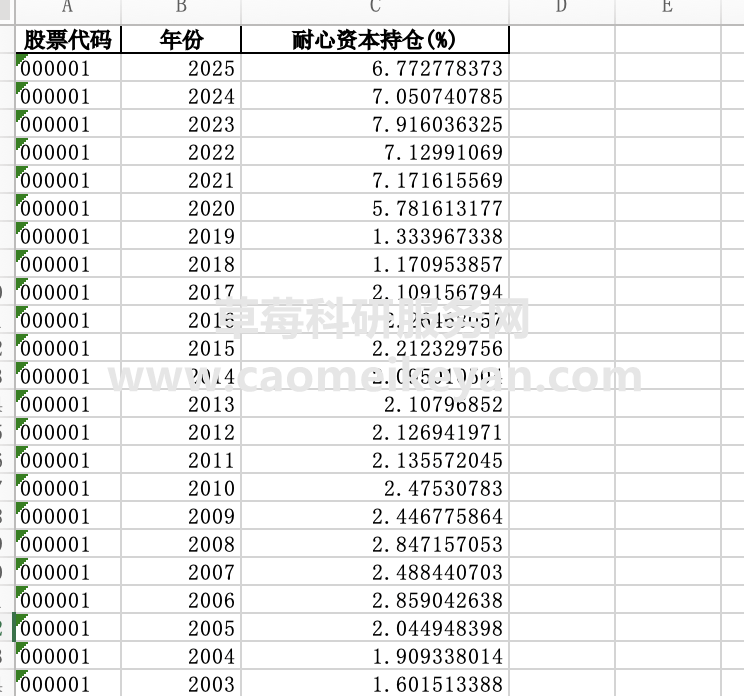
2025-2003年上市公司企业耐心资本持仓数据、基金耐心资本持仓数
Sou Hu Cai Jing· 2026-01-12 02:50
Core Insights - The article presents data on the holdings of Patience Capital in publicly listed companies from 2003 to 2025, focusing on the percentage of holdings relative to the fund's net value [1] - The analysis utilizes a comprehensive dataset covering over 40,000 companies, including more than 9,000 firms across various stock exchanges and ETFs, ensuring a thorough examination of Patience Capital's investment style [1] Data Analysis - The methodology for calculating the holdings percentage is based on the approach outlined by Li Xinwu in a top journal, where the fund's holding in a company is expressed as a percentage of the fund's net value [1] - The dataset includes original daily data, but annual data is used for calculations, leading to larger values represented in logarithmic form [1] - The holding data from 2019 to 2003 is noted to be incomplete, but other original data and holdings from 2020 to 2025 were used for extrapolation [1] Reference Data - The article provides specific holding percentages for a particular stock (code: 000001) over the years, showing a significant increase from 1.33% in 2019 to 6.77% in 2025 [1] - The holding percentages for the years 2020 to 2025 are as follows: 5.78% (2020), 7.17% (2021), 7.13% (2022), 7.92% (2023), and 7.05% (2024) [1]