
GDP增速

Search documents
中信建投证券首席经济学家黄文涛:预计2026年出口增速有望继续超预期
Sou Hu Cai Jing· 2025-11-13 05:42
Core Viewpoint - The 2026 GDP growth target for China is set at around 5%, which is deemed necessary and feasible to stabilize investor confidence in Chinese assets and capital markets [1][3]. Group 1: Economic Growth Projections - The chief economist of CITIC Securities, Huang Wentao, indicated that China's GDP growth is expected to reach around 5% next year due to policy support [1]. - The average GDP growth rate required from 2020 to 2035 to achieve the goal of reaching the per capita GDP of a moderately developed country by 2035 is approximately 4.73% [1]. - The average GDP growth rate during the 14th Five-Year Plan period is above 5%, meeting the stage requirements [1]. Group 2: Export and External Demand - Huang noted that external demand remains resilient, with China's export performance in 2025 exceeding expectations, contributing over 30% to GDP growth in the first half of the year [2]. - If the trade agreements are effectively executed and non-U.S. economies continue to expand, the export growth rate in 2026 is expected to exceed expectations [3]. Group 3: Real Estate Market Outlook - The negative impact of the real estate sector on the economy is expected to diminish, with a projected slight narrowing of the decline in real estate development investment and new housing sales in 2026 [3]. - The decline in new housing sales is anticipated to be within 5%, reducing the negative drag on the economy [3]. Group 4: Policy Support and Consumer Recovery - There is ample room for policy support, with fiscal, monetary, and industrial policies expected to work in tandem in 2026 [3]. - The implementation of "two重" and "two新" policies is expected to continue, with an increase in support for service consumption and the expansion of trade-in policies for consumer goods [3]. - If fiscal policies align with consumer recovery efforts, consumption is projected to improve from its current low state [3].

美国财长警告:"停摆"或影响GDP增速
Guo Ji Jin Rong Bao· 2025-11-10 00:57
Core Insights - The U.S. Secretary of the Treasury, Scott Bessenet, warned that the slowdown in cargo transportation is a consequence of the ongoing government shutdown, which has lasted for 40 days, marking the longest federal government shutdown to date [1][3] - Bessenet indicated that the economic situation is deteriorating due to the shutdown, leading to potential shortages in supply chains and during the holiday season [1] - If the shutdown continues, Bessenet projected that the U.S. economic growth for the fourth quarter could be halved, while White House economic advisor Hassett suggested that the growth rate might turn negative [3] Economic Impact - The prolonged government shutdown has raised concerns about economic issues, particularly inflation, which continues to rise during this period [1] - The potential economic growth reduction highlights the significant impact of government operations on overall economic performance [3]


特朗普首席经济顾问:政府关门对经济影响远比预期严重,美Q4 GDP增速恐减半
Sou Hu Cai Jing· 2025-11-07 20:27
Economic Impact of Government Shutdown - The government shutdown has lasted a record 38 days, with significant economic impacts that were underestimated initially [1] - The White House's economic advisor, Kevin Hassett, indicated that the GDP growth for Q4 may be halved from the original expectation of at least 3% [1] - The tourism and leisure sectors are among the hardest hit, with potential short-term recession if airline travel continues to decline [1] - The construction sector is also facing challenges, with construction projects slowing down, indicating the shutdown's effects are spreading from federal to private sectors [1] Labor Market and Economic Recovery - There is a noted degree of weakness in the labor market, attributed to the uncertainty caused by the prolonged government shutdown [2] - Hassett expressed optimism that the U.S. economy could rebound quickly once the government reopens [3] - Discontent was voiced regarding Federal Reserve Chairman Jerome Powell's suggestion of a potential pause in interest rate cuts, highlighting ongoing tensions between the Trump administration and the Fed on monetary policy [3] - Despite the negative impacts of the shutdown, Hassett did not classify any economic sector as being in recession, indicating some internal differences in economic assessments within the White House [3]
哈塞特:美国政府关门对经济的影响远比预期严重,第四季度GDP增速将会降低
Hua Er Jie Jian Wen· 2025-11-07 13:24
Core Points - The government shutdown will significantly reduce the GDP growth rate for the fourth quarter [1] - The tourism and leisure industry is among the hardest hit sectors due to the shutdown [1]
刚刚宣布!不降息了
Zhong Guo Ji Jin Bao· 2025-11-06 14:11
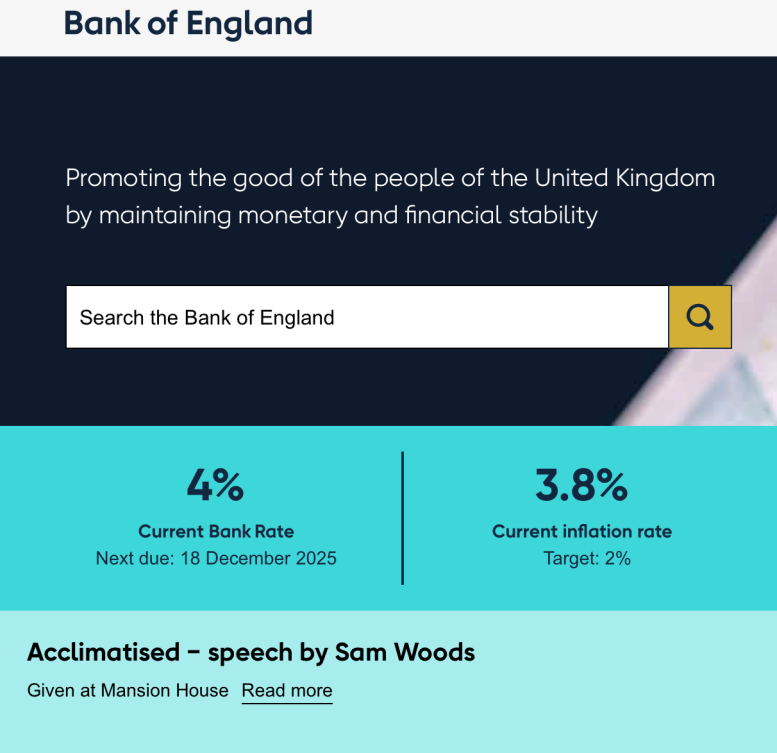
Core Points - The Bank of England decided to maintain the base interest rate at 4%, aligning with market expectations [1][4] - This decision pauses the trend of quarterly rate cuts that began in August 2024 [2] - The Monetary Policy Committee's decision reflects concerns over high overall inflation rates in the UK [4] Economic Outlook - The Bank of England has raised its GDP growth forecast for 2025 to 1.5% from a previous estimate of 1.25% [6] - Inflation expectations have been adjusted, with the one-year inflation forecast now at 2.5%, down from 2.7% [6] - The overall inflation risk is perceived to be more stable, with expectations for inflation to approach 3% by early 2026 and reach the 2% target by the second quarter of 2027 [6] Monetary Policy Insights - The decision to keep rates unchanged was passed with a 5-4 vote, with Governor Bailey casting the decisive vote [8] - Bailey indicated that future rate cuts are likely but depend on confirming that inflation is moving towards the 2% target [8] - The upcoming autumn budget is expected to influence future monetary policy decisions, with potential tax increases to address fiscal gaps [10][12] Currency Impact - Following the announcement, the British pound fell approximately 30 points against the US dollar, trading at 1.30606 [3][9] - Analysts predict continued pressure on the pound, with expectations of further depreciation if rate cuts occur in December [9] Fiscal Considerations - The upcoming autumn budget is critical for determining the timing of any future rate cuts, with expectations of tax measures to mitigate inflation [10][11] - Economic activity is currently subdued, with uncertainty surrounding the budget leading to delays in financial planning for businesses and households [12]
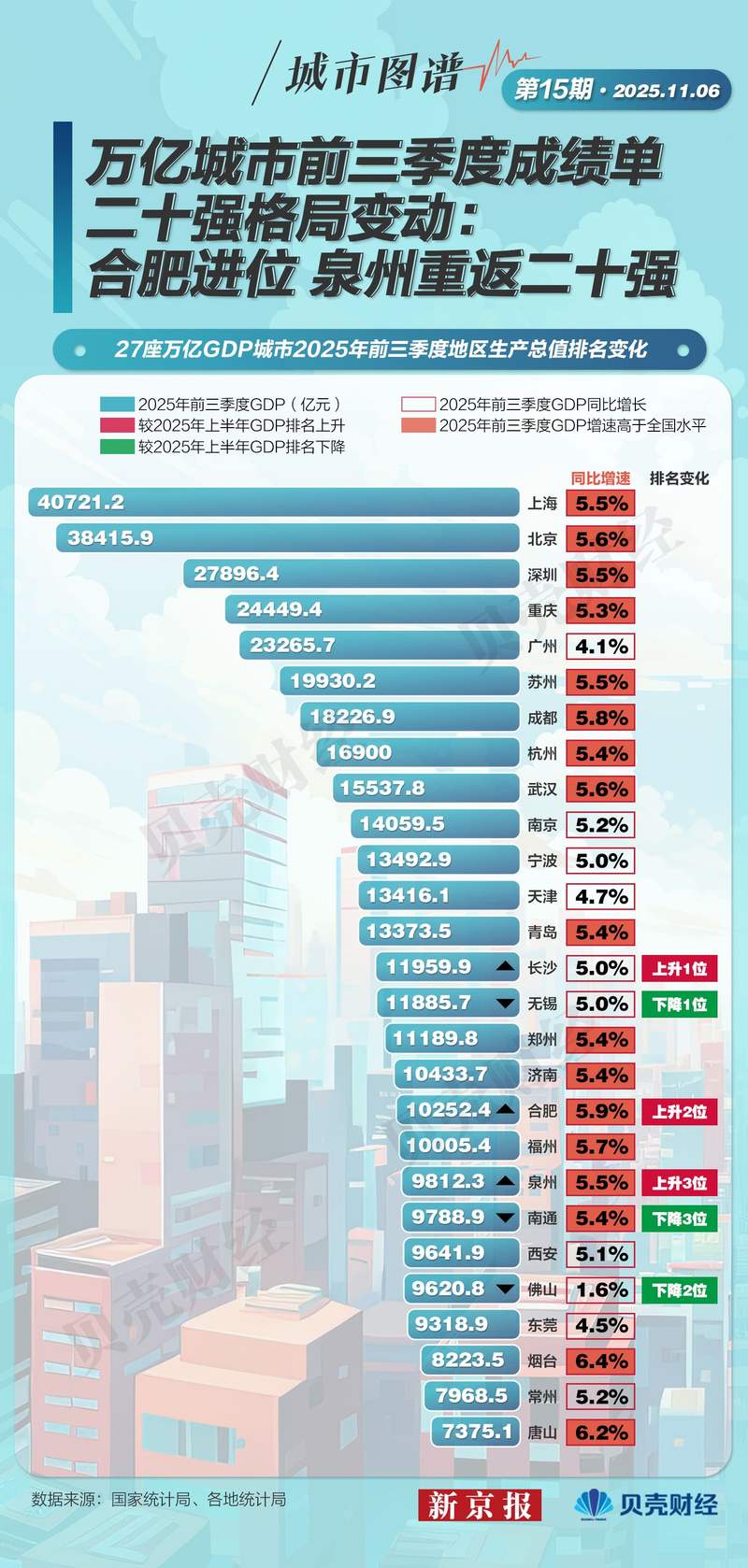
城市图谱|泉州重返万亿城市20强,无锡南通佛山排名下滑
Xin Jing Bao· 2025-11-06 08:19
Core Insights - Among the 27 trillion-yuan cities, 17 cities outperformed the national GDP growth rate in the first three quarters of the year [1] - Yantai leads with a GDP growth rate of 6.4%, followed by Tangshan at 6.2% and Hefei at 5.9% [1] - The rankings of the top twenty trillion-yuan cities have seen significant changes, with Quanzhou rising for two consecutive quarters and re-entering the top twenty [1] Economic Performance - A total of 19 cities have surpassed a GDP of one trillion yuan, with Shanghai exceeding four trillion yuan and Beijing surpassing 3.8 trillion yuan [1] - Shenzhen, Chongqing, and Guangzhou each have GDPs exceeding two trillion yuan [1] Ranking Changes - Nantong's GDP growth was strong in the first half of the year, improving its ranking by five places, but it fell out of the top twenty in the third quarter [1] - Hefei continues to maintain rapid growth, rising two places to rank 18th [1] - Foshan has declined further after dropping out of the top twenty in the second quarter, with a growth rate of only 1.6% [1]
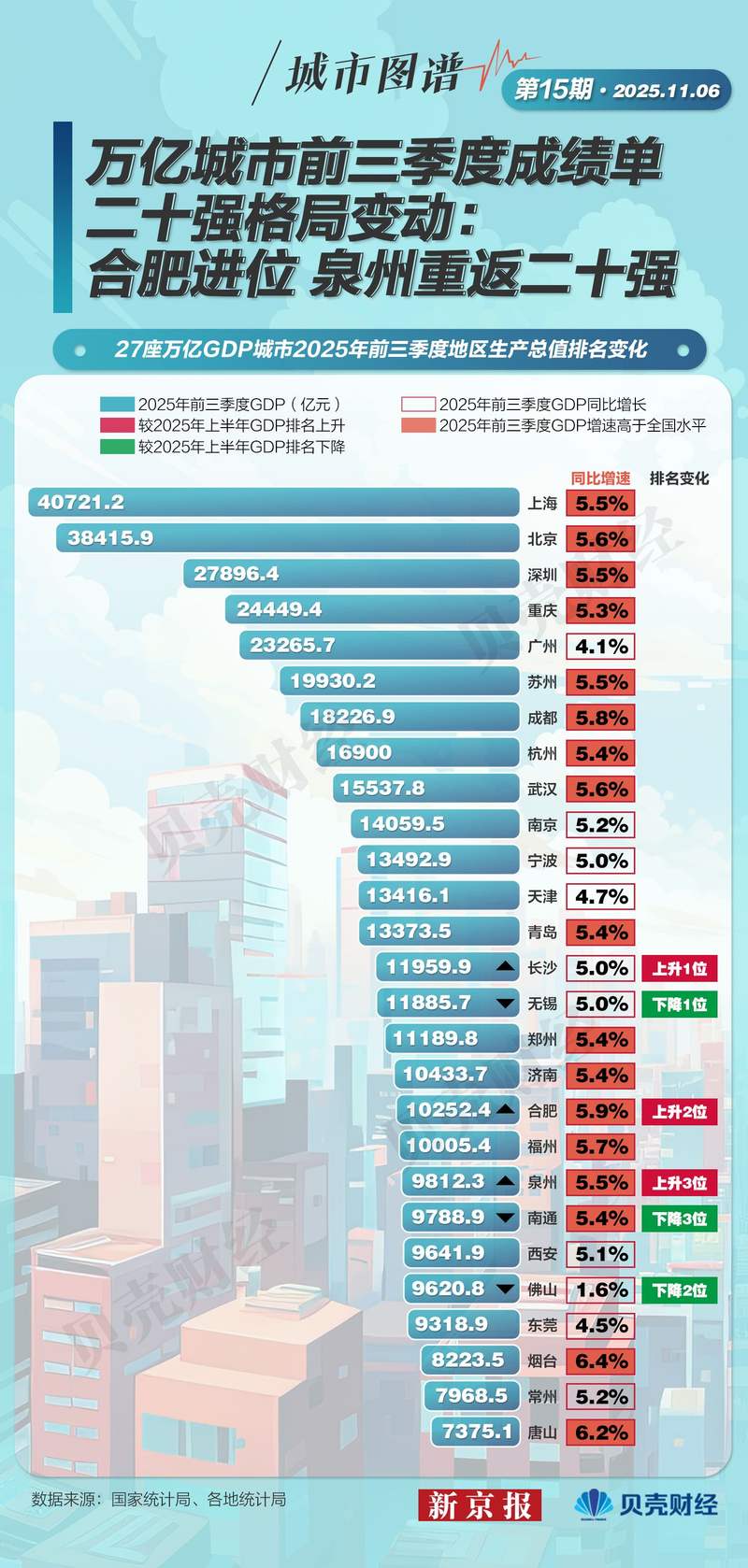
泉州重返万亿城市20强,无锡南通佛山排名下滑
Xin Jing Bao· 2025-11-06 07:51
Core Insights - As of November 6, all economic data for the 27 trillion-yuan cities in the first three quarters have been released, with 17 cities outperforming the national GDP growth rate [1] - Yantai leads with a GDP growth rate of 6.4%, followed by Tangshan at 6.2% and Hefei at 5.9% [1] - The rankings of the top twenty trillion-yuan cities have seen significant changes, with Quanzhou rising for two consecutive quarters and re-entering the top twenty, while Nantong has dropped out [1][3] Economic Performance - Currently, 19 cities have a GDP exceeding one trillion yuan, with Shanghai surpassing four trillion yuan, Beijing exceeding 3.8 trillion yuan, and Shenzhen, Chongqing, and Guangzhou all exceeding two trillion yuan [1] - Hefei has maintained high growth, moving up two positions to rank 18th, while Foshan has continued to decline after dropping out of the top twenty in the second quarter [1][3] City Rankings and Growth Rates - The GDP growth rates for various cities include: - Yantai: 6.4% - Tangshan: 6.2% - Hefei: 5.9% (up 2 positions) - Quanzhou: 5.5% (up 3 positions) - Nantong: 5.4% (down 3 positions) - Foshan: 1.6% (down 2 positions) [3]
供需双弱,价格分化
Tianfeng Securities· 2025-10-31 12:47
Report Industry Investment Rating No relevant content provided. Core Viewpoints of the Report - In October 2025, the PMI data showed a combination of "manufacturing decline and non - manufacturing slight increase." The manufacturing PMI declined more than seasonally, presenting a "weak supply and demand" pattern. Due to factors such as pre - holiday demand release, international environment complexity, and global economic slowdown, it is expected that the GDP growth rate in the fourth quarter may slow down marginally [3][9]. Summary by Related Catalogs 10 - Month PMI Data Overview - The manufacturing PMI in October was 49.0%, a 0.8 - percentage - point decrease from the previous value and below the seasonal level. The non - manufacturing PMI was 50.1%, a 0.1 - percentage - point increase from the previous value, entering the expansion range. The composite PMI output index was 50.0%, a 0.6 - percentage - point decrease from the previous value, at the critical point [3][9]. 10 - Month Manufacturing Situation Supply and Demand - The production index in October was 49.7%, a 2.2 - percentage - point decrease from the previous month, below the boom - bust line and weaker than the seasonal performance. The new order index was 48.8%, a 0.9 - percentage - point decrease from the previous month, indicating a decline in demand. The new export order index was 45.9%, a 1.9 - percentage - point decrease from the previous month, the second - lowest of the year, due to global economic slowdown and trade uncertainties [4][10]. Price - The main raw material purchase price index was 52.5%, a 0.7 - percentage - point decrease from the previous month, and it has been in the expansion range for 4 consecutive months. The ex - factory price index was 47.5%, a 0.7 - percentage - point decrease from the previous month. The gap between raw material prices and ex - factory prices widened to 5 percentage points, indicating continued pressure on the profits of mid - and downstream processing industries [4][10]. 10 - Month Non - Manufacturing Situation Services - The services PMI was 50.2%, remaining in the expansion range. Driven by holiday effects, industries related to travel and consumption had high business activity indices. The postal industry also saw accelerated growth due to promotional activities. The business activity expectation index was 56.1%, indicating strong confidence among service enterprises [5][11]. Construction - The construction PMI in October was 49.1%, a 0.2 - percentage - point decrease from the previous month, still below the boom - bust line. However, the business activity expectation index was 56.0%, a 3.6 - percentage - point increase from the previous month, showing continued improvement in the market development expectations of construction enterprises [6][12].
大湾区有条件建成高度协同共同市场
Sou Hu Cai Jing· 2025-10-28 23:12
Core Viewpoint - The article emphasizes the necessity for China to focus on development, particularly investing in human capital and new industries, to address both domestic and international challenges while achieving modernization goals [2][5][6]. Group 1: Economic Development Focus - The "15th Five-Year Plan" reiterates the importance of prioritizing economic construction, reflecting the changing domestic and international environments, including rising economic nationalism and trade protectionism [5][6]. - The plan aims for a per capita GDP of approximately $30,000 by 2035, indicating a significant growth target from the current level of over $13,000 [5]. - Development is seen as essential for addressing various issues, including livelihood, consumption, national defense, and social stability [5][6]. Group 2: Investment Direction - There is a shift in investment focus from material construction to human capital, emphasizing the need for more diverse economic activities and new industries [3][5]. - The article suggests that while maintaining a GDP growth rate of around 5% is necessary, the focus should be on nurturing new industries and innovative sectors [7][8]. - The potential for growth in service industries, such as AI, gaming, and innovative pharmaceuticals, is highlighted, indicating a need for regulatory adjustments to facilitate this growth [7][8]. Group 3: Regional Coordination and Development - The Greater Bay Area is identified as a crucial economic growth region, with a call for improved coordination among its cities to enhance industrial structure and competitiveness [10][11]. - Learning from the Yangtze River Delta's successful coordination mechanisms, the article advocates for a multi-layered collaborative approach among cities in the Greater Bay Area [10][11]. - The integration of strengths from different cities, such as Hong Kong's research capabilities and mainland China's application of technology, is seen as vital for creating a complete innovation chain [11][12].

稳地产促消费!“十五五”GDP达目标,两招很关键!
Sou Hu Cai Jing· 2025-10-25 10:45
Group 1 - The likelihood of setting a GDP growth target for the "15th Five-Year Plan" is high, as historical trends show that previous plans typically included clear growth targets, except for the "14th Five-Year Plan" due to external shocks and economic uncertainty [3][6][8] - Historical performance indicates that past GDP targets have often been exceeded, providing confidence that the "15th Five-Year Plan" can also achieve its goals [5][6] - The proposed GDP growth target for the "15th Five-Year Plan" is around 4.8%, based on calculations to meet the long-term goal of doubling economic output or per capita income by 2035 [11][13] Group 2 - The economic growth target is expected to be set at approximately 4.8%, which aligns with potential growth estimates considering factors like aging population and external economic pressures [13][24] - The policy direction for achieving the growth target will likely be proactive, focusing on increasing government leverage, expanding domestic demand, and enhancing consumer spending, particularly in services [16][20][22] - Specific measures will include maintaining a fiscal deficit rate around 4%, supporting the real estate market, and promoting service consumption through initiatives like trade-in programs [20][22][24]
