脑机接口

Search documents
A股策略周报20260118:市场的阶段与主题投资的位置-20260118
SINOLINK SECURITIES· 2026-01-18 13:05
Market Regulation and Investor Sentiment - Recent regulatory measures have led to a "cooling" in both commodity and stock markets, which may stabilize investor expectations despite initial concerns about increased volatility[3]. - The implied volatility of the CSI 300 index has diverged from historical volatility, indicating that investors were already pricing in higher future volatility before the regulatory actions[12]. Historical Context of Market Cooling - Historical instances of regulatory tightening do not consistently correlate with market peaks; for example, after regulatory actions in 2015, market tops appeared with a one-month lag[3]. - The tightening of regulations has often occurred during rapid market uptrends, yet subsequent market recoveries have been observed, as seen in 2019 and 2020[3]. Theme Investment Analysis - The current theme investment phase has not yet reached a dominant status, with only 48.43% of theme indices outperforming the Wind All A index, below the 50% threshold[5]. - The number of rising themes has increased to 54%, surpassing levels seen in Q1 2023, indicating a growing interest in specific sectors like commercial aerospace and AI applications[5]. Types of Theme Investments - Theme investments can be categorized into four types: policy-driven, industry-driven, event-driven, and new themes, each influenced by different factors such as performance realization and trading heat[4]. - For policy and industry-driven themes, the realization of performance is crucial for determining the end of the theme, while trading heat and regulatory tightening have a more significant impact on new and event-driven themes[6]. Future Outlook - The market environment remains conducive for industry-driven themes, with a focus on potential fundamental changes in the medium to long term[6]. - Key sectors for investment include AI applications, industrial resources, and consumer recovery channels, with a particular emphasis on sectors like copper, aluminum, and lithium[6].
5家“热门概念”公司被警示或立案调查
Mei Ri Jing Ji Xin Wen· 2026-01-18 12:36
Core Viewpoint - The recent surge in A-share market activity has led to regulatory scrutiny of several companies involved in popular concepts like commercial aerospace, brain-computer interfaces, and artificial intelligence due to issues with information disclosure and risk warnings [1][2]. Group 1: Companies Under Scrutiny - Five companies, including Hangxiao Steel Structure, Electric Science Digital, Yahui Long, Yingjixin, and Tianpu Co., have received warning letters or are under investigation for misleading disclosures related to trending market concepts [1][2]. - Tianpu Co. experienced a significant stock price increase of 16 times by 2025, raising concerns about its information disclosure practices [1]. Group 2: Specific Company Issues - Hangxiao Steel Structure failed to accurately disclose the impact of its involvement in a commercial aerospace project, with the contract amount accounting for less than 1% of its 2024 audited revenue [2]. - Electric Science Digital reported that its satellite communication and AI products had minimal sales impact, with 2025 orders amounting to approximately 0.1% of overall business [3]. - Yahui Long's announcement regarding a strategic partnership in brain-computer interfaces lacked clarity on the technical capabilities of its partner, leading to regulatory warnings [4][5]. - Yingjixin's disclosures about its brain-computer interface chip were found to be misleading regarding the product's market readiness and sales impact [6]. - Tianpu Co. did not clarify its connection to artificial intelligence despite establishing a subsidiary focused on related technologies, leading to regulatory action [7][8]. Group 3: Historical Context and Trends - Several of the companies involved have a history of information disclosure issues, with Hangxiao Steel Structure being notably linked to a major insider trading case [12][13]. - The information disclosure ratings of these companies have declined significantly, with Hangxiao Steel Structure dropping from B to C, Electric Science Digital from A to B, and Tianpu Co. from B to D [12].





汽车零部件、机器人主线周报:周五交易热度触底反弹,富临精工拟引进宁德31.75亿元战略投资-20260118
Soochow Securities· 2026-01-18 11:54
Investment Rating - The industry investment rating is "Overweight," indicating an expected outperformance of the industry index relative to the benchmark by more than 5% over the next six months [49]. Core Insights - The automotive parts sector has shown a weekly increase of 1.65%, ranking second among the SW automotive sector, with a year-to-date increase of 5.07% [2][10]. - The robotics sector has also performed well, with a weekly increase of 1.81% and a year-to-date increase of 5.62%, outperforming the automotive parts sector by 0.16% [2][22]. - Key developments include 富临精工 planning to issue 3.175 billion yuan in stock to 宁德时代, which will become a significant shareholder [2][33]. - Investment recommendations include focusing on product-oriented companies and those entering high-value segments to enhance average selling prices (ASP) in the automotive parts sector, and identifying certainty opportunities in the robotics sector [2][44]. Summary by Sections Automotive Parts Sector Weekly Review - The automotive parts sector has shown a strong performance with a 1.65% increase this week and a 5.07% increase year-to-date, ranking second in the SW automotive sector [2][10]. - The sector's PE (TTM) is at 84.66% historical percentile, and PB (LF) is at 79.21% historical percentile, indicating a favorable valuation [20]. Robotics Sector Weekly Review - The robotics index increased by 1.81% this week and 5.62% year-to-date, with a notable outperformance against the automotive parts sector [2][22]. - The latest PE (TTM) for the robotics sector is at 92.18% historical percentile, and PB (LF) is at 93.83% historical percentile, suggesting strong valuation metrics [32]. Key Company Tracking - Notable weekly performance includes 新泉股份 (+16.24%), 恒帅股份 (+11.36%), and 岱美股份 (+8.76%) [2][37]. - Significant corporate actions include 双环传动's capital increase of 100 million yuan to its subsidiary and 福达股份's completion of a convertible bond issuance of 470 million yuan [2][42]. Investment Recommendations - For the automotive parts sector, recommended stocks based on EPS include 福耀玻璃, 星宇股份, and 敏实集团, while PE recommendations include 拓普集团 and 银轮股份 [2][44].


医疗硬科技崛起,港股通医疗ETF(159137)上市首周告捷,AI医疗+脑机接口双线发力
Xin Lang Cai Jing· 2026-01-18 11:48
Core Viewpoint - The Hong Kong stock market continues to adjust, with the pharmaceutical sector declining alongside the market, particularly affected by a short-term cooling of AI medical concepts [1][12]. Group 1: Market Performance - The Hong Kong Medical ETF Huabao (159137) fell by 0.93%, marking two consecutive days of decline, while the Hong Kong Innovation Drug ETF (520880) dropped by 1.08% [1][12]. - The medical sector saw 13 stocks rise and 37 fall, with Ark Health, a hot stock in AI medical concepts, leading the decline at 6.98%, and Alibaba Health also falling by 5.16% [2][13]. - The Hong Kong Medical Theme Index achieved a record nine consecutive days of gains before experiencing a pullback, with the Huabao ETF having a cumulative increase of 6.9% in its first week, outperforming the Hang Seng Index, which rose by 2.34% [3][14]. Group 2: Sector Analysis - The Huabao Medical ETF covers 50 leading stocks across various medical fields, including CXO, AI medical, medical devices, and innovative drugs, indicating a comprehensive approach to capturing market trends [5][16]. - The medical sector has shown significant recovery since 2026, driven by hot themes like brain-computer interfaces and AI medical, with increasing investment value [6][17]. - The CXO sector is expected to see a recovery in demand, with WuXi AppTec forecasting a net profit of 19.151 billion yuan for 2025, reflecting a year-on-year growth of approximately 102.65% [18]. Group 3: Investment Opportunities - Analysts suggest focusing on innovative overseas expansion and hard technology sectors, such as AI medical and brain-computer interfaces, while monitoring the expansion of medical insurance and essential drug directories [18]. - The Huabao Medical ETF is highlighted as a high-elasticity investment tool for capturing new opportunities in the medical field, particularly in AI medical and innovative drug supply chains [18]. - The largest medical ETF in the A-share market, focusing on medical devices and services, is also noted for its significant weight in AI medical and brain-computer interface concept stocks [18].


国金证券:市场的阶段与主题投资的位置
Xin Lang Cai Jing· 2026-01-18 09:20
Group 1 - The core viewpoint is that recent market "cooling" is not a definitive sign of a market peak, but rather stabilizes investor expectations [1][6] - Historical instances show that regulatory "cooling" often occurs during rapid market uptrends without necessarily indicating a market top [1][6] - The current market environment suggests that the long-term upward trend in equity market centrality remains intact despite recent regulatory actions [1][6] Group 2 - The analysis of theme investments indicates that policy and industry-driven themes focus more on performance realization, while event-driven and new themes are more influenced by trading heat [2][7] - Since 2000, there have been four distinct phases where theme investments have significantly outperformed, often coinciding with A-share profit downturns [2][7] - The current theme investment phase has not yet reached a clear dominance but shows signs of increasing heat, with the proportion of theme indices outperforming the overall market at 48.43% [3][8] Group 3 - The leading themes currently are centered around commercial aerospace and AI applications, although recent cooling has affected trading sentiment in these areas [3][9] - The market environment for industry themes remains favorable, with expectations of continued high performance despite recent adjustments in overheated themes [4][10] - The next critical verification point for performance will be the Q1 earnings disclosures in April, which will be crucial for assessing the sustainability of current themes [4][10] Group 4 - Recommendations for investment include focusing on AI-related industrial resources, Chinese equipment exports, and sectors benefiting from consumer recovery and capital market expansion [5][10] - The ranking of current hot themes is suggested as humanoid robots, AI applications, brain-computer interfaces, and commercial aerospace [4][10]

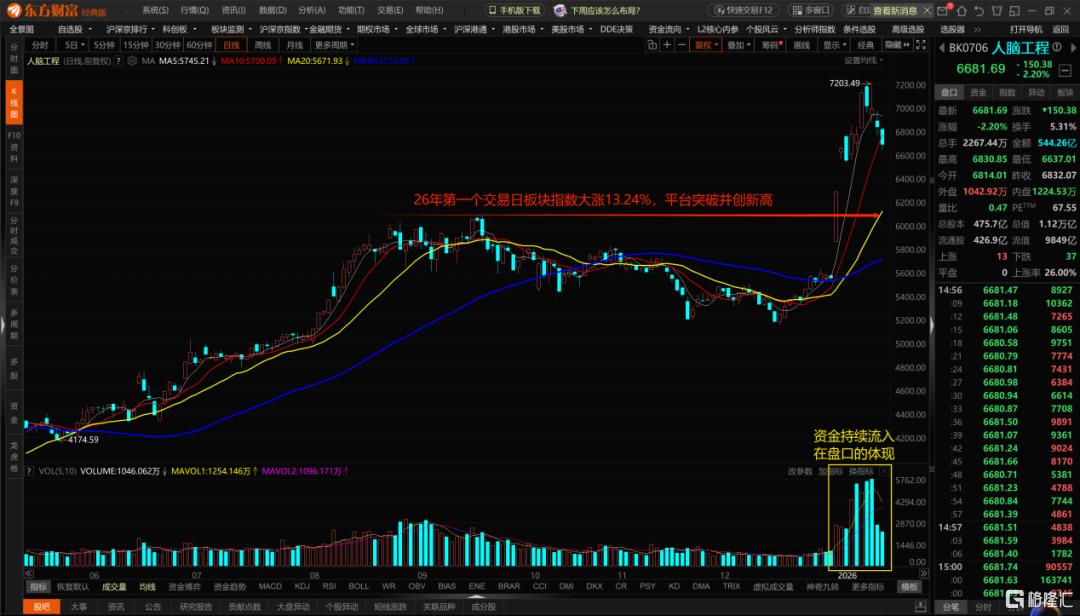
意念控物成真!脑机接口产业化爆发,这波机会别错过!
格隆汇APP· 2026-01-18 08:23
Core Viewpoint - The brain-computer interface (BCI) industry is entering a critical phase of industrialization, driven by strong policy support, clinical advancements, financing growth, and the formation of a complete industrial chain [6][9]. Policy Support - The Chinese government has consistently prioritized BCI in its development plans, with significant policy support expected in 2025, including the establishment of special funds by local governments [9]. - The "China Brain Project" and the "14th Five-Year Plan" highlight the importance of BCI, indicating a robust commitment to its development [9]. Clinical Advancements - The number of clinical trials in China is projected to increase significantly by 2025, with breakthroughs in invasive, semi-invasive, and interventional technologies [9]. - Notable achievements include the completion of the world's first interventional BCI human trial and the development of advanced devices that are fully implanted and wireless [9]. Financing Growth - In the first 11 months of 2025, there were 24 financing events in the BCI sector, marking a 30% year-on-year increase, supported by government funds and market capital [9]. - Various companies have secured significant funding, indicating strong investor interest in the sector [11]. Industrial Development - The BCI industry is evolving into a trillion-yuan market, with over 40 clinical research wards established nationwide, enhancing the ecosystem from core components to complete systems [7][9]. - The industry is witnessing a shift from experimental concepts to practical applications across medical, industrial, and transportation sectors [7]. Technological Breakthroughs - BCI technology is categorized into invasive, semi-invasive, and non-invasive types, with invasive methods offering superior signal quality [12]. - Domestic advancements include breakthroughs in electrode arrays and decoding algorithms, achieving over 90% accuracy in Chinese character writing recognition [14]. Application Scenarios - BCI applications are expanding into various fields, including medical rehabilitation, industrial safety, aerospace, and entertainment, with specific use cases such as fatigue monitoring and cognitive health assessments [15][12]. - The technology is being utilized to assist patients with spinal injuries and other conditions, while also being tested in industrial settings for safety monitoring [14][15]. Investment Opportunities - The BCI sector presents significant investment opportunities, particularly in three areas: technology-leading companies, clinical implementation firms, and industry-collaborative enterprises [18][20]. - Companies with advanced technologies in invasive and interventional methods, as well as those with established clinical partnerships, are expected to yield substantial returns [20][21].

马斯克开出千亿美元天价索赔!OpenAI回应了
Di Yi Cai Jing· 2026-01-18 04:11
马斯克的"天价索赔"正处于人工智能军备竞赛升级阶段。 当地时间1月17日,马斯克在提交给美国联邦法院的文件中,向OpenAI和微软索要高达超过千亿美元的 赔偿金。 美国银行也在一份报告中指出,超大规模数据中心运营商的借贷规模今年将加速增长。他们预计,未来 三年,五大超大规模数据中心运营商的年均借贷额将达到约1400亿美元,甚至可能超过每年3000亿美 元。去年,共发行了1210亿美元的美国公司债券,而2020年至2024年间的年均发行量仅为280亿美元。 为了扩大收入,近日OpenAI还开始进行ChatGPT广告试点。分析师表示,广告收入有望从ChatGPT的8 亿周活跃用户中释放可观的收入来源,但此举可能会激怒部分用户,并损害用户对产品的信任。 马斯克表示,他在2015年联合创立OpenAI期间,为OpenAI提供了655亿美元至1094亿美元的资金,而微 软则获得了133亿美元至251亿美元的资金。这些资金总计可高达1300亿美元。 与此同时,OpenAI CEO奥尔特曼还在脑机接口领域与马斯克展开全方位的较量。就在近日,由奥尔特 曼联合创立的脑机接口公司Merge Labs宣布完成2.52亿美元融资,O ...
意念控物成真!脑机接口产业化爆发,这波机会别错过!
Xin Lang Cai Jing· 2026-01-18 04:03
Core Insights - Brain-computer interfaces (BCIs) are emerging technologies that enable direct communication between the brain and external devices, with applications in medical, industrial, and transportation sectors [1][4] - The Chinese government has included BCIs in its key development list for future industries, with intensified policy support and accelerated clinical trials expected by 2025 [2][5] Policy Support - The Chinese government has consistently prioritized BCIs in its development plans, with significant policies expected to be rolled out by 2025, including local governments establishing special funds [5][6] Clinical Advancements - By 2025, the number of clinical trials for BCIs in China is projected to increase significantly, with breakthroughs in invasive, semi-invasive, and interventional technologies, including the world's first interventional BCI human trial [5][12] Financing Trends - In the first eleven months of 2025, there were 24 financing events in the BCI sector in China, marking a 30% year-on-year increase, supported by government funds and market capital [5][7] Industry Development - The BCI industry is evolving into a trillion-yuan market, with over 40 clinical research wards established nationwide, and a complete industrial ecosystem forming to support technology implementation [6][12] Technological Breakthroughs - Key advancements include the development of high-channel-count electrode arrays and improved decoding algorithms, achieving over 90% accuracy in Chinese character writing recognition [12][14] Application Scenarios - BCIs are being applied in various fields, including medical rehabilitation for spinal cord injuries and ALS patients, as well as in industrial safety monitoring and aerospace cognitive health assessments [12][13] Investment Opportunities - The BCI sector is in a golden period of policy support, rapid technological iteration, and growing demand, with three main investment directions identified: technology-leading companies, clinical implementation firms, and industry-collaborative enterprises [18]
微创、高效、直达大脑!我国科学家开辟脑卒中病灶给药新路径
Huan Qiu Wang Zi Xun· 2026-01-17 23:43
Core Viewpoint - The research teams from Tsinghua University and Capital Medical University have developed a novel method to bypass the blood-brain barrier using nanoparticles to deliver drugs directly to stroke lesions, potentially overcoming a significant challenge in neurological disease treatment [1][3]. Group 1: Research Findings - The study reveals that the bone marrow within the skull is not a static structure but is connected to the meninges through microchannels, allowing immune cells to bypass the blood-brain barrier and enter the brain [3]. - The research team utilized a minimally invasive injection method to deliver albumin nanoparticles into the skull bone marrow, which were efficiently taken up by immune cells, forming "skull immune cell micro-nanobots" for targeted drug delivery [3][4]. - The nanoparticles demonstrated low systemic exposure, with minimal entry into peripheral blood and major organs, ensuring good biocompatibility and safety [3][4]. Group 2: Clinical Implications - In mouse models of acute ischemic stroke, the new delivery method significantly reduced infarct volume and edema, improved neurological function, and showed long-term benefits in reducing brain atrophy and enhancing survival rates [4]. - An exploratory clinical study involving 20 patients with malignant cerebral artery occlusion indicated that the procedure was well-tolerated, with no severe adverse events reported, and showed positive trends in neurological recovery [4][5]. Group 3: Future Prospects - The research suggests that this delivery pathway could extend beyond drug delivery, potentially integrating with brain-machine interface technologies to facilitate multi-directional exchanges of materials, energy, and information between the brain and artificial systems [5].

Vitalik 博文: 为什么我们需要一个开放、可验证的世界?
Xin Lang Cai Jing· 2026-01-17 15:37
Group 1 - The core trend of the 21st century is that "the internet has become real life," impacting various aspects from communication to digital finance and health tracking [2][5][10] - The digital transformation is expected to permeate government processes, public health monitoring, and even brain-computer interfaces in the next two decades, with significant implications for power dynamics both within and between nations [2][11] - The civilizations that benefit the most from new technology waves are those that produce technology rather than merely consume it, emphasizing the need for equitable access to technology [3][12] Group 2 - The COVID-19 pandemic highlighted the consequences of unequal access to technology, particularly in vaccine production, where wealthier nations received vaccines earlier than poorer ones [5][8] - Transparency issues in vaccine science and distribution strategies have led to increased public distrust, which can undermine the effectiveness of health initiatives [8][12] - Solutions like open-source vaccine development can reduce inequality in access and enhance the ability to analyze and verify safety and efficacy [8][12] Group 3 - The importance of openness and verifiability in health and biotechnology is underscored, as proprietary systems can lead to monopolistic practices and data security risks [12][18] - The need for real-time data collection and communication in health monitoring is emphasized, which can significantly improve responses to public health threats [11][12] - The potential risks associated with proprietary health data systems include exploitation by hackers and the monopolization of critical health information by a few large companies [12][18] Group 4 - The article discusses the necessity of open-source and verifiable technologies across various sectors, including personal health tracking, governance, and public safety [23][24] - The vision for a future with open and verifiable systems includes secure personal devices, encrypted communications, and transparent governance mechanisms [23][24] - The call for a shift towards open-source technologies is framed as essential for ensuring security, freedom, and equitable access in the digital age [28][30]