
食品安全

Search documents
安徽省安庆市市场监督管理局食品安全抽检信息通告(2025年第30期)
Zhong Guo Zhi Liang Xin Wen Wang· 2025-06-26 07:22
Summary of Key Points Core Viewpoint - The announcement from the Anqing Market Supervision Administration highlights the results of food safety inspections, revealing that out of 78 food samples tested, 76 were compliant while 2 were found to be non-compliant, prompting immediate actions to address the issues [1]. Group 1: Non-Compliant Products - A total of 2 food products were identified as non-compliant during the inspection: - White Atractylodes (seasoning) sold by Xiaodu Food Business in Daguang District, Anqing, with a sulfur dioxide residue of 0.646 g/kg, exceeding the national food safety standard [1]. - Huangshan Shaobing (spicy) produced by the Xiuning Cake Factory and sold by Qibaihui Supermarket in Taicheng City, with a peroxide value of 0.58 g/100g, which is above the standard limit of 0.25 g/100g [1]. Group 2: Compliance Actions - The Anqing Market Supervision Administration has mandated local market supervision departments to conduct investigations and take necessary actions, including product recalls and public disclosures regarding the non-compliant products [1]. Group 3: Compliant Products - The inspection also identified several compliant food products, including: - Honey products from Hefei Zhicheng Bee Industry Co., Ltd. and various baked goods from local suppliers, all meeting the required safety standards [1].

兰州市市场监督管理局2025年食品安全专项抽检信息通告
Zhong Guo Zhi Liang Xin Wen Wang· 2025-06-25 05:02
Core Viewpoint - The article reports on the food safety inspection results conducted by the Lanzhou Market Supervision Administration, highlighting a high compliance rate in food products and the actions taken against non-compliant items [2]. Group 1: Inspection Results - A total of 729 batches of ordinary food were inspected, with 717 batches passing, resulting in a compliance rate of 98.33% [2]. - For agricultural products, 135 batches were tested, with 134 passing, leading to a compliance rate of 99.26% [2]. Group 2: Actions Taken - The market supervision department has initiated investigations and required non-compliant producers to cease production, remove products from shelves, and recall items to mitigate food safety risks [2]. - Consumers are encouraged to report any food safety issues by calling the complaint hotline 12315 [2].
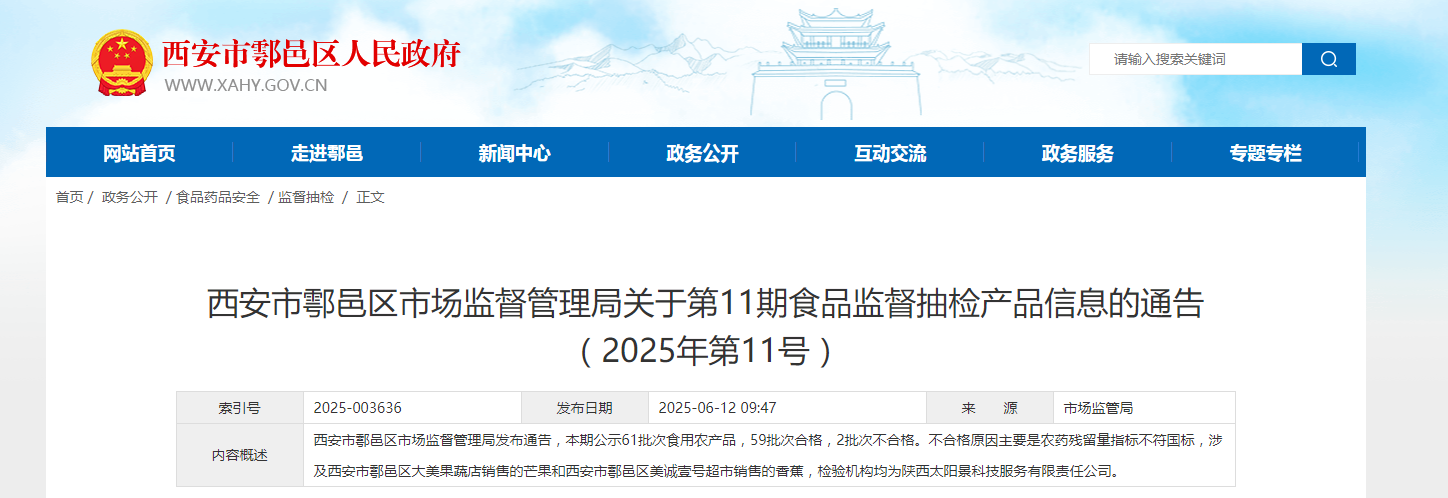
西安市鄠邑区市场监督管理局关于第11期食品监督抽检产品信息的通告(2025年第11号)
Zhong Guo Zhi Liang Xin Wen Wang· 2025-06-25 04:28
| 索引号 | 2025-003636 | 发布日期 | 2025-06-12 09:47 | 来 源 | 市场 | | --- | --- | --- | --- | --- | --- | | 内容概述 | 西安市鄂邑区市场监管管理局发布通告,本期公示61批次食用农产品,59批次合格,2批次不合格。不合格原因主要是农药残留 | | | | | | | 及西安市都邑区大美果蔬店销售的芒果和西安市鄂邑区美诚壹号超市销售的青蕉,检验机构均为陕西太阳景科技服务有限责任公 | | | | | 本期公示食用农产品1类食品共计61批次,其中抽样检验项目合格样品59批次,检验项目见附件2;抽样检验项目不合格样品2批次,检验项目见附件3。具体 通告如下: 一、总体情况: 食用农产品61批次,合格59批次,不合格2批次。不合格原因主要涉及农药残留量指标不符合食品安全国家标准规定。 二、不合格产品情况如下: (一)西安市鄠邑区大美果蔬店(个体工商户)销售的芒果,噻嗪酮检验结果为0.15mg/kg,标准规定为≤0.1mg/kg。检验机构为陕西太阳景科技服务有限责 任公司。 (二)西安市鄠邑区美诚壹号超市(个体工商户)销售的香蕉( ...
江门市市场监管局召开网络餐饮平台座谈会
Nan Fang Du Shi Bao· 2025-06-25 01:55
Core Points - The meeting organized by Jiangmen Market Supervision Administration aims to enhance the responsibility of online food delivery platforms and promote high-quality development in the online catering industry [1] - Discussions focused on the "Food Safety Rider" mechanism and the "Internet + Bright Kitchen" initiative to build a food safety social supervision network [1] - Emphasis on compliance management and fair competition principles among platform enterprises [1][2] Group 1 - The meeting included representatives from major online food delivery platforms such as Meituan, JD.com, Ele.me, and others [1] - Platforms are encouraged to actively involve riders in the selection and appointment of "Food Safety Riders" [1] - The meeting highlighted the need for platforms to strengthen supervision of partner merchants and ensure fair pricing practices [1] Group 2 - Platforms must establish a regular communication mechanism with delivery riders to gather feedback and address concerns [2] - The importance of collaboration with government departments to protect the legal rights of delivery riders was emphasized [2] - Platforms are required to implement a compliance management system that includes fair and reasonable fee structures [1]


守护"肉案子"安全:从猪肉全产业链 看食品安全新实践
Zhong Guo Shi Pin Wang· 2025-06-24 10:48
Core Viewpoint - The 2025 National Food Safety Publicity Week emphasizes the importance of food safety, particularly focusing on the pork industry, which plays a crucial role in China's meat consumption and food security [1] Group 1: Industry Overview - In 2024, China's total meat production is projected to be approximately 97.75 million tons, with pork accounting for 46% of this total, translating to a per capita pork demand of 41.3 kg, which represents 58.4% of the country's meat consumption [1] - The theme of this year's Food Safety Week highlights the need for comprehensive risk management across the entire pork supply chain, from farm to table [1] Group 2: Company Practices - Beijing Shunxin Agriculture Co., Ltd. (Shunxin Pengcheng) has established a robust food safety management system that covers key processes such as slaughtering, processing, and transportation, ensuring a high level of food safety [1][2] - The company operates modern breeding farms and implements standardized systems to control pig sourcing, ensuring traceability and quality from the very beginning [2] - Shunxin Pengcheng employs a strict pre-slaughter process, including health checks and a 12-hour resting period for pigs to minimize stress and enhance meat quality [2] Group 3: Technological Innovations - The company utilizes advanced automated slaughtering systems and innovative technologies to reduce microbial contamination and physical damage during processing [2][3] - A two-stage cooling process is employed to maintain the core temperature of fresh meat below 7°C, effectively extending shelf life and preserving quality [4] - The entire cold chain logistics process is maintained at temperatures below -18°C, ensuring freshness for consumers [5] Group 4: Quality Assurance and Certifications - Shunxin Pengcheng's commitment to quality is reflected in its adherence to multiple international food safety and quality management systems, including ISO22000, ISO9001, and HACCP [5] - The company implements a "risk assessment + process control" model for dynamic monitoring of all stages from raw material procurement to production and distribution [5] Group 5: Industry Impact and Responsibility - Shunxin Pengcheng serves as a model for the industry, demonstrating the importance of collaboration across the supply chain to ensure food safety [6] - The company emphasizes the role of technology in enhancing safety management efficiency and highlights its responsibility as a major supplier in the food safety sector [6] - The collective effort of producers, regulators, and consumers is essential for building a comprehensive safety network for pork products, contributing to the broader goal of a healthy China [6]

重庆市江北区市场监督管理局关于168批次食品安全抽检情况的通告(2025年第4号)
Zhong Guo Zhi Liang Xin Wen Wang· 2025-06-24 09:29
Core Points - The Chongqing Jiangbei District Market Supervision Administration conducted a sampling inspection of 168 batches of edible agricultural products, with 160 passing and 8 failing the safety standards [3]. Group 1: Inspection Results - Out of 168 samples tested, 160 were found to be compliant with food safety standards, while 8 samples were deemed non-compliant [3]. - The non-compliant products were identified based on specific items that did not meet the national food safety standards [3]. Group 2: Regulatory Actions - The local market supervision authority has initiated legal actions against the non-compliant products as per the Food Safety Law of the People's Republic of China [3]. - Risk control measures have been implemented to trace the distribution of the non-compliant products, including recalls and removal from shelves [3].
青蛙、过期奶、蟑螂三连击,奈雪品控失守背后:去年亏损超9亿
凤凰网财经· 2025-06-23 08:54
Core Viewpoint - The article highlights a significant food safety incident involving Nayuki Tea, where a complete frog was found in a cup of tea, raising serious concerns about the company's quality control and food safety standards [1][4][5]. Group 1: Incident Details - A video surfaced showing a frog's body floating in a cup of Nayuki Tea, which closely resembled dried jasmine flowers, making it difficult to detect [2][4]. - This incident is not isolated; Nayuki has faced multiple food safety issues in the past, leading to public outrage and scrutiny of its supply chain quality control [4][5][12]. - Following the incident, Nayuki contacted the affected customer and collected samples for investigation, promising to adhere to food safety laws for compensation [10][11]. Group 2: Historical Context - Nayuki has a history of food safety controversies, including reports of unsanitary conditions and the use of expired ingredients, which have led to regulatory actions and fines [12][15]. - In 2021, investigations revealed various hygiene issues, prompting Nayuki to apologize and implement corrective measures [12]. - In 2022, Nayuki faced penalties for using expired milk, which gained significant media attention [15]. Group 3: Financial Performance - Nayuki reported a revenue of 4.921 billion yuan in 2024, a decline of 4.7% year-on-year, with a net loss of 919 million yuan compared to a profit of 20.9 million yuan in 2023 [20]. - The company's operational challenges include a significant increase in expenses, particularly in advertising and other operational costs, leading to a net cash flow from operating activities dropping by 75.7% [20][23]. - The average daily order volume at Nayuki's self-operated stores fell by 21.43% in 2024, indicating a decline in customer demand and sales performance [26][28]. Group 4: Business Model Changes - Nayuki has begun transitioning from a solely self-operated store model to include franchise operations, with a notable increase in franchise stores from 81 to 345 by the end of 2024 [25]. - The reduction in self-operated stores from 1,574 to 1,453 suggests a strategic shift in response to declining sales and operational challenges [25][26].

市场监管总局:2024年检出非食用物质不合格产品58批次 已全部依法处置
news flash· 2025-06-21 11:06
Core Insights - In 2024, the market regulatory authority conducted over 6.7 million batches of food safety supervision and sampling, identifying 58 batches of non-compliant products containing non-edible substances [1] - The main non-compliance issues were related to substances such as Rhodamine B, boric acid, and formaldehyde, primarily found in bulk food and self-made food from restaurants [1] - The regulatory authority has taken action against the 58 batches of non-compliant food, imposing severe penalties on the involved companies and transferring 51 batches suspected of criminal activity to law enforcement for prosecution [1] - Six individuals involved in the cases have already been sentenced to prison, while other cases are still under investigation [1] - The market regulatory authority has initiated focused supervision in regions with significant issues related to non-edible substances, urging special rectification efforts to identify the root causes and eliminate safety risks [1]
李子园: 东方金诚债跟踪评字【2025】0152号浙江李子园食品股份有限公司主体及“李子转债”2025年度跟踪评级报告
Zheng Quan Zhi Xing· 2025-06-20 12:12
Core Viewpoint - Zhejiang Liziyuan Food Co., Ltd. maintains a stable credit rating of AA for both the company and its convertible bonds, indicating a solid financial position and outlook for the future [1][6]. Company Overview - The company primarily engages in the research, production, and sales of "Liziyuan" brand sweet milk beverages and other dairy products, with a focus on enhancing its product matrix and maintaining strong competitiveness in niche markets [7][10]. - As of March 2025, the company has total assets of 30.12 billion yuan and equity of 17.98 billion yuan, with a debt ratio of 40.31% [14]. Financial Performance - The company reported a revenue of 14.15 billion yuan and a profit of 2.87 billion yuan for the year 2024, reflecting a stable financial performance [6][14]. - The gross profit margin has improved due to a decrease in the prices of key raw materials such as milk powder and sugar [7][18]. Market Position - The company's sales are primarily concentrated in East China, Southwest, and Central China, with ongoing efforts to enhance brand recognition and channel management [6][7]. - The company faces competition from both national and regional brands, with a stable market concentration in the dairy beverage industry [19][22]. Industry Analysis - The dairy beverage market in China is expected to grow from 1,432.1 billion yuan in 2023 to 1,696.6 billion yuan by 2027, with a compound annual growth rate of 4.3% [17]. - The industry benefits from rising consumer income and demand for diverse beverage options, indicating significant growth potential [16][17]. Risks and Challenges - The company remains highly dependent on dairy beverage products, making it vulnerable to changes in consumer preferences and market conditions [8]. - Increased sales and management expenses have impacted overall profitability, and there are concerns regarding production capacity utilization and competition in ongoing investment projects [8][9].

《中国-新西兰领导人会晤联合成果声明》发布
news flash· 2025-06-20 11:49
Core Viewpoint - The joint statement from the China-New Zealand leaders' meeting highlights the ongoing cooperation in various sectors, emphasizing the importance of bilateral relations and cultural exchanges [1] Group 1: Areas of Cooperation - Both parties welcome cooperation in food safety, customs, agriculture, forestry, climate change, trade and economic facilitation, and improving the business environment [1] - Progress in the first round of negotiations on the negative list for services trade under the China-New Zealand Free Trade Agreement is acknowledged [1] Group 2: Cultural and Human Exchanges - The significance of cultural exchanges in tourism, culture, local government, sports, and scientific innovation for bilateral relations is reaffirmed [1] - The recent China-New Zealand Mayor Forum and the upcoming China-New Zealand Track II Dialogue are welcomed as important events [1]