自动驾驶

Search documents
【快讯】每日快讯(2026年1月19日)
乘联分会· 2026-01-19 09:07
Domestic News - Canada will import 49,000 electric vehicles from China, reducing tariffs from 100% to 6.1%, with a long-term goal of having over 50% of imported vehicles priced below 35,000 CAD (approximately 180,000 RMB) within five years [3] - In December, China's total retail sales of consumer goods reached 45,136 billion RMB, a year-on-year increase of 0.9%, with retail sales excluding automobiles growing by 1.7% [4] - Shanghai's 14th Five-Year Plan emphasizes the development of smart connected new energy vehicles through soft-hard collaboration and digital intelligence [5] - Hebei province plans to enhance electric vehicle charging infrastructure, aiming to build 1,200 high-power charging stations by 2027 [6] - Chery held its 2026 AI conference, showcasing advancements in AI technology across various vehicle models [7] - Li Auto's 2025 driving assistance report indicates a user base of 1.505 million, with a total mileage of 6 billion kilometers [8] - Lynk & Co's 30,000th vehicle rolled off the production line, with plans to expand into Latin America and the Middle East [9] - BYD opened its first brand center in Tanzania, introducing multiple electric vehicle models [10] International News - Indonesia's new car sales increased by nearly 18% year-on-year in December 2025, reaching 94,100 units, driven by incentives for electric vehicle imports [12] - Israel approved a ride-hailing bill allowing Uber and Lyft to operate, aimed at reducing taxi fares [13] - Germany plans to introduce subsidies of up to $7,000 for electric vehicle purchases to boost the market [14] - Maruti Suzuki will invest $3.9 billion to build a new factory in Gujarat, India, increasing production capacity by up to 1 million vehicles annually [15] Commercial Vehicles - Times Qi Ji and Ping An Leasing signed a strategic cooperation agreement to promote 5,000 electric heavy trucks [17] - The UK government announced a substantial subsidy program for electric trucks, with a total budget of £318 million [18] - Iveco and PlusAI are testing autonomous trucks in Spain, equipping them with SAE Level 4 technology [19] - A proposal was made in Jinan to establish regulations for the operation of unmanned delivery vehicles [20]


摸底GS重建在自动驾驶业内的岗位需求......
自动驾驶之心· 2026-01-19 09:04
Core Viewpoint - The article discusses the growing demand for algorithm teams in the field of 3DGS (3D Geometric Scene) for autonomous driving, emphasizing the need for skilled professionals to support closed-loop simulation and scene reconstruction [2][3]. Group 1: Industry Demand and Job Roles - Companies are looking to hire 5-20 algorithm team members to support the optimization of closed-loop simulations [3]. - There is a specific need for cloud data production roles, such as static road surface reconstruction from a BEV perspective, indicating a growing market for these skills [3]. - The field is relatively new, making it challenging for beginners to find effective learning resources, highlighting a gap in the market for educational programs [3]. Group 2: Educational Initiatives - The article introduces a course titled "3DGS Theory and Algorithm Practical Tutorial," designed to provide a comprehensive learning path for 3DGS technology [3]. - The course covers various aspects of 3DGS, including background knowledge, principles, algorithms, and important research directions, aiming to equip participants with a solid understanding of the technology stack [8][9][10][11][12]. Group 3: Course Structure and Content - The course is structured into six chapters, starting with foundational knowledge in computer graphics and progressing to advanced topics like feed-forward 3DGS [8][9][10][11][12]. - Each chapter includes practical assignments and discussions to enhance understanding and application of the concepts learned [10][11][12]. - The course is set to begin on December 1st and will last approximately two and a half months, featuring offline video lectures and online Q&A sessions [15]. Group 4: Target Audience and Prerequisites - The course is aimed at individuals with a background in computer graphics, visual reconstruction, and programming, particularly those familiar with Python and PyTorch [17]. - Participants are expected to have a foundational understanding of probability and linear algebra, ensuring they can engage with the course material effectively [17].
重启!刚刚,马斯克重大宣布!
天天基金网· 2026-01-19 08:29
Core Viewpoint - Elon Musk announced the completion of the AI5 chip design, leading to the restart of the Dojo 3 supercomputer project, which aims to provide robust computing power for autonomous driving systems and AI models, reducing reliance on external suppliers [3][5][8]. Group 1: AI5 Chip Development - The AI5 chip is expected to support more complex Full Self-Driving (FSD) system algorithms, with a performance of 2000-2500 TOPS, approximately five times that of the current HW4 chip [11]. - The production timeline for the AI5 chip includes sample deployment in 2026 and mass production expected by 2027 [12]. - The AI6 chip is already in early development, likely to follow the same manufacturing partnerships as AI5, with plans for Samsung Electronics to be the exclusive manufacturer [12][13]. Group 2: Dojo Project Significance - The Dojo project, first mentioned in 2019, is seen as a cornerstone of Tesla's AI ambitions, aiming to enhance performance in processing autonomous driving video data and optimizing neural network models [8][9]. - Analysts estimate that full deployment of Dojo could potentially increase Tesla's valuation by billions [9]. Group 3: FSD Subscription Model - Starting February 14, Tesla will shift its FSD offering from a one-time purchase price of $8,000 in the U.S. to a monthly subscription model, marking a significant strategic shift towards a Software as a Service (SaaS) approach [14][16]. - This change aims to lower the usage threshold for FSD, increase penetration rates, and create a continuous revenue stream [17].


联合动力:已完成动力域全平台产品的自主化,将持续推进动力域集成,并积极布局智能底盘相关产品
Ge Long Hui· 2026-01-19 08:16
Core Viewpoint - The company has completed the independent development of its power domain platform products and will continue to advance the integration of the power domain while actively laying out smart chassis-related products [1] Group 1: Product Development - The company has achieved autonomy in its power domain platform products [1] - There is a focus on the integration of the power domain and the exploration of cross-domain collaboration between the power domain and chassis domain [1] Group 2: Technological Advancements - The company aims to enhance the support for autonomous driving through collaborative control along the XYZ axis [1] - This technological advancement is expected to enable more functions and improve user experience [1]
联合动力(301656.SZ):已完成动力域全平台产品的自主化,将持续推进动力域集成,并积极布局智能底盘相关产品
Ge Long Hui· 2026-01-19 08:15
Core Viewpoint - The company has completed the localization of its entire power domain product platform and will continue to advance the integration of the power domain while actively laying out products related to intelligent chassis [1] Group 1: Product Development - The company has achieved the localization of all products within the power domain platform [1] - There is a commitment to further promote the integration of the power domain [1] - The company is exploring cross-domain collaboration between the power domain and chassis domain [1] Group 2: Technological Advancements - The company aims to enhance automatic driving capabilities through collaborative control along the XYZ axis [1] - This technological integration is expected to support the implementation of more functions and improve user experience [1]
重启!刚刚,马斯克重大宣布
Sou Hu Cai Jing· 2026-01-19 08:11
Group 1 - Tesla CEO Elon Musk announced the completion of the AI5 chip design, leading to the restart of the Dojo 3 supercomputer project development [1][2] - The Dojo project aims to provide robust computing power for autonomous driving systems and AI models, reducing reliance on external suppliers [1][4] - Analysts believe the AI5 chip will support more complex Full Self-Driving (FSD) system algorithms, with its production timeline directly impacting the rollout of Tesla's FSD features [1][5] Group 2 - The AI5 chip is expected to achieve performance levels of 2000-2500 TOPS, approximately five times the current HW4 chip performance [5] - Production of AI5 chip samples and small-scale deployment is planned for 2026, with mass production expected in 2027 [5][6] - Tesla is transitioning its FSD offering from a one-time purchase model to a monthly subscription model starting February 14, aiming to lower usage barriers and increase penetration [7][8]
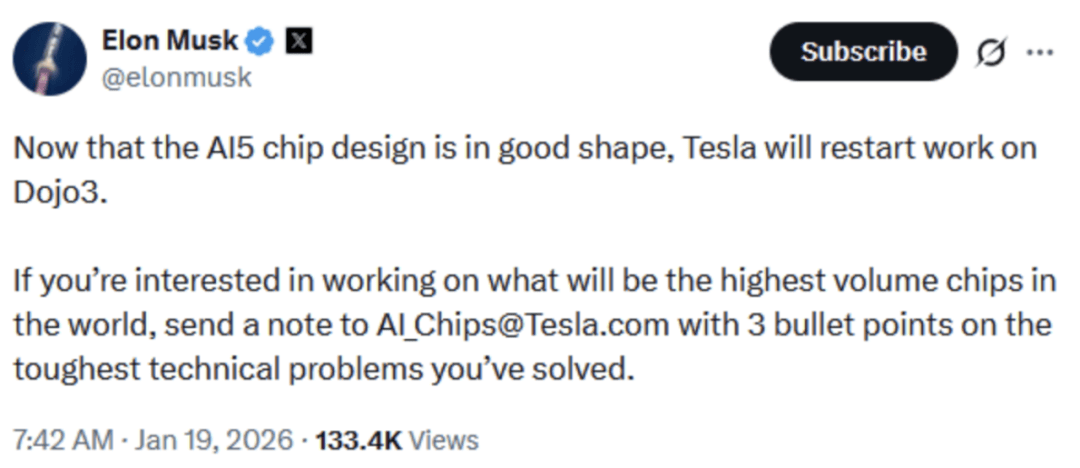
刚刚,马斯克重大宣布!
是说芯语· 2026-01-19 08:02
Core Viewpoint - Tesla is making significant advancements in its AI capabilities by restarting the Dojo supercomputer project, driven by the completion of its self-developed AI5 chip, which is crucial for its autonomous driving and robotics initiatives [2][3]. Group 1: Dojo Project and AI5 Chip - The Dojo project, initially proposed by Elon Musk in 2019, aims to create Tesla's own computing foundation to support its Full Self-Driving (FSD) system and AI models, reducing reliance on external chips [3]. - The AI5 chip boasts impressive performance, with a single SoC performance comparable to NVIDIA's Hopper level and a dual-chip configuration nearing Blackwell level, while being more cost-effective and energy-efficient [3][4]. - The AI5 chip's operational performance ranges between 2000 to 2500 TOPS, approximately five times that of the current HW4 chip, enabling more complex FSD algorithms and potentially serving as the "brain" for Tesla's robots [5]. Group 2: Production and Future Developments - Sample production and small-scale deployment of the AI5 chip are set to advance in 2026, with mass production expected to be completed by 2027, involving partnerships with Samsung and TSMC for manufacturing [5][6]. - Tesla has already initiated early development of the AI6 chip, which is planned for release in 2028, featuring a modular design that integrates deeply with the Dojo supercomputer [6]. Group 3: Software and Business Model Changes - Starting February 14, 2026, Tesla will transition its FSD from a one-time purchase model to a monthly subscription model, marking a significant shift in its software business strategy [7]. - This change aims to lower the usage barrier and increase adoption rates while establishing a stable revenue stream from software, supporting the rollout of new features like fully autonomous driving and Robotaxi testing [7]. - Analysts estimate that the full deployment of Dojo could enhance Tesla's valuation by up to $500 billion, highlighting the potential impact on its future business ventures, including robotics and shared mobility [7].
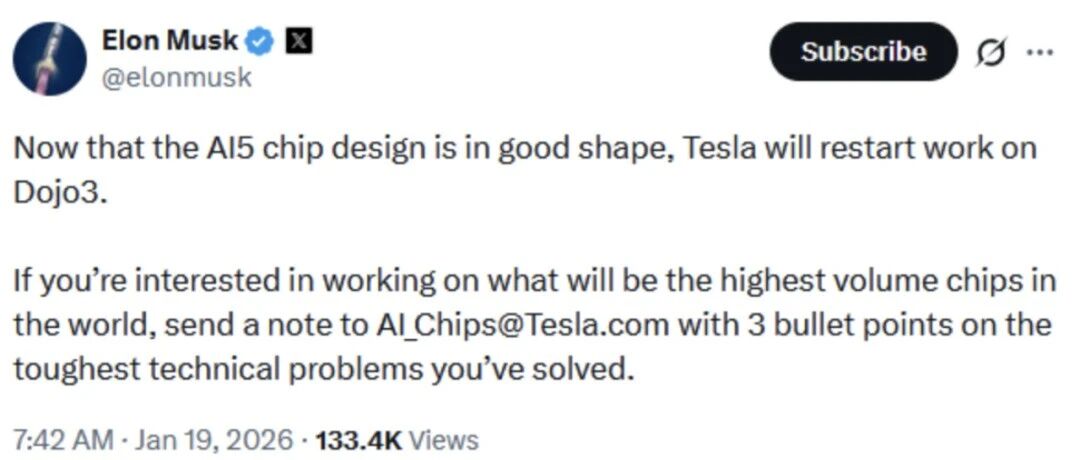
重启!刚刚,马斯克重大宣布!
券商中国· 2026-01-19 07:50
Core Viewpoint - Tesla is set to restart the development of its supercomputer project Dojo 3 following the completion of the AI5 chip design, which is crucial for enhancing its Full Self-Driving (FSD) capabilities and reducing reliance on external suppliers [2][4]. Group 1: AI5 Chip Development - The AI5 chip is designed to support more complex FSD algorithms, with performance expected to reach 2000-2500 TOPS, approximately five times that of the current HW4 chip [8][9]. - The production timeline for the AI5 chip includes sample and small-scale deployment in 2026, with mass production anticipated in 2027 [9]. - The AI5 chip's development is critical for Tesla's robot business and the overall advancement of its autonomous driving technology [2][9]. Group 2: Dojo Project - The Dojo project aims to provide robust computational support for Tesla's autonomous driving systems and AI models, thereby minimizing dependence on external suppliers [6]. - Morgan Stanley estimates that full deployment of the Dojo project could lead to a potential valuation increase of several billion dollars for Tesla [6]. - The project was initially paused in 2025 but is now being revived as resources are refocused on the AI5 and subsequent chips [5][6]. Group 3: Strategic Shift in FSD - Tesla will transition its FSD offering from a one-time purchase model to a monthly subscription service starting February 14, aiming to lower usage barriers and increase penetration [10][12]. - The previous one-time purchase price for FSD was $8,000 in the U.S. and approximately 64,000 RMB in China [10]. - This strategic shift indicates a significant change in Tesla's approach to autonomous driving, focusing on creating a continuous revenue stream [12].

中信建投:反内卷及出海预期改善 自动驾驶及机器人催化连连
Zhi Tong Cai Jing· 2026-01-19 06:23
Automotive Sector - The automotive sector is currently experiencing weak performance during the off-season, but there are structural improvements expected due to reduced competition and overseas expansion [1] - In January 2026, domestic passenger vehicle wholesale and retail sales decreased by 40% and 32% year-on-year, respectively, with new energy vehicles down by 30% and 38% [1] - The Ministry of Industry and Information Technology, the National Development and Reform Commission, and the State Administration for Market Regulation are working to regulate competition in the new energy vehicle industry and resist disorderly price wars [1] Autonomous Driving - 2026 is anticipated to be the year of commercialization for autonomous driving, with Tesla's FSDV14 potentially reaching near Level 4 autonomy [2] - The U.S. House of Representatives is discussing more relaxed legislation for new automotive autonomous driving [2] - Shanghai has released an action plan aiming for large-scale implementation of high-level autonomous driving applications by 2027 [2] Humanoid Robots - The market for humanoid robots continues to strengthen, with Tesla's V3 prototype video boosting market expectations [3] - Key communications with core suppliers in the T-chain are ongoing, leading to a phase of fundamental realization [3] - Future tracking points for the sector include Tesla's annual report on January 28, the official release and small-scale production of the V3 prototype in February-March, and progress in overseas production capacity [3] Commercial Vehicles - Weichai Power's stock has performed strongly, with major domestic manufacturers resuming AIDC construction tenders [4] - The acceleration of domestic substitution for computing cards is expected to expand the tender scale for 2027-2028, boosting growth expectations for diesel engine units and their core components [4] - Yutong Bus is highlighted for its opportunities in the left-side layout, with strong performance in new energy exports and a clear mid-term trend of rising volume and profit [4]

新石器无人车入围2025胡润中国人工智能企业50强
Jin Rong Jie· 2026-01-19 06:12
Core Insights - The article highlights the recognition of New Stone Technology's autonomous vehicle as a benchmark in the industry, ranking 41st in the "2025 Hurun China AI Companies Top 50" list due to its technological breakthroughs and commercialization capabilities in the autonomous driving sector [2][4]. Company Overview - New Stone Technology has made significant advancements in autonomous driving technology, particularly with its AI-driven next-generation logistics solution unveiled at CES 2026, featuring a dual-engine architecture optimized for large-scale autonomous vehicle fleets [2][3]. - The company’s core technologies include a "Global Intelligent Scheduling System" and "Mapless L4 Autonomous Driving," which have redefined logistics operations and improved efficiency [3][4]. Technological Innovations - The Global Intelligent Scheduling System utilizes large models and deep learning to automate the entire logistics lifecycle, capable of supporting over 100,000 L4 autonomous vehicles simultaneously and enhancing operational efficiency by 30% [3]. - New Stone Technology achieved commercial deployment of mapless L4 autonomous driving technology in 2025, allowing for centimeter-level positioning accuracy without relying on high-precision maps, thus reducing deployment costs and preparation time [3][4]. Competitive Positioning - The entry into the top 50 list serves as a validation of New Stone Technology's competitive edge and foresight in the autonomous driving sector, emphasizing the importance of this field within the broader AI landscape [4]. - The Neolix-VA visual action model, a key innovation, enables the autonomous vehicles to navigate complex traffic scenarios effectively, showcasing superior adaptability and lower deployment costs compared to traditional L4 technology stacks [4].