
红利风格

Search documents
盘中速递 | 同类规模最大的自由现金流ETF(159201)成交额率先突破2.4亿元
Mei Ri Jing Ji Xin Wen· 2025-09-25 06:29
Core Viewpoint - The Guozheng Free Cash Flow Index has shown a slight increase, with significant gains in constituent stocks, indicating a positive trend in the market for free cash flow-focused investments [1] Group 1: Market Performance - As of September 25, 2025, the Guozheng Free Cash Flow Index rose by 0.05%, with notable gains in stocks such as Lianxu Electronics, Tailong Co., Shanghai Electric, Luoyang Molybdenum, and Lingyun Co. [1] - The largest free cash flow ETF (159201) followed the index's upward movement, achieving a trading volume of 240 million yuan during the session [1] - The average daily trading volume of the free cash flow ETF over the past month reached 327 million yuan, ranking it first among comparable funds [1] Group 2: Investment Strategy - Nanjing Securities highlighted that the growth sector is experiencing volatility, while sectors with strong policy expectations, such as "anti-involution" and "promoting domestic demand," remain relatively undervalued, presenting high cost-performance for medium to long-term allocation [1] - The free cash flow ETF (159201) closely tracks the Guozheng Free Cash Flow Index, addressing the limitations of traditional dividend strategies in terms of industry coverage and future performance predictions, focusing on internal growth capacity and financial health [1] - The fund management fee is set at an annual rate of 0.15%, and the custody fee at 0.05%, both of which are among the lowest in the market, maximizing benefits for investors [1]
券商四季度策略来了!这一主线有望延续
Zhong Guo Zheng Quan Bao· 2025-09-24 13:56
Core Viewpoint - The A-share market is entering a period of fluctuation as the third quarter concludes, with brokerages maintaining a relatively positive outlook for the fourth quarter, suggesting that the market trend is not yet over [1][2]. Market Performance - The A-share market has shown a daily trading volume exceeding 2 trillion yuan, with major indices experiencing divergence; the Shanghai Composite Index remains in a high-level fluctuation while the Shenzhen Component and ChiNext indices continue to rise [2]. - A structural recovery in A-share earnings is anticipated, driven by policy expectations, macro and micro liquidity improvements, and a resilient export growth forecast [2]. Policy Impact - The recent Federal Reserve interest rate cuts are expected to boost the RMB exchange rate, attracting global capital inflows into China, with a shift in market focus towards 2026 economic and policy expectations [3]. - Domestic liquidity is expected to remain loose, with increased allocation towards equity assets by residents, contributing to market growth [3]. Market Style - The market is expected to exhibit a more balanced style in the fourth quarter, with both growth and value styles having opportunities [4]. - Historical data suggests that value styles have a slightly higher probability of outperforming growth styles in the fourth quarter since 2013 [4]. Investment Focus - The primary investment focus for the fourth quarter includes technology growth sectors, particularly AI, alongside cyclical products and sectors with improving economic conditions [5][6]. - Specific sectors identified for potential growth include rare earth permanent magnets, precious metals, military, financial IT, and various consumer goods [6]. Sector Recommendations - Companies are advised to focus on sectors such as non-ferrous metals, AI hardware and applications, and consumer services, with particular attention to emerging trends in pet economy, IP toys, and beauty products [6].
A股收评 | 创指探底回升涨0.21%!芯片股反攻 机构热议本轮行情持续性
智通财经网· 2025-09-23 08:31
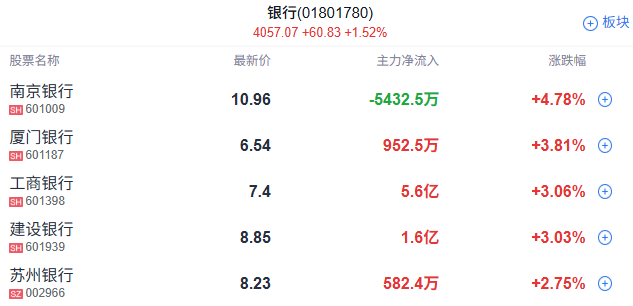
Market Overview - The market experienced fluctuations with the Shanghai Composite Index down 0.18%, Shenzhen Component Index down 0.29%, and ChiNext Index up 0.21% at the close [1] - The trading volume in the Shanghai and Shenzhen markets reached 2.49 trillion yuan, an increase of 372.9 billion yuan compared to the previous trading day [1] Key Sectors Banking Sector - Bank stocks collectively rose, with Nanjing Bank increasing by over 5%, and other banks like Xiamen Bank and Agricultural Bank also seeing gains [2][3] - Morgan Stanley's report remains bullish on Chinese bank stocks, emphasizing their stable dividend yields and strong performance [3] Precious Metals - Gold stocks saw an uptick, with Xiaocheng Technology rising over 8% [4][5] - International gold prices reached a new high, with COMEX gold futures surpassing $3,760 per ounce [5] Semiconductor Sector - The semiconductor industry showed signs of recovery, with stocks like Kaimeteqi and Wavelength Optoelectronics hitting the daily limit [6][7] - Longchuan Technology projected a significant profit increase of 131.39% to 145.38% year-on-year for the first three quarters of 2025 [7] Other Notable Stocks - Tianpu Co. achieved a 15-day consecutive limit-up, with a total increase of 279.73% since September 22 [1] Institutional Insights - CICC reports indicate that the current A-share market is in a short-term adjustment phase but maintains a mid-term upward trend, suggesting a more stable and long-term market condition [9][10] - Huatai Securities notes that market sentiment is a key factor influencing A-share performance, with trading funds remaining active [11] - Galaxy Securities expresses optimism for the computing-related sectors, including PCB and domestic computing, as they remain in a performance realization phase [12]



W126市场观察:长江“成长+”系列维持较好表现
Changjiang Securities· 2025-09-22 02:14
Market Performance - The weekly trading volume showed a slight recovery, while the Shanghai Composite Index experienced a minor decline[2] - The "Growth+" series indices from Changjiang maintained a positive performance, with the Changjiang Growth Index doubling its year-to-date increase[2] - The weekly performance of the Changjiang Dual Innovation Growth Index was notably strong[6] Style and Sector Analysis - The trading activity of the dividend style continued to recover, while the crowding degree of the growth style slightly decreased[6] - High profitability quality stocks saw a sustained increase in trading activity, while micro-cap stocks' crowding degree continued to decline[2] - The consumer discretionary sector led the weekly performance among industry sectors, followed by information technology and hardware[28] Fund Performance - The fund-heavy 50 index outperformed other fund-heavy indices, with a weekly return of 1.62%[22] - The overall fund-heavy index maintained an upward trend during the week[23] - The Northbound heavy series underperformed compared to the Changjiang All A index since the beginning of 2025[26] Thematic Trends - The Changjiang Manufacturing Champion Selected Index showed strong weekly performance, leading the thematic indices[34] - The Changjiang Low-Carbon Leader 30 Index achieved a weekly return of 4.25%[34]

中金公司:本轮行情可能更具备“长期”、“稳进”条件
Xin Lang Cai Jing· 2025-09-22 00:31
Core Viewpoint - The recent report from CICC indicates that the A-share market is currently in a short-term adjustment phase, but this does not alter the medium-term trend. The current market conditions may be more aligned with "long-term" and "steady progress" characteristics [1] Group 1: Market Trends - The growth style has recently shown characteristics of diffusion and rotation, expanding from technology growth to sectors such as innovative pharmaceuticals, high-end manufacturing, military industry, and new energy since the beginning of the year [1] - The strong sectors are expected to continue to alternate, indicating a potential for ongoing market dynamics [1] Group 2: Earnings and Policy Focus - As the third quarter draws to a close, investor attention towards the third-quarter earnings reports is likely to increase [1] - Important policy moments should be monitored for their implications on medium to long-term reform directions, particularly in areas benefiting from support for new productive forces, green development, and expanded openness [1] Group 3: Dividend Style - The dividend style remains a phase-specific and structural performance characteristic [1]

W125市场观察:红利风格交易活跃度持续回暖
Changjiang Securities· 2025-09-14 23:31
Market Overview - The trading activity of dividend style has shown a recovery, with the micro盘 index's congestion level continuing to decline[1] - The weekly trading volume in the market has slightly decreased, while the Shanghai Composite Index has risen[1] - The growth style has rebounded from last week's pullback, indicating ongoing style switching in the market[1] Sector Performance - The real estate sector has led the weekly gains, with TMT (Technology, Media, and Telecommunications) sectors also performing relatively well[3] - High dividend sectors such as coal and insurance remain at low congestion levels, suggesting potential for future growth[1][3] Fund Performance - The fund-heavy indices have continued their upward trend, with the fund-heavy index gaining 2.50% this week, outperforming the benchmark[23] - The Northbound heavy series has underperformed compared to the overall market since the beginning of 2025[27] Style Tracking - The "Growth+" series has performed well, with the growth index showing a weekly gain of 4.78%[33] - The high profitability quality index has also seen a recovery, indicating a positive trend in profitability quality[1][3] Thematic Trends - The specialized and innovative series indices have shown good rebounds, with the specialized and innovative selected index gaining 6.92% this week[35] - The carbon neutrality and rural revitalization indices have also performed positively, with gains of 2.08% and 1.03% respectively[35]
W124市场观察:盈利质量、红利风格交易活跃度有所回暖
Changjiang Securities· 2025-09-07 10:11
Market Overview - The Shanghai Composite Index experienced increased volatility with a slight decline in trading volume during the week[2] - Growth style saw a pullback, but a strong rebound was noted on the last trading day, particularly in the ChiNext Index[2] Trading Activity - Dividend style trading activity showed signs of recovery, while high profitability quality continued to rise[3] - The congestion level in high dividend sectors like coal and insurance remains at the bottom, indicating potential for growth[2] Sector Performance - The healthcare sector led the weekly performance, with healthcare leaders significantly outperforming dividend stocks in the same sector[3] - The value stable and value prosperity composite strategies outperformed during the week[3] Fund Performance - The Fund Heavyweight 50 Index recorded a weekly return of 2.35%, continuing its upward trend[22] - The overall performance of the Fund Heavyweight Index was volatile, but it led the institutional series in returns[22] Theme Trends - The low-carbon leader indices (30/60) showed strong weekly performance, with returns of 8.58% and 8.26% respectively[34] - The carbon neutrality index also performed well, with a weekly return of 5.53%[34]
A股收评 | 三大利好提振!A股大反攻 沪指收复3800点关口
智通财经网· 2025-09-05 07:15
Market Overview - The A-share market experienced a significant rebound, with the ChiNext Index soaring over 6% and the Shanghai Composite Index recovering above 3800 points, driven by strong performances in the new energy and computing power sectors [1] - The total market turnover reached 2.3 trillion yuan, a decrease of over 200 billion yuan compared to the previous trading day, with more than 4800 stocks rising and over 100 stocks hitting the daily limit [1][2] Key Drivers - Three major positive factors influenced the market: 1. Policy support for the new energy sector, with two departments issuing guidelines to promote the orderly layout of the photovoltaic and lithium battery industries [1] 2. Liquidity support from the central bank, which conducted a 1 trillion yuan reverse repurchase operation to inject medium-term liquidity into the market [1] 3. Positive outlook from foreign investment banks, with UBS projecting a sustained slow bull market for A-shares and Goldman Sachs noting that a significant amount of "existing capital" has yet to enter the market [1] Sector Performance - Strong rebounds were observed in sectors such as chips and computing hardware, with stocks like Shenghong Technology hitting a 20% limit up and setting a new historical high [1] - New energy stocks, including photovoltaic, energy storage, wind power, and lithium mining, also saw substantial gains, with Tianji Co. achieving two consecutive limit-ups [1] - The sports industry sector rose, with Lisheng Sports hitting the limit up, while sectors like banking, food and beverage, and insurance showed declines [1] Fund Flow - Main funds focused on accumulating stocks in the battery, photovoltaic equipment, and energy metals sectors, with notable net inflows into companies like XianDao Intelligent, Luxshare Precision, and XinWangDa [3] Future Outlook - CICC believes that the rapid rise in A-share trading volume may lead to short-term adjustments, but this will not hinder the medium-term trend, emphasizing the importance of growth style expansion and rotation [7] - CITIC Securities suggests that the current market lacks substantial negative factors, and the recent declines are primarily due to a drop in risk appetite, indicating potential for horizontal consolidation in the market [8] - Zheshang Securities highlights that the decline in interest rates is a key driver of the current A-share rally, with long-term growth potential remaining intact, particularly in hard technology sectors like robotics, semiconductors, and new energy [9]
A股午评 | 创指半日涨逾3% 新能源赛道股延续强势 芯片、算力反弹
智通财经网· 2025-09-05 03:51
Market Overview - A-shares experienced a rebound with over 3,900 stocks rising, and the half-day trading volume reached 1.37 trillion, a decrease of 226.3 billion compared to the previous trading day [1] - By midday, the Shanghai Composite Index rose by 0.35%, the Shenzhen Component Index increased by 2.01%, and the ChiNext Index surged by 3.48% [1] Key Drivers of Market Movement - Three major positive factors influenced the market: 1. Policy support for the new energy sector, with two departments issuing documents to guide local governments in the orderly layout of the photovoltaic and lithium battery industries [2] 2. Recent bullish outlooks from foreign investment banks, with UBS stating that a slow bull market for A-shares is likely to continue, and Goldman Sachs noting that a significant amount of "existing capital" has yet to enter the market [2] 3. External factors, including rising expectations for interest rate cuts, with all three major U.S. stock indices closing higher, and the S&P 500 reaching a record high [2] Sector Performance - **New Energy Sector**: Continued strong performance with solid-state battery stocks surging, and companies like Tianji Co. and Tianhong Lithium hitting the daily limit [3] - **Computing Hardware Stocks**: Experienced a rebound, particularly in the CPO segment, with companies like Shenghong Technology rising nearly 10% [4] - **Sports Industry**: The sector saw gains, with companies like Lisheng Sports and Shuhua Sports hitting the daily limit, supported by government policies aimed at enhancing sports consumption and industry growth [5] Institutional Insights - **CICC**: Acknowledged that the rapid increase in trading volume may lead to short-term adjustments but does not alter the mid-term trend. The current A-share valuation is reasonable, with a PE ratio below 14, indicating a relatively low level globally [6][7] - **CITIC Securities**: Suggested that the current market lacks substantial negative factors, attributing recent declines to a drop in risk appetite and technical adjustments following significant prior gains [7] - **Zheshang Securities**: Highlighted that declining interest rates are a key driver of the current A-share market rally, with long-term growth potential remaining intact, particularly in hard technology sectors like robotics and semiconductors [8]
开盘:三大指数涨跌不一 体育产业涨幅居前
Xin Lang Cai Jing· 2025-09-05 03:13
Market Overview - The three major indices showed mixed performance, with the sports industry leading in gains. As of the market opening, the Shanghai Composite Index was at 3761.88 points, down 0.11%, the Shenzhen Component Index at 12140.76 points, up 0.18%, and the ChiNext Index at 2789.91 points, up 0.49% [1] Institutional Insights - CICC's report indicated that the recent decline of over 1% in the Shanghai Composite Index does not alter the mid-term trend, with limited downside risks. The upward trend since September 2022 is expected to continue. The overall valuation of the A-share market is considered reasonable, and the market's performance globally has been in the mid-range. Positive growth in A-share earnings is anticipated for the year, with the second half expected to outperform the first half. Additionally, policy benefits are becoming evident, with regulatory emphasis on maintaining the stability and positive momentum of the capital market [2] - CITIC Securities highlighted that domestic AI applications are benefiting from accelerated industrial development and technological evolution. Numerous companies have reported positive progress in AI application implementation. The current phase of AI application in China is characterized by rapid penetration, particularly in enterprise management, industrial manufacturing, and marketing sectors. Overall, leading companies in various fields are expected to see a positive outlook for AI application revenue, with the annual revenue share of AI applications likely to exceed double digits. AI-related businesses are helping downstream clients reduce costs and increase efficiency, while AI application companies are lowering development costs through internal empowerment, both contributing to improved gross margins and profitability for companies in this sector [2] - Investment recommendations suggest that the computer sector will see continuous performance improvement in the first half of 2025, with a focus on investment opportunities in AI software and hardware, trusted computing, and stablecoins [2]