美国就业市场

Search documents
【环球财经】美联储宣布再次降息 鲍威尔称12月进一步降息并非板上钉钉
Xin Hua She· 2025-10-29 23:17
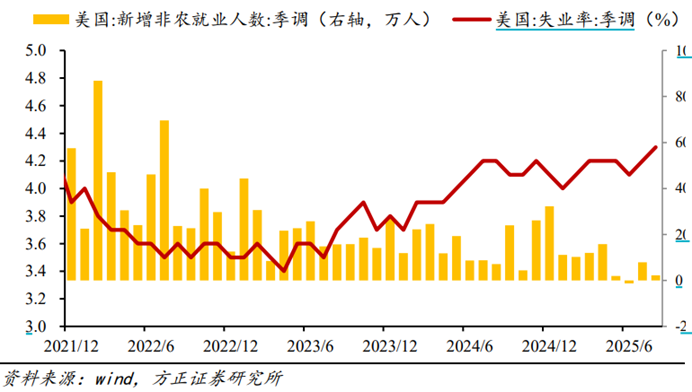
Core Points - The Federal Reserve announced a 25 basis point cut in the federal funds rate target range to 3.75% to 4.00% [1] - Fed Chairman Powell indicated that further rate cuts in December are not guaranteed, emphasizing the need to assess evolving economic data and risks [2] Economic Indicators - Current indicators show moderate expansion in U.S. economic activity, with a slowdown in job growth and a slight increase in the unemployment rate [1] - Inflation rates have risen since the beginning of the year and remain at high levels [1] Decision-Making Process - The Federal Open Market Committee (FOMC) will carefully evaluate the latest data and changing economic outlook before making further adjustments to the federal funds rate [1] - The decision to cut rates was supported by 10 out of 12 FOMC members, with differing opinions on the extent of the cut [1] Future Projections - Analysts suggest that despite inflation being above the Fed's 2% target, employment issues are becoming a focal point for the Fed [2] - Morgan Stanley predicts continued rate cuts until January 2026, with a final target range of 3.00% to 3.25% [2] - Franklin Templeton Investments anticipates that inflation concerns will limit the extent of rate cuts, with the final target likely above 3.5% [2]
2025年9月美国CPI数据点评:美国通胀叙事进一步弱化
Orient Securities· 2025-10-28 05:19
Inflation Data Summary - In September 2025, the U.S. CPI increased by 3% year-on-year, below the market expectation of 3.1% and up from the previous value of 2.9%[7] - Month-on-month, the CPI rose by 0.3%, lower than the expected 0.4%[7] - Core CPI also recorded a year-on-year increase of 3%, matching the market expectation but down from the previous 3.1%[7] Core Inflation Insights - Core goods inflation remained stable at 1.5%, primarily driven by imported goods, with furniture and household items seeing a slight increase to 3%[7] - Core services inflation showed a downward trend, with rent for primary residences decreasing from 3.5% to 3.4% year-on-year[7] - The overall trend indicates a short-term characteristic of rising goods prices and falling service prices, with manageable overall price increases[7] Economic Outlook and Risks - The report highlights risks of a hard landing for the U.S. economy and a significant rebound in inflation, which could affect the Federal Reserve's interest rate decisions[4] - The labor market is showing signs of weakness, which is expected to continue to suppress consumer confidence and core inflation trends[7] - The Federal Reserve is anticipated to focus on employment performance, with a projected target interest rate of 3.6% by the end of 2025, allowing for two more 25 basis point cuts[7]
美国9月CPI未达预期 美联储10月或将降息
Qi Huo Ri Bao· 2025-10-25 09:47
Group 1 - The U.S. Consumer Price Index (CPI) rose by 0.3% month-on-month in September, lower than the 0.4% increase in August, and year-on-year it increased by 3.0%, slightly above the previous value of 2.9% but still below market expectations of 3.1% [1] - Core CPI, excluding food and energy, rose by 0.2% month-on-month, marking the third consecutive month of decline, with the year-on-year increase also dropping to 3.0% [1] - Analysts believe that the moderate inflation growth opens up the possibility for the Federal Reserve to cut interest rates by 25 basis points in the upcoming meeting, despite short-term increases in energy prices [1] Group 2 - Minsheng Securities anticipates that the core inflation in September will continue to show a moderate upward trend, reinforcing the market's pricing of a rate cut in October [2] - The Federal Reserve's focus is shifting towards supporting the labor market, as signs of weakness in the job market have become more apparent, even in the absence of government data during the shutdown [2] - Even if a 25 basis point rate cut occurs in October, the path for future easing by the Federal Reserve may be more constrained, with potential upward pressure on inflation leading to a possible pause in rate cuts in December or January [2]
华泰证券:美国9月CPI回落铺平降息道路
Zheng Quan Shi Bao Wang· 2025-10-25 08:17
Core Viewpoint - The report from Huatai Securities indicates that the U.S. CPI in September unexpectedly slowed down, primarily due to a surprising decrease in the housing component, while tariffs continue to moderately push up commodity prices [1] Economic Indicators - The unexpected drop in inflation in September was influenced by disturbances in the housing component [1] - The ongoing government shutdown and a cooling job market suggest a high probability of the Federal Reserve lowering interest rates in October, with December also being a baseline scenario for a rate cut [1] Tariff Impact - The current round of tariffs has a relatively small overall impact on inflation but is characterized by a longer-lasting effect [1] - The limited impact of tariffs on inflation suggests that they will not significantly constrain the Federal Reserve's ability to lower interest rates [1] Employment Market - The persistent government shutdown and the expiration of the DOGE buyout plan are expected to impact the fragile U.S. job market in the short term [1] - The Federal Reserve needs to be cautious of the risk of a rapidly weakening job market, reinforcing the expectation of rate cuts in October and December [1]

布米普特拉北京投资基金管理有限公司:巴尔对美联储连续降息表怀疑
Sou Hu Cai Jing· 2025-10-22 11:13
Core Viewpoint - Federal Reserve Governor Barr emphasizes the need for caution in monetary policy adjustments amid persistent inflation and a cooling job market, adding uncertainty to expectations of consecutive rate cuts [1][3]. Group 1: Monetary Policy Stance - Barr supports the Fed's decision to cut rates by 25 basis points in September but clarifies that this does not imply a series of continuous rate cuts [3]. - He highlights ongoing concerns about inflation, citing that it may not return to the 2% target until the end of 2027, which he considers a long wait for consumers [3][6]. Group 2: Economic Indicators - The latest data shows that the Personal Consumption Expenditures (PCE) price index rose by 2.7% year-on-year in August, with the core index reaching 2.9% [6]. - Barr anticipates that the core PCE price index will remain above 3% by the end of the year, indicating a prolonged path to achieving the inflation target [6]. Group 3: Labor Market Conditions - The labor market has shown signs of cooling, with job creation significantly slowing since May, although the unemployment rate remains at 4.3% as of August [6][9]. Group 4: Tariff Policy Impact - Barr expresses skepticism about the impact of tariff policies on inflation, noting that the effective tariff rate has risen significantly, reaching approximately 11% in August, which may lead businesses to pass costs onto consumers [6]. Group 5: Internal Policy Discrepancies - Barr's cautious stance contrasts with other Fed officials, such as New York Fed President Williams, who supports further policy easing, and newly appointed Governor Stephen Milan, who advocates for more aggressive rate cuts [9].

AI是否该为美国就业疲软“背锅”?(国金宏观钟天)
雪涛宏观笔记· 2025-10-15 00:17
Core Viewpoint - The article discusses the limited impact of AI technology on the U.S. labor market, emphasizing that the current employment environment is characterized by "low hiring, low layoffs," which affects young and less experienced workers more significantly [4][6][37]. Group 1: Employment Trends and AI Impact - The U.S. job market is experiencing a slowdown in non-farm employment growth, particularly affecting young and highly educated workers who are more vulnerable to AI [4][6]. - The overall unemployment rate increased from 3.67% in 2019 to 4.18% in 2025, with specific groups like recent college graduates seeing a rise from 3.25% to 4.59% [5]. - The article suggests that the weakness in employment is more a result of the previous interest rate hike cycle rather than a direct consequence of AI technology [6][37]. Group 2: AI Adoption and Employment Dynamics - Companies are primarily in the "retraining" phase regarding AI adaptation, indicating limited immediate impact on employment [8][10]. - The penetration rate of AI remains low, with only six out of over twenty major industries exceeding a 10% adoption rate, and the highest being in the information technology sector at approximately 25% [15][20]. - A study categorizing potential AI impacts on jobs found that 42% of occupations show no improvement from AI, while 44% have potential for enhancement, indicating that AI's disruptive effects are not uniform across the job market [16][28]. Group 3: Structural Issues in Employment - The article highlights that the current employment dynamics are more influenced by economic cycles and corporate caution in layoffs rather than AI technology [25][30]. - Young workers are particularly affected by the combination of low hiring rates and low turnover, resulting from companies hoarding labor during the pandemic and being hesitant to lay off employees [32][34]. - The article argues that the introduction of AI technologies like ChatGPT coincided with existing employment trends rather than being the primary cause of job market changes [26][30].


鲍威尔重申美联储利率政策没有预先确定路径
Sou Hu Cai Jing· 2025-10-14 22:46
Core Viewpoint - The Federal Reserve, led by Chairman Powell, emphasizes a flexible approach to policy-making based on evolving economic conditions rather than a predetermined path [1] Group 1: Monetary Policy - Powell reiterated that the Fed's interest rate policy does not have a risk-free path due to the need to balance employment and inflation targets [1] - The next Federal Open Market Committee meeting is scheduled for October 28-29, with market expectations leaning towards a potential 25 basis point rate cut following the previous cut on September 17 [1] Group 2: Economic Monitoring - Powell addressed the impact of the federal government shutdown on official data reporting, stating that the Fed has its own contacts and data sources to monitor the health of the U.S. economy [1] - According to the data available to the Fed, there has been little change in employment and inflation outlook since the September meeting [1]
美联储沃勒:就业市场恶化已成首要担忧,美国就业或遇负增长
智通财经网· 2025-10-10 13:00
Core Viewpoint - The U.S. job growth may have turned negative in recent months, with the current job market being a primary concern for policymakers [1] Group 1: Employment Market - Christopher Waller, a Federal Reserve governor, indicated that the job market is in a weak state, which is a critical consideration for policy decisions [1] - The September non-farm payroll report was delayed due to the U.S. government shutdown, which adds uncertainty to the employment data [1] Group 2: Federal Reserve Policy - Waller expressed a preference for continuing interest rate cuts but emphasized the need for caution among policymakers [1] - He is a leading candidate to succeed Jerome Powell as the Federal Reserve Chair, with discussions focusing on serious economic issues rather than political factors [1]
路透社:美国 9 月就业市场停滞 美联储可能继续推动降息
Sou Hu Cai Jing· 2025-10-03 10:01
来源:市场资讯 (来源:吴说) 据路透社报道,美国政府停摆导致官方就业数据推迟,市场转向替代指标评估 9 月劳动力市场状况。芝 加哥联储估算失业率维持在 4.3%,显示整体稳定但就业增长乏力。ADP 数据显示私企减少 3.2 万岗 位,Intuit 报告称小企业裁员超过 4.8 万,而 Challenger 报告则显示裁员环比下降 37%,但全年招聘计 划创 2009 年以来最低。整体迹象表明劳动力市场停滞,美联储可能继续推动降息。 ...
美国消费者信心指数转弱,就业预期连续九个月恶化并创多年新低
Huan Qiu Wang· 2025-10-02 00:39
Group 1 - The consumer confidence index in the U.S. dropped to 94.2 in September, a decrease of 3.6 points from August, marking the lowest level since April [1] - The percentage of respondents who believe job opportunities are "plentiful" fell to 26.9%, a decline of over 3 percentage points from August, while those who think jobs are "hard to find" remained at 19.1% [1] - There is a significant increase in pessimism regarding financial conditions, with the largest single-month decline in perceptions of current financial status since July 2022 [1] Group 2 - The Conference Board's senior economist noted a clear weakening in consumer judgment regarding business conditions, with a continuous deterioration in views on job opportunities for nine months, reflecting the slowing U.S. economic recovery and pressure on household spending [1] - Wall Street analysts suggest that the stability of the labor market is a crucial consideration for Federal Reserve officials as they contemplate future interest rate movements [1] - The Vice Chairman of the Federal Reserve indicated that inflation rates in the U.S. are expected to decline next year, reaching 2% in the coming years, while the downside risks to the labor market are increasing [1] Group 3 - Recent employment data in the U.S. has shown a weaker-than-expected trend for two consecutive months, indicating a cooling labor market [3] - The decline in employment numbers is attributed to reduced labor supply due to immigration policies, which has prevented a significant rise in the unemployment rate, and wage growth remains moderate [3] - Current conditions do not warrant a high-risk assessment for a recession in the U.S. economy at this time [3]