
联邦基金利率

Search documents
招银国际:明年美联储或进一步减息两次 明年底联邦基金利率目标降至3.25%-3.5%
智通财经网· 2025-10-27 02:37
Core Viewpoint - The report from 招银国际 indicates that the U.S. CPI in September showed a slight recovery year-on-year, but it was below market expectations. The core CPI experienced a slowdown month-on-month, primarily due to a drop in used car prices, while prices of imported goods rebounded significantly, reflecting ongoing tariff effects [1]. Inflation and Monetary Policy - The inflation rebound was less than anticipated, leading the Federal Reserve to focus more on employment risks, with expectations of a potential rate cut in October or December, targeting a year-end federal funds rate of 3.75%-4% [1]. - The October CPI is likely to be suspended, and based on historical data from 2013, the first CPI data after a long hiatus may show significant deviations due to limited sample data, increasing uncertainty regarding the timing of rate cuts [1]. Banking System and Future Projections - As the banking system's reserves approach a reasonable level of abundance, the Federal Reserve may soon halt quantitative tightening (QT) [1]. - Looking ahead to next year, as economic growth stabilizes and inflation declines, the Federal Reserve may implement two additional rate cuts, with a year-end target for the federal funds rate of 3.25%-3.5% [1].
黄金暴跌,是“倒车接人”还是“顶部崩塌”?
Jing Ji Guan Cha Wang· 2025-10-22 10:32
Core Viewpoint - The recent sharp decline in gold prices, with a drop exceeding 6% on October 21, has raised significant concerns among investors, marking the largest single-day drop since April 2013 [2][4][5]. Market Reaction - On October 22, gold ETFs opened significantly lower, with declines exceeding 4%, and the Shanghai Gold Exchange reported a drop of 54 CNY per gram [2][4]. - Domestic gold jewelry prices also adjusted downward, with reductions of up to 83 CNY per gram in some stores [2]. Causes of the Decline - The decline in gold prices is attributed to multiple negative factors, including a decrease in risk aversion, a strengthening dollar, and profit-taking by investors concerned about high price levels [5][6]. - Specific triggers include improved expectations regarding U.S.-China relations, potential resolution of the Russia-Ukraine conflict, and the end of the U.S. government shutdown, which reduced market uncertainty [6]. Investor Sentiment - Investors are experiencing heightened volatility in the gold market, with some expressing a willingness to hold onto their investments despite recent losses, citing low average purchase prices as a buffer [7]. - Analysts suggest that while short-term adjustments may occur, long-term demand from central banks and investment growth will likely support gold prices [7][8]. Future Outlook - Analysts predict a potential 10%-15% correction in gold prices, similar to market behavior observed earlier in the year [3]. - The long-term outlook remains positive, with expectations that gold will continue to be a fundamental asset in investment portfolios, driven by ongoing geopolitical and economic uncertainties [8].

大摩:无数据,无问题:为什么美联储仍可结束量化紧缩并继续降息
2025-10-20 14:49
Summary of Key Points from the Conference Call Industry Overview - The discussion primarily revolves around the Federal Reserve's monetary policy, specifically focusing on quantitative tightening (QT) and interest rate management in the context of the U.S. economy. Core Insights and Arguments - The Federal Reserve's balance sheet peaked at $9 trillion during the financial crisis and pandemic due to quantitative easing, but it is currently undergoing quantitative tightening to reach a "sufficient reserves" level [1][4] - The Fed does not intend to restore its balance sheet to pre-crisis levels, as there are ample reserves in the banking system, necessitating a shift to a "sufficient reserves" framework instead of the traditional corridor system [5][1] - Insufficient reserves could lead to a sharp rise in short-term interest rates, as evidenced by the events of September 2019, which highlighted the risks of low reserve levels [6][1] - Powell indicated that QT might end sooner than the market's expectation of June 2026, potentially as early as the first quarter of 2026, reflecting the Fed's attentiveness to recent developments in the money market [7][1] - After the conclusion of QT, the Fed's balance sheet is expected to stabilize, continuing to manage short-term interest rates while maintaining appropriate reserve levels to avoid financial strain [8][1] Additional Important Content - The "sufficient reserves" framework, adopted in 2019, ensures that the Fed provides enough reserves to manage interest rates effectively, contrasting with the "ample reserves" and "scarce reserves" conditions that can lead to market volatility [2][1] - During the pandemic, the Fed purchased approximately $4.6 trillion in securities, leading to a peak balance sheet of about $9 trillion, and ceased asset purchases by the end of 2021 due to rising inflation [4][1] - The Fed is expected to let mortgage-backed securities (MBS) mature and reinvest the proceeds into U.S. Treasuries, with ongoing discussions about the duration structure of these investments [9][1] - There is a proposal to abandon the federal funds rate as a policy tool in favor of the Tri-Party General Collateral Rate (TGCR) or the Secured Overnight Financing Rate (SOFR), as the federal funds market no longer accurately reflects the cost of funds [10][1] - Powell's comments suggest that while the economic data has shown stability, there remains a necessity for potential rate cuts, with expectations for a 25 basis point reduction in the upcoming October meeting [11][1]
流动性警报拉响!美国银行准备金再跌破3万亿美元,美联储QT或于未来几月落幕
智通财经网· 2025-10-17 01:45
Group 1 - The U.S. banking system's reserves have fallen below $3 trillion, with a decrease of approximately $45.7 billion in the week ending October 15, bringing the total to $2.99 trillion [1] - Federal Reserve Chairman Jerome Powell indicated that quantitative tightening (QT) may stop in the coming months as reserves approach a level deemed "adequate" by policymakers [2] - The Federal Reserve's balance sheet reduction is impacting daily operations in the financial system, with liquidity tightening potentially leading to market volatility [1][2] Group 2 - Federal Reserve Governor Christopher Waller stated that the current balance sheet size has returned to a reasonable level corresponding to "adequate reserves," estimated at around $2.7 trillion [2] - The effective federal funds rate has seen a slight increase, indicating a potential tightening of financial conditions, currently within the 4% to 4.25% target range [2] - The trading volume in the federal funds market has decreased, with non-U.S. institutions having less excess cash to allocate, and Federal Home Loan Banks shifting more funds to the repurchase market due to higher rates [3]
融资压力持续:美国SOFR上涨10个基点,创9月17日以来新高
Xin Lang Cai Jing· 2025-10-16 14:52
Core Insights - The overnight secured financing rate (SOFR) reached 4.29% on October 15, marking the largest single-day fluctuation since September 30, which had a volatility of 11 basis points [1] - The previous day's SOFR was reported at 4.19%, indicating a notable increase [1] - The effective federal funds rate remained unchanged at 4.10% on the same day [1]
美联储9月会议纪要曝光:委员一致支持降息
Yang Shi Xin Wen· 2025-10-10 00:29
Core Viewpoint - The Federal Reserve's September meeting minutes indicate a consensus among members to lower the federal funds rate target range by 25 basis points to between 4% and 4.25% due to signs of economic slowdown and persistent inflation above the 2% target [1] Economic Indicators - Employment growth has shown signs of slowing down, with a slight increase in the unemployment rate and indications of a weakening labor market [1] - Inflation remains slightly above the 2% target, prompting discussions on monetary policy adjustments [1] Economic Growth Forecast - The Federal Reserve has slightly upgraded its economic growth forecasts for the years 2023 to 2028, driven by stronger-than-expected consumer spending and business investment data [1] - Tariff increases are expected to continue exerting upward pressure on inflation this year, with further inflationary impacts anticipated until 2027 when the 2% target may be reached [1]
等待鲍威尔讲话指引 沪银持续多日高涨
Jin Tou Wang· 2025-10-09 07:32
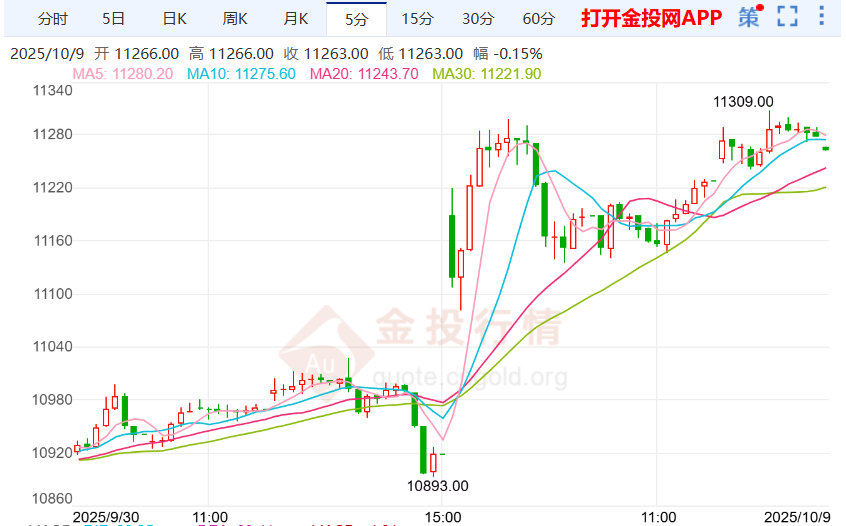
Group 1 - Silver futures are currently trading above 11210, with a reported price of 11265 per kilogram, reflecting a 3.10% increase [1] - The highest price reached today was 11309 per kilogram, while the lowest was 11082 per kilogram, indicating a short-term oscillating trend in silver futures [1] Group 2 - The Federal Reserve's meeting minutes reveal a division among officials regarding future interest rate levels, with a consensus leaning towards further rate cuts due to slowing job growth [3] - More than half of the 19 officials anticipate at least two more rate cuts this year, suggesting potential cuts in the upcoming meetings [3] - The CME FedWatch tool indicates a strong market expectation for a 25 basis point cut in October and a 78.6% probability for a cut in December [3] Group 3 - Investors are focusing on Powell's speech at the community banking conference for signals regarding the Fed's future interest rate direction [4] Group 4 - Long-term outlook for silver remains bullish, with expectations of continued oscillation and potential volatility post-holiday; recommended to maintain a long position and control exposure within the range of 11130-11300, and a broader range of 11000-11400 [5]
会议纪要显示美联储官员担心就业下行风险
Sou Hu Cai Jing· 2025-10-09 03:57
Core Viewpoint - The Federal Reserve is expected to further cut interest rates due to weaker-than-expected employment data and rising risks in the labor market [1] Group 1: Economic Activity and Labor Market - The Federal Reserve noted a slowdown in economic activity in the first half of the year and a weak labor market, with inflation still slightly above the long-term target of 2% [1] - Following the monetary policy meeting on September 17, the Federal Reserve announced a 25 basis point cut in the federal funds rate target range to between 4.00% and 4.25% [1] - This marks the first rate cut in 2025, following three cuts in 2024 [1] Group 2: Inflation and Tariff Impact - There is a divergence of opinions among Federal Reserve officials regarding the impact of tariffs on inflation [1] - Some officials believe that without considering this year's tariff increases, inflation levels would be close to the target, while others feel that even excluding tariff impacts, the progress towards the 2% target remains slow [1] Group 3: Future Rate Cuts - In the September monetary policy meeting, nearly all voting members of the Federal Open Market Committee supported the 25 basis point rate cut, with only one member opposing the decision [1] - The majority of Federal Reserve officials expect at least two more rate cuts before the end of the year [1]
美联储公布9月会议纪要,大多委员同意降息25个基点
Sou Hu Cai Jing· 2025-10-09 00:44
Core Points - The Federal Reserve's September meeting minutes indicate a consensus among members that economic indicators show a slowdown in job growth and a slight increase in the unemployment rate, suggesting signs of weakness in the labor market [1] - The inflation rate remains slightly above the 2% target, leading nearly all members to agree on a 25 basis point reduction in the federal funds rate target range to between 4% and 4.25% [1] - Due to stronger-than-expected consumer spending and business investment data, the Fed has slightly upgraded its economic growth forecasts for the years 2023 to 2028 [1] - The Fed anticipates that tariff increases will continue to elevate inflation this year and exert further upward pressure on inflation until 2026, with a return to the 2% target expected by 2027 [1]
How does the president affect mortgage rates?
Yahoo Finance· 2025-10-06 17:40
Core Insights - The president of the United States does not directly control mortgage rates but can influence them through various channels such as Federal Reserve appointments and economic policies [1][2][3] Influence of the President on Mortgage Rates - The president's appointees and policies can affect the 10-year Treasury yield, which is closely linked to mortgage rate trends [2][5] - The Federal Reserve's actions, particularly the federal funds rate, serve as a foundation for consumer interest rates, including mortgages [3][4] - The president nominates the Fed chair and Board of Governors, thereby influencing interest rate policies indirectly [4][5] Economic Policies Impacting Mortgage Rates - Economic policies, including tax changes and tariffs, can affect consumer spending and inflation, which in turn influence mortgage rates [8][9] - High inflation typically leads the Federal Reserve to increase rates, while low inflation may result in rate cuts [9] Housing Policy Changes - The president can impact mortgage rates through housing policies that affect supply and demand, such as homebuyer incentives and housing supply initiatives [10][11] - Immigration policies can also indirectly affect the housing market by influencing labor availability for homebuilders [10] Strategies for Lowering Mortgage Rates - Individuals can take steps to secure lower mortgage rates, such as improving credit scores, buying discount points, and shopping for the best mortgage lender [12][13] - Making a larger down payment can also help in obtaining a lower interest rate [13] Factors Affecting Mortgage Rates - Mortgage rates are influenced by Federal Reserve policy, inflation, employment market conditions, economic growth, and the 10-year Treasury yield [14] - Rates tend to drop when inflation decreases, home-buying demand slows, or the economy cools [15]