
AI硬件

Search documents
未知机构:上证指数SHCOMP003-20260128
未知机构· 2026-01-28 02:15
Summary of Conference Call Notes Industry Overview - The A-share market showed mixed performance with the Shanghai Composite Index (SHCOMP) slightly up by 0.03% and the CSI 500 down by 0.67% [1] - Total market turnover reached 1.89 trillion RMB, indicating a stable trading environment despite fluctuations [1] Key Points on Market Dynamics - The AI hardware sector regained market focus, particularly in semiconductors and CPO concepts, leading to significant gains [2] - Dongxin Co., Ltd. (688110.SH) saw a 20% surge due to its subsidiary's launch of a new GPU, highlighting the strong interest in AI-related technologies [2] - Conversely, small-cap stocks continued to decline, with the CSI 2000 index dropping by 1.23% [2] - The battery materials sector faced challenges, primarily due to fluctuations in lithium carbonate futures and disappointing annual results from Multi-Flor (002407.SZ), which fell by 7.35% [2] Financial Performance Insights - Industrial profits in December showed a significant year-on-year recovery of 4.9%, contrasting with a decline of 13.0% in November [3] - However, industrial revenue decreased by 5.7% year-on-year, compared to a slight decline of 0.4% in November, indicating a mixed outlook for the industrial sector [3] - Goldman Sachs noted that the volatility in industrial profits exceeded the macroeconomic fundamentals reflected in December's industrial production and PPI inflation [3] Investment Strategy - Current market dynamics suggest a balanced buying and selling strategy, with investments being made in gold, semiconductors, and AI data center (AIDC) sectors while selling off CPO, metals, and aerospace sectors [3]



A股开盘速递 | A股窄幅震荡!贵金属板块延续强势 半导体产业链再度走强
智通财经网· 2026-01-28 01:54
1月28日,A股早盘窄幅震荡,截至9:35,沪指涨0.10%,深成指跌0.10%,创业板指下跌0.17%。 东方证券认为,当前市场内生韧性较强,并非单纯依靠权重股拉动。当前随着上市公司年报预告进入披 露高峰,业绩影响将更加显著,结合年报业绩预告线索,当前业绩具备亮点且本轮涨幅偏低的行业主要 集中在AI硬件(北美算力、消费电子)、电池、医药等,值得投资者持续关注。 盘面上,贵金属概念延续强势,中国黄金4连板;半导体产业链再度走强,存储芯片领涨,气派科技、中 微半导涨超10%;算力产业链继续走高,美利云一字涨停。下跌方面,光伏、保险、医药等板块跌幅居 前。 贵金属概念延续强势,中国黄金4连板,湖南黄金3连板,四川黄金、赤峰黄金、招金黄金、豫光金铅、 盛达资源、兴业银锡跟涨。 点评:消息面上,现货黄金持续刷新历史新高,涨幅扩大至2.6%,报5142美元/盎司。现货白银站上113 美元/盎司。 机构观点 1、华西证券:保持慢牛上涨趋势不变 展望后市,信达证券认为,春节前流动性环境大概率较好,市场可能继续偏强,1月在资金情绪分化的 背景下可能会有一些波动,2月或是更确定的窗口期。 热门板块 1、算力租赁概念走强 算力租 ...


2026年,巨头疯抢这个赛道
3 6 Ke· 2026-01-28 01:34
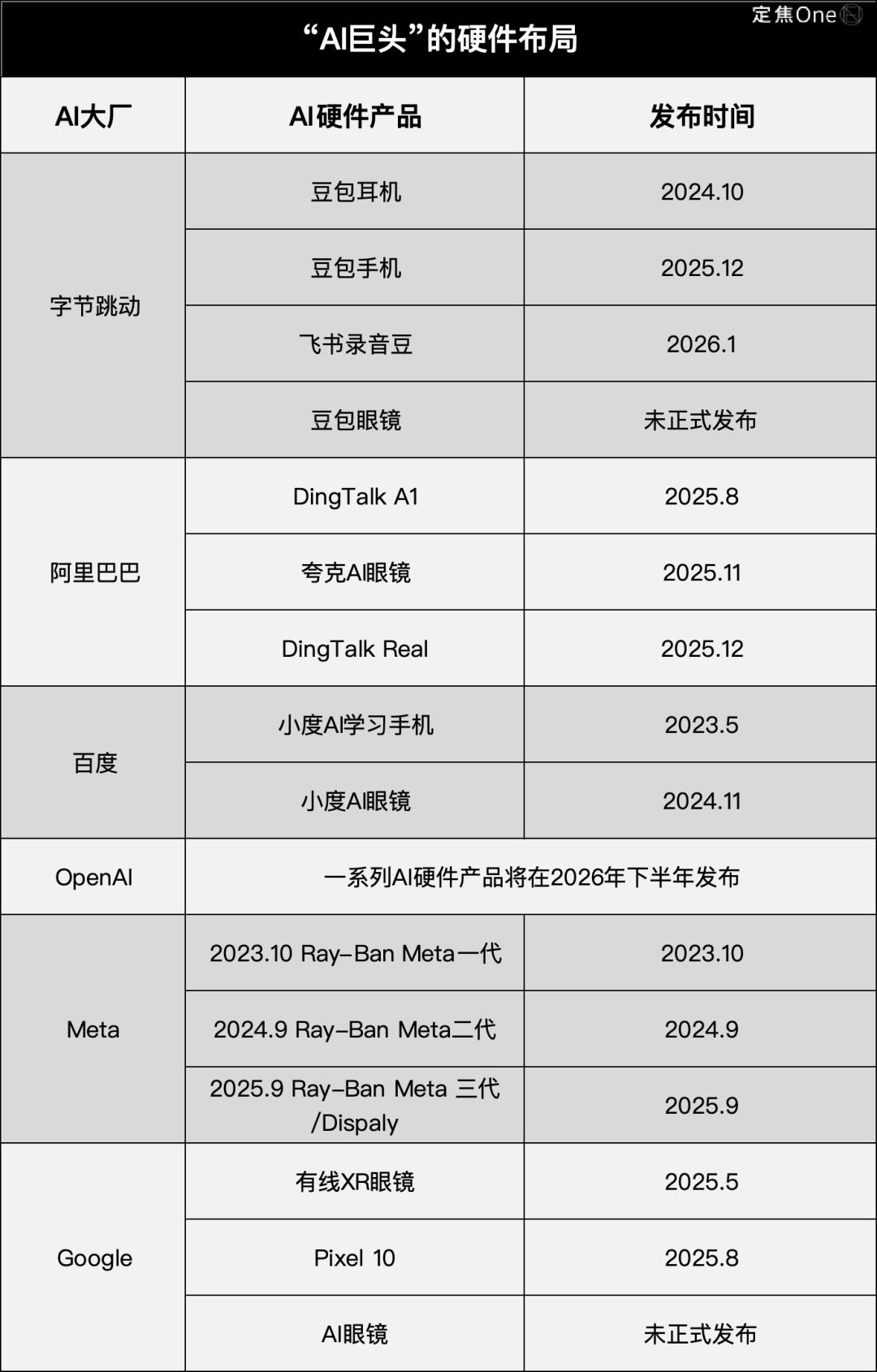
Core Insights - The AI hardware race has intensified with major players like OpenAI, Google, Alibaba, and ByteDance entering the market, with OpenAI planning to launch its first hardware device in the second half of 2026 [1][5] - Domestic companies are diversifying their AI hardware offerings, focusing on proven product categories rather than new hardware forms [1][3] Group 1: AI Hardware Landscape - OpenAI is set to release a series of AI hardware products, including a device codenamed "Sweetpea" and another called "Gumdrop," which is a smart pen or wearable audio device [2][3] - Major AI companies are focusing on three main categories: AI glasses, AI office tools, and AI smartphones, with AI glasses being the most frequently mentioned product type [4][6] - Meta's Ray-Ban Meta smart glasses have sold over 2 million units, indicating a strong market for AI glasses, while Google and other companies are also developing similar products [6][20] Group 2: Market Dynamics and Competition - The entry of AI giants into hardware is driven by the saturation of the AI software market and the decreasing barriers to hardware development [12][14] - Different companies have varying strategies: ByteDance is aggressively testing multiple hardware forms, while Alibaba is more cautious, aiming to integrate hardware into its existing software ecosystem [15][18] - The competition between ByteDance and Alibaba centers on who can establish a hardware presence first, while overseas companies like Meta and Google face their own challenges in the hardware market [19][22] Group 3: Commercial Viability and Challenges - AI hardware products are currently seen as experimental, with initial sales figures indicating market interest but not substantial volume [26][30] - Successful examples of AI hardware commercialization exist, such as Plaud's AI recording card achieving $250 million in annual recurring revenue [27] - The challenge remains whether AI hardware can replace smartphones as the next universal interface, with current products not yet meeting consumer demand for necessity [30][33]



ETF午评 | AI硬件板块走强,科创半导体ETF、科创半导体设备ETF涨3%
Ge Long Hui· 2026-01-27 06:12
Market Overview - The three major A-share indices showed mixed performance in the morning session, with the Shanghai Composite Index up by 0.03%, the Shenzhen Component down by 0.37%, and the ChiNext Index up by 0.44% [1] - The North China 50 Index fell by 1.26%, and the total trading volume in the Shanghai, Shenzhen, and Beijing markets reached 1.89 trillion yuan, a decrease of 372.6 billion yuan compared to the previous day [1] - Over 4,400 stocks in the market experienced declines [1] Sector Performance - The computing power hardware industry chain strengthened, with CPO and memory sectors leading the gains [1] - Gold and semiconductor concept stocks also showed strength, while sectors such as consumer goods, lithium batteries, rare earth permanent magnets, innovative pharmaceuticals, and AI applications weakened [1] ETF Performance - In the ETF market, the semiconductor equipment sector saw significant gains, with the Huaxia Fund's Sci-Tech Semiconductor ETF, the Huatai-PB Fund's Sci-Tech Semiconductor Equipment ETF, and the Penghua Sci-Tech Semiconductor Equipment ETF all rising over 3% [1] - The CPO sector remained resilient, with the Guotai Fund's Communication ETF and the Fuguo Fund's Communication Equipment ETF increasing by 2.31% and 2.27%, respectively [1] - Conversely, the Guotai 2000 ETF from ICBC fell by 7%, and the vaccine sector declined, with the Vaccine ETF and the Fuguo Vaccine ETF both dropping by 5% [1] - The lithium battery sector faced a broad decline, with the Lithium Battery ETF and the Southern Battery ETF both down by 3% [1]
国光电器股份有限公司 2025年度业绩预告
Zhong Guo Zheng Quan Bao - Zhong Zheng Wang· 2026-01-26 23:29
Group 1 - The company expects a net profit to be negative for the fiscal year 2025, covering the period from January 1, 2025, to December 31, 2025 [1] - The company has communicated with the accounting firm regarding the earnings forecast, and there are no significant discrepancies between both parties [1] - The company is actively expanding into new business areas, particularly in AI hardware, and has seen new customers and projects emerging [1] Group 2 - The company has commenced operations at its bases in Jiangxi and Vietnam, which are crucial for future capacity expansion and adapting to changes in the international trade environment [1] - The company has significantly increased its R&D and operational teams, leading to a rise in expenses by approximately 220 million yuan compared to the previous year [1] - The company incurred a foreign exchange loss of about 70 million yuan due to unfavorable currency fluctuations [1] Group 3 - The company has recognized impairment provisions totaling approximately 83 million yuan for long-term equity investments and financial assistance to industrial park companies [1] - Non-recurring gains and losses are expected to be around 60 million yuan, primarily from government subsidies and income from transferable large-denomination certificates of deposit [1]

涨停复盘:今日全市场共79只股涨停,连板股总数15只,贵金属概念白银有色、四川黄金涨停!
Jin Rong Jie· 2026-01-26 11:11
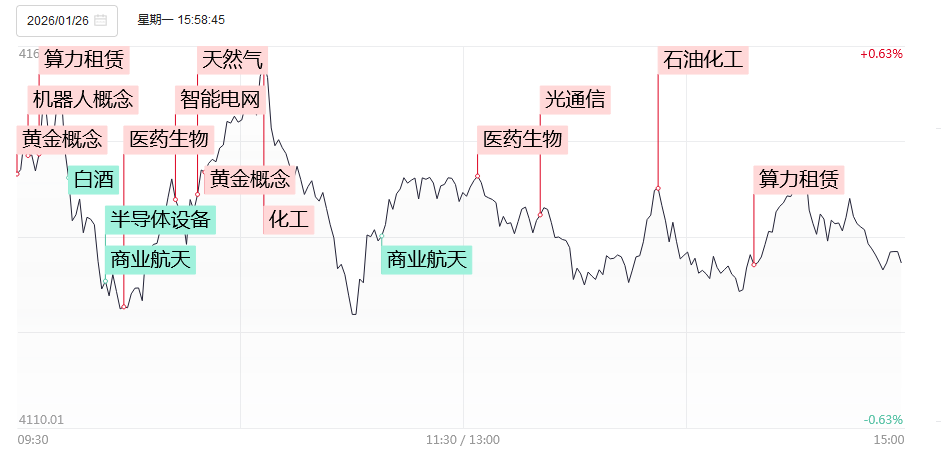
Market Overview - On January 26, the market experienced fluctuations with significant divergence between large and small indices, where the Shenzhen Component and ChiNext indices opened high but closed down over 1% [1] - The total trading volume in the Shanghai and Shenzhen markets reached 3.25 trillion yuan, an increase of 163 billion yuan compared to the previous trading day [1] - The market saw over 3,700 stocks decline, with only 79 stocks hitting the daily limit up [1] Sector Performance - The non-ferrous metals sector led the gains, particularly the precious metals concept, with notable performances from Sichuan Gold, which achieved four limit-ups in eight days, and Zijin Mining reaching a historical high [1] - The oil and gas sector also showed strength, with China National Offshore Oil Corporation hitting a historical high and Intercontinental Oil & Gas achieving three limit-ups in four days [1] - The chemical sector experienced a rebound, with stocks like Hongbaoli and Chengxing Co. hitting the limit up [1] - Conversely, the commercial aerospace and semiconductor equipment sectors faced significant declines, with several commercial aerospace stocks hitting the limit down [1] Limit-Up and Limit-Down Stocks - A total of 70 stocks hit the limit up today (excluding ST and delisted stocks), with 15 stocks on consecutive limit-ups [1] - Key stocks included Baiyin Nonferrous Metals with five consecutive limit-ups and Sichuan Gold with four limit-ups in eight days [1][9] Related Hotspots - The precious metals sector continues to rise, with gold prices in New York surpassing $5,100 and silver prices exceeding $109 [11] - In the AI sector, major companies like Tencent and Baidu have initiated cash red envelope activities for the Spring Festival, indicating a competitive landscape in AI applications [12] - The robotics sector saw a partnership announcement between China Central Television and Magic Atom for the 2026 Spring Festival Gala [12]

国光电器(002045.SZ):2025年预亏8000万元-9850万元
Ge Long Hui A P P· 2026-01-26 09:37
Core Viewpoint - Guoguang Electric (002045.SZ) expects a net profit loss attributable to shareholders of the listed company for the period from January 1, 2025, to December 31, 2025, ranging from 98.5 million to 80 million yuan, representing a year-on-year decline of 138.94% to 131.62% [1] Financial Performance - The company anticipates a net profit loss, excluding non-recurring gains and losses, of 159 million to 140 million yuan, reflecting a year-on-year decrease of 180.01% to 170.70% [1] - The expected non-recurring gains and losses for the reporting period are approximately 60 million yuan, primarily from government subsidies and income from transferable large-denomination certificate of deposits [1] Business Development - During the reporting period, the company actively explored new business opportunities and expanded into the AI hardware sector, with multiple new clients and projects emerging [1] - The production and normal operation of the Jiangxi and Vietnam bases are crucial for the company's future capacity expansion and adaptation to changes in the international trade environment [1] Cost and Investment - The company has significantly increased its R&D and operational teams, leading to a year-on-year rise in sales management and R&D expenses by approximately 220 million yuan [1] - Due to unfavorable foreign exchange rate fluctuations, the company incurred an exchange loss of about 70 million yuan during the reporting period [1] - The company recognized impairment provisions totaling approximately 83 million yuan for long-term equity investments and financial assistance to industrial park companies [1]
国光电器:2025年预亏8000万元-9850万元
Ge Long Hui· 2026-01-26 09:31
Core Viewpoint - Guoguang Electric (002045.SZ) expects a net profit loss attributable to shareholders of the listed company for the period from January 1, 2025, to December 31, 2025, ranging from 98.5 million to 80 million yuan, representing a year-on-year decline of 138.94% to 131.62% [1] Financial Performance - The company anticipates a net profit loss, excluding non-recurring gains and losses, between 159 million and 140 million yuan, reflecting a year-on-year decrease of 180.01% to 170.70% [1] - The expected non-recurring gains and losses for the reporting period are approximately 60 million yuan, primarily from government subsidies and income from transferable large-denomination certificate of deposit investments [1] Business Development - During the reporting period, the company actively explored new business opportunities and expanded into the AI hardware sector, with multiple new clients and projects emerging [1] - The production and normal operation of the Jiangxi and Vietnam bases are crucial for the company's future capacity expansion and adaptation to changes in the international trade environment [1] Cost and Investment - To support its new business initiatives, the company significantly increased its R&D and operational teams, resulting in a year-on-year rise in sales management and R&D expenses of approximately 220 million yuan [1] - The company incurred a foreign exchange loss of about 70 million yuan due to unfavorable currency fluctuations during the reporting period [1] - A total impairment provision of approximately 83 million yuan was made for long-term equity investments and financial assistance to industrial park companies [1]
短期与中期逻辑均具备坚实支撑!红利低波ETF(512890)近20个交易日吸金18.8亿
Xin Lang Cai Jing· 2026-01-26 04:22
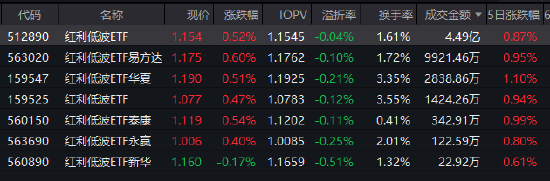
Core Viewpoint - The report focuses on the investment opportunities in AI applications, commercial aerospace, and nuclear fusion for 2026, highlighting the performance of the Dividend Low Volatility ETF (512890) amidst a mixed market environment [1][7]. Market Performance - On January 26, A-shares showed mixed results with the Shanghai Composite Index up by 0.12%, while the Shenzhen Component and ChiNext Index experienced declines [1][7]. - The Dividend Low Volatility ETF (512890) rose by 0.52%, closing at 1.154 yuan, with a turnover rate of 1.61% and a transaction volume of 449 million yuan [1][7]. Fund Holdings - The latest quarterly report indicates a mixed performance among the top ten holdings of the Dividend Low Volatility ETF. Notable movements include Shanghai Bank down by 0.21%, Nanjing Bank up by 1.35%, and Gree Electric down by 0.58% [2][9]. - The specific holdings and their market values are as follows: - Shanghai Bank: 781.92 million yuan - Nanjing Bank: 747.01 million yuan (up 32.82%) - Ping An Bank: 712.31 million yuan - Agricultural Bank of Shanghai: 704.49 million yuan - China National Sugar: 690.55 million yuan (down 7.95%) [9]. Fund Flow - The Dividend Low Volatility ETF has seen significant net inflows, with 1.34 billion yuan over the last 5 trading days, 1.88 billion yuan over the last 20 days, and 4.39 billion yuan over the last 60 days. As of January 23, 2026, the fund's circulation scale was 27.845 billion yuan [9]. Investment Strategy - Analysts suggest that the current liquidity environment is a key driver for the spring market rally, supported by new insurance premiums, maturing deposits, and the appreciation of the RMB attracting foreign capital [4][11]. - The report emphasizes the importance of focusing on sectors with strong earnings performance and relatively low price increases, such as AI hardware, batteries, pharmaceuticals, steel, and non-bank financials [11]. - The Dividend Low Volatility strategy is seen as a robust tool for asset allocation in volatile markets, with a three-year return of 36.01%, outperforming its benchmark [12].
金百泽:持续加大新业务投入 以“制造+服务+平台”夯实产业服务能力
Zhong Zheng Wang· 2026-01-26 01:21
Core Viewpoint - The company, Jinbai Ze, forecasts a significant decline in net profit for 2025, projecting a range of 16 million to 23.5 million yuan, representing a year-on-year decrease of 39.84% to 59.04% due to rising raw material costs and ongoing business transformation challenges [1] Group 1: Financial Performance - The expected net profit for 2025 is between 16 million and 23.5 million yuan, indicating a substantial decline compared to previous years [1] - Key raw materials such as gold salts, copper balls, and tin bars have seen price increases, directly impacting the cost structure of the company's mid-to-high-end products [1] Group 2: Business Transformation - The company is transitioning from a traditional PCB manufacturing model to a "manufacturing + service + platform" model, aiming to enhance overall innovation efficiency for clients [2] - This new business model requires upfront investment with benefits expected to materialize in the long term, particularly as demand in sectors like AI hardware and industrial control is anticipated to grow [2] Group 3: Strategic Focus - The company is enhancing its engineering capabilities and digital transformation services, which are expected to support research and development collaboration, improve engineering efficiency, and optimize delivery capabilities [1][2] - Long-term competitiveness is increasingly measured by engineering platform capabilities, AI empowerment, and customer loyalty rather than just manufacturing capacity [2]