智能化

Search documents
国产版新世代BMW iX3将在2026年下半年上市
Yang Shi Wang· 2025-12-05 09:05
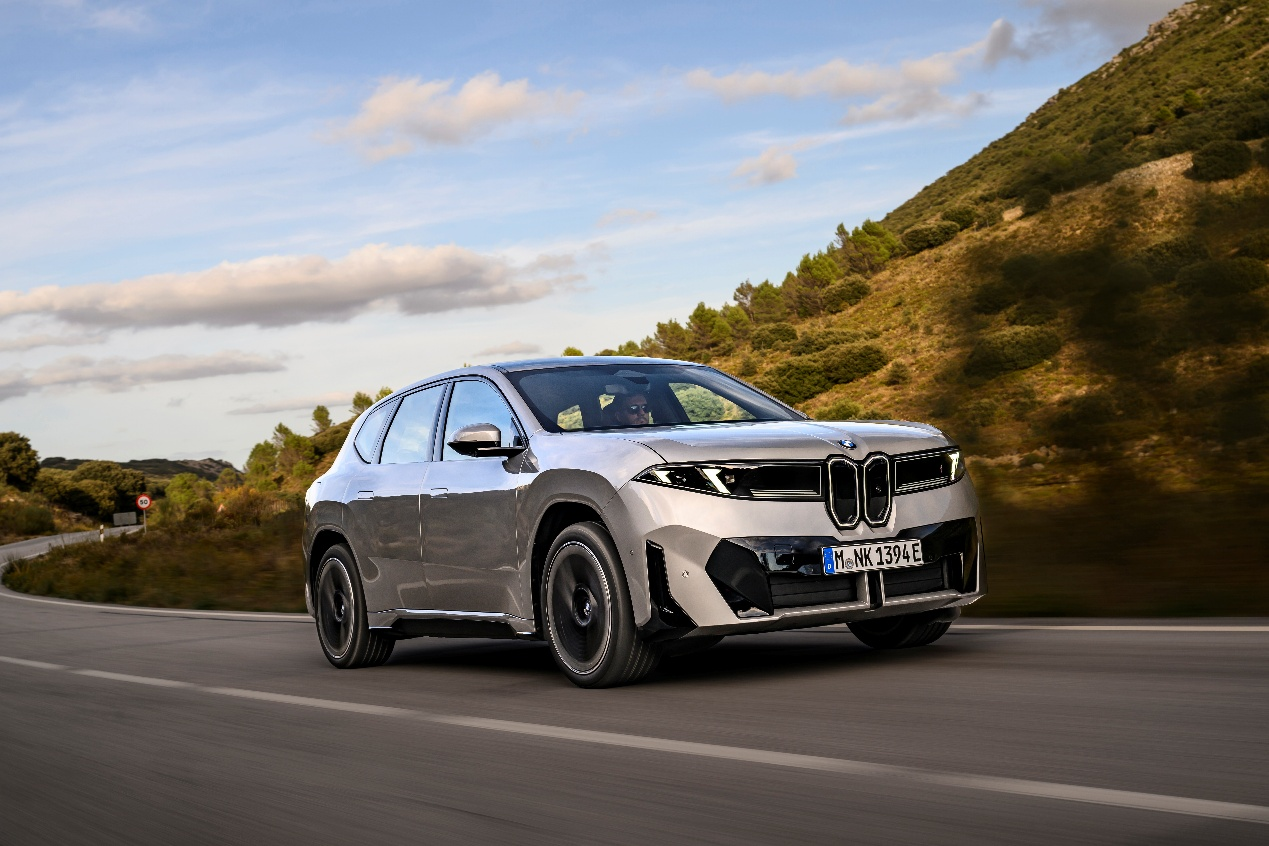
Core Insights - BMW announced that the new generation BMW iX3, specifically designed for the Chinese market, will be launched in the second half of 2026 [1] Group 1: Product Features - The long-wheelbase version of the new generation BMW iX3 is tailored for Chinese customers, featuring customizations in smart cockpit, intelligent driving assistance, and ride comfort [3] - The design of the new generation BMW iX3 embodies the electric era's core principles, combining luxury, technology, and aesthetics, with a distinctive appearance that remains recognizable as a BMW [5] - The vehicle includes innovative features such as a super-sensitive steering wheel, a super-sensitive central control, and a new 3D head-up display, all designed to enhance driver focus [5] Group 2: Technology and Performance - The new generation BMW iX3 is equipped with the latest sixth-generation BMW eDrive technology, featuring a revolutionary cylindrical battery and a self-developed energy management system [7] - It boasts an impressive electric range of over 900 kilometers under CLTC conditions, with a record-setting test showing a range of over 1,007 kilometers on a single charge [7]


奇瑞集团前11月新能源销量破81万辆 同比大增69.4%
Yang Shi Wang· 2025-12-05 09:03
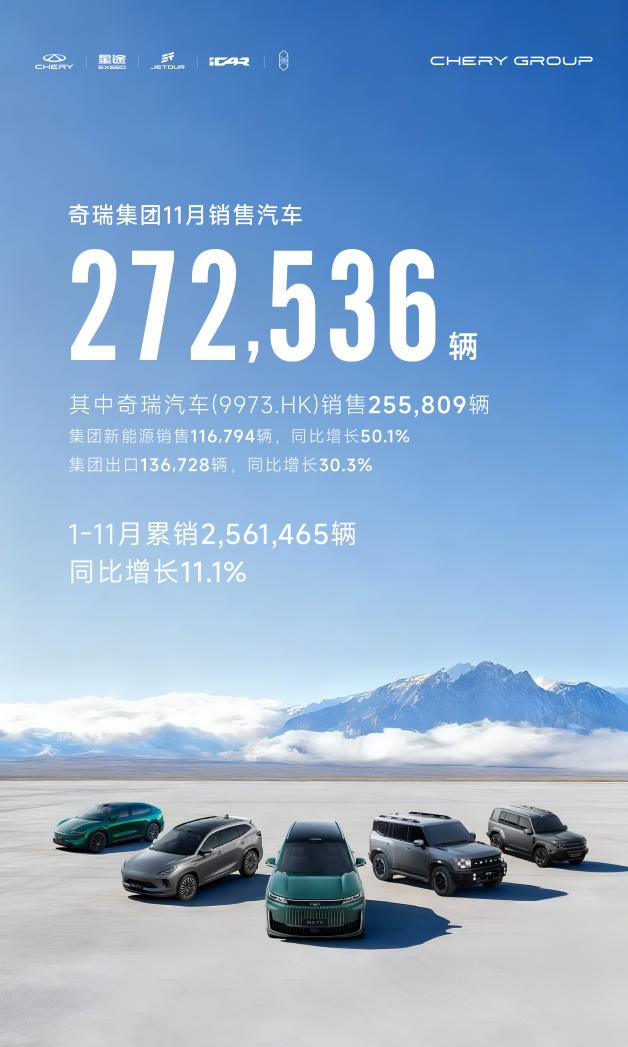
Group 1 - Chery Group reported sales of 272,536 vehicles in November, with 116,794 of those being new energy vehicles (NEVs), marking a 50.1% year-on-year increase and setting a new record [1] - Cumulative sales from January to November reached 2,561,465 vehicles, a year-on-year growth of 11.1%, with NEV sales totaling 814,685 units, up 69.4% [1] - The company exported 136,728 vehicles in November, a 30.3% increase, maintaining its position as the top exporter for seven consecutive months [1] Group 2 - Chery Group is advancing a dual-track strategy of "new energy + new fuel," launching the fifth-generation Tiggo 8 as part of its "Chinese New Fuel" strategy, which aims to provide a driving experience akin to electric vehicles [3] - Several new models were launched in November, including the Starway ET5 and the 2026 Jietu Traveler C-DM, showcasing a diverse product matrix to meet global market demands [3] Group 3 - The company is focusing on integrating smart technology into its vehicles, with advancements in intelligent driving, AI models, and smart cockpits since the "Chery Smart Night" event in March [5] - Chery is building a "people·car·home" ecosystem, involving over 500,000 users in product development and feedback processes to enhance user experience [5] Group 4 - Chery Group is transitioning from "product export" to "brand export" as part of its globalization strategy, aiming for upward brand recognition in global markets [7] - The launch of the Zongheng G700 in Dubai highlights the company's efforts to penetrate the luxury off-road market, receiving positive feedback from local users [7] Group 5 - By the end of 2025, Chery Group aims to accelerate its transformation into a globally recognized high-tech ecological group, focusing on long-term strategies in new energy, smart technology, and globalization [9]
科马材料、江天科技两家北交所IPO企业获注册
Sou Hu Cai Jing· 2025-12-05 07:52
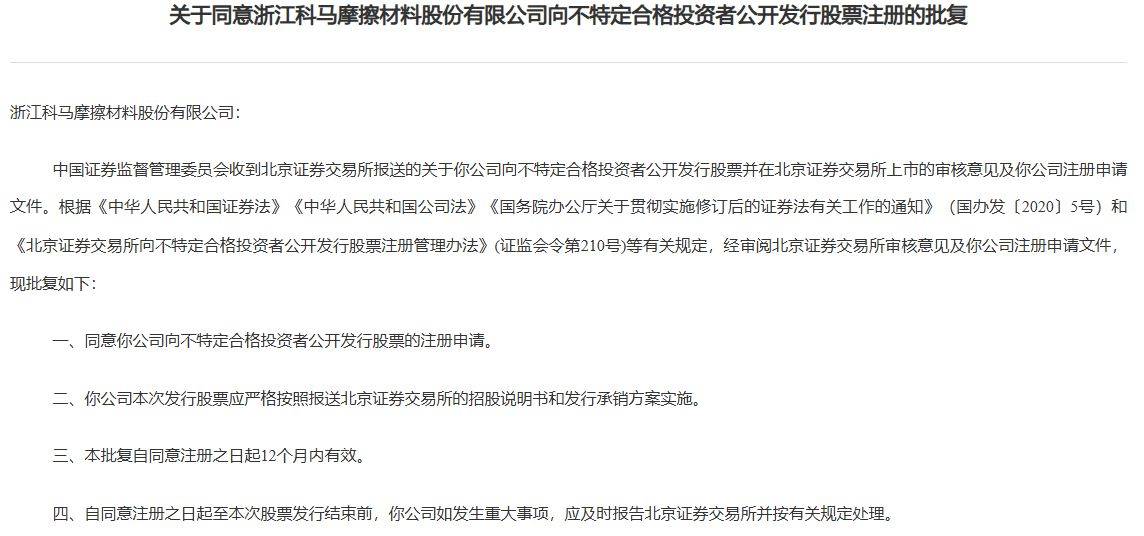
Group 1: Company Overview - Zhejiang Kema Friction Material Co., Ltd. specializes in the R&D, production, and sales of dry friction plates and wet paper-based friction plates, focusing on the development and application of new friction materials [2] - The company’s products are categorized into braking system friction materials (brake pads) and transmission system friction materials (dry and wet friction plates), playing a crucial role in safety across various applications [2] Group 2: Industry Status - The global friction materials market is projected to reach approximately 206.36 billion RMB by 2024, with a compound annual growth rate (CAGR) of about 3.6%, expected to approach 264.36 billion RMB by 2031 [3] - The growth is driven by the expansion of the automotive and rail transportation industries, particularly in the Asia-Pacific region, alongside a significant technological upgrade and environmental transformation within the industry [3] Group 3: Industry Challenges - The industry faces substantial challenges, including pressures from global environmental regulations pushing towards "copper-free" and low-metal formulations, necessitating significant investment in new formula development [3] - Supply chain vulnerabilities, particularly in key raw materials like aramid fibers and phenolic resins, pose risks to cost stability and production continuity [3] - Chinese companies encounter unique challenges, including a technological gap in high-end materials and core formulations compared to leading Japanese and European firms, as well as the need for improved brand influence and control over high-value chains in international markets [3] Group 4: Future Outlook - The future direction of the friction materials industry is clear, focusing on "more environmentally friendly, smarter, and more integrated" solutions, with an emphasis on developing high-performance non-asbestos organic materials and ceramic composite materials [4] - The market is dominated by major players like Knorr, Nisshinbo, Bosch, and Tenneco, with the Asia-Pacific region being the largest production and consumption market [4] - Chinese companies have advantages in their large domestic market and complete supply chain but need to enhance their positioning in the global market, particularly in high-end segments [4] Group 5: Industry Transformation - The friction materials industry is transitioning from a traditional "consumable" role to high-performance safety components centered around new material technologies [5] - International giants face the challenge of leading environmental innovation while managing global supply chains, whereas Chinese companies have opportunities in the electric vehicle and "new infrastructure" markets, contingent on breakthroughs in core technologies [5]
从武汉车展看产业未来 中国商用车正迈入深度融合新阶段
Zhong Guo Qi Che Bao Wang· 2025-12-05 07:16
Group 1: Core Themes - The 2025 China International Commercial Vehicle Exhibition highlighted the transformation of the commercial vehicle industry in China, driven by technology, market dynamics, and policy changes, focusing on high-end, intelligent, and green developments [1] - The exhibition served as a significant platform to observe the trends in the commercial vehicle sector, particularly as the industry transitions from the "14th Five-Year Plan" to the "15th Five-Year Plan" [1] Group 2: Green Transformation - The sales of new energy commercial vehicles in China reached 566,000 units from January to September 2025, marking a 61.4% year-on-year increase, with a market penetration rate of 23.9%, indicating a shift from policy-driven growth to market-driven dynamics [5] - At the exhibition, the ratio of new energy vehicles to fuel vehicles was 2:1, showcasing various technologies such as pure electric, hydrogen fuel cells, and hybrid systems, reflecting the industry's diverse technological landscape [5][6] - Dongfeng Liuzhou's participation featured a significant number of new energy models, demonstrating the company's strategic commitment to the new energy sector, contrasting sharply with its previous year's lineup [5] Group 3: Technological Advancements - Key competitive factors in the industry include high-voltage platforms, large-capacity batteries, and fast charging capabilities, exemplified by the Dongfeng Liuzhou's electric tractor, which offers a range of 500 kilometers and rapid charging [6] - Hydrogen fuel cell technology is gaining attention, particularly for long-distance and heavy-load applications, as infrastructure and demonstration projects develop [6] Group 4: Intelligent Upgrades - The industry is transitioning from basic functionality to deep scenario-based empowerment, with L2+ level intelligent driving assistance systems becoming standard in mid-to-high-end models [10] - Intelligent connectivity systems are emerging as a core differentiator for commercial vehicle companies, enabling digital transformation in vehicle management and operational efficiency [10][11] Group 5: High-End Development - High-end development is characterized by a focus on user lifecycle value rather than mere configuration enhancements, with ongoing improvements in fuel efficiency and reliability in traditional power vehicles [14] - The application of advanced technologies such as high-voltage platforms and lightweight materials is indicative of the industry's progress in manufacturing and system integration [14] Group 6: Global Expansion - From January to September 2025, China's commercial vehicle exports reached 748,000 units, a 10.2% increase year-on-year, with new energy vehicle exports growing 150% to 64,000 units [18] - Chinese commercial vehicle companies are shifting from simple product exports to deeper collaborations involving technology transfer and localized production, enhancing their global competitiveness [18] Group 7: Future Outlook - The exhibition reflects the ongoing transformation and innovation within the Chinese commercial vehicle industry, which is poised for high-quality development characterized by green, intelligent, and global strategies [19] - Companies with systematic layouts, technological foundations, and global perspectives are expected to gain a competitive edge in the evolving market landscape [19]

比亚迪王传福:当前技术领先度不及前几年 后面将有重磅技术发布
Zhong Guo Zheng Quan Bao· 2025-12-05 05:17
Core Insights - BYD's chairman Wang Chuanfu stated that the company's current technology is not as advanced as in previous years, indicating that significant technological releases are forthcoming but cannot be disclosed at this time [1][3] - The company has identified several key directions for future development, including a focus on electric and intelligent technologies over the next 2 to 3 years, enhancing marketing capabilities, and expanding into overseas markets [1] Group 1 - BYD's core competitiveness lies in its technology, supported by a team of 120,000 engineers, which is crucial for future technological advancements [1] - The company plans to increase investment in research and development to launch more leading-edge technological achievements [1] - BYD acknowledges the marketing inertia that has developed in a favorable market environment and aims to strengthen its marketing capabilities to better meet user demands [1][3] Group 2 - The company reported a decline in domestic market sales this year, attributed to a decrease in the perceived leading edge of its technology and the emergence of industry homogenization [3] - User pain points, such as slow low-temperature charging speeds, need to be addressed through technological breakthroughs [3] - The changes in market performance align with the cyclical nature of product and technology development [3]

SHEIN(希音)赋能跨境电商+产业带出海,巩固提升传统企业全球竞争力
Sou Hu Cai Jing· 2025-12-05 05:10
Core Viewpoint - The recent "14th Five-Year Plan" emphasizes the support for the development of new business models like cross-border e-commerce and the enhancement of traditional industries, particularly textiles, to strengthen their global competitiveness and promote digital transformation in manufacturing [1] Group 1: Cross-Border E-Commerce Growth - In the first nine months of this year, driven by leading companies like SHEIN, Guangzhou's cross-border e-commerce import and export value reached 169.12 billion, contributing to a 12.5% growth in the city's foreign trade, with clothing exports surging by 18.8% year-on-year [1] - The 138th Canton Fair showcased over 310,000 overseas buyers and set multiple historical records, highlighting the global appeal of Chinese manufacturing and positioning cross-border e-commerce as a key driver of new productivity [1] Group 2: SHEIN's Supply Chain and Infrastructure Investment - SHEIN has accelerated its domestic supply chain network over the past three years, focusing on Guangzhou and surrounding cities, with a total investment exceeding 15 billion in building a comprehensive smart system covering R&D, production, warehousing, and logistics [3] - The Bay Area Supply Chain Project in Guangzhou, with a total investment of 10 billion, aims to create a modern supply chain center that will support SHEIN's global sales network and is expected to attract 100,000 industry talents upon completion [3][6] - The Bay Area Smart Industrial Park in Zhaoqing, operational since July, is designed to meet supply chain needs and stimulate local employment and growth in related sectors [3] Group 3: Digital and Green Transformation - SHEIN's model integrates cross-border e-commerce with local industrial clusters, leveraging over 10 billion in infrastructure investments to facilitate the digital and green transformation of small and medium-sized enterprises in domestic industrial belts [5] - The "small order quick response" flexible supply chain system introduced by SHEIN has reduced the average inventory rate from 30% to single digits, while also shortening payment cycles to enhance supplier focus on production [6] - SHEIN has implemented over 650 energy-saving measures by the end of 2024, significantly reducing resource consumption and providing comprehensive support for suppliers to achieve carbon reduction [6] Group 4: Talent Development and Employment - SHEIN established a training and certification base in Guangzhou to enhance the skill level of digital garment technology, addressing structural employment issues and fostering continuous innovation in the domestic fashion industry [6][8] - The company's successful practices in digitalization, intelligence, and sustainability have created millions of high-quality jobs and improved the export competitiveness of products from 400 cities across the country [8]

对于未来发展 比亚迪明确了几大方向
Xin Lang Cai Jing· 2025-12-05 04:45
Core Viewpoint - BYD has outlined its future development directions, focusing on electric and intelligent technology advancements, marketing capabilities, and international market expansion [1] Group 1: Technology Development - Over the next 2 to 3 years, BYD will intensively focus on electric technology and the second half of intelligent technology, increasing research and development efforts and launching more leading technological achievements [1] - The company aims to maintain and expand its technological leadership [1] Group 2: Marketing Strategy - BYD acknowledges past marketing inertia due to favorable market conditions and plans to enhance its marketing capabilities to better align with user needs [1] - The goal is to efficiently convert technological advantages into market competitiveness [1] Group 3: International Expansion - The company will continue to increase efforts in exploring overseas markets [1]
“不客气”!奇瑞,大爆发
Zhong Guo Ji Jin Bao· 2025-12-05 04:30
Core Insights - Chery Group achieved significant growth in automotive sales, with a total of 2.562 million vehicles sold in the first eleven months of 2025, marking an 11.1% year-on-year increase, and electric vehicle sales surpassing 800,000 units for the first time [2][9] Group 1: Sales Performance - Chery Group's automotive sales increased by 11.1% year-on-year to 2.562 million units, with exports rising by 14.7% to approximately 1.2 million units [2] - The company's electric vehicle sales surged by 69.4% to 815,000 units in the same period, achieving a historical milestone [9] - In November 2025 alone, Chery's electric vehicle sales reached 117,000 units, reflecting a 50.1% year-on-year growth [9] Group 2: Global Expansion and Innovation - Chery Group maintained its position as the leading Chinese automotive exporter, with exports growing by 30.3% to 137,000 units in November 2025 [5] - The company is transitioning from product export to brand export, emphasizing a global innovation strategy [5] - Chery plans to establish 26 overseas R&D centers to enhance competitiveness and meet local regulatory requirements [8] Group 3: Product Development and Technology - The launch of the Zongheng G700 SUV signifies Chery's commitment to high-end technology and luxury markets [6] - Chery's vehicles, including the Tiggo 8 and Tiggo 7, received five-star safety ratings from European NCAP, making it the Chinese automaker with the most five-star rated models globally [8] - The company is focusing on smart technology integration across its vehicle lineup, with significant advancements in intelligent driving and AI applications [10][12] Group 4: Ecosystem and User Engagement - Chery Group is developing a "people-car-home" ecosystem to enhance user experience and engagement [13][16] - The company has involved over 500,000 users in product development through global co-creation initiatives, ensuring user feedback drives continuous improvement [13] - Chery aims to deepen its value proposition by transitioning users from participants to co-creators within its brand community [16]
“不客气”!奇瑞,大爆发
中国基金报· 2025-12-05 04:14
Core Viewpoint - Chery Group has achieved significant growth in automotive sales, particularly in the new energy vehicle (NEV) sector, with a commitment to long-term strategies in innovation and globalization [2][5][12]. Sales Performance - In the first eleven months of 2025, Chery Group's total vehicle sales increased by 11.1% year-on-year to 2.562 million units, with exports rising by 14.7% to approximately 1.2 million units and NEV sales surging by 69.4% to 815,000 units [2][12]. - In November 2025 alone, NEV sales reached 117,000 units, marking a 50.1% year-on-year increase and achieving a historic high [12]. Globalization Strategy - Chery Group has maintained its position as the leading Chinese automotive exporter, with exports in November 2025 growing by 30.3% to 137,000 units, achieving over 100,000 units in monthly exports for seven consecutive months [6][10]. - The company is transitioning from "product export" to "brand export" through a global strategy that emphasizes local integration [6][10]. Product Development and Innovation - Chery Group has launched several new NEV models, including the Starway ET5 and Wind Cloud A9L, contributing to the formation of a strong product matrix [12][14]. - The company has received multiple international safety ratings, with 55 models achieving a global five-star safety rating, enhancing its credibility in high-standard markets [9][10]. Intelligent Technology and Ecosystem - Chery Group is advancing in intelligent technology, with significant breakthroughs in smart driving, AI models, and intelligent cabins, recognized by awards such as the "World's Top Ten Smart Cars" for the Starway ET5 [15][18]. - The company is also expanding into the robotics sector, with its humanoid robot "Mo Yin" achieving global delivery, aiming for sales of over 40,000 units by 2030 [18]. User-Centric Ecosystem - Chery Group is focusing on creating a "people-car-home" ecosystem, enhancing user engagement through co-creation initiatives that involve over 500,000 users in product development [23][24]. - The company aims to deepen its value proposition by providing comprehensive ecological services throughout the user journey, transitioning users from participants to co-creators [25].
比亚迪赚走6成利润,6家新势力亏掉107亿,14大车企前三季度业绩锐评
3 6 Ke· 2025-12-05 02:56
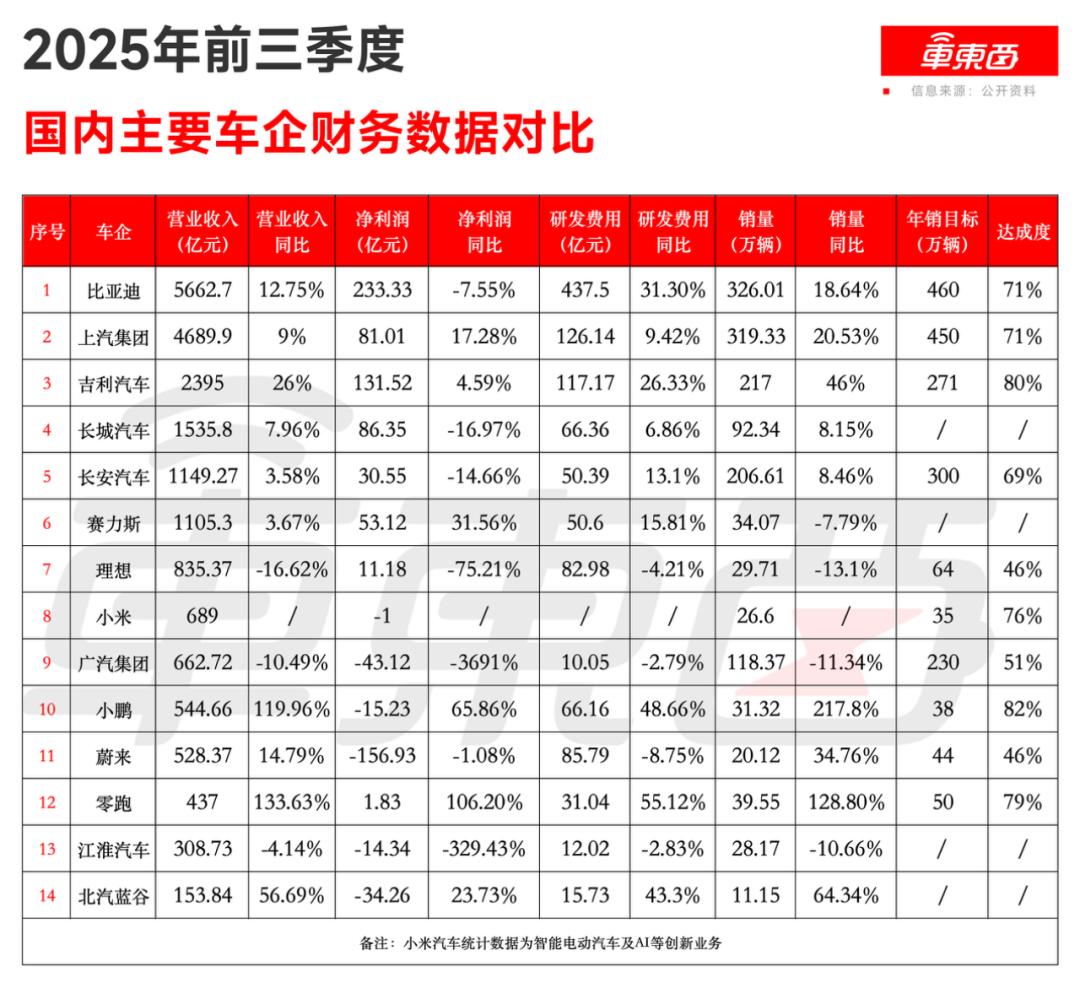
Core Insights - The financial reports of 14 major domestic car manufacturers for the first three quarters of 2025 show a total revenue of 2.07 trillion yuan and a net profit of 364 billion yuan, resulting in a net profit margin of only 1.76% [2][6][22]. Group 1: Financial Performance - Among the traditional car manufacturers, eight companies reported a combined net profit exceeding 471 billion yuan, with BYD leading with a net profit of 233 billion yuan, accounting for 64% of the total net profit of the 14 companies [4][8]. - Geely's revenue reached 239.5 billion yuan, a 26% increase year-on-year, with a net profit of 131.52 billion yuan, benefiting from its accelerated transition to new energy vehicles [8][22]. - The new energy vehicle sector is experiencing significant losses, with six new entrants collectively losing 107 billion yuan, while only Seres, Li Auto, and Leap Motor reported profits [4][6][22]. Group 2: Revenue and Profit Comparison - BYD's revenue was 566.27 billion yuan, a 12.75% increase, while its net profit decreased by 7.55% [5][7]. - SAIC Group reported a revenue of 468.99 billion yuan and a net profit of 81.01 billion yuan, both showing growth [11][22]. - NIO's revenue was 528.37 billion yuan, with a significant net loss of 156.93 billion yuan, highlighting the challenges faced by the company [22][24]. Group 3: R&D Investment - BYD led in R&D investment with 437.5 billion yuan, a 31.3% increase, indicating a commitment to technological expansion despite a slight decline in net profit [25][29]. - Geely's R&D expenditure was 117 billion yuan, up 26%, reflecting its focus on innovation [29][32]. - NIO, despite its losses, invested 85.79 billion yuan in R&D, maintaining a strong commitment to technology development [32][36]. Group 4: Sales Performance - The total sales volume for the 14 companies reached 15 million units, with BYD, SAIC, Geely, and others achieving significant growth [37][41]. - BYD sold 3.26 million vehicles, a year-on-year increase of 18.64%, while SAIC's sales reached 3.19 million units, growing by 20.53% [38][45]. - New entrants like Leap Motor and Xpeng saw substantial sales increases, with Leap Motor's sales up 128.8% and Xpeng's up 217.8% [49][50]. Group 5: Market Dynamics - The competitive landscape in the automotive industry is intensifying, with companies facing pressures from supply chain costs, rapid technological changes, and the need for substantial R&D investments [52]. - The performance of these 14 companies reflects a growing divide in profitability, with only a few achieving a balance between revenue growth and profit margins [22][52].