
战略性新兴产业

Search documents
科创债ETF鹏华(551030)盘中上涨20bp!兼具政策红利与稳健收益机会
Sou Hu Cai Jing· 2025-07-31 03:47
Core Viewpoint - The recent rebound of the Sci-Tech Bond ETF indicates a recovery in the bond market, driven by strong policy support and the focus on high-quality AAA-rated bonds [1] Group 1: Sci-Tech Bond ETF Overview - The Penghua Sci-Tech Bond ETF (551030) rose by 0.20% as of July 31, 2025, at 11:15 AM [1] - This ETF tracks the Shanghai AAA Sci-Tech Innovation Company Bond Index, which includes bonds with AAA ratings and above, reflecting the performance of high-grade tech innovation bonds listed on the Shanghai Stock Exchange [1] - The index is adjusted monthly, ensuring it accurately represents the overall performance of high-grade tech innovation bonds [1] Group 2: Investment Characteristics - The Sci-Tech Bond ETF has a low credit risk profile due to its requirement for constituent bonds to have AAA ratings, providing a higher level of safety for investors [1] - There is ongoing policy support for the Sci-Tech bond market, with continuous policy initiatives since 2025 aimed at promoting its development [1] - The focus on technology innovation and strategic emerging industries aligns with national priorities, suggesting a clear long-term growth trajectory for the sector [1] Group 3: Advantages of ETF Investment - Compared to single bond purchases, the Sci-Tech Bond ETF offers advantages such as low fees, low trading costs, high transparency, and high diversification, which help mitigate investment risks [2] - The ETF structure allows for efficient "T+0" trading, enhancing liquidity and capital efficiency [2] - Penghua Fund has established a comprehensive fixed-income product strategy since the second half of 2018, with a product library that includes 9 products totaling 57.7 billion [2]
上半年省属监管企业资产总额同比增长9.8%
Si Chuan Ri Bao· 2025-07-31 00:27
Group 1 - The core viewpoint is that the state-owned economy in Sichuan has stabilized and rebounded in the first half of the year, with total assets reaching 2.97 trillion yuan and operating revenue of 306.2 billion yuan, reflecting year-on-year growth of 9.8% and 0.7% respectively [1] - Significant progress has been made in major project construction, including the completion of the Cangba Expressway and the commissioning of new power generation units by Sichuan Energy Development Group [1] - The deepening reform of state-owned enterprises is advancing steadily, with strategic restructuring in the energy sector showing notable results and the orderly promotion of professional integration in key areas [1] Group 2 - The industrial layout is increasingly focused on "new" sectors, with investments in six major advantageous industries and strategic emerging industries growing by 55.2% and 73% respectively [2] - Sichuan is actively shaping new industrial momentum by establishing various investment funds, with a total scale exceeding 50 billion yuan [2] - The state-owned enterprises have contributed to poverty alleviation efforts, with new investments in underdeveloped counties amounting to 13.074 billion yuan in the first half of the year, totaling over 33.5 billion yuan cumulatively [2]

【省知识产权局】秦创原高价值专利大赛开始报名
Shan Xi Ri Bao· 2025-07-31 00:03
Group 1 - The Fourth Qin Chuangyuan High-Value Patent Competition has begun registration, with winning teams eligible for a maximum reward of 100,000 yuan [1] - The competition is organized by multiple provincial departments and consists of five stages: registration, preliminary round, semi-finals, finals, and awards ceremony, with the finals scheduled for November [1] - Participating projects must focus on key industrial sectors in Shaanxi Province and strategic emerging industries such as new-generation information technology, artificial intelligence, commercial aerospace, biomanufacturing, and low-altitude economy [1] Group 2 - The competition encourages innovative patent projects that are not yet on the market, with projects that are about to be launched or not yet industrialized categorized into the startup group, and those with sales under 10 million yuan categorized into the growth group [2] - Awards for the finals include first, second, and third prizes for both the startup and growth groups, with the first prize offering a reward of 100,000 yuan [2] - Additional awards include a patent agent award for the team responsible for writing the core patent of the winning project and an "Excellent Organization Award" for city-level intellectual property management departments that contribute positively to the event [2]
让外贸发展韧性更强活力更足
Mei Ri Shang Bao· 2025-07-30 22:20
Core Viewpoint - China's foreign trade showed resilience in the first half of the year, with a total import and export value of 21.79 trillion yuan, reflecting a year-on-year growth of 2.9% despite global economic challenges and rising trade protectionism [1] Group 1: Trade Performance - The export of high-end equipment increased by over 20%, and the export of "new three samples" products accelerated [1] - Trade with over 190 countries and regions experienced growth, indicating a broadening of trade partnerships [1] Group 2: Strategic Focus - Emphasis on enhancing hard power through quality supply to boost foreign trade development [1] - Transitioning from price and cost advantages to technological comparative advantages, highlighting the increasing value of "Made in China" [1] - Focus on high-end, intelligent, and green transformation trends in industries to improve the added value and technological content of export products [1] Group 3: Market Expansion - The need to explore new markets while consolidating traditional ones to mitigate risks from market fluctuations [2] - Importance of capturing diverse consumer demands and providing customized products to adapt to changing international market conditions [2] Group 4: Collaborative Networks - Deep integration into global supply chains and sharing development opportunities with other countries through various sectors, such as textiles and agriculture [2] - The establishment of a unified national market in China is expected to provide new opportunities for global trade [2] Group 5: Competitive Advantage - China's comprehensive competitive advantage in foreign trade remains solid, with a focus on maintaining strategic determination and stimulating potential vitality [2] - The steady progress of China's foreign trade is anticipated to inject stronger momentum into the country's economic development and contribute to global trade growth [2]
《中国城市创投活力及城市创新力指数报告》发布: 创投创新联动 头部城市差异化发展各显其能
Zheng Quan Shi Bao· 2025-07-30 22:03
Group 1 - The core viewpoint of the report indicates that Shanghai, Shenzhen, and Beijing are leading the Chinese venture capital market in both vitality and innovation indices for 2024 [1][2] - The report highlights a significant gap between the top three cities and the subsequent ones, showcasing a "head-led, tiered differentiation" pattern in venture capital vitality [2] - In terms of fundraising, investment, and exit indices, Beijing ranks first in fundraising due to its concentration of top financial institutions and national funding platforms [2] Group 2 - In the innovation index, Beijing maintains a clear lead, supported by national laboratories, central enterprise R&D headquarters, and top universities [2] - The semiconductor integrated circuit sector ranks among the top three in most major cities, indicating a strong capital aggregation effect [3] - The healthcare sector, particularly biopharmaceuticals and medical devices, remains highly active across multiple cities, reflecting sustained interest in the medical health field [3]
创投观察:地方政府投资基金优化返投条件 迈向科学规范发展新阶段
Zheng Quan Shi Bao· 2025-07-30 11:54
Core Insights - The government investment funds are entering a new phase characterized by scientific regulation and improved efficiency [1][3] - Recent guidelines emphasize that the establishment of government investment funds should not focus on attracting investment, encouraging a reduction or elimination of return investment ratios [1][2] Group 1: Policy Changes - The National Development and Reform Commission has solicited public opinions on new guidelines for government investment funds, which align with earlier directives promoting high-quality development [1] - Several provinces and cities, including Guangdong and Shenzhen, have responded to these policies by implementing measures to optimize return investment mechanisms [1][2] Group 2: Challenges in Traditional Models - The return investment requirement has historically been a core conflict between venture capital institutions and local government investment funds, limiting market efficiency and leading to discrepancies between actual outcomes and policy intentions [2] - Traditional return investment models restrict investment institutions to specific regions, potentially missing out on superior projects nationwide, thus reducing capital allocation efficiency [2] Group 3: Regional Disparities - Many local government investment funds focus on strategic emerging industries like AI and renewable energy, which may not align with regional strengths, complicating the identification of quality return investment targets [2][3] - The issue of "return investment difficulty" stems from mismatches between industrial positioning and regional endowments, particularly in underdeveloped areas where suitable projects are scarce [2] Group 4: Innovative Solutions - Regions are actively exploring ways to create a positive cooperation ecosystem with fund managers, such as establishing project pools that meet investment criteria to enhance the quality of return investment projects [3] - Some areas have introduced profit-sharing mechanisms to incentivize private capital participation, exemplified by Shenzhen's angel fund allowing excess returns to be fully passed on to fund managers and investors after recovering initial costs [3] Group 5: Future Outlook - Government investment funds, as a significant source of capital in the primary market, are transitioning towards a more regulated and efficient operational model, which is expected to drive sustainable growth in the venture capital industry [3]
创投观察:地方政府投资基金优化返投条件 迈向科学规范发展新阶段
证券时报· 2025-07-30 11:38
Core Viewpoint - Government investment funds are entering a new stage of scientific regulation and efficiency improvement, as indicated by recent policy changes aimed at optimizing the investment return mechanism and reducing the emphasis on local investment requirements [1][2][3]. Group 1: Policy Changes - The National Development and Reform Commission has solicited public opinions on guidelines that encourage reducing or eliminating return investment ratios, aligning with earlier directives that also discourage local investment as a primary goal [1]. - Since the issuance of the "Guiding Opinions on Promoting the High-Quality Development of Government Investment Funds," nearly ten provinces and cities, including Guangdong and Shenzhen, have introduced measures to optimize return investment mechanisms [1][2]. Group 2: Issues with Traditional Models - The traditional return investment model has created significant inefficiencies, limiting investment institutions to specific regions and potentially missing out on high-quality projects nationwide [2]. - Some institutions have resorted to "fake return investments" through shell companies to meet local requirements, which undermines the original intent of guiding funds to support technological innovation and leads to resource wastage [2]. Group 3: Regional Initiatives - Various regions are actively exploring solutions to the return investment dilemma by establishing project pools that meet investment criteria, thereby improving the quality of return projects [3]. - Initiatives such as profit-sharing mechanisms have been introduced, exemplified by Shenzhen's angel fund, which allows excess returns to be fully passed on to fund managers and investors after recovering initial costs [3]. Group 4: Future Outlook - Government investment funds have become a significant source of capital in the primary market, and with the implementation of new regulatory documents, they are transitioning towards a more scientific and efficient operational model, which is expected to drive high-quality development in the venture capital industry [3].


2024年四季度“科技金融-战新产业指数”呈上升态势 新增城市群“区域视角”
Zhong Guo Jin Rong Xin Xi Wang· 2025-07-29 12:38
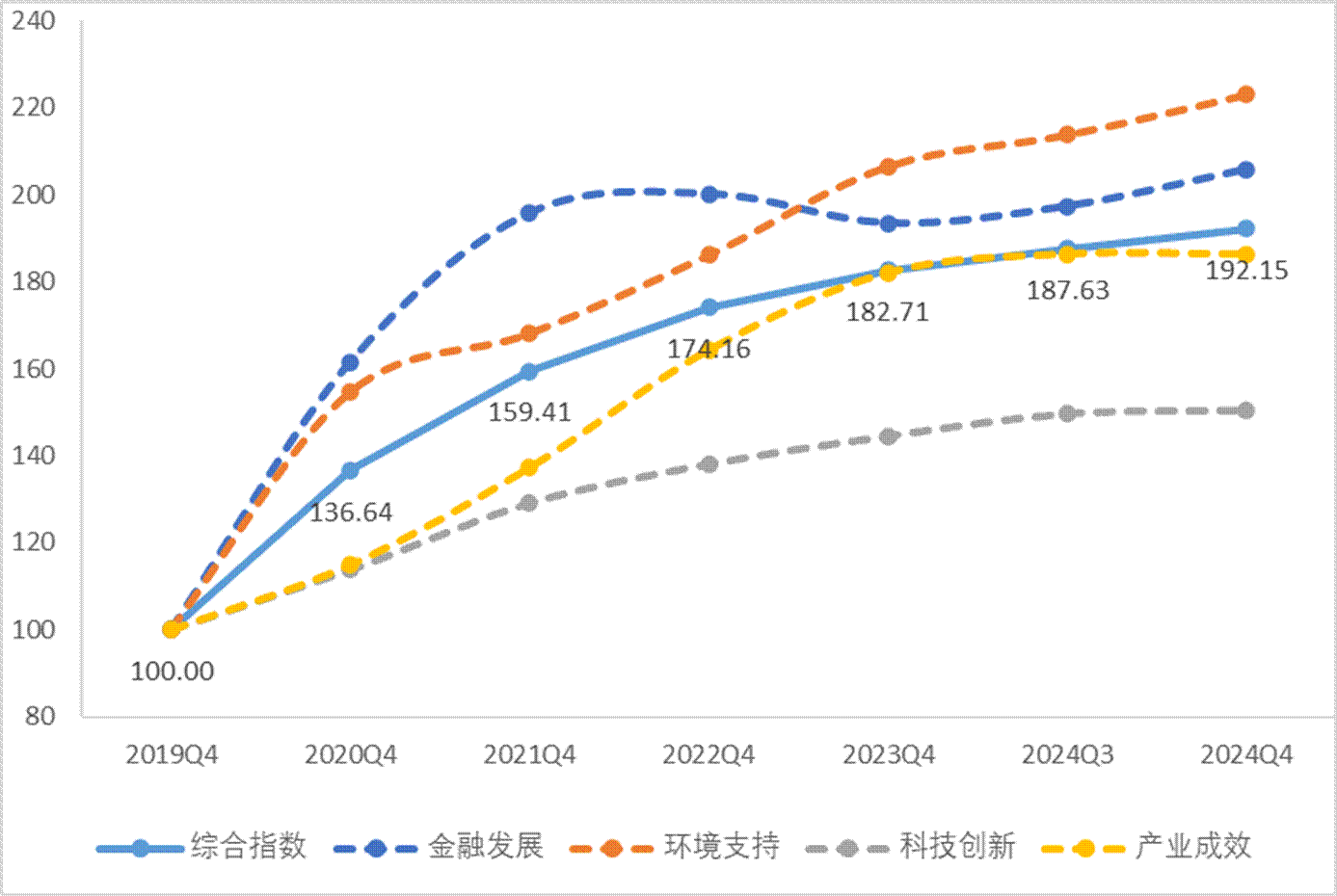
Core Insights - The "Technology Finance - Strategic Emerging Industries Index" for Q4 2024 shows a year-on-year growth of 5.16%, slightly higher than the previous year's 4.91%, indicating a steady upward trend [1][2] - The performance of the five strategic emerging industries is increasingly differentiated, with the new energy sector experiencing both year-on-year and quarter-on-quarter declines [1] Summary by Categories Overall Index Performance - The total index reached 192.15 points in Q4 2024, reflecting a year-on-year increase of 5.16% and a quarter-on-quarter increase of 2.41% [2] - The financial development sub-index rebounded to its highest point, growing by 6.38% year-on-year and 4.28% quarter-on-quarter [4] Financial Development - The financial development sub-index score is 205.89 points, supported by a significant increase in bank loans to high-tech enterprises, with 25.81 million companies receiving loans and a loan balance of 15.63 trillion yuan, up 7.5% year-on-year [4] - Private equity and venture capital performance remained subdued, with a cautious investment approach favoring larger projects [4] Environmental Support - The environmental support sub-index scored 223.14 points, with a year-on-year growth of 7.98% and a quarter-on-quarter growth of 4.32% [4] - The scale of science and technology theme funds increased by 29.41% compared to Q4 2023, providing strong support for emerging industries [4] Technological Innovation - The technological innovation sub-index scored 150.45 points, with a year-on-year increase of 4.07% but only a slight quarter-on-quarter increase of 0.53% [5] - Innovation output growth rates have declined due to various factors, including tightened R&D investments and stricter standards [5] Industry Performance - The industry effectiveness sub-index scored 186.30 points, with a year-on-year growth of only 2.33% and a quarter-on-quarter decline of 0.02% [7] - The new energy sector saw a year-on-year decline of 3.57%, marking the first annual decrease since the index's inception, with key metrics like average profit margins and tax contributions also declining [7] Sector-Specific Insights - The new energy vehicle sector led in growth, with a score of 202.20 points, reflecting a year-on-year increase of 6.01% [8] - The new generation information technology sector scored 205.85 points, showing a year-on-year growth of 3.12% but a noticeable slowdown compared to previous years [12] - The bio-industry scored 160.10 points, with a year-on-year increase of 2.80%, while the new materials sector scored 149.35 points, reflecting a year-on-year growth of 0.96% [12][13] Regional Development - The Yangtze River Delta region ranked highest in the development of strategic emerging industries with a score of 168.69, followed by the Pearl River Delta and Beijing-Tianjin-Hebei regions [15][17] - The Yangtze River Delta demonstrated strong performance across all evaluation dimensions, while the Chengdu-Chongqing region lagged behind [17][19]

培育新职业发展沃土 多元举措护航良性发展
Sou Hu Cai Jing· 2025-07-28 23:18
Group 1 - The emergence of new professions in China is driven by the integration of technological advancements and industrial upgrades, reflecting the vitality of social and economic development [1] - New professions are closely linked to strategic emerging industries and future industries, providing essential talent support while expanding employment opportunities [1] - New employment forms serve as a "reservoir" and "stabilizer" in uncertain job markets due to their diverse job types, flexible labor methods, and strong inclusivity [1] Group 2 - Government should play a leading role in developing standards for new professions, including skill standards and certification systems, while enhancing social security for new employment forms [2] - Educational institutions are encouraged to deepen the integration of industry and education, adjusting curricula to meet the needs of new professions and improving the quality of the talent pool [2] - A positive social atmosphere is necessary to foster understanding and respect for new profession workers, enhancing their sense of identity and belonging through media and public activities [2]
资产资金双端发力 释放资本市场“活”的潜能
Zhong Guo Zheng Quan Bao· 2025-07-28 21:05
Group 1 - Over 90% of the 57 companies that have listed on the A-share market this year belong to strategic emerging industries, indicating a strong focus on innovation and technology sectors [1] - The China Securities Regulatory Commission (CSRC) aims to deepen reforms to invigorate the multi-tiered capital market, emphasizing the need for collaboration between asset and capital sides to unleash market potential [1][2] - The number of companies involved in strategic emerging industries includes significant representation from information technology, new materials, and healthcare sectors [1] Group 2 - Mergers and acquisitions (M&A) in the hard technology sector have been prominent this year, with policies supporting listed companies to focus on technological innovation and industrial upgrades [2] - The implementation of the "1+6" policy measures for the Sci-Tech Innovation Board and the continued application of the third set of standards for the Growth Enterprise Market are expected to provide diversified financing support for tech startups [2][3] - The establishment of guiding funds to support technological innovation is accelerating, with local governments setting up funds to attract venture capital [2] Group 3 - The Asset Investment Company (AIC) is anticipated to become a vehicle for patient capital, with suggestions to implement long-term assessment and error tolerance mechanisms to encourage investment in early-stage hard technology projects [3] - The development of diversified exit channels for private equity investments is progressing, with the establishment of secondary market funds and M&A funds enhancing the exit mechanisms [3][4] - Regulatory bodies are focused on maintaining a balanced approach between asset and capital sides to ensure a stable market environment [3][4] Group 4 - Enhancing the multi-tiered capital market system is crucial for a vibrant capital market, with various measures being implemented to support long-term capital inflow and public fund reforms [4][5] - The bond market's support for technological innovation is also highlighted as a key component in promoting an active capital market [5] - Optimizing the capital market ecosystem is essential, with recommendations for improved judicial and administrative collaboration to prevent conflicts of interest and enhance corporate governance [5]