贸易战

Search documents
美国威胁全部无效,14个国家无一服软,特朗普4字点名中美现状
Sou Hu Cai Jing· 2025-07-13 19:58
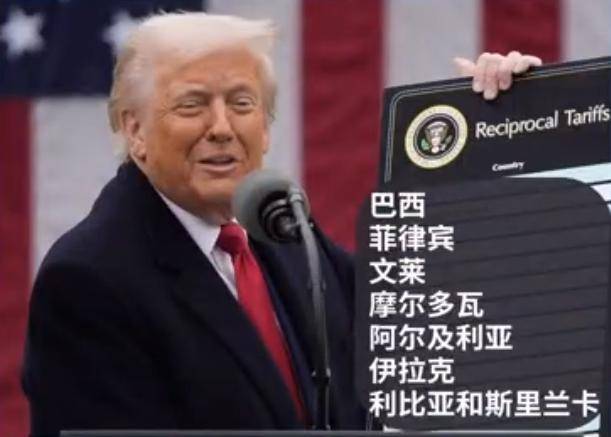
用关税作为威胁来倒逼其他国家对美国做出让步,这已经是特朗普常用的手段了。但是估计特朗普怎么都没想到,这次他明明对14个国家都发出了最后通 牒,却没有一个人对美国服软,他的威胁更是全部失效。 在这种情况之下,特朗普顿时明白了一个问题并迅速喊话中国,用四个字点明了中美现状。那么特朗普所说的这四个字究竟是什么?美国的威胁当真已经无 用了吗? 特朗普的威胁 早在七月初期,特朗普就曾表示过关税暂停期到期之后将会对和中国有着密切贸易关系的14个国家恢复之前的对等关税,并且还专门给这14个国家发送了信 函进行通告。 这已经是赤裸裸的威胁了,不过值得注意的一点是,这次被加征关税的14个国家中,甚至能看到日韩这类和美国有着盟友关系的国家。 很明显,这次特朗普已经决定要继续奉行"美国至上"主义了,不管是不是美国盟友,只要触碰到了美国利益就会受到同样的威胁和制裁。 对此,日本也在第一时间做出了回应称:日本和美国已经进行过了多轮谈判,但是却没有取得任何进展,日本已经做好了全面准备去坚定自身立场。 日本的这一番表态也是把话给美国挑明了,无论你怎么威胁,这次我都不准备让步了。因为美日之间的盟友关系,之前日本政府或许还会有所克制,至少不 ...

30%重税砸向欧洲!冯德莱恩硬刚后秒怂,欧美贸易要变天?
Sou Hu Cai Jing· 2025-07-13 14:30
Group 1 - Trump's proposed 30% tariffs on European goods are seen as a negotiation tactic to gain leverage in trade discussions, particularly aimed at garnering support from American blue-collar workers ahead of elections [3][6][10] - The European Union, particularly under Ursula von der Leyen's leadership, is caught between a desire to retaliate and the fear of significant economic repercussions, as many European industries rely heavily on the U.S. market [5][8][10] - The potential impact of these tariffs could lead to increased prices for consumers on both sides of the Atlantic, affecting everyday goods and services, and ultimately harming the working class [9][11] Group 2 - The U.S. economy is currently fragile, and a trade war could exacerbate existing issues, making both sides hesitant to escalate tensions further [10][11] - The situation reflects a broader concern about the reliability of the U.S. as an ally, as European nations may need to reconsider their trade strategies and relationships moving forward [10] - The outcome of this trade dispute is likely to result in minimal actual changes, with both sides using aggressive rhetoric to negotiate better terms rather than engaging in a full-blown trade war [10][11]
90天谈判收效甚微 美国加码关税施压
Bei Jing Shang Bao· 2025-07-13 14:10
Group 1 - The U.S. will impose a 30% tariff on goods imported from the EU and Mexico starting August 1, marking a significant escalation in trade tensions [1][3] - Trump has sent letters to 25 trade partners, with new tariffs ranging from 20% to 50%, creating greater uncertainty in the global economic landscape [1][3] - The EU and Mexico are under pressure to negotiate, but Trump has indicated that tariffs may increase if no agreement is reached [3][4] Group 2 - The EU has suspended plans to impose a digital tax on U.S. tech giants in an effort to reach a compromise, but the U.S. continues to demand high tariffs on key EU exports [4][5] - European leaders, including French President Macron and Spanish Prime Minister Sanchez, have expressed strong opposition to the proposed tariffs and are preparing countermeasures [5][6] Group 3 - The German automotive industry, particularly BMW and Volkswagen, is expected to be severely impacted by the tariffs, along with French luxury goods and Italian machinery [6] - Mexico is seeking diplomatic solutions to the trade disputes and has formed a delegation to negotiate various issues with the U.S. [6][8] Group 4 - The U.S. is also set to impose tariffs of 25% to 40% on imports from Japan and South Korea, further complicating international trade relations [7] - Increased tariffs on imports from Brazil could lead to higher prices for essential goods in the U.S., including coffee and orange juice, affecting consumer costs [7][8] Group 5 - The termination of the "tomato agreement" with Mexico will result in approximately 17% tariffs on Mexican tomatoes, potentially raising prices and impacting employment related to tomato imports in the U.S. [8]
想掐断巴西的活路?卢拉第一个不答应,套用中国招式反击特朗普
Sou Hu Cai Jing· 2025-07-13 13:37
(特朗普宣布对8国,增加关税税率) 1、"50%关税大棒砸向巴西,卢拉强硬反击 据报道,特朗普团队扔出的第二波"关税大礼包",共包含8个国家,其中巴西以50%的惊人税率"荣登榜 首"——这个数字相当离谱,这可比日韩25%的关税高出一倍,比特朗普给菲律宾的"友情价"20%更是高 出不少。 但最魔幻的是,根据美国自己的贸易数据,过去15年美国对巴西保持着4100亿美元的顺差。这就好比你 去超市买东西,老板不但不收钱,还倒贴你钱,结果你反手就告超市"占你便宜"。 第二波"征税函"来了,多国接连被美国"关税大棒"砸中,四处张望不知所措,而在这些国家中,巴西强 硬举起反制大旗。 (卢拉反美国不合理关税:巴西不会接受被任何人控制) 卢拉可不是第一次和美国硬碰硬。早在2000年,他就因为拒绝美国主导的"美洲自由贸易区"(FTAA) 而让华盛顿气得跳脚。如今20年过去,巴西的经济实力更强,金砖国家的影响力更大,卢拉更不可能在 贸易问题上低头。他直接搬出了巴西《商业互惠法》,摆明了要和美国打一场对等报复战。 特朗普这一招,不仅伤不到巴西,反而可能让美国企业自己吃亏——巴西大豆、铁矿、牛肉都是全球硬 通货,美国加税,中国、欧盟、 ...
【海外点评】德、英股市创历史新高,特朗普升级贸易攻势
Sou Hu Cai Jing· 2025-07-13 11:13
Group 1: Global Market Performance - The MSCI Global Stock Index decreased by 0.34%, while the Bloomberg Global Commodity Index fell by 0.42%, the Bloomberg Global Aggregate Bond Index dropped by 0.89%, and the FTSE EPRA/NAREIT Global REITs Index declined by 0.90% [1] - Emerging markets outperformed developed markets, with only the Chinese stock market rising among the BRICS nations; the Shanghai Composite Index increased by 0.82% and the Hang Seng Index rose by 0.93% [1] - In developed markets, the European STOXX Index rose by 1.15%, with Germany's DAX Index up by 1.97% and France's CAC40 Index up by 1.73%, while U.S. indices fell, with the S&P 500 down by 0.31% [1] Group 2: Commodity Market Insights - Brent crude oil futures rose by 3.02% to $70.36 per barrel, while WTI crude oil futures increased by 2.16% to $68.45 per barrel [4] - Industrial metals showed mixed performance; aluminum prices increased by 0.50%, while copper prices fell by 2.07% [2] - Gold prices rose by 0.55% to $3,355.59 per ounce, and silver prices increased by 4.02% [2] Group 3: Bond Market Developments - U.S. Treasury yields saw a slight increase, with the 10-year yield rising by 6.4 basis points to 4.411% [2] - European countries also experienced rising yields, with the UK's 10-year yield up by 3.6 basis points to 4.620% [2] - The U.S. dollar index rose by 0.69% to 97.853, while the Japanese yen depreciated by over 2% against the dollar [2] Group 4: Economic Data and Trends - U.S. initial jobless claims were reported at 227,000, slightly below expectations, while continuing claims rose to 1.965 million [3] - The Federal Reserve's June meeting minutes indicated a divergence in views on interest rate adjustments, with some members favoring rate cuts while others expressed concerns about persistent inflation [3] - The Eurozone's retail sales increased by 1.8% year-on-year, surpassing expectations [3] Group 5: REITs and Real Estate Market - The global REITs market saw a decline, with the STOXX Global 1800 REITs Index down by 1.03% [10] - U.S. REITs showed varied performance across sectors, with hotel REITs outperforming expectations [10] - The outlook for REITs remains mixed, with healthcare REITs showing consistent growth while retail REITs face volatility [10] Group 6: Investment Opportunities - Investors are advised to monitor oil price fluctuations due to geopolitical risks and OPEC+ production increases [7] - The ongoing geopolitical tensions in the Middle East may enhance gold's safe-haven appeal, prompting investors to consider gold price trends [9] - The potential for further monetary easing by central banks could create long-term investment opportunities in REITs [10]
国际观察丨巴西卢拉政府为何对特朗普强硬说“不”
Xin Hua She· 2025-07-13 10:35
Core Viewpoint - The article discusses the recent announcement by U.S. President Trump to impose a 50% tariff on goods imported from Brazil starting August 1, alongside demands for Brazil to cease judicial investigations against former President Bolsonaro. The Brazilian government, led by President Lula, has strongly rejected these actions, indicating a commitment to respond in kind to the U.S. measures [1][2]. Trade Relations - Trump claims that the trade relationship between the U.S. and Brazil is "very unfair," despite Brazil's experts noting that the U.S. actually enjoys a trade surplus with Brazil, amounting to approximately $7 billion in 2024 and a total surplus of about $410 billion over the past 15 years [2]. - Lula criticized Trump's assertions as unfounded, suggesting that if tariffs were to be imposed, it should be Brazil imposing them on the U.S. [2]. - The Brazilian National Confederation of Industry's president stated that there is no factual basis for the significant increase in tariffs on Brazilian products [2]. Political Interference - Trump's letter also requested Brazil to halt the judicial investigation into Bolsonaro, which has been interpreted as an attempt to interfere in Brazil's internal affairs [3]. - Analysts suggest that the U.S. is leveraging economic power to influence Brazilian politics, indicating that Trump's actions are politically motivated rather than purely economic [3]. Sovereignty and Resistance - The article highlights Brazil's historical context of U.S. interventionism in Latin America, with experts labeling Trump's actions as imperialistic [4]. - Lula's government has emphasized its commitment to sovereignty, rejecting any external control over Brazil's judicial processes [3][4]. - Public sentiment in Brazil appears to be against U.S. hegemony, with citizens expressing support for Lula's stance on social media and during protests [4][5].
特朗普惹事了!巴西对美打出3连击,中方送上两颗定心丸成关键
Sou Hu Cai Jing· 2025-07-13 04:54
Core Points - The article discusses the escalating trade tensions between the United States and Brazil, particularly following President Trump's announcement of a 50% tariff on Brazilian goods, which has been met with strong resistance from Brazilian President Lula [1][2][4]. Trade Policy Impact - The U.S. plans to impose high tariffs on goods from Brazil and 14 other countries starting August 1, 2025, significantly affecting Brazil's economy, especially its major exports like coffee, beef, and orange juice [4][6]. - Brazil's response includes legal measures to counteract the U.S. tariffs, indicating a readiness for a trade conflict [6][13]. Political Context - Trump's tariff decision appears to be politically motivated rather than economically justified, as the trade balance shows a surplus of $6.8 billion for the U.S. from Brazil [9][11]. - The tariffs are seen as a reaction to Brazil's shift in foreign policy under Lula, moving closer to China and away from U.S. influence [11][12]. Brazil's Economic Alliances - Brazil's economic ties with China are strengthening, with bilateral trade reaching $188.17 billion in 2024, compared to $72.2 billion with the U.S. [15]. - Brazil is diversifying its economic partnerships, reducing reliance on the U.S. market, and exploring new opportunities through cooperation with China [17][19]. Conclusion - The trade conflict highlights Brazil's determination to defend its economic interests and sovereignty against U.S. unilateralism, with China's role as a significant ally in this context [19].

523票赞成!欧盟议会抗议稀土管制,中国使团一句话戳中问题关键
Sou Hu Cai Jing· 2025-07-13 04:36
Group 1 - The European Parliament passed a resolution on July 10, demanding China to lift its export controls on rare earths, reflecting the EU's strong demand for these resources [1] - China's response emphasized that rare earths are dual-use materials and that its export controls are in line with international law, aimed at ensuring global security and stability [1][3] - The EU's stance appears contradictory as it criticizes China's controls while simultaneously working to strengthen its own rare earth industry and reduce reliance on external sources [3][4] Group 2 - The EU's recent diplomatic dynamics indicate a wavering policy towards China, focusing on maintaining a balanced economic relationship while reducing dependency on Chinese resources [4][6] - New proposals from the EU aim to enhance control over critical materials and prevent supply chains from being "weaponized," indicating a strategic shift in policy [4][6] - Ongoing trade negotiations between the EU and the US are accelerating, with potential agreements that may ease tariffs and reflect a shift towards closer alignment with US interests [6][8]
重税砸向亚洲后,美国财长第一时间喊话中国,好话说尽,底牌全露
Sou Hu Cai Jing· 2025-07-13 04:17
Group 1 - Trump's recent announcement of imposing tariffs ranging from 25% to 40% on 14 countries, including Japan and South Korea, starting August 1, has escalated global trade tensions [1][5][7] - The underlying motive behind Trump's tariff policy appears to be aimed at pressuring China by constricting trade opportunities for its neighboring countries, which are significant for China's export costs and supply chain efficiency [5][20] - The U.S. economy is facing challenges, with the first quarter GDP showing contraction and predictions for the second quarter being pessimistic, indicating a potential technical recession [7][20] Group 2 - U.S. Treasury Secretary Bessent's unexpected friendly overtures towards China, emphasizing mutual respect and cooperation, suggest underlying anxieties within the U.S. administration [11][13] - The U.S. has been attempting to exert pressure on China regarding rare earth resources, but China's strengthened export controls have enhanced its leverage in the global rare earth market [13][16] - China's response to U.S. pressures has been measured, maintaining control over rare earth resources while allowing some U.S. companies access to its market, showcasing its confidence and patience [16][22] Group 3 - The ongoing trade rivalry between the U.S. and China is far from over, with rare earth issues likely to remain a central topic in negotiations, where China's control gives it a favorable position [20][22] - The potential rifts in U.S. relations with traditional allies may provide China with more diplomatic space, as countries like Japan and South Korea might seek a balanced approach with China amid economic pressures [22]
特朗普刚加税,不到24小时,加拿大找上中国,说了句前所未有的话
Sou Hu Cai Jing· 2025-07-13 04:17
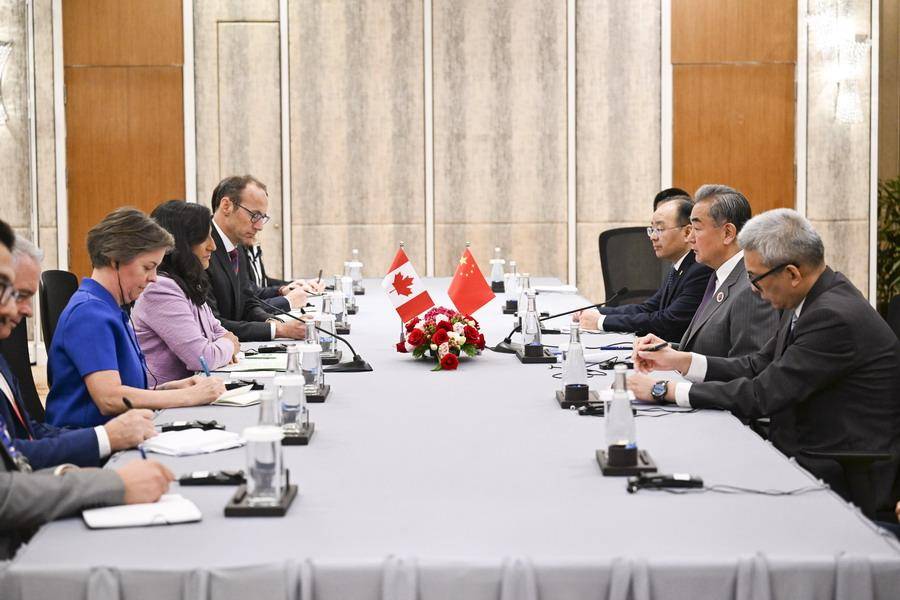
Core Viewpoint - The recent announcement by Trump to impose tariffs on Canadian goods has prompted Canada to seek support from China, indicating a shift in international trade dynamics and alliances [1][3][5]. Group 1: Tariff Announcement and Implications - On July 10, Trump announced tariffs of up to 35% on Canadian imports, citing Canada's high tariffs on U.S. dairy products as a significant threat to U.S. economic and national security [3][5]. - This move is seen as part of a broader strategy to restart a global trade war, with 23 countries receiving similar tariff notifications, including major economies like Japan and Brazil [5][6]. - The decision to target Canada, despite its status as a close ally and major trading partner, reflects Trump's "America First" policy and the need to demonstrate quick results to his voter base [6][8]. Group 2: Canada's Response and Shift Towards China - Following the tariff announcement, Canadian Foreign Minister Anand met with Chinese Foreign Minister Wang Yi, expressing a desire to "recalibrate" Canada-China relations and restore cooperation across various sectors [8][9]. - Canada's pivot towards China is driven by the unpredictability of U.S. trade policies, which have repeatedly put Canada at a disadvantage, and the need to diversify its economic partnerships [9][11]. - The meeting signaled a willingness from both Canada and China to engage in constructive dialogue and explore mutually beneficial cooperation, highlighting the potential for a stronger economic relationship [9][11]. Group 3: Broader Trade Dynamics - The current trade tensions and the U.S.'s aggressive tariff policies are eroding its credibility in the international trade system, pushing countries like Canada to seek alternative partnerships [11]. - China's commitment to multilateralism and free trade positions it as a stable and reliable partner for countries looking to reduce dependence on the U.S. market [8][11].