量子计算

Search documents
三星年底将全面停产8GB DDR4模组,供需彻底反转,存储将迎“超级周期”;“量子力学”获2025年诺贝尔物理学奖——《投资早参》
Mei Ri Jing Ji Xin Wen· 2025-10-09 00:36
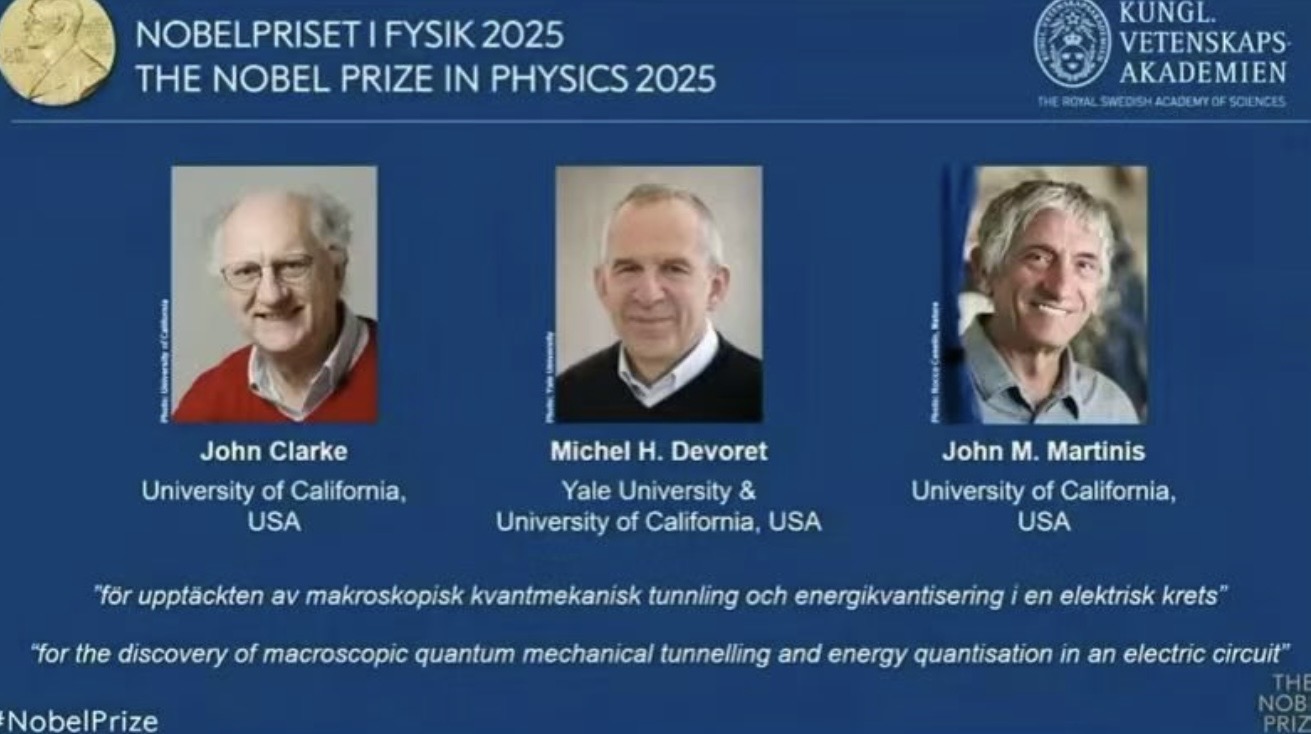
Important Market News - The Federal Reserve's meeting minutes indicate that most officials believe further easing of policies may be appropriate this year, with an emphasis on the upward risks to inflation. Major U.S. stock indices closed mixed, with the Nasdaq up 1.12% and the S&P 500 up 0.58%, both reaching new closing highs. The Dow Jones was nearly flat. Notable tech stocks saw significant gains, with AMD rising over 11% and achieving a three-day cumulative increase of 43%, marking its best three-day performance in nine years [1] - Spot gold rose 1.41% to $4040.42 per ounce, reaching a new high, with an intraday peak of $4059.31. COMEX gold futures increased by 1.40% to $4060.60 per ounce, while COMEX silver futures rose 1.95% to $48.44 per ounce. International oil prices also increased, with U.S. crude oil main contract up 0.92% to $62.3 per barrel and Brent crude oil main contract up 0.9% to $66.04 per barrel. European stock indices all closed higher, with Germany's DAX up 0.87%, France's CAC40 up 1.07%, and the UK's FTSE 100 up 0.69% [1] Industry Insights - Samsung Electronics has issued price increase notifications to major clients for the fourth quarter due to supply tightness and surging demand from cloud enterprises. DRAM prices are set to rise by 15% to 30%, while NAND flash prices will increase by 5% to 10%. Micron Technology has also raised its storage prices by approximately 20% after previously pausing some quotes. SanDisk has increased NAND flash prices by about 10% as well. The storage sector is expected to enter a "super cycle" driven by a complete reversal in supply and demand [2] - The storage industry is experiencing a recovery driven by limited capacity and unexpected demand. Major cloud service providers are shifting NAND supply from consumer markets to enterprise markets, with DRAM price indices rising approximately 72% over the past six months. Companies in the storage supply chain, such as Tongyou Technology, Liyuan Information, and Langke Technology, are expected to see significant improvements in performance [3] Quantum Computing Breakthrough - The 2025 Nobel Prize in Physics was awarded to John Clarke and others for their discovery of macroscopic quantum tunneling effects and energy quantization in electric circuits. This breakthrough allows quantum effects to transition from "microscopic" to "macroscopic," providing experimental evidence for the engineering of quantum computing. The recognition is anticipated to herald a new era in quantum computing, with significant implications for various industries [4] - Quantum computing is positioned as a core driver of next-generation information technology, moving from laboratory breakthroughs to industrial applications. The industry is expected to experience rapid growth from 2025 to 2030, potentially reaching a market size of hundreds of billions of dollars. China's "14th Five-Year Plan" has identified quantum technology as a core strategy, with expectations for breakthroughs in quantum communication and optical quantum computing [4] Solid-State Battery Advancements - A team from the Institute of Metal Research at the Chinese Academy of Sciences has made significant progress in solid-state lithium batteries, addressing issues of high interfacial resistance and low ion transport efficiency. Their new material, which integrates ion-conducting ethoxy groups and electrochemically active short sulfur chains, enhances ion transport and can withstand 20,000 bending cycles. When used as a polymer electrolyte in composite cathodes, energy density can increase by 86% [5] - Solid-state batteries are accelerating the replacement of traditional lithium-ion batteries due to their high energy density and safety. Major global companies plan to achieve small-scale production of solid-state batteries by 2027 and large-scale applications by 2030. China is expected to capture 40% of the global market share, with projections indicating that by 2030, global solid-state battery shipments will reach 614.1 GWh, with a market size exceeding 250 billion yuan [6]

大疆部分产品直降上千元!消费者炸锅,官方回应;辱骂网友?荣耀高管多次发声惹争议;「廉价版」特斯拉发布,市值一夜蒸发超4000亿
雷峰网· 2025-10-09 00:23
Group 1 - Honor's executive Ro Wei has sparked controversy with multiple statements, including insults directed at netizens, leading to calls for CEO Li Jian to intervene [3][5] - DJI has announced significant price reductions on several products ahead of the Double Eleven shopping festival, causing dissatisfaction among consumers who purchased items at higher prices [8][9] - Tesla has launched cheaper versions of its Model 3 and Model Y, resulting in a significant drop in its market value by over $40 billion [11][12] Group 2 - Xiaomi's product director Jin Fan has hidden his Weibo account and changed his profile picture, prompting speculation about his departure or a period of seclusion [14][15] - Yao Shunyu, a notable figure from Tsinghua University, has left Anthropic due to disagreements with the company's stance on China and joined Google DeepMind [16] - Ping An Good Doctor has announced a leadership change, with Guo Xiaotao taking over as chairman and He Mingke appointed as CEO following Li Dou's resignation [17] Group 3 - SAIC Motor reported a 40.4% year-on-year increase in vehicle sales for September, leading the industry with nearly 440,000 units sold [18] - The sudden passing of Zeng Yu, vice president of Yujian Technology, has raised awareness about the health of corporate executives [19] - WeChat is testing a new feature that allows users to batch withdraw messages, enhancing user experience [25] Group 4 - Samsung has secured an exclusive contract to supply OLED screens for Apple's first foldable iPhone, expected to launch in 2026 [27][28] - Intel's recent layoffs have led to the abandonment of several Linux open-source projects, marking a significant shift in its operational focus [29] - Tesla has reduced its production target for the "Optimus" robot due to challenges with the hand design, leading to a reassessment of its production plans [30] Group 5 - Reports indicate that major DRAM manufacturers in South Korea and the U.S. have paused pricing for a week, potentially leading to a price increase of 30% or more in the fourth quarter [30][31] - Elon Musk's AI startup xAI is raising $20 billion, with Nvidia investing $2 billion as part of the funding round [32] - AMD's CEO has not ruled out potential collaboration with Intel, although the focus remains on its partnership with TSMC [33]



“AI+”推动量子计算迈向“万原子时代”
Ke Ji Ri Bao· 2025-10-08 23:32
近日,由上海量子科学研究中心(合肥实验室上海研究基地)、上海人工智能实验室、中国科学技术大 学等单位研究人员组成的联合团队,通过人工智能(AI)和量子计算的跨界融合,成功构建了世界规 模最大的无缺陷二维和三维原子阵列,以2024个原子规模刷新了该领域的世界纪录。相关论文日前发表 于国际期刊《物理评论快报》。 正因如此,世界各国围绕量子计算原型机的研制展开激烈角逐。在并行推进的超导、离子阱、光量子等 多种技术路线中,中性原子量子体系因具有高扩展性、高保真度、高并行性等优势,在过去十年中迅速 脱颖而出,成为极具潜力的量子计算和量子模拟平台。但受困于技术,中性原子阵列的规模始终止步于 数百个原子,如何将其扩充至数千甚至数万个原子规模,成为通往通用量子计算机道路上首先要解决的 问题。 算力限制是科学技术发展面临的最大挑战之一,没有足够的算力就无法有效进行大规模数据处理和复杂 算法运算。量子计算机被视为破解算力瓶颈的"终极武器",其有能力在瞬间破解传统计算机需数千年才 能完成的难题。 原子阵列面临规模化瓶颈 可扩展的量子比特系统是实现量子计算和量子模拟的基石,量子比特越多,计算能力越强。对于超导与 光量子等其他体系结构 ...
Stock market will see gains and good performance from financial assets, says JPMorgan's Tom Kennedy
Youtube· 2025-10-08 20:38
Market Overview - The S&P 500 reached a new all-time high despite ongoing government shutdowns, indicating market resilience and optimism [2] - Credit spreads are at historical lows while equity markets are also at all-time highs, suggesting a favorable investment environment [3] - Interest rate volatility has significantly decreased, potentially encouraging further investment in equities and private equity [4] Economic Indicators - Leverage is primarily concentrated at the government level, with consumers and corporations maintaining low levels of debt, which supports economic stability [6] - Earnings for major tech firms, particularly hyperscalers, are currently outpacing capital expenditures, indicating strong financial health [7] Investment Sentiment - There is a prevailing belief that the stock market will continue to see gains, driven by positive economic fundamentals [5] - Concerns about potential bubbles in sectors like AI are present, but the current market dynamics do not suggest an immediate risk [6][12] Market Dynamics - The market is experiencing a short-term rally characterized by speculative investments in low-quality stocks, particularly in meme stocks and emerging technologies [10][11] - The performance of firms without profits is lagging behind the broader market, which could indicate a lack of sustainable growth if this trend continues [12]
谷歌连续收获诺贝尔奖!AI拿下去年化学奖,量子计算拿下今年物理学奖
Hua Er Jie Jian Wen· 2025-10-08 11:58
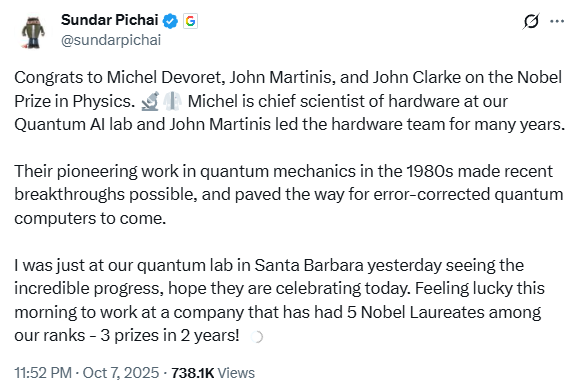
Core Insights - Alphabet's scientists have won the Nobel Prize for two consecutive years, highlighting the company's strong capabilities in cutting-edge research areas like artificial intelligence and quantum computing, which are expected to disrupt future business and market landscapes [1][2] - The 2025 Nobel Prize in Physics was awarded to three physicists, including Google Quantum AI Lab's current hardware chief scientist Michel Devoret, recognizing their groundbreaking contributions to quantum mechanics [1][3] - Google CEO Sundar Pichai emphasized that the awardees' research lays the foundation for the company's latest breakthroughs in quantum computing, signaling that long-term investments in fundamental science are translating into core competitive advantages in key technology areas [1][5] Quantum Breakthrough Focus - The Nobel Prize in Physics was awarded to Michel Devoret, John Martinis, and John Clarke for their discoveries in macroscopic quantum tunneling and energy quantization in circuits, demonstrating the peculiar properties of the quantum world in tangible systems [3] - Devoret's role as hardware chief scientist at Google Quantum AI Lab is crucial in building scalable, fault-tolerant quantum computers, while Martinis previously led the team that achieved "quantum supremacy" in 2019 [3] AI Nobel Moment - The recent Physics award follows last year's Nobel Prize in Chemistry awarded to DeepMind's CEO Sir Demis Hassabis and senior research scientist John Jumper for their contributions to protein structure prediction through the AI model AlphaFold2, which has significant applications in pharmaceuticals and materials science [4] R&D Strength of Tech Giants - Winning Nobel Prizes in consecutive years illustrates Google's R&D prowess and its long-term commercial moat, with AI and quantum computing being critical variables in future market competition [5] - Sundar Pichai expressed pride in working at a company with five Nobel laureates, highlighting Google's culture of attracting and retaining top scientific talent, which is seen as a driver of continuous innovation [5] - For investors, these awards serve as important indicators of the company's innovative capacity and future potential, suggesting that Google's sustained investment in fundamental science is positioning it favorably for the next technological revolution [5]

国富量子收涨逾11% 量子计算再成诺奖赢家 公司已推出GFQ量子加密硬件钱包
Zhi Tong Cai Jing· 2025-10-08 08:21
Core Viewpoint - The stock of Guofu Quantum (00290) surged by 11.68% to close at HKD 2.39, with a trading volume of HKD 30.99 million, following the announcement of the 2025 Nobel Prize in Physics awarded to John M. Martinis and two other quantum physicists for their work in quantum mechanics [1] Company Summary - Guofu Quantum is the only quantum computing concept stock listed in Hong Kong [1] - The company recently launched the world's first "true random number" quantum encryption hardware wallet, targeting institutional-level quantum security infrastructure [1] - The GFQ quantum encryption hardware wallet offers standard OEM and custom development services to meet the high-level needs of financial institutions for protection against quantum attacks and cross-border compliance [1] - The team behind Guofu Quantum Communication originates from the "Mozi" quantum satellite team, positioning the company as a leader in quantum communication and quantum cryptography technology globally [1] Industry Summary - The announcement of the Nobel Prize in Physics has positively impacted the quantum computing sector, with related stocks like Quantum (QMCO.US) rising by 12% [1]
量子科学研究成果获诺贝尔奖,关注量子技术产业化前景
Orient Securities· 2025-10-08 08:12
Investment Rating - The report maintains a "Positive" investment rating for the electronic industry, indicating an expectation of returns exceeding the market benchmark by more than 5% [6][17]. Core Insights - The Nobel Prize in Physics awarded for quantum science research is expected to enhance the attention of governments and leading tech companies towards the industrialization of quantum technology, accelerating its commercialization process [3][10]. - The research recognized by the Nobel Prize lays a theoretical foundation for the industrialization of quantum technology, with significant contributions from the awarded scientists in developing superconducting circuits and quantum bits [9][10]. - Recent advancements in quantum technology, such as the installation of the first quantum computer in a data center in New York City, signify a shift from laboratory research to practical applications in the industry [9][10]. Summary by Sections Investment Recommendations and Targets - The report suggests focusing on leading domestic quantum technology companies, including Guandun Quantum, Guoxin Technology, Tengjing Technology, and Huagong Technology, as potential investment targets [3][10]. Industry Overview - The report highlights the growing interest in quantum technology following the Nobel Prize announcement, with expectations for increased investment and development in quantum computing, communication, and measurement technologies [9][10].




另一位Yao Shunyu也跳槽了:与Anthropic价值观有根本分歧
量子位· 2025-10-08 04:25
Core Insights - The article discusses the recent transition of Shunyu Yao, a prominent AI researcher, from Anthropic to Google DeepMind, highlighting his background and motivations for the move [1][4][41]. Group 1: Background and Career Transition - Shunyu Yao, a distinguished alumnus of Tsinghua University, recently joined Google DeepMind as a Senior Research Scientist after leaving Anthropic, where he contributed to the Claude AI model [1][41]. - Yao's departure from Anthropic was influenced by a fundamental disagreement in values, which he stated accounted for 40% of his decision, while the remaining 60% involved internal details he chose not to disclose [21][24]. - His experience at Anthropic was marked by a high workload, which he described as "super busy," preventing him from reflecting on his transition from physics to AI research until after his departure [7][8][18]. Group 2: Insights on AI Research - Yao expressed that the field of AI research, particularly in large models, is currently in a chaotic state, akin to the early days of thermodynamics, where foundational principles are not yet fully understood [14][15][16]. - He noted the rapid evolution of AI, with the Claude model progressing from version 3.7 to 4.5 within a year, emphasizing the fast-paced nature of advancements in the field [27]. - Yao's background in theoretical physics provided him with a unique perspective on AI research, allowing him to appreciate the ability to identify patterns without fully understanding the underlying principles [16][18]. Group 3: Academic Achievements - During his undergraduate studies, Yao made significant contributions to condensed matter physics, publishing groundbreaking work in the prestigious journal Physical Review Letters [30][31]. - His research achievements include the introduction of new physical concepts and theories related to non-Hermitian systems, which have been recognized as substantial contributions to the field [32][33]. - After completing his PhD at Stanford University, Yao's work continued to focus on cutting-edge topics in quantum mechanics, further establishing his reputation as a leading researcher [35].

专家解读诺贝尔物理学奖:三位获奖人为超导量子计算奠基
Xin Jing Bao· 2025-10-07 14:50
Core Insights - The 2025 Nobel Prize in Physics was awarded to John Clarke, Michel H. Devoret, and John M. Martinis for their foundational work in discovering macroscopic quantum tunneling effects and energy quantization in circuits [1][2][3] Group 1: Contributions to Quantum Computing - The awarded scientists made significant contributions to superconducting quantum computing, establishing the basis for superconducting qubits, which are essential for quantum computing [1][3] - Their work demonstrated that macroscopic devices, like superconducting Josephson junctions, can exhibit quantum effects under specific conditions, bridging the gap between microscopic quantum states and macroscopic systems [2][4] - John M. Martinis played a crucial role in advancing the number of qubits from a few to dozens, significantly pushing the development of superconducting quantum computing [3] Group 2: Future Prospects of Quantum Computing - Superconducting quantum computing is considered one of the most promising technological routes in quantum computing, with major companies like Google and IBM focusing on this area [3][5] - The advancements in superconducting quantum computing are expected to demonstrate superior capabilities over classical computers in practical applications within the next five to ten years, particularly in fields such as artificial intelligence, biomedicine, cryptography, and materials manufacturing [5]
诺奖对量子计算“下赌注”!谷歌“悬铃木”发明人获奖
Di Yi Cai Jing· 2025-10-07 12:09
Group 1 - The 2025 Nobel Prize in Physics was awarded to three scientists for their contributions to quantum mechanics, specifically for discovering macroscopic quantum tunneling and energy quantization in circuits [1] - The Nobel Prize committee stated that this year's award opens opportunities for the development of next-generation quantum technologies, including quantum cryptography, quantum computers, and quantum sensors [1] - The award highlights the significant contributions of the winners to superconducting quantum computing, which is based on macroscopic quantum effects and energy quantization [3] Group 2 - The concept of "quantum computing superiority" refers to the ability of quantum computers to outperform classical computers in solving specific problems that even supercomputers cannot solve in a short time [4] - The mainstream academic view suggests that the development of quantum computing will follow a three-step process: achieving quantum computing superiority, developing manipulable quantum simulators, and creating programmable universal quantum computers [4] - Major technology companies, including Google, IBM, Microsoft, and NVIDIA, are actively investing in quantum information technology, accelerating the transition from laboratory research to industrial applications [4]