AI算力

Search documents
长城基金汪立:市场行稳致远,结构加速轮动
Xin Lang Cai Jing· 2026-01-20 08:00
Group 1: Market Overview - The A-share market exhibited a structured differentiation and active trading pattern, with a rapid shift in structure under margin trading regulations, where commercial aerospace and AI application themes weakened while electronic semiconductors and machinery strengthened [1][5] - In December, China's export growth rate was 6.6% in USD terms, up from 5.9% previously, indicating strong resilience despite high base effects from 2024 [1][5] - Exports to the US decreased by 30.0%, while exports to ASEAN and Latin America increased by 11.1% and 9.8%, respectively, showcasing a shift in trade dynamics [1][5] Group 2: Monetary Policy - On January 15, the central bank announced eight optimization policies for structural monetary policy tools, including a 0.25 percentage point reduction in interest rates and lowering the minimum down payment for commercial property loans to 30% [2][6] - The core objective of these policies is to reduce the cost of targeted funding, expand the coverage of structural tools, and enhance support for private, small, technology, and green sectors, with a moderate impact on overall liquidity [2][6] Group 3: Investment Strategy - The investment strategy emphasizes emerging technology as a main focus, with cyclical consumption undergoing transformation [3][7] - The regulatory environment in China's capital market is improving, which is expected to enhance the market's investability and allow more investors to benefit from transformation and reform dividends [3][7] - Key investment directions include: 1) Technology growth, particularly in semiconductor manufacturing, driven by strong global AI computing demand [3][7] 2) Non-bank financials, benefiting from increased wealth management demand and capital market reforms [3][7] 3) Cyclical sectors, which are expected to improve due to domestic demand expansion policies [3][7]
国内电网投资高增,电网设备主题指数午后拉升涨超2%
Xin Lang Cai Jing· 2026-01-20 06:45
Core Viewpoint - The electric grid equipment sector is experiencing a significant surge, driven by substantial investments from the State Grid and Southern Power Grid, marking a new phase in China's energy transition [1] Investment and Market Dynamics - The State Grid announced a fixed asset investment of 4 trillion yuan during the 14th Five-Year Plan, while Southern Power Grid disclosed an investment scale of 180 billion yuan for 2026, indicating a shift towards annual investments nearing 1 trillion yuan [1] - This investment not only sets a historical high but also signifies the acceleration of new power system construction from planning to implementation, providing crucial support for China's energy transition [1] Industry Trends and Future Outlook - The consensus in the industry is that "the end of AI is electricity," highlighting the critical role of power supply in the development of AI technologies, especially with the increasing energy demands of large models like GPT-5 [1] - Goldman Sachs predicts that by 2030, AI data centers will increase global electricity demand by 175% compared to 2023, emphasizing the mismatch in the speed of data center construction and transmission line installation [1] - Dongguan Securities notes that significant projects in China, such as smart grids and urban-rural grid renovations, require substantial electric grid equipment, leading to a demand for efficient, energy-saving, and environmentally friendly transformers [1] Investment Products - The Tianhong CSI Electric Grid Equipment Theme Index closely tracks the performance of 80 listed companies involved in ultra-high voltage and smart grid construction, reflecting the overall performance of electric grid equipment stocks [2] - Investors interested in capitalizing on the growth of AI computing power may consider the Tianhong CSI Electric Grid Equipment Index [2]


午后强势翻红,电网设备ETF(159326)规模破百亿,单日成交额再创新高
Mei Ri Jing Ji Xin Wen· 2026-01-20 06:35
Group 1 - The A-share market experienced a collective pullback on January 20, with the only electric grid equipment ETF (159326) rebounding strongly after hitting a low, achieving a gain of 0.38% and a trading volume of 3.892 billion yuan, marking a new high since its listing [1] - The electric grid equipment ETF has seen continuous capital inflow over the past 8 days, accumulating over 6.636 billion yuan, with its latest scale surpassing 10 billion yuan, reaching 11.778 billion yuan, making it the largest electric grid-related ETF in the market [1] - Key stocks in the electric grid equipment sector, such as China XD Electric and Huan Cable, hit the daily limit, while Shanda Electric surged over 10% and Baobian Electric rose over 9% [1] Group 2 - The electric grid equipment ETF (159326) is the only ETF tracking the CSI Electric Grid Equipment Theme Index, with a strong representation in the industry, primarily consisting of power transmission and transformation equipment, grid automation equipment, cable components, and distribution equipment [2] - The smart grid has a weight of 88% in the index, while ultra-high voltage equipment accounts for 65%, both being the highest in the market [2] Group 3 - The surge in AI computing power has led to a global shortage of electricity in data centers, with Elon Musk highlighting the explosive growth in power demand for AI supercomputing clusters and data centers, indicating a critical need for high-performance transformers [1] - According to Chengtong Securities, the aging electric grid equipment in developed economies, with over 20 years of usage, necessitates urgent upgrades, which will benefit domestic electric grid equipment companies as investment growth in the grid accelerates, alongside stable growth in overseas export business [1]
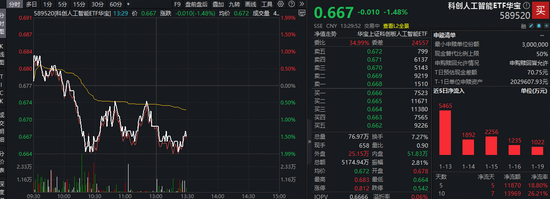
谷歌Gemini业务销售额飙升,AI应用商业化有望加速!科创人工智能ETF华宝(589520)近5日连续吸金1.19亿元!
Xin Lang Ji Jin· 2026-01-20 06:02
Group 1 - The core viewpoint of the news highlights the strong performance and investor confidence in the domestic AI industry chain, as evidenced by the trading activity of the Huabao Sci-Tech AI ETF (589520) which saw a price drop of 1.48% but maintained a high trading volume of over 51 million yuan, indicating a "buy the dip" mentality among investors [1] - The Huabao Sci-Tech AI ETF has attracted a total of 119 million yuan in inflows over the past five days, reflecting ongoing investor interest in the domestic AI sector [1] - Among the ETF's constituent stocks, Weisheng Information led with a gain of over 6%, while other stocks like Lanke Technology and Xindian Software also saw increases, indicating a positive trend in the sector [1] Group 2 - Google has experienced a significant surge in its Gemini AI model sales, with API call volume increasing over 100% to 85 billion times and enterprise subscriptions reaching 8 million, which is expected to boost revenue for Google Cloud services [3] - The current dynamics in the AI industry are marked by substantial activity, with overseas companies like xAI and Anthropic securing funding, and domestic policies promoting "AI + manufacturing," suggesting a robust growth trajectory for the sector [3] - By 2025, the synergy between self-sufficiency and AI is projected to drive strong performance in related sectors, with trends expected to strengthen further into 2026 [3] Group 3 - The Huabao Sci-Tech AI ETF (589520) is strategically positioned across four key segments of the AI industry chain: application software, terminal applications, terminal chips, and cloud chips, reflecting a shift from reliance on foreign technology to self-sufficiency [4] - The ETF focuses on domestic AI industry chains, emphasizing strong domestic substitution characteristics, with significant holdings in leading domestic GPU and ASIC companies, indicating a high concentration and aggressive investment strategy [5] - The ETF serves as an efficient tool for investors looking to gain exposure to domestic computing power, being a financing and margin trading target [5]

半导体板块拉升,江化微涨停,蓝箭电子等大涨
Zheng Quan Shi Bao Wang· 2026-01-20 03:31
Group 1 - The semiconductor sector experienced a strong rally, with notable stock increases for companies such as Blue Arrow Electronics (up over 14%), InnoGrit and Guoxin Technology (up over 10%), Jianghua Microelectronics (limit up), and Huahai Chengke (up about 9%) [1] - TSMC announced a record revenue of $122 billion for 2025, representing a significant year-on-year growth of 35.9%, driven by the strong demand for AI computing and the full-scale implementation of 3nm process technology [1] - TSMC's gross margin is projected to be nearly 60% in 2025, with advanced process revenue (7nm and below) accounting for 77% of total revenue, and 3nm and 5nm processes contributing 63% of wafer sales [1] - The net profit attributable to the parent company for TSMC is expected to reach NT$1.72 trillion in 2025, marking a year-on-year increase of over 30%, setting a historical high [1] Group 2 - CITIC Securities highlighted TSMC's record performance in 2025 and significantly increased capital expenditures for 2026, indicating ongoing benefits from AI computing and advanced processes [2] - Domestic wafer manufacturers are entering a phase of expansion to address a million-piece advanced capacity gap, creating a market opportunity worth hundreds of billions of dollars for equipment suppliers [2] - The investment outlook for semiconductor equipment is positive, driven by advanced processes and domestic substitution, with a focus on leading companies that have achieved technological breakthroughs in core equipment areas such as etching, thin film deposition, cleaning, and CMP [2] - Companies with flexible domestic substitution rates in lithography, coating, developing, metrology, and testing are also expected to benefit significantly from this historic industry opportunity [2]


未知机构:应流股份持续重点推荐加油太阳25年两机业务新签订单20亿左右24年两机收入9-20260120
未知机构· 2026-01-20 02:25
Company and Industry Summary Company: 应流股份 (Yingliu Co., Ltd.) Key Points - **New Orders and Revenue Growth** 应流股份 has secured approximately 2 billion in new orders for its two-machine business, with projected revenue of 950 million for 2024. The company has experienced rapid growth in this sector over the past two years, driven by increasing demand for gas turbine blades due to the surge in electricity demand from overseas AI computing power and tight global blade production capacity [1][3]. - **Production Capacity Expansion** Following the recent convertible bond fundraising, the company's monthly production value is expected to increase from 70-80 million to 200 million. This expansion is anticipated to support the company's performance growth over the next five years [1][4]. - **Key Client Relationships** 应流股份 has established strong partnerships with leading domestic and international clients. Internationally, the company collaborates with major players such as Baker Hughes, Siemens Energy, Ansaldo, and GE Aviation, with orders consistently exceeding expectations [2][5]. Domestically, the company supports large-scale projects from China’s major state-owned enterprises, indicating promising growth potential over the next five years [6]. - **Supply Chain and Value Addition** The company is expanding its supply range from solely casting to include upstream alloy smelting and downstream machining processes. This expansion is expected to enhance the value of individual blades by 50-100% due to increased demand for turbine hot-end components and the addition of post-processing capabilities [7][8]. - **Future Revenue Projections** By 2030, the two-machine business revenue is projected to reach approximately 5 billion, with a net profit margin expected to approach 20%. Revenue is anticipated to grow from 1.4 billion in 2025 to around 3 billion by 2027. The overall revenue forecast for 2030, including traditional business, nuclear power, and low-altitude operations, is expected to reach around 10 billion, with total revenue projected to exceed 10 billion [10]. - **Profitability Expectations** The company expects long-term gross margins to improve from the current 37-38% to 45-50%, while net margins are projected to rise from 13-14% to 20%, aligning closely with international benchmark companies like HOWMET [10].

未知机构:DB电新强瑞杰瑞双瑞要点更新瑞彩祥云0119强-20260120
未知机构· 2026-01-20 02:10
Company and Industry Summary Company: 强瑞技术 (Qiangrui Technology) Key Points - **Semiconductor Equipment Growth**: The company is experiencing significant growth in semiconductor equipment, particularly with the new Kailai product line, which shows high revenue and profit elasticity [1] - **Profit Projections**: Expected profit for 2026 is 100 million, leading to a market valuation of 10 billion [1] - **Future Growth**: Anticipated rapid growth over the next three years, indicating a potential explosion in performance [1] - **Server Liquid Cooling**: Projected profit from liquid cooling for 2026 is over 120 million, serving major clients like NVIDIA, Google, and Industrial Fulian, primarily in overseas markets [1] - **Market Valuation**: The company is looking at a market valuation of 6 billion, with high growth rates [1] - **Core Business Performance**: Expected performance of 180 million, valued at over 20 times, equating to a valuation of 4 billion [1] - **Commercial Aerospace**: Significant potential with an initial target of 8 billion [1] - **Overall Valuation Outlook**: Initial target valuation of 28 billion, with potential for further growth [1] - **High Margin and Elasticity**: The company has a high safety margin and significant elasticity in its operations [1] - **Order and Performance Surge**: Both orders and performance are expected to see substantial increases [1] - **Stock Incentive Plan**: Recently implemented a stock incentive plan at 92 yuan, reflecting strong confidence in future performance [1] Company: 杰瑞股份 (Jereh Group) Key Points - **Main Logic**: The company is positioned to benefit from AI giants building their own computing centers, with an increasing gap in gas turbine supply [1] - **Capacity Lock-in**: Production capacity for the next five years is secured, indicating sustained high growth in both volume and price [1] - **Profit Projections**: Expected to see unit prices more than double within five years, with unit profits increasing fivefold [1] - **Gas Turbine Revenue**: Projected shipment of 700 MW in 2027, generating 5 billion in revenue and 1.4 billion in profit [1] - **Leasing Revenue**: Consistent leasing revenue of 200 million, totaling 1.6 billion in profit [1] - **Integrated Power Supply**: Additional revenue from energy storage, liquid cooling, and distribution, with average selling price (ASP) exceeding three times that of gas turbines [1] - **Revenue Enhancement**: Expected to add 10 billion in revenue and 1.4 billion in profit [1] - **Total Market Valuation**: Estimated total market valuation of 190 billion, combining AI power supply profits and core oil and gas business [2] - **Price Increase Impact**: If considering a price increase of 30% to 50% due to supply gaps, profit elasticity could be significantly enhanced [3]
美克美家“家具抵薪”惹怒员工!“企二代”接棒后巨亏超18亿 | BUG
Xin Lang Cai Jing· 2026-01-20 00:25
Core Viewpoint - The closure of Meike Home's Tianjin factories has raised significant concerns about the company's operational status and financial health, with reports of unpaid wages and ongoing losses [2][3][4]. Group 1: Company Operations and Financial Performance - Meike Home announced the suspension of operations at its two wholly-owned subsidiaries in Tianjin due to significant operational losses and low capacity utilization, averaging less than 20% [3][22]. - The company has accumulated losses exceeding 18 billion yuan over the past three years, with revenue declining from 4.496 billion yuan in 2022 to 3.395 billion yuan in 2024, and net losses increasing from 289 million yuan to 864 million yuan during the same period [7][25]. - In the first three quarters of 2025, Meike Home reported revenue of 2.223 billion yuan, a year-on-year decrease of 10.10%, with a net loss of 220 million yuan [8][25]. Group 2: Employee Issues and Labor Relations - Workers at the Tianjin factories reported being owed wages for five months prior to the closure, leading to dissatisfaction with the company's proposal to compensate with a mix of cash and furniture [3][4][21]. - The company has settled all outstanding wages through a government-regulated account, but employees are still pursuing promised severance compensation [4][21]. - Reports indicate that wage delays have been a recurring issue since 2024, prompting large-scale employee protests [4][21]. Group 3: Strategic Challenges and Management - The company's management has been criticized for being outdated, with employees suggesting that the leadership has failed to adapt to market changes and competition [10][27]. - Despite attempts at reform under the new chairman, Feng Lu, who took over in 2022, the company's performance has continued to decline, indicating that these efforts have not been effective [12][29]. - Meike Home's strategy to close underperforming stores has resulted in the closure of 40 locations over two years, reflecting a significant contraction in its retail presence [14][30]. Group 4: Market Environment and Industry Context - The challenges faced by Meike Home are indicative of broader issues within the home furnishings industry, which is experiencing a downturn due to a sluggish real estate market and reduced consumer demand [10][27]. - The company is attempting to pivot towards AI and technology by planning to acquire Shenzhen Wandeng Technology, despite its ongoing financial struggles, raising concerns about the viability of such a move [17][33]. - The acquisition plan has sparked debate among investors, as it diverges from the company's core business and may exacerbate its financial difficulties [17][33].
A股苏州板块市值首破3万亿 比去年年初增加约1.31万亿元,大幅增长76.32%
Su Zhou Ri Bao· 2026-01-20 00:16
Core Insights - The total market capitalization of the "Suzhou sector" in A-shares reached a historical high of 30,286.6 billion yuan as of January 19, marking a significant increase of approximately 1.31 trillion yuan or 76.32% year-on-year [1] - The growth in market capitalization is attributed to both the quantity and quality of listed companies in Suzhou, with 229 A-share companies currently listed, ranking fifth nationally [1] - The emergence of leading enterprises, particularly in the AI and high-end PCB sectors, has been a key driver for the market capitalization breakthrough [2] Market Capitalization Growth - The "Suzhou sector" has crossed the 30 trillion yuan threshold for the first time, reflecting a robust increase in both the number and quality of listed companies [1] - By 2025, Suzhou is expected to add 12 new A-share listed companies, positioning it first among major cities in China, which will support further market capitalization growth [1] Leading Enterprises - Tianfu Communication has emerged as a leader with a market capitalization of 1,502.12 billion yuan, driven by the benefits of AI computing power [2] - Other notable companies such as Huidian Co. and Dongshan Precision have also entered the billion-yuan market capitalization club, showcasing strong competitiveness in the high-end PCB sector [2] - A number of enterprises with market capitalizations around 500 billion yuan are steadily developing, contributing to a multi-tiered market capitalization structure [2] R&D Investment - Non-financial A-share companies in Suzhou reported a record high in R&D expenditures for the first three quarters of 2025, with an average R&D intensity of 8.4%, significantly exceeding the national average [2] - Breakthroughs in key technologies by Suzhou companies, such as Guoxin Technology and Zhejing Pharmaceutical, highlight the ongoing transformation of hard technology into market capitalization growth [2] Future Outlook - The milestone of 30 trillion yuan in market capitalization symbolizes the successful integration of industrial transformation and capital market development in Suzhou [3] - There is a commitment to enhancing the enterprise listing cultivation service system and supporting innovative companies to further expand the scale and quality of the "Suzhou sector" [3]
从“引得来”到“发展好”:昆山千灯镇2025年揽获逾120亿元投资背后的营商密码
Sou Hu Cai Jing· 2026-01-19 23:20
Core Viewpoint - The Jiangsu Provincial Development and Reform Commission has officially released the list of major projects for 2026, highlighting the successful inclusion of the Kunshan Fuliwang Intelligent Core Components Project from Qiantang Town, marking the fourth consecutive year for Qiantang to have projects recognized in the provincial major project list. This achievement reflects the comprehensive strength of Qiantang Town [1]. Group 1: Investment and Project Achievements - In 2025, Qiantang Town secured over 28 projects with total investments exceeding 12 billion yuan, setting a historical record [1]. - Industrial investment in Qiantang has maintained high levels for two consecutive years, with 3.07 billion yuan in 2025, ranking first among towns in the city [1]. - The planned investment for major industrial projects in 2026 is 2.17 billion yuan, placing Qiantang second among towns [1]. Group 2: Investment Attraction Strategies - A "professional team" was established through reforms in the investment attraction system, leading to the signing of the 3 billion yuan Taihong Wanlihua East China Automotive Core Components Manufacturing Center project, marking a significant achievement for the newly formed investment service company [2]. - A detailed "investment navigation map" was created, focusing on cutting-edge fields such as AI computing power, hydrogen energy, humanoid robots, and new energy vehicles, identifying over 1,200 key enterprises in the industrial chain [2]. - The investment team expanded its global outreach by visiting key cities in southern China and Europe, engaging with leading companies to promote project landing and enterprise upgrades [2]. Group 3: Space and Resource Management - Over 400 acres of land space were successfully revitalized through various methods, including land release and storage, to support new projects [4]. - Innovative models like "fixed construction" and "first rent then let" were introduced to reduce costs and construction time for enterprises [4]. - The Huaxin Micro Measurement project utilized idle factory space, achieving an average investment of 12 million yuan per acre and expected output value exceeding 22 million yuan per acre [4]. Group 4: Financial Support Initiatives - The town actively assisted enterprises in applying for national bonds and other funding, securing over 50 million yuan in subsidies for equipment updates and various awards in 2025 [6]. - Additional funding of over 24.4 million yuan was allocated for unicorn cultivation and gazelle enterprise recognition [6]. Group 5: Environmental and Infrastructure Support - Environmental compliance was ensured through precise allocation of pollution discharge indicators, facilitating project landing while avoiding pollution risks [8]. - Ongoing improvements to the sewage treatment infrastructure were highlighted, including the expansion of the sewage network and the construction of the Qianfeng Sewage Treatment Plant [8]. Group 6: Service and Ecosystem Development - A comprehensive enterprise visit initiative was launched to gather and respond to business needs, ensuring timely support for operational challenges [10]. - A collaborative service model was implemented to streamline inspections and reduce disruptions for enterprises, allowing them to focus on production and innovation [12]. - Regular policy briefings and resource matching events were organized to foster long-term growth and collaboration between enterprises and the local government [14].