通用人工智能(AGI)

Search documents
蒲慕明院士:未来数十年会用AI的人取代不会用AI的人
Di Yi Cai Jing· 2025-05-17 13:14
Group 1 - The core viewpoint is that in the next two to three decades, it will not be AI replacing humans, but rather those who use AI replacing those who do not [1] - According to McKinsey Global Institute, within the next five years, 20% to 30% of jobs will be replaced by AI, and by 2030 to 2060, 50% of existing jobs may be affected, with a midpoint around 2045 [3] - The International Monetary Fund (IMF) estimates that by 2050, 60% of jobs in developed economies could be impacted by AI [3] Group 2 - The emergence of general artificial intelligence (AGI) could lead to the restructuring of over 90% of jobs by 2050, although the exact timeline remains debated [3] - There is a need to consider changes in educational content and models, with AI being integrated as a fundamental subject alongside traditional subjects like language and mathematics [3] - The goal of science education and popular science in the AI era is to cultivate future scientists and scientifically literate citizens who can engage with AI and contribute to its governance [4]

阿里Q4财报:淘天货币化率提速 AI将成第二增长曲线
Zhong Guo Jing Ying Bao· 2025-05-16 11:14
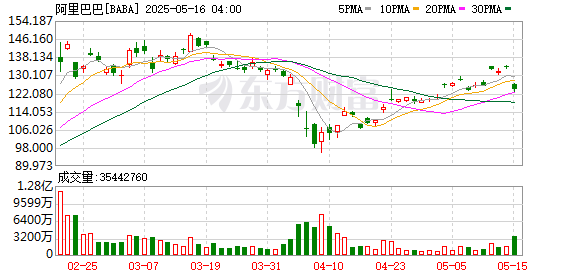
Core Viewpoint - Alibaba's Q4 FY2025 financial results show a revenue increase of 7% year-on-year, driven by a user-first and AI-driven strategy, despite a stock price drop due to lower-than-expected revenue [2][3][4]. Financial Performance - Alibaba reported Q4 revenue of 2364.54 billion yuan, up from 2218.74 billion yuan in the same quarter last year, marking a 7% increase [3]. - Non-GAAP net profit for Q4 was 298.47 billion yuan, a 22% increase from 244.18 billion yuan year-on-year [2]. - Taotian Group's customer management revenue grew by 12% to 710.77 billion yuan in Q4 [6]. Business Segment Performance - Taotian Group revenue reached 1013.69 billion yuan, a 9% increase from 932.16 billion yuan year-on-year [3]. - Alibaba International Digital Commerce Group revenue increased by 22% to 335.79 billion yuan [3]. - Alibaba Cloud revenue grew by 18% to 301.27 billion yuan, driven by faster public cloud business growth and increased adoption of AI-related products [3][4]. AI and Cloud Strategy - Alibaba plans to invest over 380 billion yuan in cloud and AI hardware infrastructure over the next three years to meet growing AI demand [5]. - AI-related product revenue has seen triple-digit year-on-year growth for seven consecutive quarters, contributing to Alibaba Cloud's double-digit annual growth [4][5]. Monetization and User Engagement - The number of Taotian 88VIP members exceeded 50 million, maintaining a double-digit year-on-year growth [6]. - The implementation of the "All-Station Promotion" tool has improved monetization efficiency, allowing merchants to achieve a more predictable ROI [6][7]. - Alibaba's e-commerce strategy includes a focus on "instant retail," aiming to convert more users into instant retail customers [8].

阿里AI产品爆发!吴泳铭最新研判
新华网财经· 2025-05-16 02:23
Core Viewpoint - Alibaba Group's financial results for the fourth quarter and fiscal year 2025 demonstrate strong growth driven by AI initiatives, with significant increases in revenue and shareholder returns [1][21]. Financial Performance - For the fourth quarter ending March 31, 2025, Alibaba reported revenue of 236.45 billion RMB, a year-on-year increase of 7%, and a non-GAAP net profit of 29.85 billion RMB, up 22% from the previous year [4][20]. - In fiscal year 2025, Alibaba achieved total revenue of 996.35 billion RMB, a 6% increase year-on-year, with adjusted EBITA growing 5% to 173.07 billion RMB [6][20]. - Alibaba Cloud's revenue grew 18% year-on-year to 30.13 billion RMB, marking the fastest growth in three years, driven by strong AI demand [10][12]. Shareholder Returns - Alibaba repurchased 1.197 billion shares for a total of 11.9 billion USD in fiscal year 2025, becoming one of the largest repurchasers among Chinese concept stocks [1][21]. - The company announced a total dividend of 4.6 billion USD for fiscal year 2025, reinforcing its commitment to enhancing shareholder returns [1][21]. AI and Cloud Business Growth - AI-related product revenue has seen triple-digit growth for seven consecutive quarters, indicating robust demand across various industries [1][12]. - Alibaba Cloud's market share has been recovering for three consecutive quarters, reflecting the increasing adoption of AI solutions [10][12]. Strategic Focus and Trends - CEO Wu Yongming highlighted two key trends in AI: the shift of AI applications from internal systems to user-facing scenarios in medium and large enterprises, and the expansion of AI usage among small and medium-sized enterprises [2][13]. - The company plans to invest over 380 billion RMB in cloud and AI hardware infrastructure over the next three years to meet growing AI demand [21]. Business Segment Performance - The International Digital Commerce Group's revenue grew 22% year-on-year to 33.58 billion RMB, driven by strong performance in cross-border business [19][20]. - The Local Services Group's revenue increased by 10% to 16.13 billion RMB, supported by order growth from Gaode and Ele.me [19][20]. - The Digital Entertainment Group's revenue rose 12% to 5.55 billion RMB, primarily due to strong performance in film and entertainment [19][20].

GPT-4V仅达Level-2?全球首个多模态通才段位排行榜发布,General-Level打造多模态通用AI评测新范式
量子位· 2025-05-16 01:24
Core Insights - The article discusses the rapid rise of Multimodal Large Language Models (MLLMs) that can understand and generate multiple modalities such as images, text, audio, and video. It emphasizes the need for a scientific evaluation mechanism to assess these models effectively as the AI competition evolves [1][2]. Evaluation Framework - The General-Level evaluation framework introduces a five-tier ranking system to measure the generalist capabilities of multimodal models, focusing on the synergy effect where knowledge transfer occurs between different tasks and modalities [3][12]. - The five levels are: - Level-1: Specialist models fine-tuned for specific tasks [6]. - Level-2: Generalists that support multiple modalities without synergy [11]. - Level-3: Task-level synergy where models outperform specialist models in certain tasks [11]. - Level-4: Paradigm-level synergy indicating integrated reasoning capabilities across understanding and generation tasks [7]. - Level-5: Total synergy across all modalities, representing the ultimate goal of achieving AGI, which no model has yet reached [9][72]. General-Bench Evaluation Benchmark - General-Bench is described as the largest and most comprehensive evaluation benchmark for multimodal AI, covering over 700 tasks and 325,000+ samples across five core modalities: image, video, audio, 3D, and language [14][17]. - It includes a wide range of tasks from traditional understanding tasks to generative tasks, allowing for free-form responses and objective assessments [15][18]. Leaderboard Design - The Leaderboard system is designed to present evaluation results transparently, featuring a multi-tiered scope mechanism that allows models of varying capabilities to compete in different categories [19][20]. - Scope-A is the main leaderboard for "full-modal generalists," while Scope-B, Scope-C, and Scope-D focus on specific modalities, understanding/generation tasks, and detailed skill categories, respectively [22][24][27][29]. Current Leaderboard Status - As of now, the Leaderboard includes over 100 multimodal models, with a significant number classified as Level-2, indicating they support a wide range of tasks but lack synergy [56][61]. - Level-3 models demonstrate task-level synergy, outperforming specialist models in certain benchmarks, while Level-4 models are rare and show promise in cross-paradigm reasoning [65][69]. - No models have yet achieved Level-5, highlighting the challenges in reaching comprehensive multimodal synergy [72][75]. Community Engagement - The General-Level project encourages community participation, allowing researchers to submit models and contribute to the benchmark's task diversity, fostering an open and collaborative environment for advancing multimodal AI [77].

坚定大投入 阿里、腾讯全力逐浪AI
Shang Hai Zheng Quan Bao· 2025-05-15 18:25
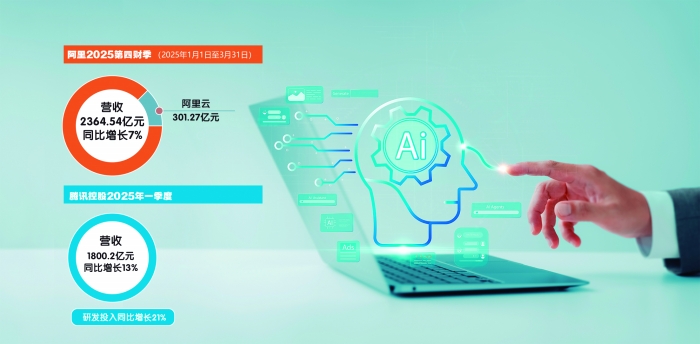
Core Insights - The core viewpoint of the articles highlights the significant role of AI in driving growth for major tech companies like Alibaba and Tencent, with both companies intensifying their investments in AI to capture future growth opportunities [1][5][8]. Group 1: Alibaba's Performance and Strategy - Alibaba's revenue for Q4 of FY2025 reached 2364.54 billion yuan, marking a 7% year-on-year increase, with AI-driven initiatives contributing to this growth [2]. - Alibaba Cloud's revenue for Q4 grew from 3% to 18% year-on-year, with AI-related product revenue achieving triple-digit growth for seven consecutive quarters [2]. - For FY2025, Alibaba Cloud's revenue reached 1180 billion yuan, reflecting an 11% year-on-year increase, and its market share has been recovering for three consecutive quarters [2][7]. Group 2: Tencent's Performance and Strategy - Tencent's Q1 FY2025 revenue was 1800.2 billion yuan, showing a 13% year-on-year growth, with AI strategies revitalizing its marketing services, value-added services, and fintech sectors [2][3]. - Tencent has increased its R&D investment by 21% year-on-year in Q1 FY2025, focusing on enhancing AI capabilities across its product lines [6]. - The company has adopted an "AI in All" strategy, accelerating AI integration across all business lines to create new synergies and value [6]. Group 3: Industry Trends and Future Outlook - The articles indicate two major trends in AI application: the shift from internal systems to user-side scenarios in medium and large enterprises, and the expansion of AI product usage from large enterprises to a significant number of small and medium enterprises [1][6]. - Both Alibaba and Tencent are committed to investing heavily in AI infrastructure, with Alibaba planning to invest over 380 billion yuan in cloud and AI hardware over the next three years [5]. - The demand for AI is rapidly growing across various industries, including traditional sectors like agriculture and manufacturing, indicating a broadening application of AI technologies [7][8].

郭彦东“详解”具身智能:将AGI的能力真正赋予物理世界的机器人
经济观察报· 2025-05-15 13:57
Core Viewpoint - The prediction of the "iPhone moment" for general-purpose robots will arrive in 5 to 7 years, driven by technological advancements, cost reductions, and evolving market demands [31][34]. Company Overview - Zhihui Square, founded by Guo Yandong, aims to achieve a production capacity of one million units by 2033, covering diverse scenarios such as industrial, logistics, and home services [2][34]. - Guo Yandong has a strong background in AI, having worked with Microsoft, Xiaopeng Motors, and OPPO, and is focused on expanding AGI from the digital to the physical world [2][3]. Technological Challenges - The company identifies three major challenges: ensuring the generality and robustness of technology, balancing cost and value, and deepening the exploration and standardization of application scenarios [7][8]. - The goal is to develop robots that can adapt across various industries and tasks without extensive reprogramming, which requires breakthroughs in multi-modal perception and autonomous decision-making [7][31]. Business Model - Zhihui Square adopts a "soft and hard integration" model, emphasizing the delivery of complete solutions rather than standalone technology components [10][12]. - The company plans to self-build production lines to maintain control over product quality, iteration speed, and long-term cost management [10][34]. Product Development - The GOVLA model is claimed to be the world's first all-domain, all-body VLA model, enabling robots to understand and adapt to dynamic environments [13][14]. - The model's capabilities allow robots to perform complex tasks autonomously, such as preparing breakfast by navigating to different locations [14][15]. Market Strategy - The initial focus on high-end industrial scenarios like automotive, semiconductor, and biotechnology is due to their urgent need for automation and the high willingness to pay from clients [25][26]. - The company aims to gradually expand into public services and home services, creating a closed loop of technology, scenarios, and data [28]. Future Outlook - The expectation is that the hardware costs for high-performance robots will significantly decrease within the next 5 to 7 years, making them accessible to ordinary consumers [32][34]. - The emergence of "killer applications" in key scenarios will be crucial for stimulating large-scale demand for general-purpose robots [32][31]. Competitive Advantage - China is seen as having a unique advantage in developing the embodied intelligence industry due to its robust hardware supply chain, diverse application scenarios, and strong support from investors and government [36][37]. - The company emphasizes the importance of core technology self-research and innovation to compete globally, particularly in the development of intelligent models and algorithms [37].

郭彦东“详解”具身智能:将AGI的能力真正赋予物理世界的机器人
Jing Ji Guan Cha Wang· 2025-05-15 12:47
Core Insights - The company aims to expand its production capacity to one million units by 2033, targeting diverse applications in industrial, logistics, and home services [2][31] - The CEO, Guo Yandong, emphasizes the integration of software and hardware, with a focus on self-developed AI models to drive the capabilities of their robots [3][9] - The company is positioned in the emerging field of embodied intelligence, aiming to transition general artificial intelligence (AGI) from the digital realm to physical robots [4][5] Technology and Innovation - The GOVLA model is claimed to be the world's first all-encompassing VLA (Vision-Language-Action) model, enabling robots to understand and interact with dynamic environments [13][14] - The company focuses on creating robots that can autonomously navigate and perform tasks in real-world settings, moving beyond traditional automation tools [14][15] - The technology aims to achieve robustness and generalization across various industries, addressing the challenges of adapting to different environments without extensive reprogramming [7][8] Business Model and Strategy - The company adopts a "robot as a service" model, providing comprehensive solutions rather than just selling hardware [27][11] - It plans to validate its business model through early revenue generation in high-value industrial sectors such as semiconductors and automotive manufacturing [24][11] - The strategy includes self-building production lines to maintain control over product quality and cost, avoiding reliance on external suppliers [31][32] Market Position and Future Outlook - The CEO predicts that the "iPhone moment" for general-purpose robots will occur in 5 to 7 years, driven by technological advancements and decreasing costs [28][29] - The company aims to leverage China's robust supply chain and diverse application scenarios to establish a competitive edge in the global market [34][35] - The focus on core technology development and understanding market needs is seen as crucial for the company's success in the competitive landscape of embodied intelligence [36][35]


多模态大模型国家队中科紫东太初完成首轮融资,中科创星领投
Sou Hu Cai Jing· 2025-05-15 11:58
Group 1 - Zhongke Zhidong Taichu (Beijing) Technology Co., Ltd. has completed its first round of financing amounting to several hundred million yuan, led by Zhongke Chuangxing, with participation from multiple investment institutions [1] - The financing will be used for research and application of multimodal artificial intelligence technology, aiming to enhance the development of general artificial intelligence (AGI) and deepen the industrial layout in the "AI+" field [1][7] - The company is recognized as a key player in the national strategy for multimodal large models, with its self-controlled AGI model being pivotal in global technological competition [3] Group 2 - The multimodal large model developed by Zhongke Zhidong Taichu is listed as a key project in the 14th Five-Year Plan by the Chinese Academy of Sciences and has received the highest award at the 2022 World Artificial Intelligence Conference [5] - The model has evolved from version 1.0, the world's first trillion-parameter multimodal model, to version 3.0, which fully benchmarks against GPT-4, setting a new standard for multimodal AI development [5] - The chairman of the company emphasized the importance of AI as a new focus in international strategic competition and its potential to reshape various industries, committing to technological innovation and industrial empowerment [7] Group 3 - By May 2025, Zhongke Zhidong Taichu is expected to be listed among the top 50 AI technology companies in China by Forbes, with its chairman recognized as an influential figure in AI [9] - The completion of this financing is seen as a dual recognition of the company's technological accumulation and industrial practice, providing strong momentum for future development [9] - The company plans to leverage this opportunity to increase investment in core technology research and contribute to the high-quality development of China's AI industry [9]
第四范式2025一季报:先知AI平台营收增60.5%,Agent战略显成效
Jing Ji Guan Cha Bao· 2025-05-15 11:25
Core Insights - Fourth Paradigm (06682.HK) reported a total revenue of RMB 1.077 billion for Q1 FY2025, marking a year-on-year growth of 30.1% [2] - The gross profit reached RMB 444 million, also reflecting a 30.1% increase, with a gross margin of 41.2% [2] - The core business, the Prophet AI platform, generated revenue of RMB 805 million, showing a significant year-on-year growth of 60.5% [2] Business Expansion - The Prophet platform underwent a major upgrade, introducing an AI Agent full-process development platform, allowing enterprise clients to integrate over 150 mainstream large models [3] - The platform includes a comprehensive suite of AI applications covering various enterprise scenarios such as AIGC, intelligent office, digital employees, and more [3] - The AI Agent has been implemented in over 14 industries, including finance, aviation, automotive, healthcare, and retail [3] Revenue Breakdown - The SHIFT intelligent solutions business generated RMB 212 million, accounting for 19.7% of total revenue, despite a year-on-year decline of 14.9% [4] - The AIGS service revenue was RMB 60 million, representing 5.6% of total revenue, with enhancements in programming Agent capabilities [4] Strategic Focus - The company is focusing on enhancing the core capabilities of the Prophet AI platform and the deployment of enterprise-level Agents, leading to a strategic resource reallocation [4] - The company has established a dual-core business structure, maintaining its enterprise services while launching a consumer electronics segment, Phancy, which focuses on integrated AI Agent solutions [6] - Phancy has released several user-level Agent solutions aimed at improving daily work efficiency for enterprise users [6]

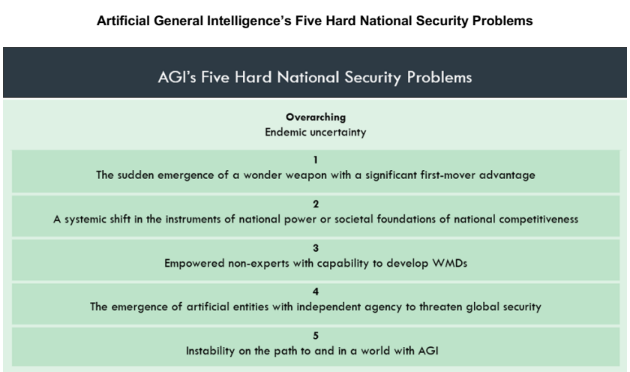
AGI五大安全困境:如何应对不确定“黑洞”?
Hu Xiu· 2025-05-14 06:55
Core Insights - The emergence of breakthroughs in generative artificial intelligence (AGI) is expected to have significant implications for national security, with the first entity to achieve AGI potentially gaining irreversible military advantages [1][4] - The development of AGI is characterized by "endemic uncertainty," making it difficult to predict the path to achieving AGI and its subsequent impact on global security dynamics [2][19] Group 1: Technical and Strategic Uncertainties - The technical path to AGI remains unclear, primarily relying on "scaling laws," but the causal relationship between computational investment and AGI breakthroughs is not well established [2] - Development teams may only recognize the achievement of AGI after it has occurred, indicating a lack of foresight in the process [2] - The societal implications of AGI development are chaotic, with calls for research pauses and concerns about existing technological paradigms lacking physical world understanding [2][3] Group 2: Security Dilemmas and Opportunities - AGI presents unique opportunities and potential threats to national security strategies, necessitating a comprehensive understanding of its implications rather than over-optimizing any single aspect [4][6] - The potential for AGI to create advanced military capabilities, such as war simulation, cyber warfare, and autonomous weapon systems, could provide significant military advantages [9][10] Group 3: Systemic Power Shifts - Historical evidence suggests that technological breakthroughs rarely produce decisive military advantages, with cultural and procedural factors often being more influential [11] - AGI could lead to systemic shifts in national power dynamics, affecting military competition, public opinion manipulation, and economic structures [12] Group 4: Risks of Non-Expert Weapon Development - The accessibility of AGI may enable non-experts to develop destructive weapons, raising concerns about nuclear proliferation and biological security [13][15] Group 5: Autonomous Entities and Strategic Instability - The increasing reliance on AI may undermine human agency, with AGI potentially optimizing critical systems in ways that are beyond human comprehension [16] - The pursuit of AGI by nations and corporations could lead to heightened tensions and strategic instability, with misperceptions potentially escalating conflicts [18] Group 6: Global Governance Challenges - The advent of AGI signals a transformative era that necessitates a reevaluation of national security frameworks, as the pace of technological advancement outstrips institutional evolution [19][20] - Successful national strategies will depend on establishing resilient governance frameworks before the onset of technological singularity, balancing innovation incentives with risk management [20]