套息交易

Search documents
时隔两月再现反转 港元缘何突然“扶摇直上”
Shang Hai Zheng Quan Bao· 2025-08-19 19:25
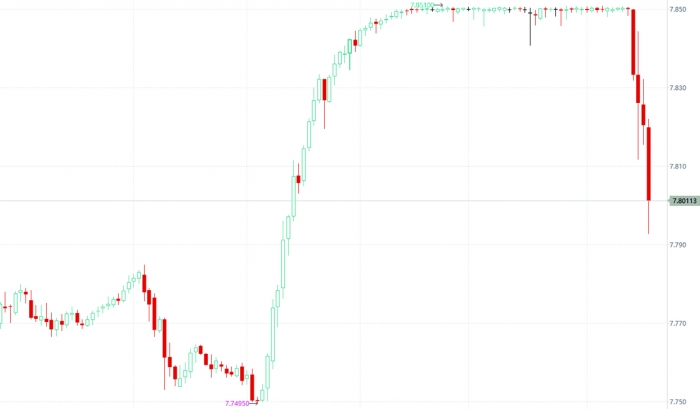
Core Viewpoint - The recent appreciation of the Hong Kong dollar against the US dollar is attributed to a combination of factors including the Hong Kong Monetary Authority's (HKMA) interventions, narrowing interest rate differentials, and significant inflows of southbound capital into Hong Kong stocks [1][4][5]. Group 1: Exchange Rate Movements - The Hong Kong dollar has appreciated for five consecutive trading days, reaching a high of 7.7926 against the US dollar, with a daily increase of 0.35% [1]. - The exchange rate has broken through multiple levels, moving from a stable 7.85 to 7.80, indicating a significant upward trend [1][2]. Group 2: HKMA Interventions - The HKMA has intervened to stabilize the Hong Kong dollar by withdrawing liquidity, with significant amounts of HKD 70.65 billion and HKD 33.76 billion being absorbed on August 13 and 14, respectively [2]. - The total balance of the Hong Kong banking system has decreased from nearly HKD 175 billion in June to approximately HKD 53.7 billion, nearing the pre-intervention level of HKD 44.6 billion [2][4]. Group 3: Interest Rate Dynamics - The Hong Kong Interbank Offered Rate (HIBOR) has surged, with overnight rates rising from below 0.2% to nearly 3% due to tightening liquidity conditions [2][4]. - The relationship between liquidity and interest rates is non-linear, with significant changes in HIBOR occurring when the total balance approaches HKD 500 million [4]. Group 4: Capital Inflows - There has been a notable influx of southbound capital, with a record net inflow of approximately HKD 35.877 billion on August 15, driving demand for the Hong Kong dollar [4]. - The demand for the Hong Kong dollar is further supported by the expectation of a potential interest rate cut by the Federal Reserve, which is anticipated to influence the interest rate differential between the Hong Kong dollar and the US dollar [5][6]. Group 5: Future Outlook - The future trajectory of the Hong Kong dollar will depend on the balance between interest rate differentials and the activity of carry trades [5]. - While the Hong Kong dollar may appreciate moderately, it is unlikely to return to the strong side of the peg at 7.75 in the short term due to the current low interest rate environment and limited likelihood of significant Fed rate cuts [6].

每日投资策略-20250819
Zhao Yin Guo Ji· 2025-08-19 02:49
Global Market Overview - The Hang Seng Index closed at 25,177, down 0.37% for the day but up 25.51% year-to-date [1] - The S&P 500 closed at 6,449, down 0.01% for the day and up 9.65% year-to-date [1] - The Shanghai Composite Index rose by 0.85% to 3,728, with a year-to-date increase of 11.23% [1] Industry Insights - The healthcare sector showed resilience, with major life sciences companies reporting better-than-expected performance in 2Q25, leading to upward revisions in annual guidance [5][6] - The pharmaceutical industry is facing pressure on profit margins due to external factors, but major pharmaceutical companies continue to invest in R&D, indicating a stable outlook for innovation [8] - The retail sector in the U.S. demonstrated resilience with a monthly growth rate increase from 0% in the first half of the year to 0.7% in July, indicating strong consumer spending [4] Company Analysis - Tongcheng Travel reported a total revenue of RMB 4.7 billion in 2Q25, a 10% year-on-year increase, with adjusted net profit rising by 18% to RMB 775 million, exceeding expectations [8] - Xtep's sales for the first half of 2025 grew by 7% to RMB 6.8 billion, with net profit increasing by 21% to RMB 913 million, surpassing forecasts [13] - Leap Motor achieved a revenue of RMB 14.2 billion in 2Q25, a 42% quarter-on-quarter increase, marking its first positive operating profit [14] Investment Ratings - Leap Motor is rated as a "Buy" with a target price of HKD 80, reflecting a strong growth outlook driven by new model launches and expanding sales [14] - Xtep maintains a "Buy" rating with a target price of HKD 7.39, supported by robust sales performance and operational efficiency [12] - Tongcheng Travel is also rated as a "Buy," with a target price of HKD 24.00, based on its strong core business performance [8]


高盛亚洲宏观:港元 - 原因及与约翰的相关内容 孙路最新关于台币、人民币和印度卢比的分析
Goldman Sachs· 2025-08-18 15:10
Investment Rating - The report indicates a cautious approach towards the Hong Kong dollar, suggesting a light holding of positions due to market volatility and uncertainty in exchange rate direction [4]. Core Insights - The rising cost of Hong Kong dollar funding poses risks, necessitating banks to maintain higher liquidity buffers. Market liquidity has decreased, exacerbating market anxiety among carry traders [1][2]. - The yield curve is flattening, with short-term financing costs remaining high. The market is seeking yield protection for 1 to 3-month terms, with 3-month rates recently exceeding 2% [1][3]. - The report highlights the potential for arbitrage opportunities in the Hong Kong dollar, but emphasizes the importance of risk-reward ratios and timing for entry [5]. Summary by Sections Hong Kong Dollar Analysis - The significant volatility in the Hong Kong dollar is attributed to a general complacency in the market, with banks needing to hold higher liquidity buffers due to large settlement demands [2]. - The current state of the spot market is chaotic, with a preference for light positions until further evidence of exchange rate direction emerges [4]. Yield Curve and Market Behavior - During the initial volatility, there was increased interest in long-term sports betting, reflecting expectations that Hong Kong dollar arbitrage remains attractive despite recent price declines [3]. - The yield curve is currently flat, with a concentration of price movements at the front end, indicating a market focus on short-term yield protection [3]. Taiwan Dollar and Indian Rupee Insights - The Taiwan dollar is expected to appreciate moderately in the second half of the year, with increased hedging to mitigate liquidity ratio deterioration risks [7]. - The Indian rupee faces pressure due to changing trade sentiments and capital outflows, with expectations of reaching a target of around 87 by year-end [10].
中原按揭:港元拆息回升有助港美息差收窄 套息交易诱因减弱
智通财经网· 2025-08-18 06:13
Core Viewpoint - The Hong Kong interbank offered rate (HIBOR) has been rising, with the one-month HIBOR reaching 2% on August 18, marking a new high since May 8, indicating a shift in the banking system's liquidity and interest rate dynamics [1][2] Group 1: Banking System and HIBOR Trends - The banking system's surplus has decreased from a high of 1,740 million HKD in May to approximately 537 million HKD, nearing levels before the Hong Kong Monetary Authority (HKMA) intervened in early May [1] - The continuous rise in HIBOR over four consecutive working days suggests a tightening liquidity environment, with the actual mortgage rate now at 3.3%, still below the market cap of 3.5% [1][2] - The significant widening of the interest rate differential between Hong Kong and the U.S. has led to increased arbitrage activities, prompting the HKMA to intervene multiple times [1] Group 2: Future Expectations and Implications - The rise in HIBOR is expected to narrow the interest rate differential between Hong Kong and the U.S., reducing the incentive for arbitrage and stabilizing the Hong Kong dollar [2] - Despite the current HIBOR being over 2% lower than U.S. rates, expectations of a potential U.S. rate cut later this year could further influence HIBOR downward, with predictions of a decrease in the best lending rate (P) and capped mortgage rates by 0.25% to 0.5% [2] - Factors such as demand for Hong Kong dollars, arbitrage activities, and seasonal influences will continue to affect HIBOR fluctuations, necessitating borrowers to choose capped mortgage plans to mitigate risks associated with rising rates [2]
香港金管局出手!港元直线拉升
Sou Hu Cai Jing· 2025-08-15 09:41
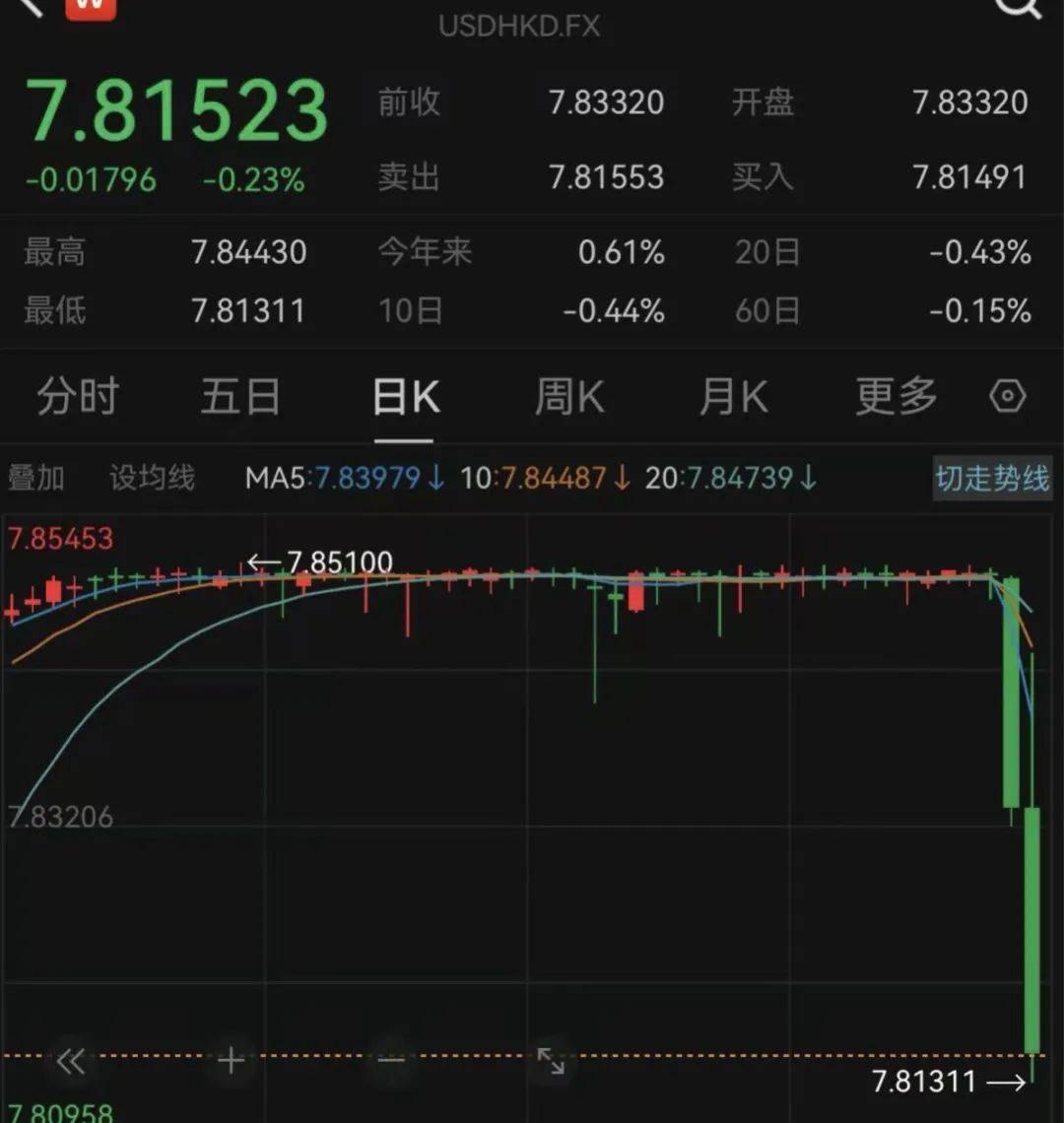
Core Viewpoint - The Hong Kong dollar (HKD) has recently appreciated against the US dollar (USD), breaking through the 7.82 level after being stable around 7.85 for several days, indicating intervention by the Hong Kong Monetary Authority (HKMA) to stabilize the currency [1][3]. Exchange Rate Movements - The HKD/USD exchange rate rose from 7.85 to 7.81823, with a daily low of 7.81330 as of August 15 [1]. - The HKMA intervened by buying HKD 33.76 billion and selling USD on August 14, and HKD 70.65 billion on August 13, to maintain the peg [3][4]. HKMA Intervention - The HKMA has intervened multiple times in the foreign exchange market this year, purchasing over HKD 110 billion since late June [4]. - The HKMA's actions are guided by the Currency Board system, which mandates buying USD and selling HKD when the exchange rate hits the weak-side convertibility threshold of 7.85 [3]. Market Conditions and Outlook - The interest rate differential between Hong Kong and the US remains significant, making carry trades attractive and keeping the HKD close to the 7.85 level [4]. - Analysts expect that the HKMA's interventions will lead to a moderate increase in HKD interest rates, although they may remain below levels seen before May [4][5]. - Factors influencing future HKD movements include US monetary policy, market sentiment, and global capital flows [4][5].
日经指数突破42700点创新高 后续或受日元、财政扩张等影响
2 1 Shi Ji Jing Ji Bao Dao· 2025-08-12 14:43
Core Viewpoint - The Japanese stock market has surged to historical highs due to the easing of uncertainties surrounding US-Japan tariff measures and strong corporate earnings [1][3]. Market Performance - On August 12, the Nikkei 225 index rose by 2.15% or 897.69 points, closing at 42,718.17 points, while the Topix index increased by 1.39%, closing at 3,066.37 points [1][3]. - Technology and banking stocks led the gains, with SoftBank Group up 6.92% and Mizuho Financial Group up 3.32% [2]. Factors Driving the Market - Easing concerns over the impact of US tariffs and a weaker yen have been primary drivers for the rise in Japanese stocks [2]. - Multiple factors contributed to the Nikkei index's increase, including reduced trade tensions, strong corporate earnings, and favorable government policies aimed at enhancing shareholder returns [3][4]. - The influx of foreign capital has been notable, with overseas funds showing net buying for 14 consecutive weeks from April to mid-July [3]. Investment Appeal - Japanese stocks are seen as attractive due to their valuation advantages compared to major developed markets, with many non-financial companies holding significant cash reserves and offering high dividend yields [4]. - The ongoing low-interest-rate environment and the depreciation of the yen have encouraged international investors to seek returns in Japanese equities [4]. Future Outlook - Analysts maintain an optimistic outlook for the Japanese stock market, with Goldman Sachs raising the 12-month target for the Topix index from 3,000 to 3,200 points, and Citigroup forecasting the Nikkei 225 index to reach 45,000 points by year-end [6]. - However, potential risks include concerns over the sustainability of government debt and the impact of rapid yen appreciation on carry trades, which could affect market stability [5][6].
日经指数突破42700点创新高,后续或受日元、财政扩张等影响
2 1 Shi Ji Jing Ji Bao Dao· 2025-08-12 12:01
Core Viewpoint - The recent surge in Japanese stocks is attributed to multiple factors, including easing trade tensions, strong corporate earnings, and favorable government policies, rather than an optimistic outlook on the Japanese economy [1][2][3]. Group 1: Market Performance - On August 12, the Nikkei 225 index rose by 2.15% or 897.69 points, closing at 42718.17 points, while the Topix index increased by 1.39%, closing at 3066.37 points [1]. - The rise in the stock market was led by technology and banking stocks, with SoftBank Group up 6.92% and Mizuho Financial Group up 3.32% [1]. Group 2: Factors Influencing the Market - Easing of trade tensions between Japan and the U.S. has alleviated concerns, benefiting sectors like automotive and electronics [2]. - Recent corporate earnings reports indicate stable profitability and healthy cash flow among Japanese companies, enhancing investor confidence [2]. - The Japanese government's policies aimed at improving shareholder returns and increasing stock buybacks have created a more attractive investment environment [2]. Group 3: Investment Dynamics - There has been a continuous net inflow of foreign capital into Japanese stocks for 14 weeks from April to mid-July, driven by the attractiveness of Japanese equities [2]. - The valuation advantage of Japanese stocks compared to other developed markets suggests a potential for catch-up gains [3]. - The low debt levels and high cash positions of many non-financial Japanese companies contribute to their appeal [3]. Group 4: Future Outlook - Analysts remain optimistic about the Japanese stock market, with Goldman Sachs raising the Topix index target from 3000 to 3200 points and Citigroup forecasting the Nikkei 225 index to reach 45000 points by year-end [5]. - The potential for continued fiscal stimulus from the Japanese government is expected to provide liquidity support for the stock market [4]. - However, concerns about government debt sustainability and the impact of potential interest rate hikes by the Bank of Japan could introduce volatility [4][5].
“套利交易”再度升温,墨西哥比索成贸易战大赢家
Hua Er Jie Jian Wen· 2025-08-12 07:50
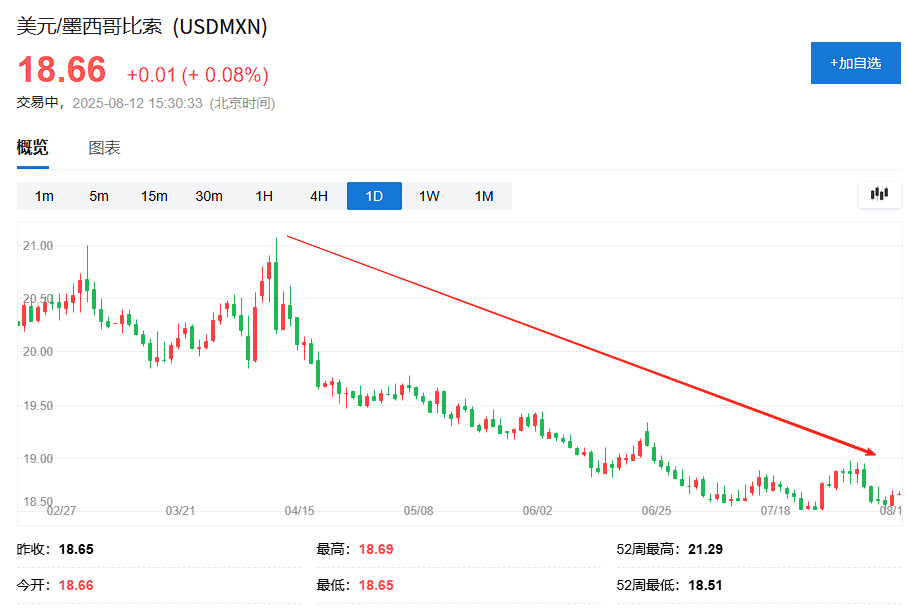
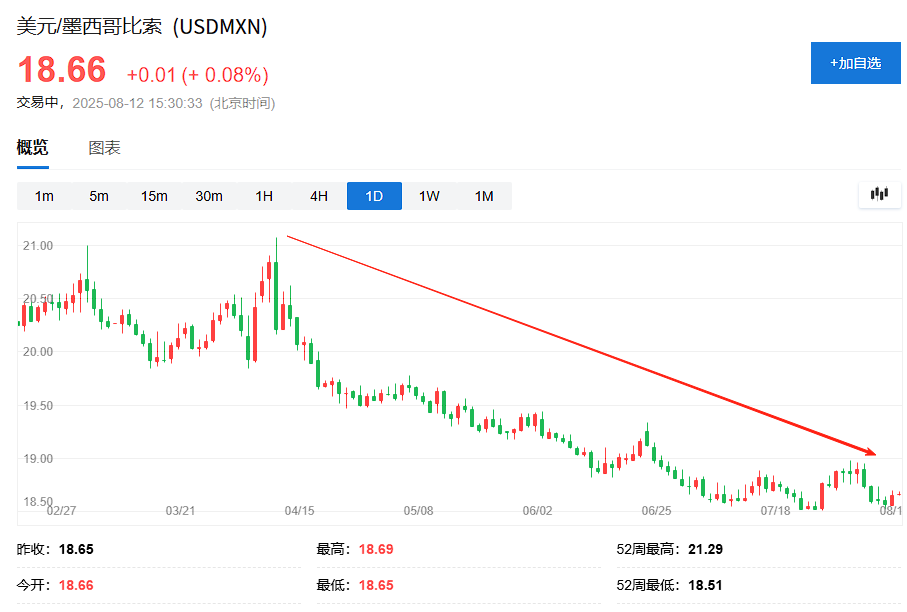
Core Viewpoint - The Mexican peso has emerged as a significant beneficiary of global carry trade, driven by expectations of Federal Reserve rate cuts and a weakening dollar, recovering from previous lows due to trade tensions with the U.S. [1][3] Group 1: Currency Performance - Over the past three months, the peso has appreciated by 4% against the dollar, outperforming other major currencies and becoming the best-performing emerging market asset [1] - The peso rebounded from a low of 21 pesos per dollar in February to around 18.5 pesos, erasing losses since Trump's election [1] Group 2: Trade Relations and Agreements - Mexico's relative success in U.S. trade negotiations, particularly through the USMCA agreement, has allowed it to secure tariff exemptions on most goods [3] - The extension of Trump's "reciprocal tariffs" policy for 90 days has further supported the peso's strength [3] Group 3: Factors Driving Carry Trade Revival - Three key changes have made carry trades attractive again: 1. Weak U.S. employment data has increased expectations for a Fed rate cut, lowering the cost of borrowing dollars [6] 2. The interest rate differential between emerging markets and developed countries is significant, with Mexico's central bank rate at 7.75% compared to a 4.3% yield on U.S. Treasuries [7] 3. A notable decrease in market volatility has made carry trades more appealing [7] Group 4: Investment Trends - Global asset management firms are reallocating investments towards high-yield markets like Mexico, with emerging market bond funds seeing consistent inflows over the past four months, peaking at $1.7 billion in a single week [8] - Leveraged funds have increased bullish bets on the peso to the highest level in nearly a year, reflecting confidence in maintaining a high-interest environment [8] Group 5: Market Sentiment - The overall strength of the peso and Mexican assets is attributed to a weak dollar environment and high carry yields [9] - Despite concerns over U.S. trade policies, recent fluctuations in Trump's more destructive policies have somewhat alleviated investor worries [9]
“套利交易”再度升温,墨西哥比索成贸易战大赢家!
Hua Er Jie Jian Wen· 2025-08-12 07:37
Core Viewpoint - The Mexican peso has emerged as a significant beneficiary of the recent global carry trade revival, driven by expectations of Federal Reserve rate cuts and a weakening dollar, making it the top-performing emerging market asset in the past three months [1][4]. Group 1: Currency Performance - The peso appreciated by 4% against the dollar over the past three months, recovering from a low of 21 pesos per dollar after the announcement of a 25% tariff on Mexico by the U.S. in February, now trading around 18.5 pesos [1][4]. - The peso's recovery has erased losses since Trump's election and positioned it as a core beneficiary of the resurgence in carry trades [1]. Group 2: Trade Relations and Agreements - Mexico's relative success in U.S. trade negotiations, particularly through the USMCA agreement, has allowed it to secure tariff exemptions on most goods and a 90-day extension on Trump's "reciprocal tariffs" policy [4][5]. - Analysts note that Mexico has managed its relationship with the U.S. more effectively than other countries, contributing to the peso's strength [4]. Group 3: Factors Driving Carry Trade Revival - Three key factors have contributed to the renewed interest in carry trades: 1. Weak U.S. employment data has heightened expectations for a Fed rate cut in September, lowering the cost of borrowing in dollars [5]. 2. The interest rate differential between emerging markets and developed countries is significant, with Mexico's central bank rate at 7.75% compared to a lower U.S. Treasury yield [6]. 3. A notable decrease in market volatility has made carry trades more appealing, as indicated by the decline in the dollar-peso exchange rate volatility index [6]. Group 4: Institutional Investment Trends - Global asset management firms are reallocating investments towards high-yield markets like Mexico, with emerging market bond funds seeing consistent inflows over the past four months, peaking at $1.7 billion in a single week [7]. - Leveraged funds have increased their bullish bets on the peso to the highest level in nearly a year, reflecting confidence in the currency's high-interest environment [7]. - Latin American currencies, including the peso, have shown strong performance in carry trade yields, significantly outperforming those in Europe, Africa, and Asia [7]. Group 5: Market Sentiment and Risks - The overall strength of the peso and Mexican assets is primarily driven by a weak dollar environment and high carry yields [8]. - Despite positive trends, U.S. trade policies remain a potential risk factor, although recent fluctuations in Trump's policies have somewhat alleviated concerns [8].
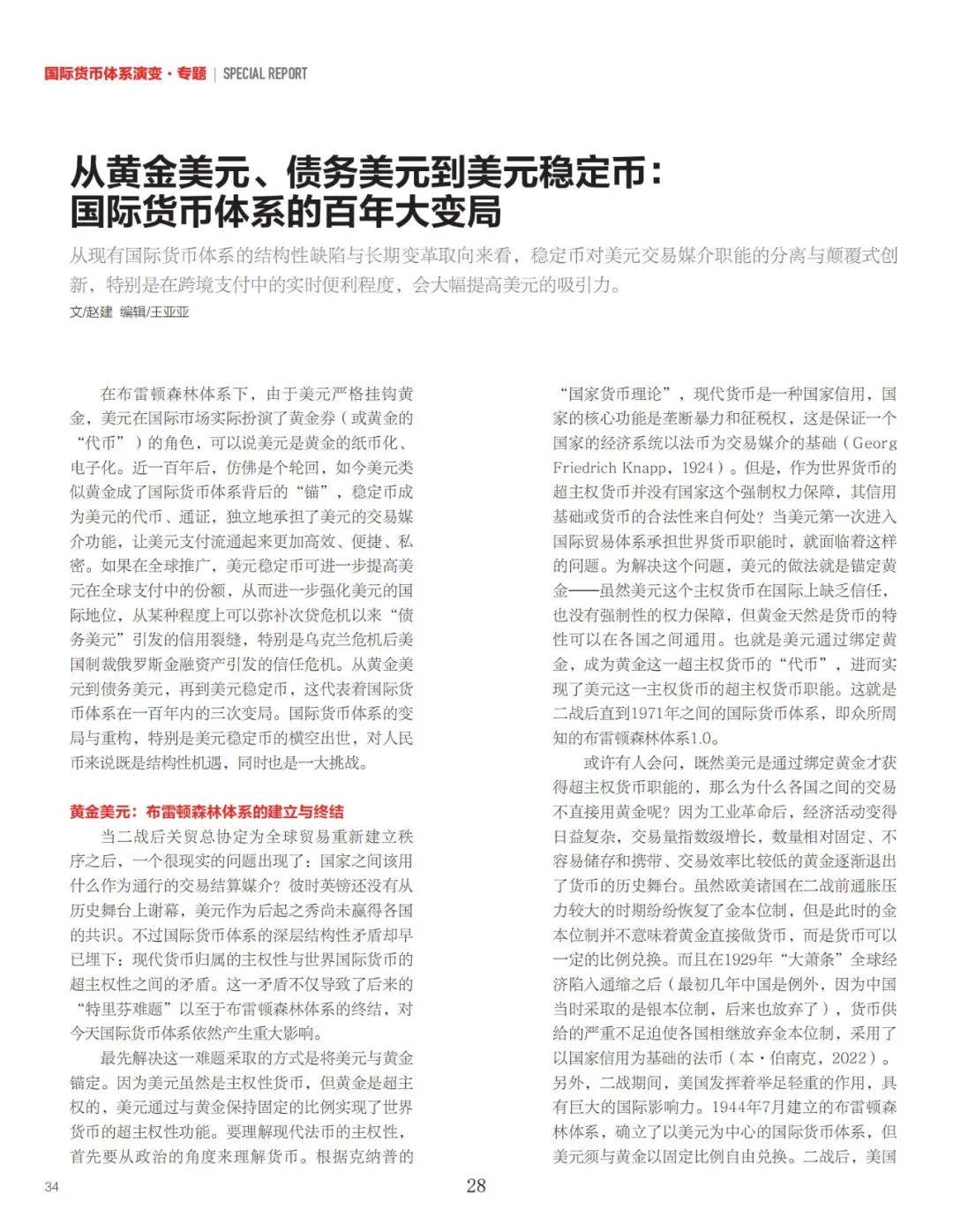
赵建:从黄金美元、债务美元到美元稳定币——国际货币体系的百年大变局
Sou Hu Cai Jing· 2025-08-11 09:33
Group 1: Core Views - The article discusses the structural flaws of the current international monetary system and the transformative potential of stablecoins, particularly in enhancing the efficiency of dollar transactions in cross-border payments [4][18][19] - It outlines the historical evolution of the international monetary system, highlighting three significant phases: the "golden dollar" era under the Bretton Woods system, the "debt dollar" phase driven by debt expansion, and the emergence of "dollar stablecoins" as a technological innovation [4][10][18] Group 2: Golden Dollar: Establishment and Termination of the Bretton Woods System - The Bretton Woods system established the dollar's peg to gold, allowing it to function as a global trade and reserve currency, but this system faced inherent contradictions leading to its collapse [5][9] - The "Triffin Dilemma" emerged as a critical issue, where the demand for dollars in international trade outpaced the growth of gold reserves, ultimately resulting in the suspension of dollar convertibility to gold in 1971 [9][12] Group 3: Debt Dollar: Modern Credit Currency Era and Its Flaws - The transition to a "debt dollar" system marked a shift where the dollar was no longer tied to gold, leading to a reliance on debt for currency creation, which has resulted in significant global financial implications [10][12] - The article identifies three phases of the debt dollar system, including the rise of global dollar loans, the debt explosion post-2008 financial crisis, and the surge in U.S. government debt during the COVID-19 pandemic [15][17] Group 4: Dollar Stablecoins: Technological Innovation and Future of the International Monetary System - Stablecoins are positioned as a solution to enhance the efficiency of dollar transactions, potentially restoring confidence in the dollar amidst concerns over its debt issues and geopolitical tensions [19][20] - The article emphasizes the rapid growth of stablecoin transactions, which reached $27.6 trillion in 2024, surpassing the combined transaction volumes of Visa and Mastercard, although most of this volume is still tied to crypto assets [21] - It discusses the theoretical and technical foundations of stablecoins, including their ability to separate the functions of currency, and the underlying technologies that support their operation [20][21]