Workflow
特朗普关税政策
icon
Search documents
从美国看美国-IMF与IIF会议六大观察
2025-04-27 15:11
Summary of Key Points from the Conference Call Industry or Company Involved - The discussion primarily revolves around the impact of Trump's tariff policies on the global economy, particularly focusing on the United States and its trade relations with China. Core Points and Arguments - **Impact of Tariff Policies**: Trump's tariff policies pose a significant threat to the global economy, leading the IMF to downgrade global growth forecasts, particularly affecting small and medium-sized enterprises with limited liquidity, which could result in a weakened job market [1][2][4] - **Trust in the Dollar System**: The tariff policies have diminished trust in the dollar system, with concerns that they may lead to a downgrade of the U.S. credit rating and an increase in U.S. Treasury yields [1][2] - **Legal Challenges**: There are legal concerns regarding the unilateral imposition of tariffs without Congressional approval, raising questions about the legitimacy of using the International Emergency Economic Powers Act (IEEPA) as a legal basis [3] - **Global Economic Rebalancing**: The IMF and IIF meetings highlighted the need for global economic rebalancing, emphasizing multilateral cooperation to address inequality and trade protectionism, alongside discussions on monetary policy coordination and structural reforms [5] - **Critique of Global Institutions**: Bessenet criticized the IMF and World Bank for failing to effectively coordinate global economic imbalances, suggesting a need for reform to refocus on their core responsibilities [6] - **Recommendations for U.S. and China**: Bessenet proposed that the U.S. should reduce consumption and increase manufacturing investment, while China should promote consumption and reduce excess supply to achieve economic rebalancing [7] - **Opposition to Recommendations**: Critics argue that Bessenet's suggestions overlook the U.S. fiscal deficit issue, asserting that without addressing this, tariffs alone will not resolve the underlying problems [8] - **Trade Negotiation Dynamics**: Both the U.S. and China perceive themselves as having the upper hand in tariff negotiations, leading to a lack of trust and willingness to compromise, which complicates trade discussions [10][11] - **Supply Chain and National Security**: Current tariff policies are accelerating corporate relocations and are linked to national security concerns, emphasizing the need for key industries to return to the U.S. [13] - **Monetary Policy Challenges**: The Federal Reserve faces significant challenges due to potential threats to its independence and the need to respond to economic data changes, with discussions on possible interest rate cuts if economic conditions worsen [14][18] Other Important but Possibly Overlooked Content - **European Economic Positioning**: The tariff situation may inadvertently position Europe as a potential beneficiary, as it accelerates policy initiatives and could lead to closer ties with both the U.S. and China [16][20] - **Long-term Trade War Dynamics**: The ongoing trade war is expected to have long-lasting implications, with both sides believing they can win, which increases the risk of sustained conflict [9][12]
铜产业链周度报告-20250427
Guo Tai Jun An Qi Huo· 2025-04-27 06:25
铜产业链周度报告 Special report on Guotai Junan Futures 2 进口铜精矿现货亏损扩大至3400元/吨左右 COMEX和LME铜价价差回升至1400美元上方 -60 -40 -20 0 20 40 60 80 100 120 -4000 -3000 -2000 -1000 0 1000 2000 3000 4000 2019-01 2019-05 2019-09 2020-01 2020-05 2020-09 2021-01 2021-05 2021-09 2022-01 2022-05 2022-09 2023-01 2023-05 2023-09 2024-01 2024-05 2024-09 2025-01 元/吨 铜精矿现货冶炼盈亏 现货TC(右轴) 美元/吨 -500 0 500 1000 1500 2000 2022-03 2022-05 2022-07 2022-09 2022-11 2023-01 2023-03 2023-05 2023-07 2023-09 2023-11 2024-01 2024-03 2024-05 2024-07 2024-09 2 ...
小摩:美联储降息带来“巨大机遇” 美债比欧债更具吸引力
智通财经网· 2025-04-25 02:48
Group 1 - JPMorgan Asset Management believes that U.S. Treasuries have greater upside potential compared to European bonds due to traders underestimating the extent of rate cuts by the Federal Reserve relative to the European Central Bank [1] - Myles Bradshaw, the global head of comprehensive strategy at JPMorgan, anticipates that the Federal Reserve will eventually need to implement larger rate cuts after maintaining policy for a longer period [1] - Concerns over Trump's tariff policies have led to a sell-off in U.S. government bonds, resulting in rising yields, but some global investors, including PIMCO, are beginning to see the attractiveness of U.S. Treasuries [1] Group 2 - The current market expects the European Central Bank to lower deposit rates to 1.5% with three additional rate cuts this year, while traders anticipate at least three rate cuts from the Federal Reserve down to 3.75% [2] - Recent comments from Trump regarding trade negotiations with China and his softened stance towards Fed Chairman Powell have eased market tensions, leading to a significant drop in long-term U.S. Treasury yields [2] - The fundamental drivers for future market movements will be economic growth and inflation, which will determine the next steps [2]
没跟美国谈拢,欧盟代表急了:聊了两个小时,“明白鬼”都没当成
Sou Hu Cai Jing· 2025-04-24 06:15
跟美方聊了两个小时,欧盟派出的交涉人员,现在脑子里恐怕只有一个字:晕。 之前,对于那些愿意谈判的国家,美国总统特朗普把自己的关税措施,延后了90天,这无疑让欧盟看到了和谈的希望,赶紧暂停了对美国的关税反制,派出 一队人马飞往华盛顿。 这回领头的,是欧盟分管贸易和经济安全事务的谢夫乔维奇委员,他带着一群欧盟外交官,跟美国商务部长卢特尼克会谈,想要彻底让美国取消关税。 出发之前,欧盟这边就想好了各种对策,比如同意向特朗普让步,清零对美的工业品关税,但同样,欧委会主席冯德莱恩也强调,如果双方谈不拢,欧盟也 会扩大对美国的反制。 不过,如果特朗普从一开始,就没打算跟欧盟各退一步,那么他这种谈判方式,是不是就能理解了呢?之前,他曾向美国人吹嘘,只有自己的谈判方式 能"宰"他们,换其他人来就是就是"贱卖"。 两个小时的会谈过后,谢夫乔维奇连美方到底是个什么立场,想要利用关税获得什么,都没有搞明白,唯一明确的一点就是,美国对欧盟征收的大部分关税 不会取消。 而与他同行的欧盟外交官,更是被特朗普政府内部的混乱给整晕了,好像每个人都能出来说两句,很难分辨哪些表态,是美方真正的政策意图,哪些只是谈 判的策略,谁有权力决策,谁的话 ...
特朗普关税:野心与现实的落差
2025-04-22 04:46
特朗普关税:野心与现实的落差 2025042120250416 摘要 • 美国关税收入远低于预期,尽管理论上提高关税应带来千亿美元收入,但 实际数据显示,关税收入增量仅为数十亿美元,与预期相差甚远,表明关 税政策的执行效果不佳。 • 特朗普的对等关税政策可能导致全球贸易量显著收缩,美国进口弹性约为 负 0.8 至负 1,进口量显著下降,WTO 预测全球商品贸易量可能下降 1.5%,北美地区受影响更严重。 • 中国通过非直接贸易渠道向美国出口增加值利润,大约 20%的增加值通过 非直接渠道流向美国,且中国出口商品中包含其他国家零部件,使得中国 仍能保持出口增长。 • 美国从中国直接进口商品占比约为 14%,但考虑到非直接贸易渠道,中国 从美国消费者每花 100 美元购买海外商品中赚取的最终利润约为 18 美元, 较直接进口高出 30%。 • 关税政策对中国经济带来扰动,但中国具备足够的政策韧性应对,外交盟 友拓展比短期内部刺激更为重要,中国经济基本面出现积极起稳信号,资 本市场仍可保持乐观。 Q&A 特朗普关税政策的收入预期与实际差距如何? 特朗普的关税加征政策在实际执行过程中面临显著挑战。根据 2025 年 ...
美股崩了!特朗普警告
Sou Hu Cai Jing· 2025-04-22 00:32
美国总统特朗普4月21日在社交媒体平台"真实社交"上发文,再次敦促美国联邦储备委员会作出降息决 定。特朗普在帖文中宣称"美国实际上已不存在通胀,能源、食品及其他大多数商品价格下行趋势如此 显著,几乎不可能引发通胀。但 如果'太迟先生'(注:指美联储主席鲍威尔)不立即降息,美国经济将 面临放缓风险。" 市场方面, 4月21日开盘,美股三大指数大跌,道琼斯指数跌超700点,纳斯达克指数跌约2.6%,标普 500指数跌超2%。 有分析称, 特朗普的关税政策引发的担忧压制了华尔街情绪。周末期间, 芝加哥联邦储备银行行长奥 斯坦·古尔斯比在采访中表示,这些关税可能导致美国经济活动在夏季"突然下滑"。 围绕美联储独立性的质疑也进一步打压了股市。特朗普上周四呼吁美联储降息,甚至暗示可能"解雇"鲍 威尔。白宫经济顾问凯文·哈塞特在上周五表示,总统及其团队正在研究解除鲍威尔职务的可能性。 特朗普近来频繁施压鲍威尔,要求美联储立即降息,并称鲍威尔的行动总是"又迟又错","越早走人越 好"。 而鲍威尔当地时间4月16日在芝加哥经济俱乐部发表讲话时说,"美国政府已宣布的关税上调幅度远超预 期水平,其给美国经济带来的影响,包括推高通胀 ...
晨报|美债波动影响几何?
中信证券研究· 2025-04-22 00:10
Group 1: U.S. Treasury Market - Recent volatility in the U.S. Treasury market reflects a declining trust in dollar assets, potentially increasing pricing pressure on global sovereign debt markets and driving funds towards alternatives like gold and Chinese or European bonds [1] - In the medium to long term, China's A-shares and RMB assets may become more attractive due to policy support and domestic economic resilience [1] Group 2: Lithium Battery Anode Materials - CATL's recent product launches, including the second-generation Shenxing and sodium-ion batteries, are expected to open new opportunities for anode materials, with the second-generation Shenxing battery achieving a peak charging rate of 12C [2] - The introduction of self-generating anode technology in the Xiaoyao dual-core battery may have limited impact on traditional graphite anode materials, but the overall anode materials and related supply chain are likely to benefit significantly [2] Group 3: Real Estate Policies - Real estate is being integrated into consumption-boosting policies, highlighting its importance in driving consumption through housing-related spending and the wealth effect on consumer confidence [3] - A nationwide policy is anticipated to be introduced in April-May, favoring developers with strong product offerings and those holding quality operational assets [3] Group 4: Photovoltaic Supply Chain - The U.S. "reciprocal tariffs" are impacting the photovoltaic supply chain, but Chinese manufacturers have adapted by utilizing Southeast Asia for indirect exports to the U.S. [5] - Despite increased production costs due to tariffs, Chinese photovoltaic firms may still maintain a relative advantage over U.S. manufacturers, with a focus on diversifying markets and enhancing technology and branding [5] Group 5: Fixed Income Market - Recent reductions in bank deposit rates are aimed at managing interest margin pressures and may lead to a broader decline in interest rates, including government bond yields [6] - The phenomenon of "deposit migration" could intensify as banks adjust their strategies [6] Group 6: Fiscal Data - March fiscal revenue showed a marginal improvement, with tax revenue still in negative growth, while fiscal spending has accelerated, particularly in social security and employment [8] - The issuance of special bonds is expected to accelerate in the second quarter as local self-assessment mechanisms mature [9] Group 7: Solid-State Battery Materials - The upcoming Shanghai Auto Show is expected to catalyze the solid-state battery industry, with policy support likely to strengthen [10] - High-end applications for solid-state batteries are projected to grow significantly by 2025, driving the materials sector into a high-growth phase [10] Group 8: Coal Power Upgrades - The increasing influence of renewable energy is raising demands on coal power, prompting upgrades that support the construction of a new power system [11] - The new coal power upgrade action plan will set higher standards for existing and new units, encouraging regional energy departments to develop tailored action plans [11]
四大因素掣肘,鲍威尔不得不“保持耐心”?
Hua Er Jie Jian Wen· 2025-04-21 13:34
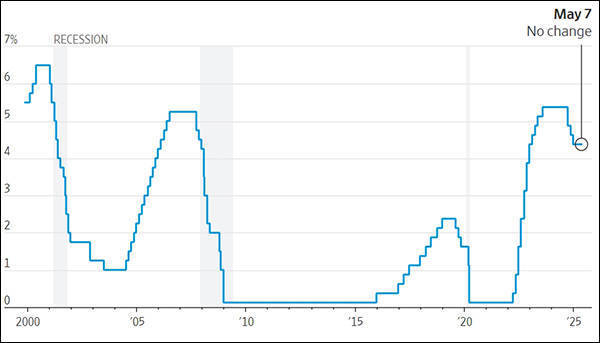
Core Viewpoint - The Federal Reserve's patience in the face of economic uncertainty in the U.S. may be the correct approach, as recent comments from Chairman Powell indicate a cautious stance due to inflation and economic challenges posed by tariffs [1] Group 1: Economic Uncertainty - High inflation and declining economic growth potential are significant concerns, with the Fed facing a dilemma due to Trump's tariff policies [1][2] - The expectation is that the Fed may not lower interest rates significantly this year, with a potential trigger for action being a rise in unemployment above 4.5% [2] Group 2: Economic Growth Potential - The U.S. economy is experiencing a structural decline in growth potential, exacerbated by rising import prices and a decrease in labor supply due to higher deportation rates [4] - Despite a projected slowdown in GDP growth, the unemployment rate remains relatively stable at 4.2%, indicating that economic weakness may not lead to sufficient labor market softness to warrant monetary policy support [4] Group 3: Inflation Concerns - The market is beginning to accept that inflation may exceed the Fed's 2% target for a fifth consecutive year, posing a threat to the Fed's credibility [5] - Short-term inflation expectations have risen significantly, although this is not corroborated by other inflation indicators [5] Group 4: Political Pressures - Trump's attacks on the Fed's independence may influence its decision-making, as the Fed aims to maintain its credibility and avoid perceptions of political pressure [6]
特朗普与美联储博弈,A股缩量维持存量博弈
Chuang Yuan Qi Huo· 2025-04-18 10:54
Report Industry Investment Rating No relevant content provided. Core Viewpoints of the Report - The data indicates a marginal decline in the US real estate and manufacturing sectors. The Fed's hawkish stance and the ECB's interest rate cut have affected the overnight performance of various assets. The lack of progress in Trump's tariff policy and the Fed's delay in cutting interest rates will increase asset price volatility. The statements from the Fed's FOMC meeting in early May and the Politburo meeting at the end of April are important observation windows. The A-share market is in a process of strong government support and market expectation of macro - policy hedging, but the potential negative impact of the earnings reports in mid - to late April is suppressing market risk appetite. The sustainability of this rebound is uncertain, and it is expected that the stock index will have a process of retesting the bottom in the short term [2][3][7]. Summary by Relevant Catalogs 1. Market Views 1.1 Overseas Overnight - US new housing starts in March were 1.324 million units, lower than the expected 1.446 million and the previous value of 1.459 million. Building permits in March were 1.482 million units, higher than the expected 1.446 million and the previous value of 1.459 million. The Philadelphia Fed Manufacturing Index in April was - 26.4, lower than the expected 2 and the previous value of 12.5. Fed officials continue to send hawkish signals, while the ECB cut interest rates by 25BP yesterday. Overnight, the US dollar index rebounded, US bond yields rose, gold fell, the Dow and Nasdaq declined, the S&P 500 rose, the Nasdaq Golden Dragon China Index fell, and the offshore RMB exchange rate fluctuated [2][7]. 1.2 Domestic Market Review - On Thursday, the market continued its previous rhythm. The Shanghai Composite Index rose 0.13%, the Shenzhen Component Index fell 0.16%, and the ChiNext Index rose 0.09%. The index was relatively stable, but individual stock sentiment was average. The "national team" played a significant role in the eight - consecutive - day rise of the market, but the market volume shrank, indicating that off - market funds are hesitant. The real estate, building materials, social services, and light manufacturing sectors led the gains, while the automotive, non - ferrous metals, communications, and beauty care sectors led the losses. There were 3,125 rising stocks and 2,035 falling stocks in the whole market [3][8]. 1.3 Important News - Trump criticized Powell and called for interest rate cuts. There are differences within the US regarding Powell's dismissal. Trump expressed confidence in reaching a trade agreement with the EU and satisfaction with the progress of negotiations with Japan. He also mentioned the signing of a Ukraine mineral agreement. Fed's Williams believes that the current monetary policy is in a good position and there is no need for a quick adjustment. There were also a series of domestic and international events, including China - Cambodia cooperation, government policy - related statements, and China's stance on trade issues at the G20 meeting [9][10][11]. 1.4 Today's Strategy - Due to the lack of progress in Trump's tariff policy and the game between Trump and the Fed, external asset volatility has increased. The statement from the Fed's FOMC meeting in early May is an important observation window. The A - share market is in a process of government rescue and market expectation of macro - policy hedging, with the Politburo meeting at the end of April as an observation window. The potential negative impact of earnings reports in mid - to late April is suppressing market risk appetite. It is expected that the stock index will retest the bottom in the short term, and the increase in trading volume in the Shenzhen market is a sign of improvement. The strategy is to go long on the CSI 300 and short on the CSI 1000 in arbitrage, and gradually close positions according to market conditions during the index's retracement. For long - only positions, be stable and operate in a rolling manner without chasing the rise [3][12]. 2. Futures Market Tracking - The report provides detailed data on the performance, trading volume, and open interest of various stock index futures contracts, including the Shanghai 50, CSI 300, CSI 500, and CSI 1000. It also shows changes in trading volume, trading value, open interest, and net positions [14][15]. 3. Spot Market Tracking - The report presents the current points, daily, weekly, monthly, and annual changes in major stock indices such as the Shanghai Composite Index, Shenzhen Component Index, and ChiNext Index, as well as the trading volume and valuation information. It also analyzes the impact of different market styles (cyclical, consumer, growth, financial, and stable) on the Shanghai 50, CSI 300, CSI 500, and CSI 1000 indices [35][36][37]. 4. Liquidity Tracking - There are charts showing the central bank's open - market operations and the Shibor interest rate levels, but no specific numerical analysis is provided in the text [55].
集运欧线数据日报-20250415
Report Summary 1. Report Industry Investment Rating No relevant content provided. 2. Core View of the Report - The EC of the container shipping European line fluctuated, with the 06 contract closing at 1697 points, a decline of 5.3%. The SCFIS European line announced after the market was 1402.35 points, a slight drop of 20.07 points from the previous period, corresponding to the departure settlement price from April 7 - 13, and was included in the 04 contract delivery settlement price. The EC is currently more affected by the macro - impact of Trump's tariff policy, especially the potential decline in global trade demand due to tariff barriers. The impact on spot freight rates is relatively limited. Some shipping companies continued to slightly reduce the quotes for the second half of April. Compared with the price increases in March and April, the price increase in May is slower due to macro - disturbances and is still unclear. The European line is traditionally about to enter the seasonal peak season in the second quarter, but under the influence of the uncertainty of high tariffs, the decline in US - bound cargo exports may spill over to the European line. Since the festival stocking season for the European line has not started yet, there is uncertainty about whether the traditional peak season will arrive. It is expected that the expected peak season will be postponed and its actual height will be limited. There may be an emotional repair in the short term. Attention should be paid to the shipping companies' regulation of shipping capacity and the progress of price increases in May [1]. 3. Summary by Relevant Catalogs EC Contract Volume and Price | Contract | Latest Transaction Price (Points) | Latest Increase/Decrease (%) | Trading Volume | Open Interest (One - Side) | Long Positions (Top 20 Members) | Short Positions (Top 20 Members) | Net Long Positions (Top 20 Members) | | --- | --- | --- | --- | --- | --- | --- | --- | | EC2504 | 1480 | - 0.83 | 126 | 1297 | 967 | 1120 | - 153 | | EC2506 | 1697 | - 5.30 | 54583 | 33133 | 18348 | 19071 | - 723 | | EC2508 | 1708 | - 1.80 | 21084 | 29822 | 0 | 0 | 0 | | EC2510 | 1295.1 | - 0.43 | 8301 | 15747 | - | - | - | | EC2512 | 1480.2 | - 0.31 | 1722 | 3777 | - | - | - | | EC2602 | 1310.5 | - 0.40 | 1335 | 2676 | - | - | - | | Total | - | - | 87151 | 86452 | 19315 | 20191 | - 876 | [1] Latest Spot Freight Rates - European Routes | Spot Index | Indicator | Latest Period | Month - on - Month Increase/Decrease | Previous Period | Month - on - Month Increase/Decrease | Two Periods Ago | Month - on - Month Increase/Decrease | | --- | --- | --- | --- | --- | --- | --- | --- | | (Weekly) | SCFIS - Points | 1402.35 | - 1.4% | 1422.42 | - 3.5% | 1473.56 | - 2.2% | | | SCFI - $/TEU | 1356 | 1.5% | 1336 | 1.4% | 1318 | 0.9% | | Spot Freight Rates | TCI(20GP) $/TEU | 1644 | 0.7% | 1632 | 0.0% | 1632 | 0.0% | | (Daily) | TCI(40GP) $/FEU | 2705 | 0.9% | 2681 | 0.0% | 2681 | 0.0% | | Basis Spread (Points) | | | | | | | | | Previous Trading Day Basis Spread | - 387.88 | - 294.65 | | Two Trading Days Ago Basis Spread | | | Month - on - Month Change | 93.23 | [1] Spot Market Data - Shipping Capacity | | Asia - Europe Route Capacity Deployment (TEU) | Month - on - Month Increase (TEU) | Idle Capacity Ratio (%) | Global | 17000TEU+ Container Ships | 12000 - 16999TEU Container Ships | 8000 - 11999TEU Container Ships | | --- | --- | --- | --- | --- | --- | --- | --- | | Capacity | 486844 | - 2568 | 2.0 | - | 1.3 | 0.2 | 2.4 | | Average Speed (Knots) | Container Ships | 14.01 | 17000TEU+ Container Ships | 15.65 | 12000 - 16999TEU Container Ships | 15.41 | - | | In - Port Capacity (10,000 TEU) | Rotterdam | 24.59 | Hamburg Port | 9.87 | Singapore | 34.75 | - | | Bypass Situation | Number of Ships Passing Through the Gulf of Aden (Vessels) | 7 | North - bound Traffic Volume in the Suez Canal (Vessels) | 4 | South - bound Traffic Volume in the Suez Canal (Vessels) | 3 | - | | Time - Charter Rates (6 - 12 months) | 9000TEU ($/Day) | 106000 | 6500TEU ($/Day) | 73500 | 2500TEU ($/Day) | 33750 | - | [4]