
AI泡沫论

Search documents
较近期高点回撤超15%,恒生科技长期逻辑不改,当前性价比凸显
Mei Ri Jing Ji Xin Wen· 2025-11-20 03:04
Group 1 - The Hang Seng Technology Index experienced a decline of over 1% on November 20, with significant fluctuations in the largest A-share counterpart, the Hang Seng Technology Index ETF (513180), which followed the index's downward trend [1] - The Hang Seng Technology Index reached a recent high of 6715.46 on October 2, but has since undergone a correction of over 15% in less than two months, including a "four consecutive days of decline" in the last four trading days [1] - Concerns regarding the "AI bubble" and the cooling of the Federal Reserve's interest rate cut expectations have contributed to the pullback in the Hong Kong technology sector [1] Group 2 - Multiple institutions remain optimistic about the medium to long-term prospects of the Hong Kong technology and internet sector, with Cathay Pacific Securities believing that the AI wave will be a key theme for 2026 [1] - Shenyin Wanguo pointed out that AI is becoming a significant driving force in the Hong Kong internet industry, leading to accelerated growth in cloud revenue, with AI cloud products showing higher profit margins compared to traditional cloud products [2] - As of November 19, the latest valuation (PETTM) of the Hang Seng Technology Index ETF (513180) was 21.74 times, lower than other major global technology indices, indicating that the index is currently undervalued and presents a compelling investment opportunity [2]
英伟达财报及展望双双“炸裂”,有望破除“AI泡沫论”?聚焦恒生科技等中国AI核心资产
Mei Ri Jing Ji Xin Wen· 2025-11-20 02:13
11月20日早盘,港股三大指数涨跌不一,恒生科技指数高开低走。盘面上,科网股涨多跌少,芯片股走 强,创新药概念股多数上涨,中资券商股普涨。主流ETF方面,A股同赛道规模最大的恒生科技指数 ETF(513180)跟随指数震荡下行,持仓股中,快手、百度集团、联想集团、美的集团、中芯国际等领 涨,金山软件、小鹏汽车、哔哩哔哩、小米集团等领跌。 (文章来源:每日经济新闻) 近期"AI泡沫论"热度居高不下,港股的科技板块受到一定影响而有所回调。值得一提的是,当地时间周 三,英伟达发布了强劲的Q3财报数据以及Q4营收展望,或有助于平息市场对"AI泡沫论"的忧虑。具体 来看,英伟达公布Q3财季业绩,芯片销量增长速度再次超过华尔街预期,同时公司给出强劲的当季营 收预测,这让投资者相信AI投资热潮有望持续下去。Q3财报显示,公司三季度营收为570亿美元,同比 增长62%,其中,数据中心营收为512亿美元,高于预期的490亿美元,此外,其对四季度的营收展望为 约650亿美元,远高于分析师预期。财报发布后,英伟达盘后股价上涨逾5%。此外英伟达CEO黄仁勋还 表示"AI没有泡沫"。 公开信息显示,截至11月19日,恒生科技指数ETF ...

一图读懂英伟达三季报:营收利润均超预期,黄仁勋反击“AI泡沫论”
Xin Hua Cai Jing· 2025-11-20 02:11
四大云计算厂商在2026年的资本开支有望达到将近 5900亿美元,同比增长42%,也为英伟达明年业绩高 增长带来了保障。第三季度强劲的业绩表现以及对业 绩指引的上调,应能短期缓解股价压力。 「后续仍面临较大的竞争压力」 在英伟达超高的毛利率情况,各家厂商都有动力去自研 芯片或寻求替代方案,来实现"降本"的诉求。因而公 司当前75%的毛利率能否持续,尤其是对2027财年之 后业绩的不确定性将成为市场关注的焦点。 · 市场并非处于AI泡沫中,而是正在同时经历三 次大规模的平台转型:一是从CPU通用计算到 GPU加速计算的过渡,二是新型应用程序的出 现,三是代理型人工智能(Agentic Al)兴起。 · 英伟达会提前预测和计划市场需求,并与供应 链进行沟通交流,对需求有了较为准确的判 断。但"电力、散热、液冷"都是不可忽视的 排战。 · 从今年年初到2026年底,英伟达对Blackwell和 Rubin架构产品的营收预期已清晰可见,总额达 5000亿美元(约合人民币3.5万亿元)。 · 对OpenAl、Anthropic等公司的战略投资是为 了深化技术合作、而非市场担忧的"循环交 易"。 聚焦美股财报季 11月1 ...

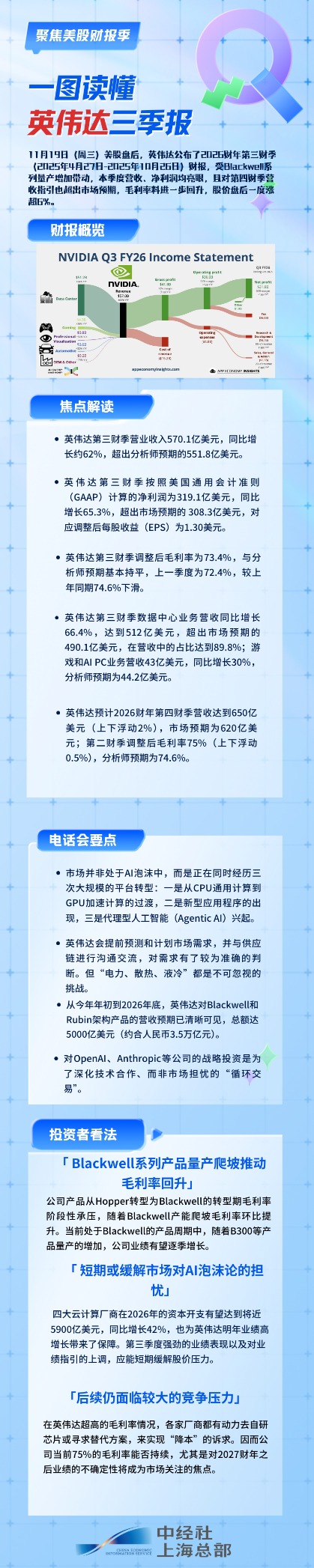
英伟达电话会:黄仁勋反击“我们看到的和AI泡沫截然相反”,公司订单能见度达5000亿美元,Rubin明年下半年推出
Hua Er Jie Jian Wen· 2025-11-20 01:08
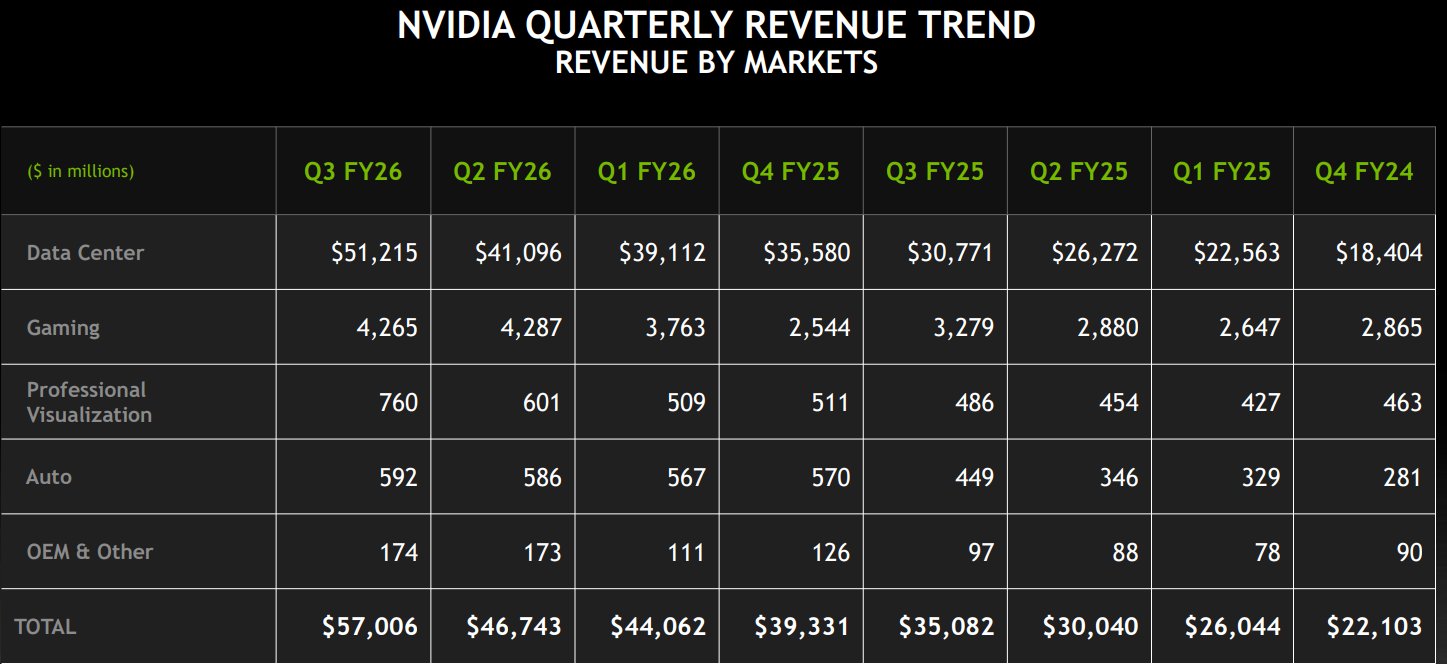
Core Viewpoint - NVIDIA's CEO Jensen Huang strongly refuted the "AI bubble" narrative, asserting that the company is at the center of three fundamental technological transformations that are driving sustained growth in AI technology [1][2][3]. Group 1: AI Transformations - The world is experiencing three major platform transformations: the shift from CPU to GPU accelerated computing, the transition from traditional machine learning to generative AI, and the rise of agentic AI [3][4][32]. - Huang emphasized that these transformations are foundational and necessary for future infrastructure growth, with NVIDIA's architecture capable of supporting all three transitions [4][35]. Group 2: Financial Performance and Guidance - NVIDIA reported a record revenue of $57 billion for Q3, a 62% year-over-year increase, with data center revenue reaching $51 billion, up 66% [15][28]. - The company provided a strong Q4 revenue guidance of $65 billion, significantly above market expectations, even without assuming any revenue from data center computing in China [11][28]. Group 3: Demand and Supply Dynamics - NVIDIA's CFO Colette Kress revealed a revenue visibility of $500 billion for the Blackwell and Rubin platforms from now until the end of 2026, indicating robust demand [5][9]. - The company acknowledged supply chain challenges, particularly in power and packaging, but emphasized that these issues are manageable [6][8]. Group 4: Strategic Partnerships and New Clients - NVIDIA announced a strategic partnership with AI model company Anthropic, marking its first adoption of NVIDIA's architecture with an initial compute commitment of up to 1 gigawatt [9][25]. - The company is also collaborating with OpenAI to build and deploy at least 10 gigawatts of AI data centers, indicating a significant scale-up in computational capabilities [11][24]. Group 5: Market Position and Competitive Edge - NVIDIA's unique architecture allows it to run all major AI models, positioning it as a leader in the AI infrastructure market [9][12]. - The company is focused on expanding its CUDA ecosystem through strategic investments in key AI companies, which are intended to deepen technical collaborations rather than merely boost short-term demand [10][25].
当“AI泡沫论”萦绕之际 英伟达(NVDA.US)业绩破空! AI算力需求继续爆表 数据中心营收猛增66%
智通财经网· 2025-11-20 00:00
Core Viewpoint - Nvidia, known as the "superpower of AI chips," has provided a strong revenue outlook for the current quarter, exceeding market expectations, which counters recent concerns about an "AI bubble" and alleviates investor fears regarding a potential decline in global AI spending [1][2][3]. Group 1: Financial Performance - Nvidia's revenue for Q3 FY26 reached $57 billion, a 62% year-over-year increase and a 22% quarter-over-quarter increase, surpassing analyst expectations of $55.2 billion [4][12]. - The company's net profit for Q3 increased by 65% year-over-year to $31.9 billion, with operating profit also rising by 65% to $36 billion [4][12]. - Nvidia's data center business, which is crucial for AI infrastructure, generated $51.2 billion in revenue, reflecting a 66% year-over-year growth [12]. Group 2: Market Dynamics - The demand for AI computing power is surging globally, driven by significant investments from the U.S. government and tech giants in AI infrastructure [2][8]. - Nvidia holds a dominant 90% market share in the AI accelerator space, indicating strong ongoing demand for its AI GPUs [2][6]. - The recent performance of Nvidia has positively influenced the stock prices of other companies in the AI computing supply chain, such as TSMC, Broadcom, AMD, and Micron [1][4]. Group 3: Future Outlook - Nvidia forecasts total revenue of approximately $65 billion for Q4 FY26, significantly above Wall Street's average estimate of $62 billion, indicating robust demand for AI computing infrastructure [2][3]. - The company is expected to continue benefiting from the ongoing AI investment wave, with projections suggesting that the AI infrastructure investment could reach $3 trillion to $4 trillion by 2030 [16][20]. - Analysts are optimistic about Nvidia's future, with some raising target prices significantly, anticipating a market cap that could exceed $8 trillion [16].
英伟达25q3业绩&AI泡沫讨论
Xin Lang Cai Jing· 2025-11-19 14:41
Core Insights - The market has high expectations for NVIDIA's upcoming earnings, with Q3 revenue projected at approximately $57 billion, a 62% year-over-year increase, surpassing the company's guidance of $54 billion [1][2] - For Q4, market expectations range from $64 billion to $65 billion, reflecting a year-over-year growth of 63% to 65%, also above the company's guidance of $62 billion to $63 billion [2] - The core growth drivers for NVIDIA are the data center segment, particularly the ramp-up of the Blackwell and Rubin chips, with significant demand from major tech companies [3][4] Market Dynamics - Traditional tech giants like Google, Microsoft, Meta, and Amazon have shown a 73% year-over-year increase in capital expenditures in Q3, indicating strong demand for AI infrastructure [3] - Emerging cloud companies such as CoreWeave and Nibiru are experiencing rapid growth in capital expenditures, with CoreWeave's expected capital spending for 2026 projected to be more than double that of 2023 [4][5] - The backlog of orders for these emerging cloud providers is substantial, with CoreWeave reporting over $55 billion in backlog, indicating strong demand for their services [5][10] Supply Chain and Production - Supply chain improvements are evident, with expectations for increased production capacity, particularly in CoWoS technology, which is crucial for NVIDIA's chip production [5][6] - NVIDIA's GTC conference indicated a projected shipment of 20 million chips, valued at approximately $500 billion, highlighting the company's robust supply chain capabilities [6][7] - The overall market is expected to see a significant increase in chip shipments, with major players like TSMC and AMD also raising their production forecasts [10][11] Long-term Outlook - By 2030, the optimistic EPS forecast for NVIDIA could reach $50, reflecting a compound annual growth rate of nearly 60% [2] - The AI infrastructure investment landscape is expected to remain strong, with both traditional and emerging cloud providers experiencing significant growth in demand [5][8] - Concerns regarding the AI bubble and profitability are present, but the long-term outlook remains positive, with a focus on the evolving demand for AI capabilities [8][9]
英伟达业绩前瞻:市场在期待什么?AI泡沫疑云能否消散?
2025-11-19 01:47
Summary of Key Points from the Conference Call Company: NVIDIA Industry Overview - The market is closely monitoring NVIDIA's performance and future expectations, particularly in the AI and data center sectors [1][2][4] Core Financial Insights - For Q3 FY2025, NVIDIA's revenue is projected to grow by 62% year-over-year, with data center revenue expected to reach $51 billion and gross margins between 73% and 74% [1][2] - Q4 FY2025 revenue is anticipated to increase by 63%-65% year-over-year, with gross margins potentially reaching around 75% [1][3] - EPS for FY2025 is expected to grow approximately 60%, reaching around $4.5-$4.8, while FY2026 EPS is projected to be around $8, reflecting a 72% increase [4] Growth Drivers - NVIDIA's growth is primarily driven by the mass shipment and ramp-up of its Blackwell and Rubin chips, with total shipments expected to reach 20 million units, corresponding to $500 billion [1][6] - The company is also benefiting from improvements in supply chain efficiency and increased production capacity [6] Data Center Demand Trends - Traditional cloud giants like Google, Microsoft, Meta, and Amazon have seen a 73% year-over-year increase in capital expenditures, with an expected annual growth rate of 63% [5] - Emerging cloud providers such as Coreweave and Nebulas are significantly increasing their capital expenditure plans, indicating strong demand for computing power [5] AI Market Sentiment - Concerns regarding the AI bubble focus on the mismatch between investment and returns, although the demand for inference computing power is rising [2][7] - The AI sector is viewed as being in the early stages of a significant technological revolution, attracting substantial new investments despite some companies like OpenAI currently operating at a loss [7] Cloud Service Profitability Concerns - Market worries about cloud service profitability are seen as short-term adjustments rather than long-term issues, with strong growth in both demand and supply sides [8] - Google Cloud's operating profit margin is expected to rise significantly, indicating ongoing profitability in cloud services [9] Chip Depreciation Cycle - The current chip depreciation cycle of 5-6 years is considered reasonable, with potential for extension due to increased reliability and changes in workload demands [10][11] Upcoming AI Catalysts - Key upcoming events include the release of Google's GEMINI 3, Microsoft's Ignite conference, and Amazon's Re:Invent conference, all of which are expected to impact the AI landscape significantly [12][13]
英伟达大考来袭,华尔街进入避险模式
2 1 Shi Ji Jing Ji Bao Dao· 2025-11-18 15:01
Market Overview - The U.S. stock market is experiencing a downturn, particularly in technology stocks, with the Dow Jones down 1.18%, S&P 500 down 0.92%, and Nasdaq down 0.84% as of November 17 [2] - The S&P 500 and Nasdaq have both fallen below their 50-day moving averages for the first time in 139 trading days [2] - The "Big Seven" tech stocks have dropped nearly 4.5% this month, with only Alphabet showing gains [2] AI Sector Insights - Nvidia's upcoming Q3 earnings report is seen as a critical indicator for the AI sector and the broader U.S. stock market [2][7] - Historically, Nvidia's earnings have exceeded market expectations, but there are concerns about high valuations and investor caution [2][7] - Recent institutional selling of Nvidia shares may reflect tactical adjustments rather than a bearish outlook on the AI sector [7][8] Economic Factors - Concerns over high valuations of AI stocks and tightening liquidity are contributing to the recent weakness in the U.S. stock market [4] - The probability of a Federal Reserve rate cut in December has decreased to 48.6% due to hawkish comments from Fed officials [4] - The recent government shutdown and liquidity risks have exacerbated market volatility, with cash balances in the Treasury increasing significantly [4][5] Institutional Behavior - Major hedge funds have reduced their positions in Nvidia, indicating a cautious approach amid high valuations and concentrated holdings [7] - The market is rewarding companies with accelerating growth driven by AI demand, while showing skepticism towards those with unclear business channels [10] Future Outlook - The sustainability of AI spending and profitability remains a key focus for investors, with expectations for significant earnings growth in 2025 and 2026 [11] - The market's current high concentration in tech giants suggests strong profitability, but any underperformance could lead to widespread corrections [11][12] - The long-term success of the AI sector will depend on the actual commercialization of technology and macroeconomic conditions [11][12]
谷歌(GOOGL.US)CEO预警:当前AI市场存在非理性因素 若泡沫破裂没有公司能幸免
智通财经网· 2025-11-18 11:08
智通财经APP获悉,在当前人工智能(AI)领域估值飙升和巨额投资引发市场对泡沫的担忧之际,谷歌 (GOOGL.US)首席执行官桑达尔·皮查伊表示,如果AI热潮崩溃,没有公司能够幸免。 皮查伊表示,在当前的投资周期中,AI行业可能的确会"过度反应"。但他也表示:"我们现在可以回顾 一下互联网的发展历程。显然,当时存在大量的过度投资,但我们都不会质疑互联网的意义深远。""我 预计人工智能也会如此。所以我认为,在这样的时刻,它既有理性的成分,也有非理性的成分。" 市场目前对AI交易可持续性和估值高企的担忧是导致近期美股表现不佳的重要原因。即将于本周三公 布的英伟达(NVDA.US)财报将为投资者揭示AI交易的最新情况。Wedbush分析师指出,英伟达本周发布 的数据对于说服那些持观望态度的投资者而言将具有重要意义,这些数据将有助于他们相信,当前的 AI投资趋势是现代科技史上前所未有的重要时刻,而非泡沫形成的时期。 值得一提的是,多家华尔街机构近期相继发声驳斥"AI泡沫论"。Mariner Wealth Advisors首席投资策略 师兼股票部门主管Jeff Krumpelman指出,过去一周科技股经历震荡,投资者纷 ...

【财经分析】AI热潮与避险需求叠加 新加坡10月出口同比激增22.2%
Xin Hua Cai Jing· 2025-11-18 08:16
Core Insights - Singapore's non-oil domestic exports (NODX) surged by 22.2% year-on-year in October 2025, marking the fastest growth since November 2021, significantly exceeding market expectations of 7.5% [1] Group 1: AI and Electronics Sector - The electronics sector saw a remarkable year-on-year export increase of 33.2% in October, driven by structural demand from the AI boom, with integrated circuits (ICs) and personal computers (PCs) rising by 40.9% and 77.7% respectively [2] - Analysts attribute this strong performance to sustained global capital expenditure related to AI, with Singapore's semiconductor production accounting for over 11% of the global market share [2] Group 2: Gold Exports and Global Sentiment - Non-electronic products experienced an 18.8% growth, primarily due to a staggering 176.8% increase in "non-monetary gold" exports, reflecting heightened global risk aversion [4] - The surge in gold exports was particularly notable to Thailand and Hong Kong, with increases of 844.6% and 68.9% respectively, amid rising concerns over trade tensions and economic downturns [4] Group 3: Government Policies and Economic Outlook - The robust export performance is supported by government macroeconomic policies, with the manufacturing Purchasing Managers' Index (PMI) indicating stability and expansion in the sector [5] - Singapore's Deputy Prime Minister has outlined a focus on developing high-value industries like AI, while the Monetary Authority of Singapore has maintained a policy of moderate appreciation of the Singapore dollar to stabilize costs for the electronics manufacturing sector [6] - Following the strong data, several institutions have revised their economic forecasts upward, with OCBC raising its NODX growth prediction for 2025 from 2.5% to 4% [6]