太空光伏

Search documents
太空光伏与“轨道数据中心”:为什么下一代能源与算力的战场,会在800km的高空?
华尔街见闻· 2026-01-11 12:21
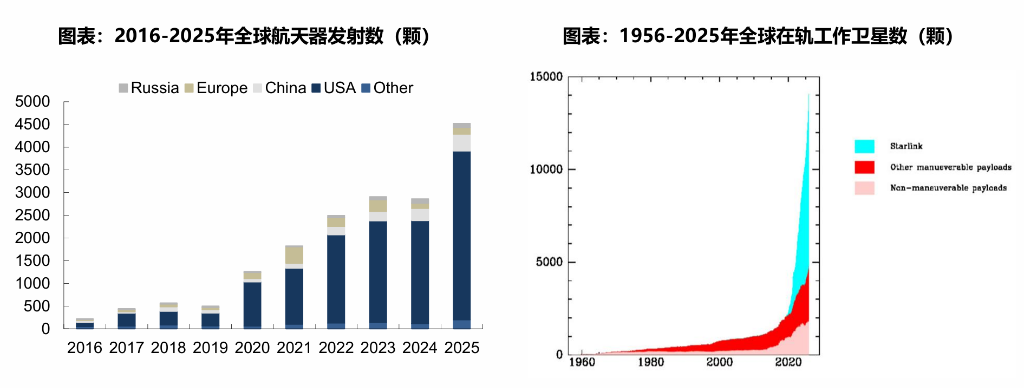
Core Viewpoint - Space photovoltaic technology is evolving from merely being "solar panels on satellites" to becoming a crucial pathway for the next generation of computing forms, specifically space computing and orbital data centers [1][4]. Group 1: Market Dynamics - The approval of SpaceX to deploy an additional 7,500 second-generation Starlink satellites, bringing the total to 15,000, is reshaping the supply-demand landscape of the space industry [2]. - The cost of deploying a data center in space is significantly lower than on the ground, with a projected total cost of approximately $8.2 million for a 40MW data center in space compared to about $167 million on the ground over ten years [3][16]. - The demand for solar wings is becoming rigid and preemptive due to the increasing number of satellites, which are expected to grow from 237 launches in 2016 to over 4,300 by 2025, reflecting a compound annual growth rate of about 34% [5][7]. Group 2: Technological Advancements - The energy and cooling requirements for satellites are being redefined, with solar wings becoming essential for long-term power supply, accounting for 20%-30% of the total manufacturing cost of satellites [5][8]. - The area of solar wings for Starlink satellites has increased dramatically, from 22.68 square meters in version 1.5 to 256.94 square meters in version 3, indicating a significant upgrade in power consumption [9]. - The market for solar wings is projected to grow significantly, with estimates suggesting a market space of approximately 200 billion yuan if annual launches reach 10,000 satellites [10][11]. Group 3: Cost Structure and Competitive Landscape - The core business logic for space computing is to convert the largest long-term cost items (energy and cooling) from ongoing expenses to one-time investments, leveraging the favorable conditions in space [17][18]. - The cost of energy systems in satellites can account for up to 22% of the overall economic viability, emphasizing the importance of developing lighter, cheaper, and scalable solar wings [14][15]. - The competition in the space computing sector will increasingly focus on the energy system's power-to-weight ratio, which will become a key competitive advantage [21]. Group 4: Future Outlook and Strategic Considerations - The optimal orbit for deploying satellites, particularly the Sun-Synchronous Orbit (SSO), is limited, which will drive competition towards larger platform motherships or multi-satellite clusters [20]. - The transition from gallium arsenide to silicon-based technologies, particularly HJT (Heterojunction Technology), is anticipated due to its advantages in energy, weight, and cost efficiency [22][29]. - The growth of space photovoltaic technology is not just an industry story but a resonance of a comprehensive system involving energy, transport, orbit, and computing [33].

华源晨会精粹20260111-20260111
Hua Yuan Zheng Quan· 2026-01-11 12:15
Group 1: Public Utilities and Environmental Protection - The commercial aerospace sector is experiencing robust growth driven by policy support, indicating a critical turning point in the industry cycle [7][8] - Solar photovoltaic (PV) technology is identified as the primary energy source for satellites, with significant market potential projected at 80-120 billion yuan globally, assuming 4,000-6,000 satellites are launched annually [8] - The transition from traditional multi-junction gallium arsenide to P-type HJT and perovskite/silicon tandem technologies is expected to enhance the efficiency and cost-effectiveness of solar panels in space applications [9] - Key recommendations include companies like Maiwei Co., Ltd., Goldwind Technology, and CIMC Anrui Technology, with a focus on related equipment and battery component firms [9] Group 2: North Exchange Market - In 2025, the North Exchange is set to accept 176 companies, accounting for over 64% of the total IPOs in the A-share market, indicating a significant influx of quality enterprises [11][12] - The average net profit for new companies in 2024 is projected at 9.523 million yuan, with 47% of these companies expected to exceed 8 million yuan in net profit [12] - The North Exchange market has shown strong recovery, with the North Index rising by 5.82%, suggesting a stable upward trend in the market [13] Group 3: New Consumption - Recent policies encourage cultural and tourism consumption, including the issuance of vouchers for travel and cinema, aimed at enhancing collective activities among workers [16] - The strategic partnership between Mao Geping and L Catterton Asia Advisors aims to expand global market reach and optimize capital structure, indicating growth potential for high-end cosmetic brands [17] - The report highlights the importance of understanding new consumer narratives, particularly among younger generations, to identify growth opportunities in emerging consumer brands [18] Group 4: CIMC Anrui Technology - CIMC Anrui Technology has achieved record-high orders, with a focus on clean energy, chemical environment, and liquid food sectors, indicating a diversified growth strategy [20][21] - The clean energy segment is expected to benefit from rising LNG demand and the low-carbon transition in the shipping industry, with new orders reaching 169.9 billion yuan in 2025 [22][23] - The company is positioned to leverage its capabilities in commercial aerospace, with anticipated revenues and orders nearing 100 million yuan by 2025 [24]




马斯克的颠覆式能源终极方案
Di Yi Cai Jing· 2026-01-11 11:52
Group 1 - Tesla CEO Elon Musk proposed that the future measure of wealth will be in "watts," emphasizing the importance of energy control [2] - Musk outlined a "three-step" plan for solar energy, starting with the use of Tesla's Megapack to store excess electricity and improve grid efficiency [2] - The second step involves launching solar AI satellites into space to maximize solar energy utilization, with a goal of deploying 100GW annually [3] Group 2 - In 2025, Tesla's energy storage products achieved a total installation of 46.7 GWh, a 48.7% year-on-year increase, with a record 14.2 GWh installed in Q4 [3] - The concept of space photovoltaics is gaining traction, with industry leaders noting that solar panels in space can generate 7 to 10 times more energy than on Earth [4] - Companies like JinkoSolar and Trina Solar are advancing their plans for space photovoltaics, with Trina Solar aiming to commercialize perovskite technology by 2026 [4][5] Group 3 - JunDa Co. has formed a strategic partnership with Shangyi Optoelectronics to explore perovskite battery technology for space energy applications, highlighting the potential for a trillion-dollar market in low Earth orbit satellites [5] - Analysts from Galaxy Securities noted that space photovoltaics can provide stable energy for space economies, with efficiency improvements expected to drive commercialization in the next 10 to 15 years [5]

光伏行业:太空光伏或成行业第二成长曲线,利好HJT、钙钛矿新技术
Dongxing Securities· 2026-01-11 11:46
Investment Rating - The industry investment rating is "Positive" [6] Core Insights - The space photovoltaic sector may become the second growth curve for the industry, benefiting HJT and perovskite technologies [3] - The demand for space photovoltaics is expected to grow significantly, with potential installation demand exceeding 800 GW if the proposed space data center concept is realized [3] - Leading companies are focusing on the space photovoltaic market, accelerating technology research and scenario exploration, indicating a shift from concept validation to explosive growth [3] Summary by Sections Market Demand - Solar energy is the preferred energy source for space activities, with increasing power requirements for satellites driving demand for larger solar wings [3] - The current market size is small but expanding rapidly, with a potential for significant growth in the future [3] Technology Development - The main requirements for space photovoltaic technology are high efficiency, lightweight, and adaptability to extreme temperatures and radiation [4] - The mainstream technology for space photovoltaics is currently gallium arsenide (GaAs), which has a conversion efficiency exceeding 30% but comes with high production costs of approximately 1000 RMB/W [4] - P-type HJT batteries are seen as a potential alternative due to their compatibility with space conditions, offering reduced weight and excellent low-temperature performance [4] Future Prospects - Perovskite tandem batteries are expected to become a key option for next-generation space photovoltaics, with theoretical conversion efficiencies reaching 45% and significant weight advantages over GaAs [5] - The flexibility of perovskite batteries allows for diverse solar wing designs, making them suitable for various space applications [5] Investment Strategy - The short-term acceleration of low Earth orbit satellites is expected to drive demand for space photovoltaics, while the long-term vision of space data centers opens up new opportunities [5] - HJT and perovskite technologies are viewed as optimal solutions for extreme space environments, benefiting related battery component manufacturers and equipment producers [5]
马斯克的颠覆式能源终极方案
第一财经· 2026-01-11 11:31
Core Viewpoint - Elon Musk suggests that the future measure of wealth will be in "watts" rather than currency, emphasizing the importance of energy control for humanity's future [3]. Group 1: Energy Solutions - Musk proposes a "three-step" plan for energy independence, starting with the use of Tesla's Megapack to store excess electricity and double the efficiency of existing power grids [4]. - The second step involves launching solar AI satellites into space to maximize solar energy utilization, requiring approximately 8,000 launches over a year for deployment [4]. - The final step includes establishing satellite factories on the Moon to manufacture satellites using local materials, aimed at significantly increasing solar energy capture [4]. Group 2: Tesla's Energy Product Growth - In 2025, Tesla's energy products achieved a total installation capacity of 46.7 GWh, marking a 48.7% year-on-year increase, with Q4 alone contributing 14.2 GWh, a 13% quarter-on-quarter growth [5]. - The demand for Tesla's Megapack and Powerwall products has driven this strong growth in the energy sector [5]. Group 3: Space Solar Power Potential - The concept of space solar power, where photovoltaic components are deployed on satellites, is gaining traction, with industry experts noting that solar energy in space can be 7 to 10 times more efficient than on Earth [6]. - Companies like JinkoSolar and Trina Solar are advancing their technologies to capitalize on the potential of space solar power, with plans for commercialization in the near future [6]. - The market for space solar power is projected to be vast, with low Earth orbit satellites alone potentially generating trillions in value [6]. Group 4: Industry Outlook - Analysts predict that the space economy, including satellite internet and deep space exploration, will require stable energy sources, with space solar power offering high efficiency and continuous energy generation [6]. - The development of perovskite tandem solar cells is expected to become mainstream in the medium to long term, supported by decreasing launch costs and breakthroughs in battery technology [6].

从Megapack到太空光伏 马斯克颠覆式提出能源终极方案
Di Yi Cai Jing· 2026-01-11 10:11
Group 1 - Tesla CEO Elon Musk proposed that the future measure of wealth will be in "watts," referring to the scale of energy one can control [1] - Musk emphasized that solar energy is the only answer for human energy freedom and outlined a "three-step" plan to maximize solar energy utilization [2] - The first step involves using Tesla's Megapack battery to store excess electricity from power plants at night, aiming to double the efficiency of the existing power grid [2] Group 2 - The second step includes launching solar AI satellites into space to leverage continuous sunlight, with an estimated 8,000 launches needed for deployment [2][3] - The third step envisions establishing satellite factories on the Moon to manufacture satellites using local materials, representing a significant upgrade for human civilization [2] - Tesla's energy storage products saw a strong growth in 2025, with a total installed capacity of 46.7 GWh, a year-on-year increase of 48.7% [2] Group 3 - The concept of space solar power, which involves deploying photovoltaic components on satellites, is gaining traction, with industry experts noting its advantages over terrestrial solar power [3] - Chinese solar companies are responding to Musk's vision, with JinkoSolar's chairman stating that solar panels in space can generate 7 to 10 times more energy than those on Earth [3] - Trina Solar plans to accelerate the commercialization of perovskite solar cells and enter the space solar power market by 2026 [4] Group 4 - JinDa Co. has formed a strategic partnership with Shangyi Optoelectronics to invest in perovskite battery technology for space energy applications, highlighting the vast potential of the space solar market [4] - Analysts from Galaxy Securities noted that space solar power can provide stable energy for the space economy, with efficiency improvements of 7 to 10 times compared to ground-based solar [4] - The commercialization of space solar power is expected to progress over the next 10 to 15 years, driven by decreasing launch costs and advancements in battery technology [4]

从Megapack到太空光伏,马斯克颠覆式提出能源终极方案
Di Yi Cai Jing· 2026-01-11 09:45
Group 1: Core Concepts - Musk proposed that solar energy is the only answer for humanity's energy freedom and that the future unit of wealth will be measured in "watts" instead of currency [2][4] - The first step in Musk's plan involves using Tesla's Megapack battery to store excess electricity from power plants at night, aiming to double the efficiency of the existing power grid [4] - The second step includes launching solar AI satellites into space to maximize solar energy utilization, with an estimated requirement of 8,000 launches per year for deployment [4][5] Group 2: Industry Developments - Tesla's energy storage products saw significant growth, with a total installed capacity of 46.7 GWh in 2025, representing a 48.7% year-on-year increase [4] - The fourth quarter of 2025 recorded a new quarterly installation record of 14.2 GWh, reflecting a 13% quarter-on-quarter growth [4] - The concept of space photovoltaics is gaining traction, with industry leaders noting that solar panels in space can generate 7 to 10 times more energy than those on Earth, addressing issues of intermittency and degradation [6] Group 3: Future Prospects - The space photovoltaic market is expected to have a massive potential, with low Earth orbit satellites alone projected to create a trillion-dollar market [6] - Companies like JinkoSolar and Trina Solar are accelerating their efforts in commercializing perovskite technology for space applications, indicating a new era in space photovoltaics and interstellar computing [6] - Analysts suggest that with decreasing commercial space launch costs and breakthroughs in battery technology, space photovoltaics could gradually commercialize over the next 10 to 15 years [6]
大能源行业2026年第1周周报(20260111):星河主场,太阳光伏即将启航-20260111
Hua Yuan Zheng Quan· 2026-01-11 07:23
Investment Rating - The industry investment rating is "Positive" (maintained) [1] Core Insights - The commercial aerospace sector is experiencing robust growth driven by policy support, indicating a critical turning point in commercialization. Satellite frequency and orbital resources are scarce strategic assets globally, with developed countries like the US leveraging early investments and SpaceX's advantages to secure significant frequency resources. China has recognized commercial aerospace as a vital strategic area, intensifying policy support to accelerate satellite network deployment [3][8] - Solar photovoltaic (PV) technology is the primary long-term energy source for satellites, with current applications focused on communication satellites. The global solar PV market is projected to reach between 80 billion to 120 billion yuan, assuming the price of gallium arsenide batteries is approximately 200,000 yuan per square meter and an annual launch of 4,000 to 6,000 satellites, each with solar wings of 100 square meters. Elon Musk's plan to deploy 100GW of computing power annually by 2030 could transition space PV from "satellite auxiliary power" to "large-scale energy infrastructure," potentially expanding the market from a hundred billion to a trillion yuan scale [4][8][9] Summary by Sections Section 1: Electric New Energy - The solar PV market is set to expand significantly, driven by the unique energy demands of satellites and large-scale space data centers. The technology is evolving from multi-junction gallium arsenide to P-type HJT and perovskite/silicon tandem cells, which are better suited for the harsh conditions of space. P-type HJT batteries offer advantages such as radiation resistance, lightweight, high efficiency, and cost-effectiveness, making them ideal for space applications [9] - The market for HJT technology is expected to grow as it moves away from competitive pressures in the terrestrial PV market, positioning it as a mainstream technology globally [9][10] Section 2: Investment Recommendations - Key companies recommended for investment include Maiwei Co., Jin Feng Technology (H), and Zhongji Anruike. Companies related to equipment such as Jiejia Weichuang and Aotewei are suggested for attention, along with battery and module companies like Dongfang Risheng, Junda Co., Jinko Solar, Trina Solar, and Mingyang Smart Energy. Other companies in the commercial aerospace supply chain include Jin Feng Technology (A), Jiufeng Energy, Xinle Energy, Guoci Materials, Jing Shan Light Machine, Saiwu Technology, Jinjing Technology, and Taisheng Wind Energy [10]



银河证券:反内卷政策趋势仍在 太空光伏产业加速
智通财经网· 2026-01-11 06:48
Core Viewpoint - The trend of anti-involution policies remains, with ongoing exploration of coordinated governance in the industry [2] Group 1: Anti-Involution Policies - The recent halt of self-regulatory actions related to silicon material integration in the photovoltaic industry by the Market Supervision Administration is characterized as a rare preemptive review, which does not provide exemptions for anti-involution or integration [2] - The halt specifically targets monopolistic self-regulation concerning price, production capacity, and market division, while allowing compliance in areas such as cost-price sales, intellectual property protection, and technical standard improvements [2] - A collaborative governance framework has been established, involving enterprises, power generation parties, and associations to ensure compliance without resorting to monopolistic practices [2] Group 2: Industry Price Trends - The price of N-type silicon material has increased to 59,200 yuan per ton, reflecting a week-on-week rise of 9.83% [3] - Prices for N-type silicon wafers and battery cells have been maintained or increased, with N-type battery cell prices rising to 0.39 yuan per watt and TOPCon module prices increasing to 0.7 yuan per watt [3] - The industry is expected to gradually recover profitability, with a forecast of turning profitable in 2026 as terminal demand begins to improve [3] Group 3: Commercial Space and Space Photovoltaics - Elon Musk has announced plans to deploy a solar energy network of 100GW satellites annually, while China aims to establish gigawatt-level space data centers between 2025 and 2035 [4] - Space photovoltaics are expected to become commercialized in the next 10-15 years, driven by decreasing launch costs and breakthroughs in battery technology [4] - The efficiency of space photovoltaic systems is significantly higher than ground-based systems, with energy density and annual generation hours improved by 7-10 times [4]
太空光伏与“轨道数据中心”:为什么下一代能源与算力的战场,会在800km的高空?
Hua Er Jie Jian Wen· 2026-01-11 04:46
Core Viewpoint - Space photovoltaic technology is evolving from a supporting system for spacecraft to a core energy solution for next-generation space infrastructure, driven by the acceleration of global satellite deployment and the rising demand for space computing power [1] Group 1: Satellite Deployment and Market Dynamics - China applied for frequency resources for over 200,000 satellites by December 2025, with 190,000 from the newly established "national team" [1] - The U.S. FCC approved SpaceX to deploy an additional 7,500 second-generation Starlink satellites, bringing the total approved to 15,000 [1] - The global spacecraft launch volume has maintained a compound annual growth rate (CAGR) of 34% over the past decade, with an expected launch number exceeding 4,300 by 2025, representing a year-on-year growth of over 50% [3][1] Group 2: Space Computing Centers and Energy Requirements - The rise of space computing centers is opening new possibilities, with projects like China's "Trisolaris Computing Constellation" and SpaceX's Starcloud targeting space data center construction [2] - A potential 10GW space computing system could lead to a solar wing market size of several trillion yuan [2] - The evolution of satellite functions is reshaping energy system requirements, with significant increases in single-satellite power demands [10][12] Group 3: Energy Supply and Technological Developments - The space photovoltaic industry is experiencing a "volume and price increase" scenario, driven by the surge in satellite numbers and the rising power density of individual satellites [14] - Photovoltaic technology is the only efficient and stable energy form for satellites in space, with the need for larger solar wings leading to concerns about weight and cost [12] - The technology route for space photovoltaics is diversifying, with gallium arsenide (GaAs) batteries dominating the high-end market due to their efficiency, while silicon-based heterojunction (HJT) and perovskite technologies are gaining traction for large-scale applications [19][22] Group 4: Economic Considerations and Future Outlook - The explosion of space photovoltaics is reshaping the value logic of the photovoltaic industry, transitioning from a closed military aerospace system to commercial photovoltaic enterprises with large-scale manufacturing capabilities [25] - SpaceX's low launch costs encourage the use of lower-cost silicon-based batteries, while China's higher launch costs still favor the use of expensive GaAs batteries, although a shift towards silicon-based technologies is anticipated [26] - The low Earth orbit (LEO) satellite market could generate nearly 200 billion yuan in solar wing market space with the launch of 10,000 satellites, and the construction of a future 10GW space computing system could expand the market size to several trillion yuan [30]