
扩大有效投资

Search documents
财政部:五年来安排中央预算内投资3.33万亿元,支持交通等基础建设
Cai Jing Wang· 2025-09-13 07:26
Core Insights - The National Development and Reform Commission held a press conference to discuss the achievements of fiscal reform and development during the "14th Five-Year Plan" period [1] Group 1: Investment and Financial Measures - The Ministry of Finance has allocated over 1.5 trillion yuan in special long-term bonds in the past two years to promote effective investment [1] - A total of 19.4 trillion yuan in local government special bonds has been arranged over five years, supporting 150,000 construction projects [1] - Central budget investments amounting to 3.33 trillion yuan have been allocated to support infrastructure projects such as water conservancy and transportation [1]
我市制定出台稳投资工作方案
Zhen Jiang Ri Bao· 2025-09-12 23:53
Core Viewpoint - The article emphasizes the importance of investment as a key driver for economic growth, highlighting the release of the "Zhenjiang 2025 Second Half Investment Stabilization Work Plan" which aims to enhance effective investment for high-quality economic and social development [1][2]. Group 1: Key Tasks - The "Work Plan" focuses on seven key tasks to stabilize investment, including accelerating major project construction, promoting real estate investment recovery, reinforcing the manufacturing sector's role, solidifying infrastructure project support, improving government investment efficiency, increasing efforts in attracting investment, and fully utilizing a package of incremental policies [1][2]. - Each task is detailed with specific requirements and measures to strengthen support in key industries and sectors, aiming for a coordinated effort to expand effective investment [1]. Group 2: Support Measures - To ensure the effective implementation of the tasks, the "Work Plan" outlines four support measures: enhancing financial support, strengthening resource guarantees, optimizing the investment environment, and improving work mechanisms [2]. - Notably, it introduces a "deficiency acceptance" approach for major projects and aims to streamline approval processes to enhance service efficiency [2]. - The investment environment will be improved through government service reforms, including initiatives like "Huiqi 'Zhen' Action" to facilitate efficient handling of investment matters, creating a favorable atmosphere for investment [2].
发改委推进基建REITs常态化申报:扩围新资产,力挺民间投资参与
Zheng Quan Shi Bao· 2025-09-12 09:58
Core Viewpoint - The National Development and Reform Commission (NDRC) has issued a notification aimed at promoting the high-quality development of infrastructure Real Estate Investment Trusts (REITs), focusing on revitalizing existing assets and expanding effective investment [1] Group 1: Market Expansion and Support - The notification prioritizes the expansion of the REITs market by consolidating mature asset advantages and exploring new fields, while also opening channels for private investment [2] - It encourages the submission of high-quality infrastructure projects that align with national strategies and policies, and accelerates the application process for mature asset types such as toll roads and clean energy [2] - New asset types such as railways, ports, and cultural tourism are identified for exploration, with a focus on resolving challenges to meet issuance conditions [2] Group 2: Dynamic Project Management - A dynamic mechanism is emphasized, requiring provincial development and reform commissions to establish project ledgers for promising infrastructure projects, ensuring compliance from the planning stage [3] Group 3: Simplified Processes and Asset Range - The notification introduces support policies to enhance the asset integration capabilities of listed REITs, lowering operational thresholds and broadening asset boundaries [4] - It allows listed infrastructure REITs to apply for new projects six months after their initial issuance, streamlining the approval process [4] - The notification supports the acquisition of similar and related projects across different sectors, promoting the consolidation of existing assets [4] Group 4: Compliance and Fund Utilization - The notification emphasizes a balanced focus on project compliance, procedural integrity, and fund utilization efficiency to ensure healthy market development [5] - It outlines key conditions for project recommendations, including clarity of ownership and stability of operations, while aligning with national strategies [5] - The NDRC encourages projects with a high ratio of net recovery funds to total fund issuance, and mandates tracking of fund usage for listed projects [5]
今日视点:固定资产投资增速触底回升有底气
Zheng Quan Ri Bao· 2025-09-07 22:47
Group 1 - The core focus of the news is on the declining trend of fixed asset investment in China, which has dropped from a high of 4.2% in January to 1.6% in July, indicating a need for effective investment expansion strategies [1] - The "Artificial Intelligence +" initiative is expected to significantly boost investment in related industries, similar to the impact of the "Internet +" initiative a decade ago, with a notable increase in investment scale and long-term benefits for industrial transformation and consumption enhancement [2] - According to IDC, China's total investment in artificial intelligence is projected to exceed $100 billion by 2028, highlighting the potential growth in this sector [3] Group 2 - Equipment updates have shown a clear positive impact on stabilizing investment, with a 15.2% year-on-year increase in investment in equipment and tools from January to July, contributing 2.2 percentage points to overall investment growth [4] - Infrastructure investment is playing a crucial role in supporting economic stability, with a 3.2% year-on-year growth from January to July, contributing 43.0% to total investment growth, which is higher than the overall investment growth rate [5] - Major infrastructure projects, such as the Yarlung Tsangpo River hydropower project and new railway lines, are expected to further stimulate investment in related industries, indicating a cautious but optimistic outlook for fixed asset investment growth in the near future [5]
中国“三号民企”的掌舵人
Zhong Guo Xin Wen Wang· 2025-09-07 04:03
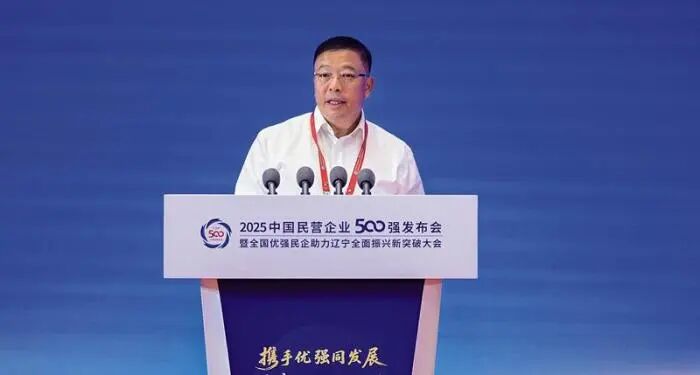
Core Insights - Hengli Group ranks 3rd in the 2025 China Private Enterprises 500 Strong list with a revenue of 871.5 billion yuan, marking its fifth consecutive year in this position [1] - The company has a workforce of 210,000, significantly larger than Tencent's 112,100 employees, highlighting its substantial scale in the industry [1] Group 1: Business Strategy - Hengli Group has established a complete industrial chain from crude oil to consumer products, including petrochemicals and textiles, which is rare in the industry [2] - The company began its journey in 1994 by acquiring a local textile factory for 3.69 million yuan, quickly turning it profitable within a year [2] - In 2002, Hengli expanded into upstream chemical fiber production, investing 2.2 billion yuan to establish Jiangsu Hengli Chemical Fiber Co., becoming a leader in the chemical fiber industry [4] Group 2: Market Adaptation - Hengli's strategic moves during economic downturns, such as acquiring production lines during the 1997 Asian financial crisis and investing in equipment during the 2008 financial crisis, allowed it to capitalize on recovery periods [8] - The company entered the petrochemical sector in 2010 with the establishment of the Dalian Changxing Island Industrial Park, which became a significant project for private enterprises in China's refining industry [4] Group 3: Recent Developments - Hengli is currently expanding into shipbuilding through Hengli Heavy Industry, acquiring the idle STX (Dalian) shipyard and building large oil tankers and bulk carriers [8][9] - The shipbuilding division has already launched over 70 vessels and has orders scheduled until 2029, positioning itself as a major player in the global shipbuilding market [9] - Hengli Heavy Industry is also preparing for a backdoor listing, with leadership transitions indicating a focus on nurturing the next generation of management [12]


《深化国资国企改革实践》系列——21篇:对外投资价值分析助力国资国企扩大有效投资
Sou Hu Cai Jing· 2025-09-05 02:06
Core Viewpoint - The article emphasizes the importance of expanding effective investment by state-owned enterprises (SOEs) to enhance their quality of development and to lead investment in society as a whole [2]. Investment Value Analysis - The Chinese government has prioritized expanding effective investment as a key task, aiming to boost consumption and investment efficiency [2]. - SOEs are encouraged to focus on both internal and external investments, with overseas investment being a significant component [2]. Industry Structure and Trends - Chinese enterprises are shifting their overseas investments from traditional labor-intensive sectors to high-end manufacturing and digital economy, enhancing their position in the global value chain [3]. - Investment focus is moving from developed countries to "Belt and Road" countries and emerging markets, creating a diversified international market landscape [3]. Investment Methods - Greenfield investments are favored as they can effectively overcome tariff barriers and gain favor from local governments [3]. - Minority stake investments or joint ventures are seen as flexible options that can help mitigate risks while pursuing key technology and new market opportunities [3]. Case Study: Client Enterprise - A major SOE group is planning to establish a joint venture in a "Belt and Road" country to set up an overseas production base, aiming to integrate domestic and international resources [4]. - The project aims to enhance the core competitive advantage and brand influence in the local automotive parts market [4]. Value Analysis - The project focuses on three main values: - **Industrial Value**: Utilizing overseas resources to optimize domestic industrial layout and enhance supply chain control [4]. - **Business Value**: Strengthening core business and acquiring advanced international resources to foster new growth points [4]. - **Economic Value**: Establishing efficient operational mechanisms to improve project returns and brand value [4]. Challenges Faced - Some SOEs lack clear overseas strategies and face difficulties in absorbing foreign technologies, leading to challenges in aligning overseas operations with domestic strategies [5]. - International operational capabilities and experiences are often insufficient, hindering effective integration of domestic and overseas operations [5]. - High market entry barriers in certain regions increase operational costs and financial risks, affecting profitability [5]. Regional and Business Development Goals - The project aims to enhance regional industrial layout and supply chain resilience through overseas investments [9]. - The goal is to integrate high-quality resources globally, optimize business layouts, and cultivate new growth points to better respond to global trade challenges [9]. - Understanding the investment destination's policies and potential risks is crucial for maximizing cost efficiency and benefits [9].
上半年GDP增长5.7%,江苏经济增量居全国首位
Yang Zi Wan Bao Wang· 2025-08-26 07:37
Core Viewpoint - Jiangsu Province is committed to taking on the responsibility of being a major economic province, achieving significant economic growth and high-level openness through deep reforms and effective investment strategies [1][3]. Economic Performance - In the first half of the year, Jiangsu's GDP reached 6.7 trillion yuan, with a year-on-year growth of 5.7%, surpassing the national average by 0.4 percentage points, maintaining the highest economic increment in the country [1][3]. - The province's total foreign trade import and export amounted to 2.81 trillion yuan, marking a year-on-year increase of 5.2%, setting a historical record for the same period [1][3]. - Actual foreign investment reached 11.54 billion USD, maintaining the top position in the country [1]. Key Development Areas - Jiangsu has focused on five key areas: building a unified national market, expanding effective investment, optimizing the business environment, promoting urban-rural integration, and enhancing high-level openness [3][4]. - The province has made progress in breaking local protectionism and promoting efficient resource circulation, including the introduction of the Jiangsu Data Regulation and the establishment of a provincial data group [3][4]. Investment and Consumption - Major project investments totaled 423.2 billion yuan in the first half of the year, with significant contributions from equipment upgrades and consumption initiatives, leading to a retail sales growth of 5% [3][4]. - The "old-for-new" consumption initiative generated over 170 billion yuan in sales [3]. Business Environment - Jiangsu has been recognized as the best province for business reputation for five consecutive years, with a total of 14.61 million business entities registered [4]. - The industrial output value of private enterprises increased by 8.7% year-on-year [4]. Urban-Rural Integration - The income ratio between urban and rural residents decreased to 1.98, lower than the national average by 0.44 percentage points [4]. High-Level Openness - Jiangsu has fully removed restrictions on foreign investment in the manufacturing sector, with 400 Fortune 500 companies already invested in the province [4]. - The province's trade with countries involved in the Belt and Road Initiative reached 1.39 trillion yuan, a year-on-year increase of 9.5%, accounting for nearly half of the province's total foreign trade [4].
扩大有效投资 新型政策性金融工具“蓄势待发”
Shang Hai Zheng Quan Bao· 2025-08-24 17:47
Group 1 - The National Development and Reform Commission (NDRC) is accelerating the establishment and deployment of new policy financial tools to expand effective investment [1][2] - New policy financial tools are expected to focus on supporting emerging industries and infrastructure projects, with a projected scale of 500 billion yuan, potentially leveraging 1.5 trillion to 2.5 trillion yuan in infrastructure investment [2] - Local governments are actively preparing project reserves for new policy financial tools, which will help address capital shortages and lower financing thresholds for projects [1][2] Group 2 - The NDRC plans to enhance coordination and resource support to accelerate project construction and promote high-quality development of key projects [3] - The issuance of long-term special bonds has increased by 300 billion yuan compared to last year, reflecting a more proactive fiscal policy [3] - The infrastructure investment growth rate is expected to rebound in the second half of the year, continuing to support economic stability [3]
赵刚在主持召开全省稳增长视频调度会时强调强化重点攻坚 科学精准施策 奋力完成全年各项目标任务
Shan Xi Ri Bao· 2025-08-20 00:39
Group 1 - The provincial governor emphasizes the importance of stabilizing economic growth in the third quarter, which is a critical phase for the annual economic work [1][2] - The focus is on stabilizing employment, enterprises, markets, and expectations to consolidate and expand the positive momentum of economic recovery [1] - There is a strong emphasis on supporting the industrial sector, particularly energy production and key manufacturing industries, to accelerate the release of quality production capacity [1][2] Group 2 - The governor calls for the expansion of effective investment through the "four batches" project management mechanism, aiming to boost infrastructure and industrial investment [2] - There is a commitment to improving the business environment by standardizing government procurement, bidding, and investment attraction processes [2] - The meeting highlights the need for targeted employment support for key groups such as college graduates, veterans, and migrant workers, alongside ensuring safety in production and disaster prevention [2]
加快释放内需潜力
Jing Ji Ri Bao· 2025-08-19 22:04
Core Viewpoint - The Chinese government emphasizes the need to effectively unleash domestic demand potential to support economic growth, focusing on expanding consumption and investment while promoting a unified national market [1][6]. Domestic Demand and Consumption - In the first half of the year, domestic demand contributed 68.8% to GDP growth, with final consumption expenditure accounting for 52% [2]. - The government has implemented policies such as the trade-in program for consumer goods, with 690 billion yuan allocated to stimulate consumption, leading to significant retail sales growth in various categories [2]. - There is a shift in focus towards service consumption and improving living standards, with new policies aimed at personal consumption loans and childcare subsidies [2][3]. - Service consumption has been growing rapidly, with projections indicating that by 2024, it will account for 46.1% of per capita consumption expenditure, contributing 63% to the growth of consumer spending [3]. Investment Expansion - The National Development and Reform Commission reported that 800 billion yuan for "two heavy" construction projects has been fully allocated, with 735 billion yuan in central budget investments also nearly disbursed [4]. - Infrastructure investment has seen significant growth, particularly in water management and information transmission sectors, with manufacturing investment rising by 6.2% in the first seven months [4][5]. - There is a strong emphasis on optimizing investment structure to meet changing demands, particularly in education, healthcare, and quality housing [5]. Reform and Policy Measures - The government aims to enhance economic growth by addressing insufficient domestic demand through targeted policies that focus on effective resource allocation and quality investments [6][7]. - Future policies will focus on deepening reforms to stimulate consumption and expand effective investment, particularly in sectors like transportation, energy, and water resources [7].