
数字中国

Search documents
“为‘泰中一家亲’谱写新篇章”
Ren Min Ri Bao· 2025-11-13 22:10
Group 1 - The visit of Thailand's King Vajiralongkorn to China marks the first state visit by a Thai monarch since the establishment of diplomatic relations, highlighting the deep-rooted friendship between the two nations [1] - Thailand's Deputy Prime Minister Prawit Wongsuwan emphasized the significant role of the Thai royal family in fostering Thailand-China relations, noting that Princess Sirindhorn has visited China over 50 times [1] - The historical ties between Thailand and China, spanning over a thousand years, have established a solid foundation for mutual respect and cooperation, making them a model for collaboration between countries with different social systems [1] Group 2 - The Thai government is aligning its "Thailand 4.0" strategy with China's "15th Five-Year Plan," focusing on renewable energy, digital infrastructure, and artificial intelligence to promote high-quality economic development [2] - Prawit Wongsuwan praised China's unique approach to modernization, particularly its focus on "common prosperity" and ensuring no one is left behind, which serves as a valuable reference for Asian countries [2] - There is a strong endorsement of China's global governance initiatives, with hopes for enhanced communication and collaboration between Thailand and China in multilateral areas to promote a more balanced and sustainable world [2] Group 3 - The Thai Deputy Prime Minister has actively promoted youth exchanges and cultural cooperation between Thailand and China, with over 20,000 Thai students studying in China and around 30,000 Chinese students in Thailand [3] - Prawit expressed a deep appreciation for Chinese culture, citing his fondness for classic Chinese literature and television dramas, which reflects the cultural ties between the two nations [3] - He extended a warm invitation for Chinese friends to visit Thailand, highlighting the country's beautiful architecture, stunning landscapes, and friendly people [3]
近400款民生服务应用完成鸿蒙化适配并上架 筑牢数字底座 赋能转型升级
Ren Min Ri Bao· 2025-11-13 22:05
Core Insights - The article highlights the rapid adoption of the HarmonyOS in various government and enterprise applications, emphasizing its role in advancing China's digital infrastructure and self-reliance in technology [1][2]. Group 1: Government Applications - Nearly 400 public service applications have been adapted to HarmonyOS, covering essential services such as social security, healthcare, and transportation [1]. - 15 provinces, including Beijing and Shanghai, have completed the adaptation of their government collaboration applications to HarmonyOS, enhancing governance capabilities [1]. Group 2: Enterprise Applications - Over 200 internal office applications from central and state-owned enterprises have been adapted to HarmonyOS, spanning critical sectors like energy, manufacturing, and finance [2]. - More than 100 mainstream office platforms, including DingTalk and WeChat Work, have launched native versions for HarmonyOS, supporting over 5 million applications and covering more than 38 million enterprises [2]. Group 3: Security and Innovation - HarmonyOS is fully self-developed from the kernel to the application framework, significantly reducing reliance on foreign software and enhancing data security in critical sectors [2]. - The Harmony Star Shield security architecture has intercepted approximately 16 million malicious application installation risks monthly, blocking 8.6 billion unauthorized permission requests [2]. - The total number of devices running HarmonyOS 5 has surpassed 23 million, with over 30,000 applications continuously iterating and contributing to system-level innovations [3].
“为‘泰中一家亲’谱写新篇章”——访泰国副总理波汶萨
Ren Min Ri Bao· 2025-11-13 22:04
Core Viewpoint - The visit of Thailand's King Vajiralongkorn to China marks a significant milestone in the diplomatic relations between the two countries, emphasizing their long-standing friendship and cooperation [1]. Group 1: Thailand-China Relations - The Thai royal family has played a crucial role in fostering Thailand-China relations, with Princess Sirindhorn having visited China over 50 times and actively engaging in cultural exchanges [1]. - The relationship between Thailand and China has been characterized by mutual respect and cooperation over the past 50 years, serving as a model for collaboration between countries with different social systems [1]. Group 2: Economic Cooperation - Thailand's Deputy Prime Minister, Prawit Wongsuwan, highlighted the alignment between China's "14th Five-Year Plan" and Thailand's "Thailand 4.0" strategy, particularly in areas such as renewable energy and digital economy [2]. - There is an expectation for deepened cooperation in emerging fields like renewable energy, digital infrastructure, and artificial intelligence to promote high-quality economic development [2]. Group 3: Cultural and Educational Exchange - The number of Thai students studying in China exceeds 20,000, while around 30,000 Chinese students are studying in Thailand, showcasing the fruitful educational cooperation between the two nations [3]. - The cultural exchange is further enriched by the interest of Thai officials in Chinese literature and media, indicating a strong cultural connection [3].
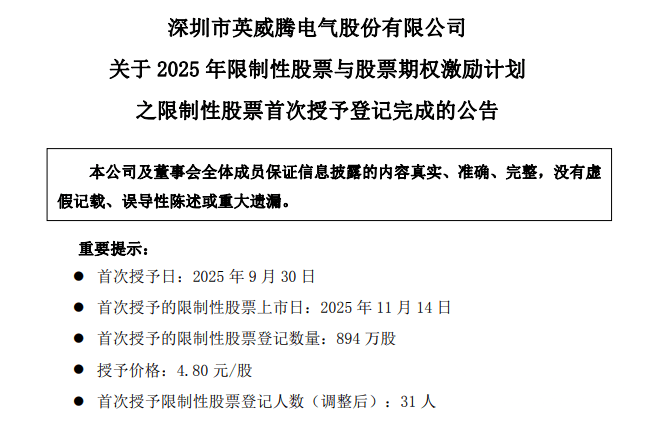
英威腾894万股限制股完成授予登记 11月14日上市
Sou Hu Cai Jing· 2025-11-13 09:05
Core Points - The company completed the initial grant registration of the 2025 restricted stock and stock option incentive plan, with the initial grant date set for September 30, 2025, and the listing date for the restricted stock on November 14, 2025 [1][3] - A total of 8.94 million shares were granted at a price of 4.8 yuan per share, with 31 individuals receiving the grants [1][3] - The initial grant of restricted stock represents 1.10% of the company's total share capital of 814 million shares at the time of the incentive plan announcement [3] Adjustments to the Incentive Plan - The board approved adjustments to the incentive plan, reducing the number of recipients from 238 to 224 due to the voluntary forfeiture of 56,000 stock options by some recipients [3] - The total number of restricted shares granted remains at 10 million, with 9.06 million shares initially granted and 940,000 shares reserved [3] - The total number of stock options granted was adjusted to 9.944 million, with 9.214 million options initially granted and the reserved quantity unchanged [3] Company Overview - The company specializes in providing solutions in industrial automation and energy power sectors, focusing on energy conservation, intelligent manufacturing, artificial intelligence, and digitalization [4] - Its business segments include industrial automation, network energy, new energy vehicles, and photovoltaic energy storage, offering products such as inverters, servo systems, and UPS power supplies [4] - For the first three quarters of 2025, the company reported revenue of 3.108 billion yuan and a net profit attributable to shareholders of 148 million yuan [4]


中金 | 深度布局“十五五”:科技硬件篇
中金点睛· 2025-11-12 23:26
Core Viewpoint - The article emphasizes the importance of domestic substitution in the semiconductor industry, particularly in the context of AI technology and the "14th Five-Year Plan" and "15th Five-Year Plan" for China's technological self-reliance and innovation [2][4][12]. Semiconductor Industry - The "14th Five-Year Plan" sets higher requirements for technological self-reliance, with a focus on AI chips as essential infrastructure for generative AI development [2]. - Domestic companies are increasingly achieving performance parity with overseas products in cloud AI chips, indicating a promising growth trajectory for the domestic cloud AI chip industry [2]. - In the edge AI chip sector, Chinese firms have reached global leadership in certain low-power scenarios, suggesting rapid deployment opportunities [2]. - The domestic semiconductor industry is witnessing a shift towards local production due to geopolitical changes and supply chain restructuring, with an expected increase in advanced process capacity during the "15th Five-Year Plan" [4][6]. - The demand for advanced packaging will rise alongside the production of advanced process chips, necessitating upgrades in packaging technology to meet performance requirements [5][6]. Consumer Electronics - China has become a global manufacturing hub for consumer electronics, with smartphone exports projected to reach 814 million units in 2024, accounting for 66% of global shipments [8]. - The consumer electronics sector is experiencing a dual trend of geopolitical uncertainty and rapid AI development, with AI-enabled products expected to drive growth by 2026 [8][9]. - The "15th Five-Year Plan" aims to promote the digital transformation of manufacturing, emphasizing the integration of AI in operations and production processes [8][9]. ICT Equipment - China has established a leading position in digital infrastructure, with over 4.5 million 5G base stations and significant growth in computing power centers [11][12]. - The digital economy is projected to contribute 10.4% to GDP by 2024, reflecting a shift towards a more technology-driven economic model [11][12]. - The "15th Five-Year Plan" will focus on advancing digital technologies, including AI, to enhance productivity and economic growth [12][13]. Future Outlook - The semiconductor industry is expected to benefit from increased domestic production capabilities and technological advancements, particularly in logic and storage chips [6][7]. - The EDA (Electronic Design Automation) market in China is gradually improving, with domestic companies gaining market share despite historically low localization rates [7]. - The upcoming "15th Five-Year Plan" will prioritize the development of AI infrastructure and the integration of AI across various sectors, positioning it as a key driver of future economic growth [16].

“十五五”规划分析及产业投资机遇展望
Ping An Securities· 2025-11-12 10:27
Group 1: Economic Strategy - The "15th Five-Year Plan" emphasizes economic construction as the core focus, aiming to build a modern industrial system centered on advanced manufacturing[9] - Key industrial development lines include "hard technology," advanced manufacturing, domestic circulation, and energy resource security[3] - The plan aims to create a market space of 10 trillion yuan by optimizing traditional industries and fostering emerging sectors over the next five years[8] Group 2: Hard Technology and Advanced Manufacturing - The plan highlights the importance of original innovation and key core technology breakthroughs, particularly in AI and digital technologies[12] - The automotive industry is expected to see accelerated commercialization of L3/L4 autonomous driving technologies during the "15th Five-Year Plan" period[34] - The focus on advanced manufacturing aims to enhance the global competitiveness of traditional industries like chemicals and machinery, with a push towards smart and green manufacturing[8] Group 3: Domestic Circulation and Consumption - The plan stresses the need to boost consumption and expand effective investment, particularly in the real estate sector, to support high-quality development[3] - The "anti-involution" policy is expected to improve the operational environment for construction materials and consumer goods, benefiting companies in these sectors[3] Group 4: Resource Security - The plan calls for strengthening the exploration and development of strategic mineral resources, particularly rare earths, to enhance their strategic importance[3] - It emphasizes the need for a new energy system, focusing on clean and efficient utilization of fossil energy while promoting renewable energy sources[3] Group 5: Market Outlook and Risks - The equity market is expected to maintain high volatility, with a focus on sectors benefiting from industrial recovery and performance superiority[3] - Key risks include macroeconomic fluctuations, lower-than-expected corporate profit growth, and geopolitical uncertainties[3]
政务服务加“数”群众体验提升
Liao Ning Ri Bao· 2025-11-12 00:59
Group 1 - The core viewpoint emphasizes the significant improvements in efficiency and convenience of government services through digital transformation, allowing for online submissions and rapid processing of applications [1][2][3] - The integrated government service platform in the province offers 120,000 online services and has processed 340 million various business transactions [2] - The "Liaoning Digital People's Congress Platform" consolidates information from over 70,000 representatives, enabling a fully online process for proposals and feedback [2] Group 2 - The "Liaoning Digital Government" initiative aims to enhance data sharing, process optimization, and collaborative management to improve service levels for enterprises and citizens [3] - The "Liaoning Enterprise Pass" provides over 1,100 "no application required" policies to benefit businesses, while the "Liaoning Service Pass" offers 3,550 high-frequency services [2] - The city of Shenyang has implemented a comprehensive urban safety risk monitoring and early warning platform, integrating real-time data from over 20 departments, processing more than 16 million data entries daily [2]
网络强国建设要以法治筑基丨法经兵言
Di Yi Cai Jing· 2025-11-11 12:13
Group 1: Core Perspectives - The rule of law serves as the foundation for digital development and a driving force for building a strong nation, playing a crucial role in guiding, regulating, and ensuring the digital transformation across various fields [1][2] - The 2025 World Internet Conference highlighted China's global governance proposals and the fundamental role of network rule of law in achieving a secure and inclusive digital future [1][8] Group 2: Legislative Framework - China has established a legal framework in network security, data protection, and technological innovation, providing solid institutional support for building a network rule of law [2][3] - The revised Cybersecurity Law, effective this year, introduces provisions for artificial intelligence, emphasizing the dual focus on development and security, and enhancing legal responsibilities for network security protection [2][4] Group 3: Implementation and Standards - The implementation of the Network Data Security Management Regulations has set a series of requirements for network activities, supported by 69 national standards to ensure compliance and security [4][5] - A comprehensive network rule of law system has been formed, ensuring that there are laws to follow in the digital space, which is crucial for accelerating the deployment of data resources and fostering innovation in emerging technologies [2][4] Group 4: Economic Innovation and Development - The rule of law empowers innovation and development, transforming institutional dividends into development momentum, with significant achievements in network infrastructure, artificial intelligence, and digital applications over the past decade [5][6] - The deployment of IPv6 has seen remarkable success, with active users reaching 865 million by September 2025, a 294-fold increase since 2017, positioning China as a leader in network scale and user base [6] Group 5: Global Governance and Cooperation - China advocates for a collaborative approach to global network governance, emphasizing the principles of security and development, and actively participates in international rule-making [8][9] - The revised Cybersecurity Law expands its applicability to include activities that threaten China's network security, enhancing deterrence against cross-border cyberattacks [8][9] Group 6: Future Directions - Moving forward, China aims to deepen the reform of cyberspace, enhance the legal framework for the digital economy, and strengthen national security capabilities in key areas such as artificial intelligence [9][10]
共同把握信息革命发展的历史主动(和音)
Ren Min Ri Bao· 2025-11-09 22:20
Core Viewpoint - China is a beneficiary of global internet development and a contributor to international cyberspace peace, emphasizing the importance of building a community with a shared future in cyberspace, a concept proposed by President Xi Jinping ten years ago [1][3]. Group 1: Achievements and Initiatives - The World Internet Conference has become a platform for gathering global wisdom and consensus, showcasing innovative technologies such as autonomous vehicles and AI solutions, with 17 projects awarded for leading technology [2]. - Over 210 institutions, organizations, and individuals from more than 40 countries and regions have become members of the World Internet Conference, expanding its influence and promoting global dialogue [2]. Group 2: China's Role in Global Internet Governance - China actively participates in the UN cybersecurity process and supports the UN's core role in global internet governance, leveraging its experience in mobile internet applications and digital payments to assist other countries [3]. - The concept of a community with a shared future in cyberspace emphasizes multilateral participation and respect for internet sovereignty, addressing the uneven distribution of resources and complex security threats in global cyberspace [4]. Group 3: Future Directions - Looking ahead, China aims to deepen the construction of a digital China and accelerate the development of a strong internet nation, providing more cooperation opportunities for global internet and digital economy development [3]. - China advocates for international cooperation to bridge the digital divide and enhance mutual development, exemplified by initiatives such as the "China-Africa Internet Enterprise Cooperation Network" and various forums [4].
聚焦服务国家大局 打造国际一流投行
Zhong Guo Zheng Quan Bao· 2025-11-09 20:15
Core Viewpoint - The securities industry must align its strengths with national strategies to achieve high-quality development, focusing on core competitiveness and comprehensive strength in the journey towards becoming a first-class investment bank [1][5]. Group 1: Key Strategies for High-Quality Development - Emphasizing high-level technological self-reliance to accelerate the construction of a modern industrial system, promoting a virtuous cycle of "technology-finance-industry" [2]. - Focusing on people-centered approaches to promote common prosperity, utilizing high-quality financial services to address income distribution issues [2]. - Expanding high-level openness to construct a new development pattern, ensuring mutual connectivity and institutional alignment in the financial sector [2]. - Leveraging digital China construction to empower high-quality development, enhancing data management and compliance to support real financing and trading needs [3]. Group 2: Financial Contributions to National Goals - The securities industry must excel in technology finance, having facilitated 58 quality enterprises to raise 45 billion yuan through IPOs this year, and issued 1,645 technology innovation bonds totaling 1.8 trillion yuan [3][4]. - Promoting inclusive finance by designing flexible financial tools for startups and small enterprises, while assisting residents in long-term asset allocation [4]. - Deepening digital finance to contribute to the construction of a financial powerhouse and digital China, emphasizing the need for digital transformation [4]. Group 3: Building a First-Class Investment Bank - Focusing on becoming a "value investment bank" by balancing functionality and profitability, integrating various financial services to enhance value creation [5][6]. - Committing to becoming a "smart investment bank" by advancing digital strategies and incorporating new technologies like AI and blockchain to improve decision-making and risk management [6]. - Aiming to establish a "new quality investment bank" by innovating business models and enhancing competitiveness in the market [6].
