人工智能(AI)

Search documents
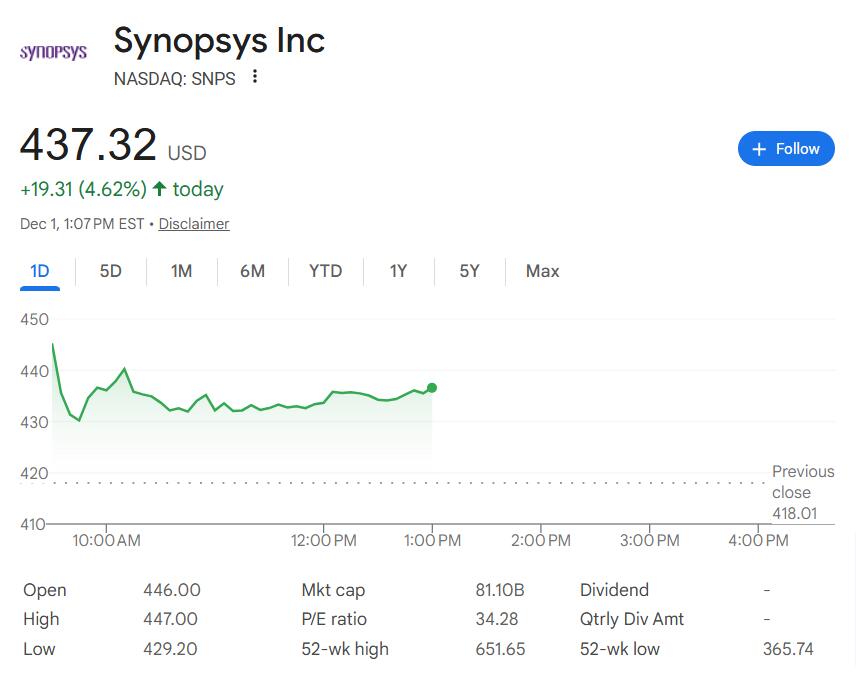
大涨4.85%!英伟达砸20亿入股EDA巨头新思科技,黄仁勋盛赞“巨大扩展机遇”、否认类似OpenAI交易闭环
美股IPO· 2025-12-01 22:29
Core Viewpoint - Nvidia's strategic investment of $2 billion in Synopsys marks a significant partnership aimed at integrating AI technology into industrial design and engineering, presenting a vast market opportunity beyond consumer AI applications [1][5][10]. Investment Details - Nvidia will acquire approximately 4.8 million shares of Synopsys at a price of $414.79 per share, representing a 0.8% discount from the previous closing price [6]. - This investment will make Nvidia the seventh largest shareholder in Synopsys, holding a 2.6% stake [5][6]. Strategic Significance - The partnership is described as a transformative move for the design and engineering sectors, leveraging Nvidia's GPU acceleration to enhance Synopsys' software tools used in chip design and verification [10][11]. - Nvidia's CEO highlighted the potential market size, indicating that industrial companies spend significantly on engineering software tools, with prototyping costs potentially being 10 to 20 times higher [10]. Collaboration Scope - The collaboration will involve using Nvidia's CUDA-X libraries and AI technologies to optimize Synopsys' computational applications across various domains, including chip design and physical verification [8]. - Both companies will work on digital twin technologies to enable advanced virtual design and testing across multiple industries [8]. Non-Exclusivity of Partnership - The partnership is non-exclusive, allowing Synopsys to continue collaborating with other semiconductor manufacturers, which differentiates it from Nvidia's previous investments like OpenAI [9][13]. - This arrangement is seen as an expansion of the technology ecosystem rather than a closed commercial loop, enhancing Nvidia's influence in the EDA market [14].



英伟达砸20亿入股EDA巨头新思科技,黄仁勋盛赞“巨大扩展机遇”、否认类似OpenAI交易闭环
Hua Er Jie Jian Wen· 2025-12-01 19:25
Core Insights - Nvidia announced a strategic partnership with Synopsys, investing $2 billion to acquire a 2.6% stake, marking a significant move into the industrial design and engineering sectors [1][3][4] - The collaboration aims to integrate Nvidia's AI computing technology into the electronic design automation (EDA) field, transforming the design process from chips to systems [1][3] - Nvidia's CEO Jensen Huang emphasized the partnership's potential to tap into a trillion-dollar industrial market, far exceeding the consumer AI application space [3][7] Investment Details - Nvidia purchased approximately 4.8 million shares of Synopsys at $414.79 per share, reflecting a 0.8% discount from the previous closing price [4] - The investment positions Nvidia as Synopsys' seventh-largest shareholder, enhancing its influence in the semiconductor design software market [3][4] Strategic Collaboration - The partnership encompasses a multi-year collaboration that includes using Nvidia's CUDA-X libraries and AI physics technology to optimize Synopsys' computational applications [6] - Both companies will work on integrating Synopsys' AgentEngineer technology with Nvidia's AI technology stack to enhance EDA and simulation workflows [6] - The collaboration aims to develop advanced digital twin solutions for various industries, leveraging Nvidia's Omniverse and Cosmos technologies [6] Market Impact - Following the announcement, Synopsys' stock surged over 6.9% in early trading, while Nvidia's stock initially dipped but later rose by nearly 1.9% [1] - Huang highlighted the significant market opportunity in industrial applications, noting that spending on engineering software tools could be several billion dollars, with prototyping costs potentially 10 to 20 times higher [7] Industry Transformation - Huang described the partnership as a revolutionary shift in the design and engineering industry, moving from traditional CPU-based systems to GPU-accelerated solutions [8] - The collaboration is seen as a non-exclusive arrangement, allowing other chip manufacturers to benefit, distinguishing it from Nvidia's previous investments in AI that raised concerns about market monopolization [9][10]

'Worse Than Being Ghosted.' Job Seekers Slam Silent Hiring Freezes as Federal Reserve Says AI Now Replacing Entry-Level Jobs Across the U.S.
Yahoo Finance· 2025-12-01 16:00
Core Insights - Companies are implementing hiring freezes, even after verbal job offers have been made, leading to increased frustration among job seekers [2][3] - The Federal Reserve's Beige Book indicates a slight decline in employment, with about half of the districts reporting weaker labor demand and explicit mentions of hiring freezes [4] - Employers are showing greater risk aversion, resulting in layoffs and an influx of overqualified applicants for limited job openings [5] Employment Trends - Hiring freezes are part of broader strategies including "replacement-only hiring," attrition, and reduced hours [4] - Companies are focusing on upskilling current employees rather than expanding headcount, although this training often does not lead to promotions or pay increases [6] - Workers are less likely to leave their current jobs due to the tighter job market, reflecting a cautious approach amid uncertainty [6]
“哭着清仓英伟达”
中国基金报· 2025-12-01 15:39
Core Viewpoint - SoftBank's founder Masayoshi Son expressed that the decision to sell all Nvidia shares was driven by the need to raise funds for AI investments, particularly in OpenAI, rather than a belief in an AI investment bubble [2][4]. Group 1: Sale of Nvidia Shares - SoftBank sold its entire stake in Nvidia, amounting to approximately 32.1 million shares, for a total value of about $5.83 billion [6]. - The sale occurred amid rising concerns in the market regarding AI investments, which triggered a chain reaction in the market [5]. - Son stated that he would not have sold Nvidia shares if the company had "unlimited money" for AI investments, indicating a strong desire to retain the investment [2][4]. Group 2: AI Investment Strategy - SoftBank is significantly increasing its AI-related investments, including partnerships for building data centers and acquiring companies like Ampere Computing [4]. - Son countered claims of an AI investment bubble by asserting that AI could generate returns equivalent to 10% of global GDP in the long term, making substantial investments worthwhile [4]. - The company plans to further increase its investment in OpenAI by the end of the year [4]. Group 3: Historical Context and Financial Impact - SoftBank initially invested $4 billion in Nvidia in 2017, acquiring nearly 5% of the company, but sold its shares in 2019, missing out on Nvidia's market value surge from $100 billion to $4 trillion [5]. - The recent sale of Nvidia shares was part of a broader strategy to fund new projects, including data center construction [2][5].


李彦宏挂帅、换将、裁员:百亿亏损下,百度这剂“猛药”管用吗?
Sou Hu Cai Jing· 2025-12-01 15:37
Core Insights - Baidu is undergoing significant turmoil and crisis, highlighted by a sudden organizational restructuring that reveals deep internal chaos and helplessness [1] - The establishment of new research departments indicates a shift in strategy but also shows the loss of core command by former CTO Wang Haifeng, reflecting Baidu's confusion in its AI transformation journey [3] Group 1: Organizational Changes - The new foundational and application model research departments report directly to CEO Li Yanhong, indicating a strategic pivot towards AI, yet this move underscores Baidu's lack of direction in this critical area [3] - A large-scale layoff has been initiated, affecting various departments with cuts ranging from 10% to 30%, creating an atmosphere of uncertainty among employees [3] Group 2: Financial Performance - Baidu reported a quarterly revenue of 31.2 billion yuan, a year-on-year decline of 7%, marking the largest drop in its history, alongside a net loss of 11.2 billion yuan compared to a profit of 7.6 billion yuan in the same period last year [3] - The online marketing business, a core revenue stream, saw a revenue drop of 3.5 billion yuan, down 18% year-on-year, continuing a six-quarter decline [3][4] Group 3: Strategic Missteps - Baidu's failure to anticipate AI development trends led to premature obsolescence of some infrastructure assets, resulting in a long-term asset impairment of 16.2 billion yuan this quarter [3] - Despite growth in AI cloud and related new businesses, these gains have not compensated for the decline in traditional business, indicating a struggle to seize market opportunities [4] Group 4: Talent and Culture Issues - Over the past two years, more than ten vice president-level executives have left Baidu, highlighting a concerning talent drain that threatens the company's innovation and competitiveness [5] - Internal reflections by CEO Li Yanhong on organizational culture reveal issues of focus and cohesion, suggesting that Baidu's lack of a unified and dynamic team hampers its ability to compete effectively [5]


哭着清仓英伟达
Zhong Guo Ji Jin Bao· 2025-12-01 15:19
Core Viewpoint - SoftBank's founder Masayoshi Son stated that the company sold its entire stake in Nvidia to raise funds for AI investments, emphasizing that he would not have sold if there were "unlimited funds" available for such investments [1][2]. Group 1: Reasons for Selling Nvidia Shares - SoftBank sold its entire Nvidia stake, amounting to approximately 32.1 million shares, for a total value of about $5.83 billion [4]. - The sale was primarily driven by the need to raise capital for projects such as data center construction and investments in OpenAI [1][2]. - Son expressed regret over the sale, indicating that he was "crying" while selling the shares, highlighting the emotional weight of the decision [1]. Group 2: AI Investment Perspective - Son refuted claims of an "AI investment bubble," arguing that AI could generate returns equivalent to 10% of global GDP in the long term, making substantial investments worthwhile [2]. - He criticized those who believe in an AI bubble, suggesting they lack understanding of the potential of AI [2]. - SoftBank has significantly increased its AI-related investments, including partnerships for data center development and acquisitions in the semiconductor sector [1]. Group 3: Historical Context of Nvidia Investment - SoftBank initially invested $4 billion in Nvidia in 2017, acquiring nearly 5% of the company [2]. - The company sold its Nvidia shares in 2019, missing out on the stock's rise from a market cap of $100 billion to $4 trillion [2]. - After a period of reduced investment, SoftBank re-established its position in Nvidia, increasing its holdings from $1 billion in Q4 of last year to approximately $3 billion in Q1 of this year [3].
专访野村亚洲及印度首席经济学家:中国东盟数字经济合作将加速
2 1 Shi Ji Jing Ji Bao Dao· 2025-12-01 12:07
Core Insights - Southeast Asian exporters are increasing prices for goods exported to the U.S., transferring some cost pressures to American consumers [1] - The U.N. Development Programme predicts a potential 9.7% decline in Southeast Asia's total exports to the U.S. due to tariff-induced price increases [1] - Despite U.S. tariff pressures, Southeast Asian economies are showing resilience, with many countries diversifying their markets away from the U.S. [1][4] Trade Agreements and Economic Cooperation - The signing of the upgraded China-ASEAN Free Trade Area 3.0 agreement is expected to enhance cooperation in emerging fields, particularly in the digital economy [2] - Southeast Asian countries are seeking to diversify their exports and move from low-tech manufacturing to higher value-added sectors, leveraging China's technological expertise [2][6] Market Dynamics and Export Trends - The U.S. tariff policy is expected to create competitive pressures within Asian economies, leading to potential "hidden reforms" as countries strive to enhance competitiveness [3][4] - Vietnam may experience a significant potential decline of 19.2% in exports to the U.S., which is double the average decline expected for Southeast Asia [3] Regional Economic Integration - The CAFTA 3.0 upgrade is anticipated to facilitate supply chain upgrades and enhance regional economic integration, focusing on high-tech manufacturing [6] - The internal consumption in Asian countries is expected to grow, leading to increased intra-regional trade, particularly in intermediate products [5] Monetary Policy and Economic Outlook - Southeast Asian central banks may gain more policy flexibility as U.S. interest rates decline, allowing them to focus on domestic economic factors [7] - Countries like Thailand may face unique challenges, including potential deflationary risks, while most Southeast Asian nations maintain positive inflation rates [8] Stock Market Performance and Investment Climate - Southeast Asian stock markets are struggling to attract foreign investment, partly due to a lack of AI-related themes and concerns over export slowdowns [9][10] - Structural reforms in the region aim to enhance market liquidity and transparency, potentially improving the attractiveness of Southeast Asian markets for foreign investors [11] Economic Resilience and Future Prospects - Despite challenges, Southeast Asian economies are expected to demonstrate resilience, with a focus on technology-driven growth and structural reforms [13] - Malaysia is highlighted as a strong performer due to robust domestic demand and infrastructure investments, while Singapore continues to benefit from its tech sector [10][11]
从EDA For AI,到EDA+AI,重构智能设计的未来
半导体芯闻· 2025-12-01 10:29
Core Insights - The article discusses the transformative impact of AI on the semiconductor and EDA (Electronic Design Automation) industries, highlighting a shift from chip-centric designs to system-level integration [1][2][3] Group 1: AI and EDA Evolution - The AI-driven era is characterized by a transition from perception AI to physical AI, necessitating a significant increase in computational power and innovative design paradigms [1] - The focus has shifted from individual chips to integrated systems, where multiple GPUs, CPUs, and memory units work together as a "super computing unit" [2] - The stagnation of Moore's Law and Dennard scaling has led to a need for collaborative innovation across various dimensions, including computation, interconnect, storage, and packaging [3] Group 2: EDA Industry Response - Major EDA companies are accelerating their transformation through acquisitions, such as Synopsys acquiring Ansys and Cadence acquiring BETA CAE Systems, to create a complete design chain from chip to system [4] - The domestic EDA company, Xpeedic, is positioning itself as a pioneer in the "chip-system" transformation, launching its "EDA For AI" strategy in 2025 [4][5] - Xpeedic has developed three core platforms aimed at supporting AI hardware design, addressing challenges in power, storage, and cooling [5] Group 3: AI Integration in EDA - AI is revolutionizing the EDA industry by optimizing design processes and enhancing productivity, allowing engineers to focus on innovation rather than repetitive tasks [7][8] - Xpeedic's "EDA+AI" initiative aims to leverage AI to improve design efficiency and accuracy, transitioning from rule-driven to data-driven design methodologies [7][9] - The integration of AI into EDA tools enables rapid exploration of design variables, facilitating the design of heterogeneous integrated systems [8] Group 4: Future of AI and EDA - The emergence of Physical AI presents new challenges for designers, requiring system-level collaboration and real-time decision-making [10] - Xpeedic anticipates that the market potential of Physical AI will provide a larger platform for its multi-physical simulation engine technology [10][11] - The article concludes that the future of AI in EDA will be shaped by a continuous feedback loop, where AI-driven technologies will further enhance AI capabilities [11]
观察| 你的孩子,正在被AI悄悄“分层”
未可知人工智能研究院· 2025-12-01 03:01
▲ 戳蓝 色字关注我们! 我们致力于工具的精良, 却忽略了工具的用途。 —— 尼尔 · 波兹曼 还在瞎操心农村孩子用不上AI?快别自作多情了! 中国青少年研究中心调研了全国8563个中小学生,数据一出来直接打脸: 城市娃用 AI 的占 63.7% ,农村娃也有 60.2%—— 没有显著差距 。 更让人惊掉下巴的是,女生用AI的比例(64.2%)居然比男生(59.2%)还高,谁说只有男生爱捣鼓这些? 真相一 这哪是什么数字鸿沟啊?分明是AI把城乡、性别这些老掉牙的标签全撕了。 但先别忙着欢呼"技术平权",这种无差别渗透根本不是什么福音,就是场藏在屏幕后的"认知绑架"。 以前农村孩子缺电脑没办法,现在好了,手机揣兜里AI随叫随到,可问题是——他们拿AI干了啥?是真用来学东西,还是纯粹当偷懒工具? 这种看不见的差距,比"有没有"可怕多了! AI 成了 " 作业外挂 " ,孩子连脑都懒得动了? 家里有中小学生的家长,随便拉一个出来都能吐槽"AI写作业"这事儿。 调研说71%的孩子用AI查资料、找思路,听着还行?可再看那16.8%的孩子——直接把题目往AI里一扔,等着要答案!这不就是换了个高科技壳子 的"抄作业"吗?连 ...
硅光取代铜缆?
半导体行业观察· 2025-12-01 01:27
Core Viewpoint - The article discusses the growing application of silicon photonics technology as a potential replacement for copper wire in data transmission, particularly in data centers, while highlighting the current limitations and future prospects of this technology [1][2]. Group 1: Current State of Transmission Technologies - Currently, silicon photonics is primarily used for long-distance transmission in data centers, while copper wire is still dominant for medium and short distances due to its high speed of up to 200 Gbit per second [1][2]. - The advancements in copper wire technology have exceeded initial expectations, achieving speeds of 200 Gbit per second, which matches the current capabilities of silicon photonics [1][2]. Group 2: Advantages and Future Developments of Silicon Photonics - Silicon photonics has the potential for significant cost reductions and efficiency improvements in the future, especially as technology advances [2]. - Future developments aim to integrate optical engines directly with switch chips on the same substrate, potentially allowing for transmission speeds of up to 400 Gbit per second per fiber [2]. - The integration of multiple optical engines could lead to a total transmission capacity of 25.6 terabits per second, significantly enhancing data transfer capabilities [2]. Group 3: Challenges and Market Dynamics - Despite the advantages of silicon photonics, challenges remain in terms of production costs and the complexity of integrating optical components, which currently limits its market share compared to copper wire [2]. - The co-packaged optics (CPO) industry is highlighted as a part of the silicon photonics manufacturing process, with many Taiwanese manufacturers focusing on contract manufacturing and backend processes [2]. Group 4: Industry Context and Demand - The demand for data transmission is rapidly increasing, driven by the explosion of generative AI and the need for higher computational power, which exposes the limitations of traditional copper wire [5][6]. - Data centers are projected to consume vast amounts of electricity, with the energy demands potentially increasing twentyfold, underscoring the need for more efficient transmission technologies [6].