AI泡沫

Search documents
多家企业盯上谷歌 Chrome 奥特曼表态 OpenAI 或考虑收购
Huan Qiu Wang Zi Xun· 2025-08-17 02:55
Group 1 - OpenAI's CEO Sam Altman expressed interest in acquiring Google's Chrome browser, which has attracted significant attention in the industry [1][3] - ChatGPT's user growth is rapid, with over 700 million users reached weekly, a fourfold increase from a year ago, and API traffic doubling within 48 hours [1][3] - OpenAI plans to invest in a brain-computer interface startup to compete with Neuralink and anticipates spending trillions on data center construction to meet computational demands [3] Group 2 - Altman acknowledged the existence of an "AI bubble," indicating that investors are overly excited about the AI sector, but he emphasized that AI remains one of the most significant technological transformations in recent years [3] - The U.S. Department of Justice is pursuing antitrust litigation against Google, which includes demands related to the potential divestiture of the Chrome browser, influencing other tech companies' interest in Chrome [3] - Altman suggested that he may not be suitable to lead a publicly traded company and hinted that AI could potentially take over leadership of OpenAI in three years [3]


AI周报 | OpenAI CEO承认存在 AI 泡沫;消息人士称DeepSeek R2在8月无发布计划
Di Yi Cai Jing· 2025-08-17 00:32
Group 1 - OpenAI CEO Sam Altman acknowledges the existence of an AI bubble, comparing it to the internet bubble of the 1990s, predicting significant losses for some and substantial gains for others [1] - The AI market has seen a surge in funding for startups, with some companies receiving high valuations despite minimal resources [1] - OpenAI plans to invest tens of billions in data center construction in the near future [1] Group 2 - DeepSeek R2 is not scheduled for release in August, despite market rumors, leading to a temporary surge in AI-related stocks [2][3] - The anticipation for DeepSeek R2 has been building, especially after the release of GPT-5, with expectations of strong competition in the domestic large model market [3] Group 3 - Mihayou co-founder Cai Haoyu's AI game "Whispers from the Star" is priced at 27.19 yuan, indicating a focus on innovation rather than profit [4] - The game introduces a new genre called FPT (First-person Talker), emphasizing real-time dialogue driven by AI [4] Group 4 - Igor Babuschkin, co-founder of xAI, is leaving to start his own venture capital firm after contributing to the development of significant AI technologies [5][6] - xAI's original team has decreased from 12 to 9 members following Babuschkin's departure [6] Group 5 - Tencent's stock reached 600 HKD per share, the highest in four years, following a strong earnings report driven by AI-related business growth [7] - Tencent's revenue for Q2 2025 was 184.5 billion yuan, a 15% year-on-year increase, with AI contributing to improvements in marketing and enterprise services [7] Group 6 - Google highlights the role of Chinese developers as key players in global innovation, with numerous awards for their applications and games [8] - The focus of the Google Developer Conference has shifted towards AI, reflecting the growing enthusiasm among developers [8] Group 7 - Apple plans to re-enter the AI space with new devices, including a desktop robot, expected to launch by 2027 [9] - The company is working on enhancing Siri's capabilities to support these new products [9] Group 8 - OpenAI is preparing to invest in Merge Labs, a brain-computer interface company, with a valuation of 850 million USD and a funding round of 250 million USD [10][11] - Merge Labs aims to compete with Neuralink in the brain-computer interface sector [11] Group 9 - Baichuan Intelligence has released the open-source medical model Baichuan-M2, outperforming other models in health benchmarks [12] - The medical field is a significant application area for large models, with various companies exploring AI's role in healthcare [12] Group 10 - xAI has made its Grok 4 model available for free to users, introducing new usage modes and limited daily queries [13] - The competition between OpenAI and xAI has intensified following the release of GPT-5 [13]

AI泡沫真相?OpenAI奥尔特曼:确有其事,有人将损失惨重
Sou Hu Cai Jing· 2025-08-16 03:11
Group 1 - The core viewpoint is that the current market for AI technology may be experiencing an over-optimistic phase, reminiscent of the internet bubble in the late 1990s [1][3] - OpenAI's CEO, Sam Altman, describes the financing situation for AI startups as "crazy," indicating that some companies are receiving high valuations based on minimal resources [1][3] - Altman expresses confidence in OpenAI's future, stating that the company plans to invest trillions of dollars in data center construction, which he believes will not hinder its stable development [3] Group 2 - Several AI startups have successfully raised significant funds over the past year, including Safe Superintelligence and Thinking Machines, which are led by notable figures in the AI field [3] - Altman warns that while some individuals may profit during a bubble, others may suffer substantial losses, but he suggests that the overall economic impact could be beneficial [3]

OpenAI 奥尔特曼承认存在 AI 泡沫
Sou Hu Cai Jing· 2025-08-15 15:02
Group 1 - The core viewpoint is that the current excitement around AI may indicate a potential bubble, similar to the internet bubble of the late 1990s [1][3] - OpenAI's CEO, Sam Altman, compares the market's reaction to AI with the internet bubble, noting that smart individuals often become overly excited about a core truth, leading to irrational valuations [3] - Altman describes the current funding environment for AI startups as "crazy," highlighting that some startups with minimal teams and just an idea are receiving high valuations, which he believes is not rational [3] Group 2 - Several AI startups have raised significant funds in the past year, including Safe Superintelligence and Thinking Machines, indicating a trend of substantial investment in the sector [3] - Altman expresses confidence in OpenAI's future, stating that the company plans to invest trillions of dollars in data center construction, suggesting resilience against a potential bubble burst [4]

格林大华期货早盘提示-20250813
Ge Lin Qi Huo· 2025-08-12 23:30
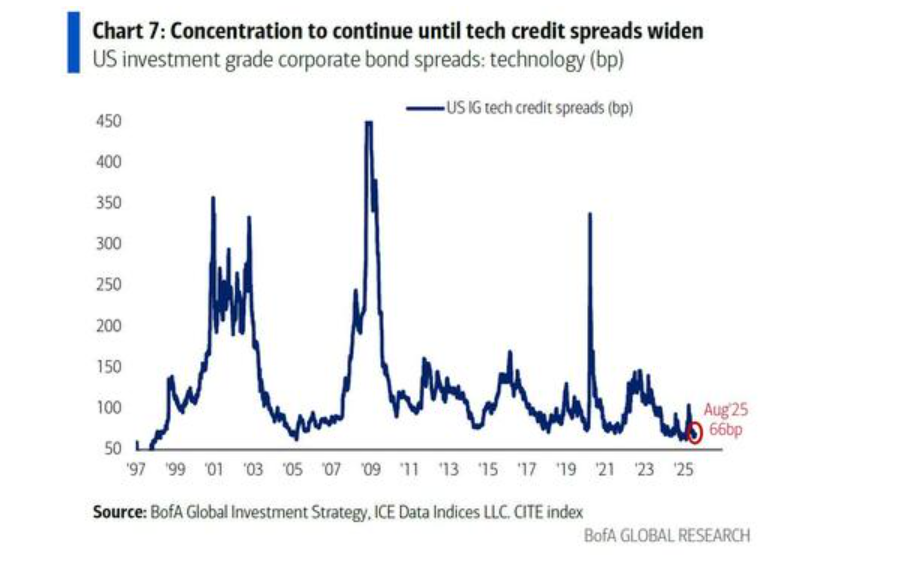
Report Summary Report Industry Investment Rating - Global economy in the macro and financial sector is rated as (Bullish) [1] Core Viewpoints - The Chinese humanoid robot industry is rapidly iterating products, with clear commercialization paths and strong potential demand in consumer - grade markets [1] - AI is creating wealth at an unprecedented pace and scale, with numerous high - value "unicorn" companies globally [1] - Nvidia has launched world models, application libraries and infrastructure for robot developers, with Cosmos Reason enabling robots to "reason like humans" [1] - The real test of an AI bubble burst is the credit spread of tech companies, and a widening spread may signal a crash [1] - The US market is facing stagflation risks, and it is recommended to short 10 - year US Treasury bonds [1] - The Chinese market is a value -洼地 favored by analysts [1] - Younger US stock retail investors are more risk - taking and less likely to panic - sell [1] - The global economy maintains an upward trend [1][2] Key Information from Different Perspectives Industry Trends - The Chinese humanoid robot industry is experiencing rapid product iteration, and its overall performance has significantly improved in just a few months [1] - AI is creating wealth on a large scale, with 498 AI "unicorn" companies valued over $10 billion globally, worth a total of $2.7 trillion, including 100 founded in 2023 or later, and over 1300 valued over $100 million [1] - Nvidia has introduced a series of products for robot developers, including the notable Cosmos Reason model [1] Market Risks and Opportunities - The credit spread of tech companies is the key indicator for an AI bubble burst [1] - The US market faces stagflation risks due to supply - side shocks [1] - The Chinese market is regarded as a value -洼地 and an attractive investment target [1] Economic Data and Policies - China's exports in July increased by 7.2%, and Sino - US reciprocal tariffs were extended for 90 days [1] - Maersk's Q2 performance exceeded expectations, with strong import growth in Europe, Latin America, West Asia, Central Asia and Africa offsetting the decline in North American imports [1] - The US Bureau of Statistics significantly revised down non - farm payroll data, and the market expects the Fed to cut interest rates by 50 basis points in September and accelerate rate cuts in 2026 [1] - China is comprehensively rectifying involution - style competition, which is expected to boost the performance of relevant listed companies [1] - The European Central Bank has cut interest rates 8 times, and Germany is expanding its military by 30%, which is expected to drive European economic growth [1]
AI泡沫何时破灭?美银Hartnett建议紧盯这个关键指标
硬AI· 2025-08-12 03:16
Core Viewpoint - The core warning from Bank of America strategist Michael Hartnett is that the true test of the AI bubble's potential collapse lies not in stock prices but in the credit spreads of technology companies. A widening spread would indicate that massive cash consumption for investments is unsustainable, signaling a potential market crash [2][3][7]. Group 1: AI Bubble and Market Dynamics - The current AI-driven bull market is characterized by significant capital expenditures, with a projected $2.9 trillion in AI-related capital spending by 2028 [5]. - Hartnett draws parallels to the 1999 internet bubble, where a similar widening of credit spreads preceded a market crash [7]. - The market's rebound is highly concentrated, with the "Magnificent Seven" tech companies contributing 80% of the S&P 500's returns since April [9]. Group 2: Labor Market Impact - The impact of AI on the labor market is becoming evident, with the unemployment rate for U.S. college graduates rising from 4.0% in December 2023 to 8.1% [9]. Group 3: Investor Sentiment and Indicators - Despite underlying risks, investor sentiment remains overly optimistic, with 60% expecting a "Goldilocks" scenario of falling interest rates and rising stock prices, while zero expect deflation [13]. - Hartnett identifies a "zero expectation" as a contrarian signal, indicating potential market vulnerability [14]. - Three sell signals from fund manager surveys suggest that a drop in expected economic "hard landing" probabilities could foreshadow a market pullback [15]. Group 4: Investment Opportunities - Hartnett highlights China as an attractive investment opportunity, citing factors such as being overlooked, peak tariffs, consumption stimulus, and record trade surpluses [19]. - The report also maintains a bullish long-term outlook on gold, driven by inflationary pressures, geopolitical isolation, and expectations of central banks reassessing gold reserves [20].

AI泡沫何时破灭?美银Hartnett建议紧盯这个关键指标
美股IPO· 2025-08-11 14:30
Core Viewpoint - The core warning from Bank of America strategist Michael Hartnett is that the true test of the AI bubble's potential collapse lies not in stock prices but in the credit spreads of technology companies. A widening spread would indicate unsustainable cash consumption from massive investments, signaling a potential market crash [1][3]. Group 1: AI Bubble and Market Dynamics - The current AI-driven bull market is characterized by significant capital expenditures, with a projected $2.9 trillion in AI-related capital spending by 2028 [5]. - Hartnett draws parallels to the 1999 internet bubble, noting that a widening credit spread among tech companies preceded the market crash during that period [7]. - The market rebound since April has been highly concentrated, with the "Magnificent Seven" tech companies contributing 80% of the S&P 500's returns, amplifying specific sector risks [9]. Group 2: Labor Market and Economic Indicators - The impact of AI on the labor market is becoming evident, as the unemployment rate for U.S. college graduates surged from 4.0% in December 2023 to 8.1% [9]. - Investor sentiment is currently overly optimistic, with 60% expecting a "Goldilocks" scenario of falling interest rates and rising stock prices, while the probability of an economic "hard landing" has dropped to 5% or below [11][12]. Group 3: Investment Opportunities - Amid warnings about the AI bubble, Hartnett highlights the Chinese market as a favored investment opportunity, citing factors such as being overlooked, peak tariffs, consumption stimulus, and record trade surpluses [15]. - Hartnett maintains a bullish long-term outlook on gold, driven by inflationary pressures, geopolitical isolation, and expectations of central banks reassessing gold reserves to alleviate debt burdens [15].

AI泡沫何时破灭?美银Hartnett建议紧盯这个关键指标
Hua Er Jie Jian Wen· 2025-08-11 12:56
Core Viewpoint - The U.S. stock market is experiencing a strong rebound driven by a few tech giants amid growing concerns about a potential bubble, with a key indicator being the change in credit spreads within the tech sector [1][6]. Group 1: AI-Driven Market Dynamics - The current AI-driven bull market's main risk is not high stock prices but the substantial capital expenditures behind it, which could lead to sustainability issues if credit spreads begin to widen [1][2]. - Morgan Stanley estimates that AI-related capital expenditures could reach $2.9 trillion by 2028, indicating significant future investment in the sector [4]. Group 2: Market Concentration and Labor Impact - The rebound has shown extreme market concentration, with the "Magnificent Seven" tech companies contributing 80% of the S&P 500's returns since April, amplifying risks associated with specific sectors [7]. - The impact of AI on the labor market is becoming evident, with the unemployment rate for U.S. college graduates rising from 4.0% in December 2023 to 8.1%, suggesting disruptive effects from AI technology [9]. Group 3: Investor Sentiment and Contrarian Signals - Despite underlying risks, investor sentiment is extremely optimistic, with 60% expecting a "Goldilocks" scenario of falling interest rates and rising stock prices, while no investors anticipate a deflationary scenario [11]. - Hartnett highlights three potential sell signals from fund manager surveys that could indicate a short-term market pullback, emphasizing the need for caution [12]. Group 4: Alternative Investment Opportunities - Amid warnings about the AI bubble, the Chinese market is identified as a favored investment opportunity due to factors like being overlooked, peak tariffs, consumption stimulus, and record trade surpluses [13]. - Hartnett maintains a long-term bullish outlook on gold, citing factors such as geopolitical isolation, inflation, and expectations of central banks reassessing gold reserves to alleviate debt burdens [13]. Group 5: Cash Levels and Market Predictions - Investor expectations for a "hard landing" in the economy have dropped to 5% or below, with global equity allocations increasing from a net 4% to over 25% [14]. - The report notes that cash levels among investors have decreased from 3.9%, with historical data indicating that cash levels below 3.7% have often preceded stock market declines [14].
经济学家示警:AI 投资狂潮背后,已蒙上泡沫破裂阴影
Sou Hu Cai Jing· 2025-07-19 06:25
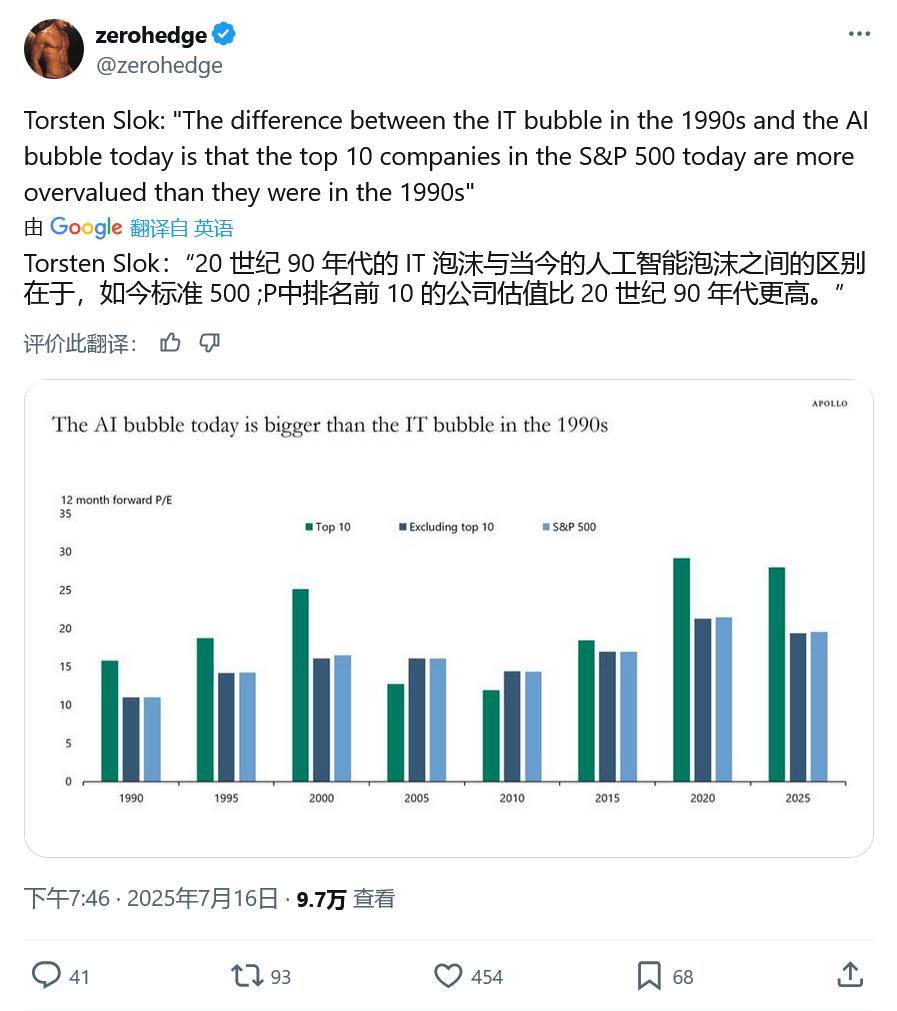
Core Viewpoint - Economist Torsten Sløk warns that the current AI bubble is larger than the early 2000s internet bubble, with many AI companies being significantly overvalued [1][4] Group 1: AI Bubble Comparison - Sløk compares the current AI bubble to the internet bubble, noting that the scale of overvaluation in AI companies is more severe [1] - The internet bubble saw massive investments leading to a market crash in the early 2000s, resulting in significant losses for many companies, including major players like Amazon [1] Group 2: Current AI Market Concerns - Major companies such as Apple, Microsoft, OpenAI, Meta, Google/Alphabet, and Amazon have seen their valuations and stock prices surge due to AI investments, which do not align with their actual profit potential [1] - Sløk indicates that the current AI market's prosperity is overshadowed by underlying concerns, as evidenced by Meta's high spending on talent and OpenAI's ambitious projects [4] Group 3: Investment Shifts - Meta's shift from investing hundreds of billions in the metaverse to focusing on AI highlights the volatility and rapid changes in investment priorities within the tech industry [4] - The anticipated transformative impact of NFTs and blockchain technology on various sectors has yet to materialize, reflecting the speculative nature of current investments [4]
超300亿美元瞬间蒸发!ASMLCEO坦言担忧:2026年确实没信心了!
Sou Hu Cai Jing· 2025-07-19 02:36
Core Viewpoint - The global tech stock market is experiencing turbulence due to ASML's CEO Christophe Fouquet's statement expressing uncertainty about the company's outlook for 2026, leading to an 11% drop in ASML's stock price and a market capitalization loss of over $30 billion, signaling potential risks in the semiconductor industry [1][3]. Group 1: ASML's Financial Performance - ASML's financial report showed strong revenue and net profit exceeding expectations, but the CEO's comments raised investor concerns about the future [3]. - The growth rate of ASML's orders is insufficient to meet previous growth forecasts for 2026, indicating a need for orders to double to achieve targets, which highlights potential risks [3]. Group 2: Market Reactions and Industry Impact - ASML has observed a shift in customer behavior, with increased caution and delayed investment decisions, leading to a significant slowdown in new order growth [5]. - The international trade environment, particularly tariff policies, has negatively impacted ASML, with the cost of an EUV lithography machine rising to $260 million due to a 30% tariff, prompting clients to reassess their investment plans [5]. - The uncertainty surrounding tariffs has affected customer behavior, causing delays in equipment procurement and new project launches, resulting in a swift and strong market reaction with declines in European tech stocks and U.S. semiconductor equipment companies [5]. Group 3: Broader Industry Implications - ASML's warning serves as a caution for investors, suggesting that while AI technology is a long-term trend, short-term market enthusiasm may be excessive, and a cooling period could benefit the industry's health [6]. - The AI boom has led to significant market excitement, but ASML's warning may indicate risks of an AI bubble burst, as all AI applications rely on chips, which ASML produces the critical equipment for [7]. - Many AI companies are currently unprofitable and rely on investor optimism, raising questions about future equipment purchases by chip manufacturers if investment enthusiasm wanes [7].