
双循环

Search documents
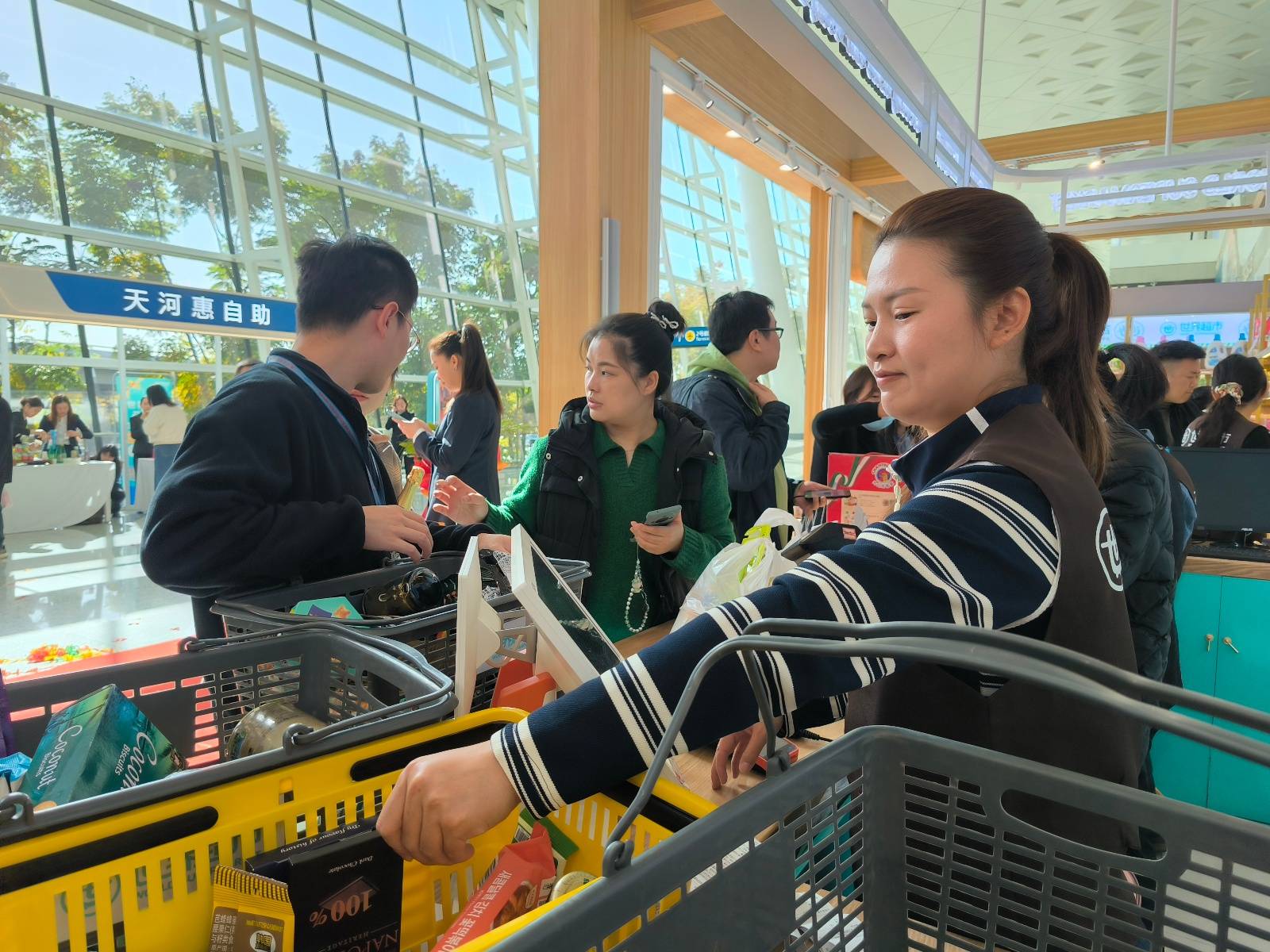
武汉天河机场“世界超市”迎客,含30多个国家的400余款商品,进口零食低至个位数
Sou Hu Cai Jing· 2025-11-28 11:10
Core Points - The "World Supermarket" at Wuhan Tianhe International Airport officially opened on November 28, featuring over 400 selected global products from more than 30 countries, aimed at enhancing consumer experience for travelers and local residents [1][6][10] Group 1: Business Model and Offerings - The supermarket focuses on core consumer categories, providing a diverse range of products including snacks, beverages, daily necessities, and personal care items, with many imported snacks priced in single digits [3][6] - All products are traceable, ensuring quality and affordability, catering to both travel needs and daily consumption scenarios [6][10] Group 2: Strategic Goals and Vision - The establishment of the "World Supermarket" is part of a broader strategy to innovate airport commerce and redefine the airport experience, aiming to transform it into a travel destination rather than just a transit point [8][10] - The initiative aligns with the goals of enhancing Hubei's high-level openness and supporting Wuhan's development as an international consumption center, leveraging the airport's hub advantages for a "buy global, sell global" strategy [10]

打造高水平对外开放新高地,威海“十四五”外贸外资量质齐升
Qi Lu Wan Bao· 2025-11-28 08:13
Core Viewpoint - Weihai City is committed to high-quality development during the "14th Five-Year Plan" period, focusing on enhancing foreign trade and investment, and creating a new high ground for open development [1] Group 1: Foreign Trade and Investment - The city has implemented over 20 policy measures to stabilize and optimize foreign trade, resulting in a total import and export volume growth from 161.46 billion in 2020 to 204.02 billion in 2024, with an average annual growth rate of 6% [2] - Weihai has cultivated 10 key foreign trade carriers and 5 national-level foreign trade transformation and upgrading demonstration bases, with significant achievements in high-quality foreign trade development [2] - The city has hosted 7 "China-Korea Cross-Border E-Commerce Conferences" and established the first national cross-border e-commerce shipping route to Korea, leading to a continuous top position in cross-border e-commerce retail exports in Shandong Province [3] Group 2: Investment Attraction - The city has established a high-quality investment attraction mechanism, with a three-year action plan focusing on attracting large and strong projects, and has seen significant participation in provincial and national investment activities [4] - Weihai has developed a precise investment attraction strategy targeting six key industries and three future industries, successfully attracting over 1,300 new projects during the "14th Five-Year Plan" period [6] - The city has optimized its investment promotion team and established a global partner center, resulting in a significant increase in the number of foreign investment projects [6] Group 3: Open Development Platforms - The city’s development zones have achieved high-quality development, with five out of seven zones improving their rankings for two consecutive years, contributing over 75% to the city's foreign investment and exports [7] - Weihai has actively participated in the China (Shandong) Free Trade Zone innovation initiatives, enhancing cooperation with provincial areas and promoting integrated development [7] Group 4: International Cooperation - The city has made significant progress in Sino-Korean economic cooperation, with over 110 cooperation topics advanced and successful trials of multi-modal transport reducing logistics costs by approximately 30% [8] - Weihai has established a provincial-level overseas economic and trade cooperation zone in Tanzania, showcasing local products and enhancing international visibility [9] Group 5: Domestic Market Development - Weihai has been recognized as a national pilot city for retail innovation and has implemented a comprehensive consumption promotion policy, significantly boosting local consumption [10][11] - The city has organized numerous activities to integrate foreign trade products into domestic markets, enhancing the overall economic landscape [3][10]
广发银行嘉兴分行:跨境人民币护航企业高质量发展
Mei Ri Shang Bao· 2025-11-28 01:05
Core Insights - The article highlights the proactive measures taken by Guangfa Bank's Jiaxing branch to enhance cross-border RMB services, aligning with national policies to facilitate global trade and support high-quality enterprise development [1][2] Group 1: Cross-Border RMB Services - Guangfa Bank's Jiaxing branch focuses on optimizing the entire process of cross-border settlement and financing through online, paperless, and electronic information handling, improving the efficiency of cross-border fund settlements [1] - The bank offers various online services for enterprises, including RMB T/T remittances, letters of credit, acceptance, and pledging, creating a digital experience for cross-border RMB transactions [1] - The branch implements a "one enterprise, one policy" service mechanism, continuously innovating products tailored to enterprise needs, such as cross-border RMB payment for imports and exports, comprehensive cross-border financing, and RMB NRA accounts [1] Group 2: Addressing Client Needs - A multinational manufacturing enterprise previously relied on USD financing for overseas export needs but faced rising costs due to Federal Reserve interest rate hikes and increased exchange rate risks [2] - In response, Guangfa Bank's Jiaxing branch customized a cross-border RMB export payment solution to help the enterprise mitigate exchange rate risks while reducing costs and improving efficiency [2] - The bank emphasizes a "finance for the people" philosophy, aiming to deepen innovation in cross-border RMB business and provide high-quality, convenient financial support to enterprises in their globalization efforts [2]
聚焦三大主题、搭建出海平台!粤港澳大湾区论坛在港凝聚发展合力
Zheng Quan Shi Bao Wang· 2025-11-27 02:19
11月26日,领航"9+2"第六届粤港澳大湾区发展论坛暨颁奖典礼在香港隆重举行。本次活动以"紧抓'十 五五'机遇,大湾区领航新局"为主题,汇聚政府、金融、科技及产业界代表,旨在分享湾区建设新成 就,共商未来发展道路,同时表彰粤港澳三地为大湾区建设作出贡献的优秀企业、团体及个人,共同推 动区域高质量融合与创新发展。 香港特别行政区政府政务司司长陈国基在致辞中表示,粤港澳大湾区建设是香港融入国家发展的重点工 作,也是本届政府全面推进的重大工作,认为国家"十五五"规划建议中有关区域发展、特别是大湾区建 设的重大部署可为香港特区政府指明未来的工作方向。陈国基指出,香港正发挥"超级联系人"和"超级 增值人"角色,强化"引进来、走出去"的双向平台功能。 全国政协委员、香港大公文汇传媒集团董事长李大宏表示,粤港澳大湾区正迎来政策赋能、资源集聚、 动能迸发的难得机遇,更承载着探索"一国两制"实践新路径、打造区域协同发展新标杆、服务国家开放 发展新格局的重大使命,应领航科技创新协同,打造国家高水平科技自立自强战略支点;领航规则标准 衔接,构建市场化法治化国际化营商环境标杆;领航双向开放枢纽,服务国家"双循环"相互赋能的新发 展 ...
北京银行行长戴炜:银行需成为企业穿越周期、基业长青的战略同盟军
Jing Ji Guan Cha Wang· 2025-11-26 12:18
Core Viewpoint - The speech emphasizes the need for banks to shift from traditional creditor thinking to a partnership model, focusing on long-term value co-creation and supporting the real economy through financial services [2][4][6]. Group 1: Insights on Development Opportunities - The "14th Five-Year Plan" period is identified as a critical time for achieving socialist modernization, requiring significant breakthroughs in strategic tasks related to Chinese-style modernization [4]. - Traditional advantages such as demographic and land dividends are diminishing, while new advantages like talent, data, and institutional dividends are emerging, necessitating a focus on technological development [4]. - A new development pattern is being established, emphasizing domestic circulation and the mutual promotion of domestic and international circulation to address external uncertainties [4]. Group 2: Strategic Positioning and Financial Services - Financial services must adhere to the original intention of serving the real economy, enhancing precision and effectiveness in service delivery [6]. - A financial service system that aligns with technological innovation is essential, facilitating a healthy cycle between technology, industry, and finance [6]. - The bank aims to transform its role from a traditional creditor to a strategic partner, fostering long-term value creation for enterprises [6]. Group 3: Modern Industrial System Development - The bank is committed to embedding its development within the real economy, aiming to become a respected institution that harmonizes economic and social values [7]. - The bank has launched various financial products, including "Leading e-loan" and green finance initiatives, with significant growth in technology and green finance loan balances [8]. - The bank has focused on ten key industrial sectors, providing over 700 billion yuan in financial support to more than 4,400 clients [9]. Group 4: Collaborative Ecosystem for High-Quality Development - The bank aims to be a participant in industrial ecosystem construction, driving high-quality development through collaboration [10]. - A chain-based service logic is established to provide integrated services across the entire lifecycle of production, supply, and sales [11]. - The bank is committed to sustainable development by integrating ESG principles into its governance and fostering a "technology-industry-finance" cycle [11].

多条直飞货运航线密集开通
第一财经· 2025-11-25 09:36
当前外贸领域呈现出"冰火两重天"的景象:一边是传统外贸遭遇旺季"不旺"的寒意,另一边是跨境电 商的逆势增长。面对外贸格局的深刻变革与业态迭代,近期多条直飞货运航线密集启航,全力抢滩今年 的海外消费旺季,为"中国货通全球"加速。 支撑跨境电商 11月21日,一架B767全货机满载50吨跨境电商货物,从温州龙湾国际机场飞往乌兹别克斯坦首都塔 什干。这标志着温州首条直飞中亚的国际航空货运航线正式开通。这也是继今年7月杭州往来塔什干全 货机航线开通以来的又一条浙江省直达中亚地区的货运航线。 这条从温州直飞中亚的货运航线,首航搭载的货物以跨境电商商品为主。瞄准"黑五"、圣诞等海外消费 旺季,直航通道的打通为浙江及周边地区跨境电商企业抢占市场提供了更强的供应链保障,也进一步增 强了本地外贸企业的国际竞争力。 2025.11. 25 本文字数:3055,阅读时长大约6分钟 作者 | 第一财经 缪琦 与此同时,这条直飞中亚的货运航线,帮助温州机场补齐了版图——"十四五"期间开通的11条国际货 运航线,让其航空货运网络实现了东南亚、东北亚、中亚三大区域的全覆盖,为辐射欧洲市场搭建了重 要中转平台。 据新华社报道,8月乌鲁木齐直 ...

为今年的海外旺季冲刺,多条直飞货运航线密集开通
Di Yi Cai Jing· 2025-11-25 09:17
直飞货运航线的开通,不仅仅为了跨境电商 当前外贸领域呈现出"冰火两重天"的景象:一边是传统外贸遭遇旺季"不旺"的寒意,另一边是跨境电商 的逆势增长。面对外贸格局的深刻变革与业态迭代,近期多条直飞货运航线密集启航,全力抢滩今年的 海外消费旺季,为"中国货通全球"加速。 支撑跨境电商 11月21日,一架B767全货机满载50吨跨境电商货物,从温州龙湾国际机场飞往乌兹别克斯坦首都塔什 干。这标志着温州首条直飞中亚的国际航空货运航线正式开通。这也是继今年7月杭州往来塔什干全货 机航线开通以来的又一条浙江省直达中亚地区的货运航线。 这条从温州直飞中亚的货运航线,首航搭载的货物以跨境电商商品为主。瞄准"黑五"、圣诞等海外消费 旺季,直航通道的打通为浙江及周边地区跨境电商企业抢占市场提供了更强的供应链保障,也进一步增 强了本地外贸企业的国际竞争力。 与此同时,这条直飞中亚的货运航线,帮助温州机场补齐了版图——"十四五"期间开通的11条国际货运 航线,让其航空货运网络实现了东南亚、东北亚、中亚三大区域的全覆盖,为辐射欧洲市场搭建了重要 中转平台。 据新华社报道,8月乌鲁木齐直飞乌兹别克斯坦的国际货运航线开通,装载着50多吨的 ...


制度红利释放服务出口潜能
Sou Hu Cai Jing· 2025-11-24 22:29
Core Insights - China's service trade has shown steady growth, with total service trade reaching 59,362.2 billion yuan in the first three quarters of this year, a year-on-year increase of 7.6% [2] - The government has implemented a series of policies to support service trade, including the recent issuance of 20 tasks and over 70 specific policy measures aimed at promoting high-quality service trade development [3] - The China Council for the Promotion of International Trade (CCPIT) has organized initiatives to help enterprises expand into international markets, including the "Thousand Groups Going Abroad" campaign [5][6] Service Trade Growth - In the first three quarters, service exports amounted to 26,015 billion yuan, growing by 14.4%, while imports reached 33,347.2 billion yuan, increasing by 2.8% [2] - The increase in service trade is attributed to the implementation of policies that enhance the business environment and promote service industry openness [2] Policy Support - The State Council's recent opinion emphasizes five areas for service trade development, including institutional opening and resource flow, with specific measures to support knowledge-intensive service sectors like digital services and intellectual property [3] - New policy measures include optimizing zero tax rate declaration procedures and enhancing inbound consumption facilitation [3] International Market Expansion - The CCPIT has facilitated 2,249 delegations to 102 countries for market exploration last year, with 1,623 exhibition projects approved this year, covering an exhibition area of 950,000 square meters [5] - The organization aims to enhance international cooperation and support enterprises in participating in global markets [6] Legal Services Enhancement - The revised arbitration law, effective from March 2026, aims to improve China's arbitration system, enhancing its international competitiveness and supporting high-quality development [7] - The establishment of the International Mediation Institute, which focuses on resolving international disputes through mediation, is expected to enhance the legal framework for international trade [8]
中国黄金5亿元落子海南!借自贸港机遇加速国际化与文化出海
Zheng Quan Shi Bao Wang· 2025-11-24 02:20
Core Viewpoint - The establishment of a wholly-owned subsidiary by China Gold Group in Hainan Free Trade Port is a strategic move to enhance international business operations and align with national policies for high-level openness and the "dual circulation" development strategy [1][2][3] Group 1: Company Strategy - China Gold Group aims to accelerate its internationalization process during the 14th Five-Year Plan, with the newly established subsidiary serving as a platform for international cooperation and investment [2][3] - The subsidiary will leverage Hainan's policy advantages, such as zero tariffs and low tax rates, to optimize global resource allocation and enhance capital connectivity [2][3][6] Group 2: Collaboration and Partnerships - China Gold has signed strategic cooperation agreements with China Duty Free Group and Nanguang Group to deepen collaboration in channel development, cultural product innovation, and cross-border marketing [4][5] - These partnerships aim to integrate China Gold's craftsmanship with regional cultural tourism resources, enhancing the international appeal of Chinese brands [5][6] Group 3: Market Positioning - The establishment of the international company marks a shift from "scale expansion" to "rule output" in the gold industry, aligning with national strategies for domestic and international dual circulation [2][3] - The company is positioned to become a leading brand in new gold consumption, responding to evolving consumer demands through innovative product offerings and cultural empowerment [4][5]

以海南为支点布局全球市场 中国黄金成立国际公司
Zheng Quan Ri Bao Wang· 2025-11-23 09:40
Group 1 - The core point of the article is that China Gold Group has approved the establishment of a wholly-owned subsidiary, China Gold Jewelry International Co., Ltd., with a registered capital of 500 million yuan, as part of its strategy to integrate into the national "dual circulation" development pattern [1][2] - The new subsidiary will serve as a platform for international business coordination and investment operations, leveraging the advantages of Hainan Free Trade Port to expand overseas markets and channels [1] - The international company will collaborate with strategic partners such as China Duty Free Group and Macau Nanguang Group in areas like channel development, cultural product innovation, and cross-border event marketing [1] Group 2 - The international company aims to utilize the policy benefits of Hainan Free Trade Port and Hong Kong's international hub status to focus on cross-border supply chain management, overseas market channel construction, and global brand promotion [2] - The establishment of the international company is seen as a significant milestone in the company's strategic upgrade, with a focus on incubating new industries and expanding international innovative business [2] - The company plans to continuously explore new models and paths in collaboration with the international subsidiary to inject sustained momentum into its global development [2]