
大食物观

Search documents
南北早餐图鉴:烟火气里藏着丰收密码
Yang Shi Xin Wen· 2025-09-23 02:16
Group 1 - The article highlights the celebration of the eighth Chinese Farmers' Harvest Festival, established in 2018, with the theme "Celebrating Agricultural Harvest, Enjoying a Better Life" [1] - The transformation of food consumption patterns in China is emphasized, moving from merely "eating enough" to "eating well," reflecting a broader "big food concept" [2] - The article illustrates the daily breakfast routines of ordinary citizens, showcasing the shift towards more nutritious and diverse meal options [3][5] Group 2 - The article describes various regional breakfast traditions, such as the hearty carbohydrate-rich meals in the north and the soup-based breakfasts in the south, highlighting local flavors and culinary practices [9][11] - Innovative breakfast combinations are emerging, such as "soy milk latte" in Shanghai and "hot dry noodles pizza" in Wuhan, catering to health-conscious consumers while also introducing new tastes [13] - The bustling morning markets in cities like Harbin and Kunming reflect the efficient circulation of agricultural products from farms to tables, showcasing a variety of local specialties and seasonal foods [15][21]

产值超5亿、集群达110亿,泰安现代食品产业链构建“四链融合”新格局
Qi Lu Wan Bao Wang· 2025-09-19 13:45
Group 1 - The core focus of the agricultural and rural development initiatives in Tai'an is to enhance the agricultural supply chain by extending the industrial chain, improving the value chain, and sharing benefits among stakeholders [1] - The city has planned 51 high-quality projects centered around dominant industries such as Tai Mountain tomatoes, pet food, and deep processing of livestock and poultry, with significant investments including three projects over 500 million and one project over 1 billion [2] - The establishment of the Tai Mountain Tomato Innovation Research Institute aims to promote collaboration in the entire tomato industry chain, from seed to juice, enhancing cold chain logistics and overall service capabilities [3] Group 2 - The city is committed to green development by encouraging enterprises to innovate production technologies and processes, thereby improving the intelligence and digitalization of production lines [3] - Future initiatives will focus on localizing the transformation and value addition of agricultural products, retaining more job opportunities in rural areas, and ensuring that the benefits of the industrial chain are shared with farmers [4]
把一粒种串成一条链,广东种业绘就鲜食玉米产业新图景
Nan Fang Nong Cun Bao· 2025-09-17 10:00
Core Viewpoint - The fresh corn industry in Guangdong is rapidly developing, with significant potential for growth and innovation, despite facing challenges such as resource constraints and natural disasters [4][5][18]. Group 1: Industry Overview - Zhanjiang has been cultivating sweet corn on a large scale since 1998, currently covering an area of approximately 700,000 acres, leading the province in both planting area and yield [2][3]. - The national planting area for fresh corn has surpassed 25 million acres, with an annual consumption of 75 billion ears [4]. Group 2: Challenges and Opportunities - The fresh corn industry faces multiple challenges, including insufficient germplasm resources, tightening production constraints, and increased natural disasters and pest issues [4][5]. - There is a need for enhanced collaboration between research institutions and seed companies to accelerate breakthroughs in germplasm innovation and address practical production challenges [15][20]. Group 3: Market Demand and Trends - Fresh corn is becoming a significant product in the context of food diversification, with a compound annual growth rate of 13.46%, marking it as a key component of the "big food concept" [18]. - The demand for new varieties of fresh corn, including black sweet and glutinous corn, is expected to grow across regions, particularly in the Yangtze River Delta [27][29]. Group 4: Quality and Breeding - There has been notable progress in the quality breeding of fresh corn, with some varieties nearing international quality standards, yet there remains room for improvement in balancing yield and quality [25][26]. - Future breeding efforts should focus on developing high-quality, visually appealing, and high-yield varieties that are resistant to diseases [33][34]. Group 5: Industry Structure and Economic Impact - Fresh corn is a crucial economic crop for restructuring and transforming the corn industry, significantly contributing to farmers' income and local economies [40]. - Guangdong is a major production area for fresh corn, with over 2 million acres planted annually, and it plays a vital role in supplying markets in major cities [41][42]. Group 6: Processing and Supply Chain - Despite the large planting area and good profitability of winter fresh corn in Guangdong, the processing segment remains a weak point, with a lack of deep processing products [49][50]. - There is a high loss rate and reduced marketability due to inadequate preservation and processing technologies for sweet corn, indicating a need for further strengthening in this area [51].

从田间到餐桌 央企打造食品“鲜”活样板
Zhong Guo Zheng Quan Bao· 2025-09-16 22:37
Group 1: Central Enterprises' Role in Food Supply Chain - Central enterprises are actively reshaping China's food supply chain, transitioning from "eating enough" to "eating well and healthily" [1] - The efficient operation of the food supply chain is exemplified by COFCO's automated systems, which allow for rapid processing of soybeans into edible oil [1] - Central enterprises are seen as leaders in technological innovation and industry upgrades, contributing to national food security strategies [1] Group 2: Healthier Food Production Techniques - COFCO has developed a key technology system for edible oil quality control, significantly improving the retention of nutrients such as vitamin E and plant sterols [2] - The new processing technology has increased the retention rates of plant sterols to over 90% and vitamin E to over 95% [2] - Huaren Wanjia is enhancing the quality of protein supply through automated and intelligent farming practices for egg production [3] Group 3: Comprehensive Supply Chain Management - Huaren Wanjia has established a complete supply chain management system for its "Runjia" brand eggs, resulting in significant sales growth [3] - The company aims to expand its product offerings across various categories, including fruits, vegetables, and meat [3] - Central enterprises are integrating technology and supply chain management to promote healthier dietary structures in China [3] Group 4: Innovations in Aquaculture - State Grid Xinjiang Electric Power Company has enabled successful seafood farming in Xinjiang through stable electricity supply [5] - The "Bay Area Lingding" self-propelled aquaculture vessel, developed by China Communications Construction Company, is set to enhance fish farming efficiency [6] - This vessel is expected to produce an annual yield of 5,000 tons, contributing to sustainable seafood supply [6] Group 5: Global Sourcing and Consumer Demand - Central enterprises are leveraging global supply chains to meet the rising demand for high-quality imported foods, such as Chilean cherries [7] - COFCO is expanding its international cooperation to introduce premium agricultural products, including flaxseed oil and Honduran shrimp [8] - The company has achieved significant operational scale, managing over 180 million tons of agricultural products annually [9]
答卷“十四五” 央企惠民生 | 从田间到餐桌 央企打造食品“鲜”活样板
Zhong Guo Zheng Quan Bao· 2025-09-16 22:23
Group 1: Central Enterprises' Role in Food Supply Chain - Central enterprises are actively reshaping China's food supply chain, transitioning from "eating enough" to "eating well and healthily" [1][2] - Companies like COFCO, China Communications Construction Company, and China National Machinery Industry Corporation are leading technological innovations and promoting national food security [1][2] Group 2: Technological Innovations in Food Processing - COFCO has developed a key technology system for edible oil quality control, significantly improving the retention rates of nutrients such as plant sterols and vitamin E [2][3] - The new technology allows for over 90% retention of plant sterols and over 95% retention of vitamin E, enhancing the nutritional and safety quality of edible oils [2] Group 3: Supply Chain Management in Egg Production - China Resources Vanguard has established a comprehensive supply chain management system for its "Runjia" brand eggs, resulting in significant sales growth [3] - The company aims to expand its product offerings across various categories, including fruits, meat, and vegetables, to provide consumers with reliable high-quality protein [3] Group 4: Innovations in Aquaculture - State Grid Xinjiang Electric Power Company has facilitated the successful aquaculture of seafood in Xinjiang, supported by stable electricity supply [4][5] - The "Bay Area Lingding" self-propelled aquaculture vessel, developed by China Communications Construction Company, is set to enhance sustainable seafood production with a capacity of 5,000 tons annually [5][6] Group 5: Upgrading Dietary Preferences - Central enterprises are leveraging global supply chains to introduce high-quality imported foods, such as Chilean cherries, to meet the growing demand for premium products [7][8] - COFCO has successfully imported various high-end agricultural products, enhancing the diversity and healthiness of food options available to consumers [8][9] Group 6: Economic Impact of Central Enterprises - COFCO's annual agricultural product handling exceeds 180 million tons, positioning it as a key player in the global agricultural supply chain [9] - The integration of refined management from farm to table and deep global supply chain collaboration is driving new consumption vitality and supporting high-quality economic development in China [9]
从田间到餐桌央企打造食品“鲜”活样板
Zhong Guo Zheng Quan Bao· 2025-09-16 20:20
Core Insights - The article highlights the proactive role of state-owned enterprises (SOEs) in reshaping China's food supply chain, emphasizing a shift from merely filling stomachs to providing healthier and higher-quality food options [1][2][3] Group 1: Food Supply Chain Innovations - SOEs are implementing advanced technologies and full-chain management to enhance food quality and safety, particularly in the edible oil sector [2][3] - The research team at COFCO has developed a key technology system for quality control in edible oil, significantly improving the retention rates of nutrients such as plant sterols and vitamin E [2] - The "Runjia" brand of eggs from China Resources has seen sales exceed last year's total within six months, showcasing the effectiveness of their integrated supply chain management [3] Group 2: Aquaculture Developments - State Grid Xinjiang Electric Power Company has facilitated the successful aquaculture of various seafood in Xinjiang, supported by stable electricity supply and advanced technology [4][5] - The "Bay Area Lingding" self-propelled aquaculture vessel, developed by China Communications Construction Company, is set to produce 5,000 tons of seafood annually, contributing to sustainable aquaculture practices [6] Group 3: Import and Global Supply Chain - Companies like China National Machinery Import and Export Corporation are leveraging global supply chains to import high-quality products such as Chilean cherries, meeting the growing demand for premium food items in China [7] - COFCO is expanding its international cooperation by introducing various high-end agricultural products, including flaxseed oil and Honduran white shrimp, to enhance consumer choices [7] - COFCO's annual agricultural product handling exceeds 180 million tons, positioning it as a key player in the global agricultural supply chain [7]
“十四五”农业答卷:粮食产量创新高,多元化食物供给提速
2 1 Shi Ji Jing Ji Bao Dao· 2025-09-16 13:01
Core Insights - The article highlights the achievements in agricultural development during the "14th Five-Year Plan" period, emphasizing food security and the diversification of food supply in China [1][3]. Agricultural Production and Food Security - China's grain production reached a new high of 1.4 trillion jin (approximately 700 million tons) last year, an increase of 74 billion jin (approximately 37 million tons) compared to 2020 [1][3]. - The per capita grain availability in China has reached 500 kg, ensuring basic self-sufficiency in grains and absolute safety in staple food [3]. - The Ministry of Agriculture and Rural Affairs has implemented a national food security strategy focusing on domestic production, moderate imports, and technological support [3]. Crop and Livestock Production - The production capacity of cotton, oil, and sugar has been continuously improved, with sufficient and diverse supply of fruits, vegetables, meat, eggs, milk, and aquatic products [1][6]. - The total output of livestock products reached 175 million tons by the end of last year, an increase of 27.78 million tons (18.8%) since 2020 [6][7]. - The soybean production reached 20.65 million tons, with a self-sufficiency rate increase of 4 percentage points compared to 2020 [4][6]. Agricultural Reform and Modernization - The Ministry of Agriculture and Rural Affairs is deepening rural reforms, including extending land contracts and managing rural housing land [2]. - Over 2 million farmer cooperatives and nearly 4 million family farms have been cultivated, promoting the integration of smallholders with modern agriculture [2]. Food Supply Diversification - The central government has emphasized the establishment of a diversified food supply system, focusing on various food sources including forests, grasslands, and aquatic resources [6][7]. - The area of facility agriculture has reached 40 million mu (approximately 2.67 million hectares), with annual vegetable production exceeding 20 million tons [7]. Consumer Engagement and Market Stability - The Ministry of Agriculture and Rural Affairs has launched a plan to boost agricultural product consumption, emphasizing brand development and marketing strategies [8][9]. - The plan aims to enhance consumer engagement through various channels, including festivals and exhibitions, to stabilize the agricultural product market [9].
新华社权威速览·非凡“十四五”丨老百姓的餐桌:供给越来越多样 品类越来越丰富
Xin Hua Wang· 2025-09-16 09:27
Group 1: Agricultural Development - The agricultural sector is promoting a diversified food supply system by sourcing food from forests, grasslands, rivers, lakes, seas, and through facility agriculture, leading to a richer variety of food on consumers' tables [1] - The total output of meat, eggs, and dairy products reached 175 million tons by the end of last year, an increase of 27.78 million tons or 18.8% compared to 2020 [2] - Per capita consumption of meat and poultry eggs reached 72 kg and 25 kg respectively, both exceeding the global average [2] Group 2: Aquaculture and Fisheries - In 2024, the total output of aquatic products reached 73.58 million tons, representing a 12.3% increase since 2020 [4] - China has maintained its position as the world's largest producer of aquatic products for 36 consecutive years, with abundant supplies of fish, shrimp, crab, and shellfish [4] Group 3: Facility Agriculture - The area of facility agriculture has reached 40 million acres, with annual vegetable production exceeding 20 million tons [6] - The annual output of edible fungi has surpassed 42 million tons, accounting for 85% of global production [6] Group 4: Biotechnology in Agriculture - The agricultural sector is accelerating the development of biotechnology and bio-industries, leading to the emergence of new food products [8] - China is at the forefront of algae cultivation technology [8]

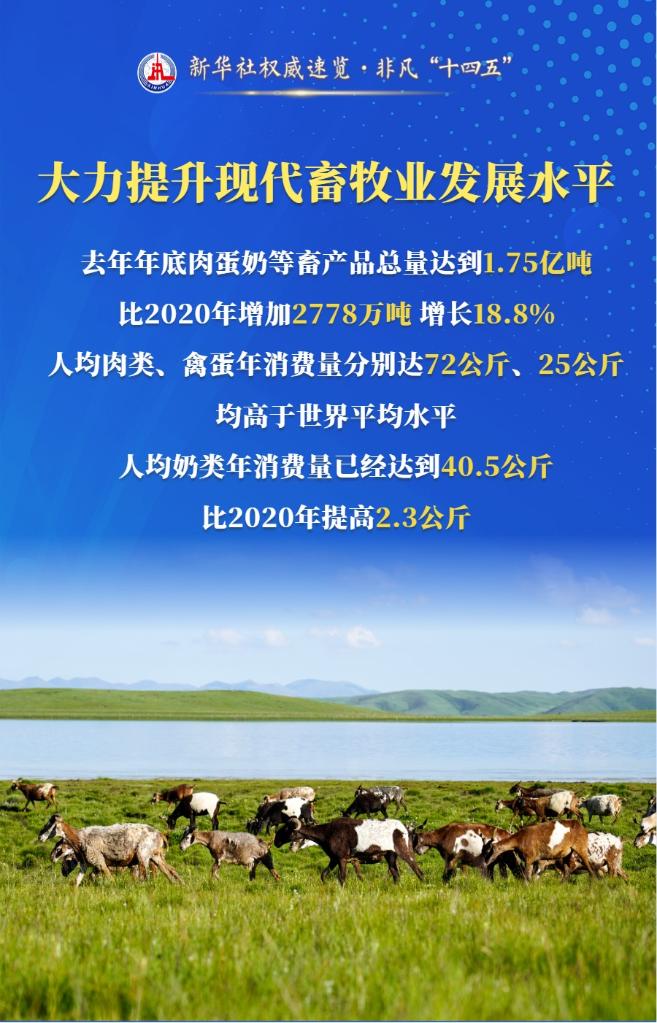
农业农村部:我国人均肉类、禽蛋年消费量分别达72公斤、25公斤 均高于世界平均水平
Qi Huo Ri Bao· 2025-09-16 08:53
Core Viewpoint - The Chinese government is making significant progress in diversifying food supply systems and enhancing agricultural development during the "14th Five-Year Plan" period, focusing on modern livestock, fisheries, facility agriculture, and biotechnology [1][2]. Group 1: Modern Livestock Development - The level of modern livestock development is being significantly improved, with a stable supply of livestock products. By the end of last year, the total output of meat, eggs, and milk reached 175 million tons, an increase of 27.78 million tons or 18.8% compared to 2020 [2]. - Per capita consumption of meat and poultry eggs in China reached 72 kg and 25 kg respectively, both exceeding the global average. Per capita dairy consumption also increased to 40.5 kg, up by 2.3 kg from 2020 [2]. Group 2: Modern Fisheries Development - The development of modern fisheries is being prioritized, with a focus on sustainable use of fishery resources, ecological fisheries in large water bodies, and deep-sea aquaculture, contributing to the creation of a "blue granary" [2]. Group 3: Facility Agriculture Development - Facility agriculture is rapidly advancing, with the area of facility crops reaching 40 million acres and annual vegetable production exceeding 20 million tons, achieving year-round balanced supply [2]. Group 4: Expansion of Agricultural Development Space - The agricultural sector is expanding from traditional crops and livestock to a wider range of biological resources, accelerating the development of biotechnology and new food products through breakthroughs in key technologies [2]. Group 5: Nutritional Improvement - The nutritional health levels of food consumed by urban and rural residents are approaching those of developed countries, indicating that the population is not only well-fed but also has access to healthier and more nutritious food [3].
“薯”光耀南粤!广东甘薯有种有力量
Nan Fang Nong Cun Bao· 2025-09-16 08:05
Core Viewpoint - The article emphasizes the importance of sweet potato cultivation in Guangdong as a key agricultural product that contributes to food security and rural revitalization, highlighting the province's efforts in enhancing the sweet potato industry through innovation and quality improvement [2][8][12]. Group 1: Industry Overview - Sweet potatoes are significant food crops that drive farmers' income and rural development [2]. - Guangdong has a large scale of sweet potato cultivation, with 2.65 million acres planted in 2023, yielding 4.43 million tons of sweet potatoes and 0.65 million acres of potatoes with a production of 1.06 million tons [10][11]. - Sweet potatoes have become a competitive agricultural industry in Guangdong, with a focus on seasonal planting to maximize market value [12][14]. Group 2: Technological and Strategic Initiatives - The province is implementing strategies to ensure food security through land and technology, emphasizing the need for high-yield and adaptable crops like sweet potatoes [7][8]. - Guangdong is constructing an integrated sweet potato industry chain, focusing on breeding, production, processing, and marketing to enhance overall quality [16][17]. - The provincial government has selected seven leading sweet potato varieties, including five sweet potato and two potato varieties, to improve market offerings [18][19]. Group 3: Processing and Market Development - The sweet potato processing sector is diversifying, producing a range of products such as sweet potato fiber cakes, dried sweet potatoes, and functional foods [27][28]. - The nutritional value of sweet potatoes is being leveraged to upgrade traditional food products and develop new health-oriented and convenience foods [29][30]. - The Ministry of Agriculture and Rural Affairs has proposed a three-year action plan (2024-2026) to promote the development of the agricultural processing industry, aligning with Guangdong's efforts to enhance its sweet potato sector [32][42].