
红利投资

Search documents
时刻六年险资举牌同业再现,什么信号?
Ge Long Hui· 2025-08-19 10:42
Group 1 - The core viewpoint of the articles highlights a resurgence in insurance companies' stake acquisitions, particularly in Hong Kong stocks, with six instances occurring within two weeks, indicating a shift from banking to consumer and insurance sectors [1][19] - The recent stake acquisitions by insurance funds mark the first occurrence in six years, reflecting a strong demand for high-dividend assets and a shift of funds from traditional dividend stocks to other high-dividend sectors [2][19] - The historical performance of dividend assets shows a cyclical rotation through four distinct phases, with the current phase indicating a strong performance in banking stocks and a relative outperformance of Hong Kong dividends compared to A-shares [2][19] Group 2 - The outlook for Hong Kong dividend opportunities suggests that they serve as a safe haven amid macroeconomic uncertainties, with insurance stocks offering both cyclical resilience and stable profitability [3][19] - The Hong Kong high-dividend low-volatility ETF (520550) tracks a diversified index of high-dividend stocks, providing exposure to various sectors while maintaining a low fee structure of 0.2% [3][5] - The Hong Kong high-dividend low-volatility index has demonstrated superior performance compared to major Hong Kong indices over the past three years, with a cumulative return of 86.88% [8][9] Group 3 - The current state of Hong Kong dividend assets is not overheated, with the high-dividend low-volatility index at a historically low level, indicating potential for future growth [9] - Hong Kong is experiencing a dividend payout peak, with total cash dividends expected to reach HKD 1.38 trillion in 2024, reflecting a year-on-year growth of over 10% [9][19] - Southbound capital inflows have surged, with a record net purchase of over HKD 35.8 billion on August 15, indicating a strong preference for high-dividend stocks across various sectors [13][19]




688098 20%三连板!利好突袭 “超级赛道”多股停潮!
Zheng Quan Shi Bao Wang· 2025-08-19 04:54
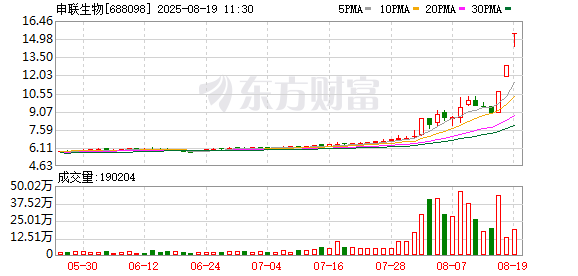
Market Overview - Pharmaceutical and biotechnology stocks showed strong performance, with Shenlian Bio (688098) hitting a 20% limit up for the third consecutive day [2][7] - The A-share market experienced slight upward movement, with the North China 50 Index rising over 3%, reaching a new historical high [2][3] - The overall market saw a slight decrease in trading volume [2] Pharmaceutical Sector - Multiple sub-sectors within pharmaceuticals, including innovative drugs, hepatitis concepts, weight-loss drugs, and AI medical concepts, reached historical highs [7] - Significant inflows into the pharmaceutical sector, with over 76 billion yuan in net inflows recorded, and a total of 736 billion yuan over the past 20 trading days [9][10] - The National Medical Insurance Administration announced the preliminary review of 534 drugs for inclusion in the national basic medical insurance directory, which is expected to further support the innovative drug sector [9] Robotics Sector - The robotics concept saw significant movement, with stocks like Southern Precision Engineering hitting a limit up and reaching historical highs [4][6] - The Shanghai Municipal Economic and Information Commission released a plan to accelerate the application of robots in key industries, indicating strong government support for the sector [6] Alcohol Sector - The liquor sector experienced a notable surge, with all stocks in the sector rising and the index reaching a new annual high [11] - Guizhou Moutai's new product launch aims to enhance brand visibility and promote a lifestyle associated with the product, reflecting a shift from merely selling alcohol to selling a lifestyle [13] - The liquor sector is attracting long-term investment interest due to its high dividend yields, with the median dividend yield around 3%, significantly higher than bond yields [13]




上市公司半年报公告拟分红总额破千亿!资金连续4日加仓红利ETF(510880),累计吸金超6.6亿
Xin Lang Ji Jin· 2025-08-19 03:31
8月以来,A股半年报披露进入密集期。截至8月18日,已有121家上市公司在2025年半年报宣布现金分 红计划,拟分红总金额达1086亿元。 此外,2025年7月11日财政部发布《关于引导保险资金长期稳健投资进一步加强国有商业保险公司长周 期考核的通知》,通过"调整国有商业保险公司绩效评价指标,新增五年周期考核权重",旨在推动险资 长期入市,红利类资产或将持续成为市场资金关注焦点之一。 据了解,红利ETF(510880)是目前市场仅有的跟踪的上证红利指数的ETF,据交易所数据,截至8月 18日,最新规模为179.91亿元,是目前市场为数不多超百亿元的红利主题ETF品种。据基金年报,红利 ETF(510880)2024年年度的基金利润达33.94亿元,为2019年来连续第6年(2019-2024年)实现正盈 利,累计为持有人带来76.43亿元利润。 持有人户数方面,截至2024年12月31日,红利ETF(510880)最新持有人户数达41.83万户,是同期全 市场仅有的持有人户数超40万户的红利主题ETF。与此同时,红利ETF(510880)也是全市场仅有的累 计分红超40亿元的红利主题指数基金,成立18年以来已 ...
千亿ETF基金公司入局!“红利+低波”新物种今日火爆开售
Xin Lang Ji Jin· 2025-08-18 00:21
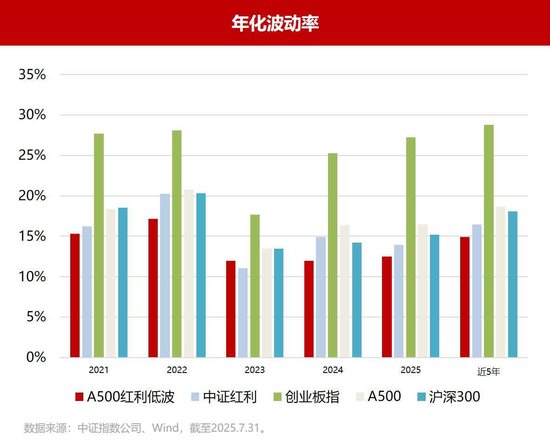
Core Insights - The "CSI A500 Index" is gaining popularity as the "hottest index" for 2024, with the launch of the Pro version, the "CSI A500 Dividend Low Volatility Index" [1][2] - The newly launched "CSI A500 Dividend Low Volatility ETF" (code: 159296) is the first ETF in the market to track this index, which selects 50 securities with high dividends and low volatility from the CSI A500 Index [1][2] Group 1: Index Characteristics - The CSI A500 Dividend Low Volatility Index features a TTM dividend yield of 4.17% and a TTM dividend rate of 30.97%, outperforming similar indices like the CSI 300 Dividend Low Volatility Index [3] - This index aims to mitigate valuation traps and enhance risk-return profiles through its dual focus on high dividends and low volatility, potentially achieving a "1+1>2" Smart Beta effect [2][3] Group 2: Performance Metrics - Since its base date (December 31, 2013), the CSI A500 Dividend Low Volatility Index has seen a cumulative increase of 393.12% and an annualized return of 15.21%, significantly outperforming the CSI Dividend Index and the CSI A500 Index [7][10] - The index has demonstrated lower volatility and maximum drawdown compared to other indices, making it a more stable investment option [3][10] Group 3: Market Position and Strategy - The launch of the A500 Dividend Low Volatility ETF (159296) marks a strategic move for Huabao Fund, which has recently crossed the 100 billion yuan threshold in equity ETF assets, solidifying its position in the market [9] - The ETF includes a regular dividend assessment mechanism, enhancing investor engagement and aligning with the current bullish sentiment in the A-share market [9]
从险资举牌看AH红利配置走向:AH红利资产的定价模式探索系列(II)
Changjiang Securities· 2025-08-16 15:19
Group 1: Dividend Investment Insights - Dividend investment arises from the pursuit of safety margins in uncertain macroeconomic environments, especially as asset returns decline during economic plateau phases[2] - For equity investors, constructing a "safety margin" relies on selecting high-yield assets or "ticket assets" in undervalued areas[2] - For fixed-income investors, yield elasticity comes from the "+" in "fixed income +", traditionally achieved by increasing equity assets, including relatively low-volatility "ticket assets"[2] Group 2: Market Trends and Stock Selection - Since August 2025, insurance companies have intensified their stock purchases, with 28 instances recorded this year, including 20 in H-shares[18][20] - The pricing formula for dividend assets follows: [Dividend Yield + Earnings Certainty] ≥ [Long-term Bond Yield + Risk Premium], with market risk preference being a core influencing factor[6] - Traditional stable dividend sectors like utilities and banks maintain relatively high dividend yields, with banks showing lower EPS volatility compared to utilities[25] Group 3: Sector Performance and Rotation - The high-dividend sector has experienced rotation, with coal dividends leading in 2021, followed by operators in late 2022, and a resurgence of coal, highways, and hydropower in 2023[7][49] - By 2025, traditional dividend assets have shown a decline, with banks maintaining relative returns, while the demand for high-dividend quality and Hong Kong stocks has increased[60] - The "反内卷" (anti-involution) theme is expected to benefit cyclical dividend assets, with static dividend yield representing an important valuation safety dimension[62]
开盘10分钟,聪明资金连续第5日增仓中证红利质量ETF(159209)
Sou Hu Cai Jing· 2025-08-15 01:58
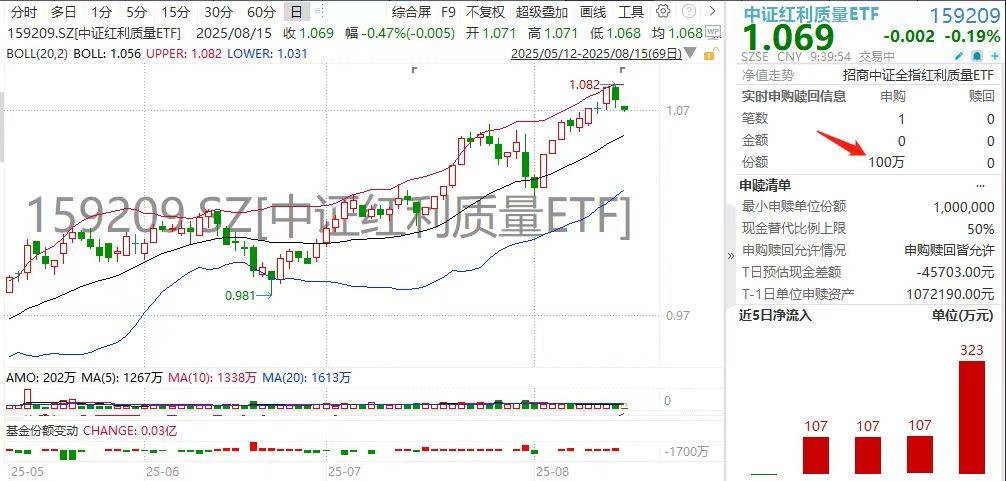
Core Viewpoint - The China Securities Dividend Quality ETF (159209) is experiencing increased trading activity, with a slight decline of 0.09% as of 9:40 AM on August 15, indicating sustained investor interest in the fund's dual focus on dividends and quality metrics like ROE [1] Group 1: Fund Performance - The ETF has seen a continuous increase in positions for five consecutive days, reflecting strong market interest [1] - The fund emphasizes both dividend yield and quality, with top holdings like Fuyao Glass and Kweichow Moutai showcasing high ROE figures of 22% and over 30%, respectively [1] Group 2: Investment Strategy - The fund is positioned as suitable for value investors who prefer acquiring great companies at reasonable prices rather than chasing low stock prices [1] - Investors are encouraged to buy into the fund at appropriate times, with the potential for excess returns when economic conditions improve [1]
打破险资举牌同业6年空白,中国平安斥资5584万港元增持中国太保H股至5.04%
Jin Tou Wang· 2025-08-15 01:37
Core Viewpoint - Insurance capital has recently increased its stake in China Pacific Insurance (China Taibao), marking a significant event in the insurance sector after a six-year hiatus in such actions [1][2]. Group 1: Investment Actions - On August 11, China Ping An invested HKD 55.84 million to acquire 174,140 shares of China Taibao at an average price of HKD 32.0655 per share, raising its stake to 5.04%, thus triggering the regulatory threshold for a stake increase [1]. - This marks the first instance of insurance capital increasing its stake in an insurance company since 2017, when China Life raised its stake in China Taibao [2]. Group 2: Financial Performance - For the year 2024, China Taibao reported a revenue of CNY 404.09 billion, a year-on-year increase of 24.7%, and a net profit of CNY 44.96 billion, up 64.9% [2]. - The total assets under management for China Taibao reached CNY 35,426.60 billion, reflecting a growth of 21.2% compared to the previous year [2]. Group 3: Market Reactions - Following the announcement of the stake increase, China Taibao's stock price rose by 4.71% on August 14, closing at HKD 36 per share, with a year-to-date increase exceeding 50% [2]. - The rolling dividend yield (TTM) for China Taibao is currently at 3.28% [2]. Group 4: Industry Insights - Analysts suggest that the insurance sector's fundamentals are not as weak as perceived, and the current valuations reflect the pressures on both assets and liabilities [3]. - The insurance stocks are seen as undervalued, with expectations of significant valuation recovery as the economy stabilizes and market conditions improve [3][4]. - The trend of insurance capital increasing stakes has reached a new high this year, with 28 instances recorded so far, indicating a strong preference for undervalued, high-dividend stocks [3].


注意:今日除权!港股红利低波ETF(520550)、中证红利质量ETF(159209)本月同步分红进行时
Sou Hu Cai Jing· 2025-08-15 01:33
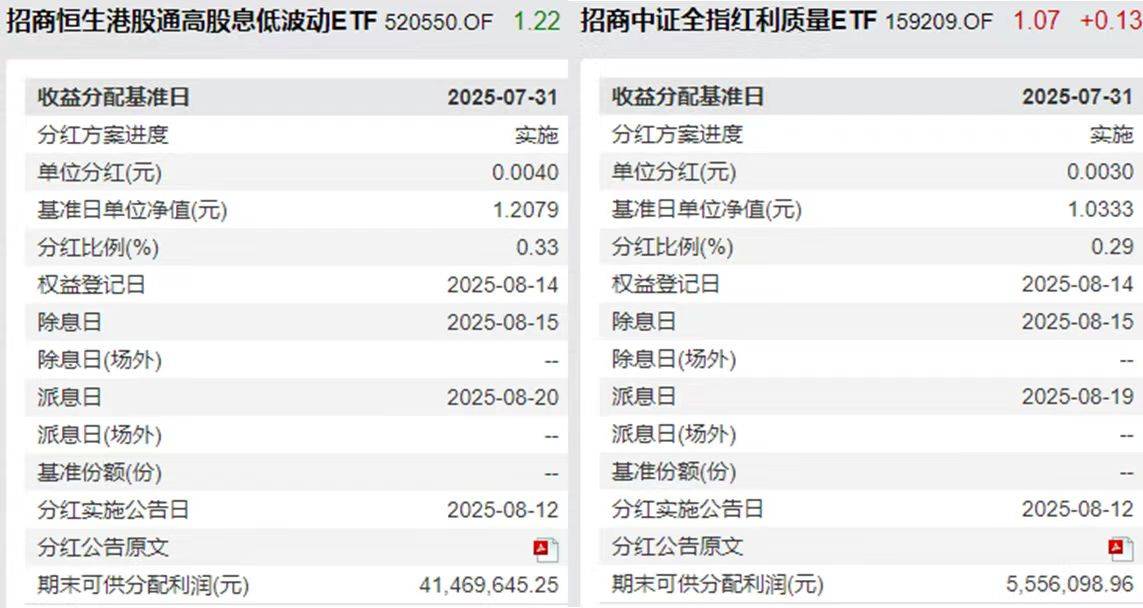
Core Viewpoint - Two dividend-paying ETFs under China Merchants Fund are distributing dividends, with the CSI Dividend Quality ETF distributing 0.003 yuan per share and the Hong Kong Dividend Low Volatility ETF distributing 0.004 yuan per share, both on August 15 [1] Group 1: ETF Details - The Hong Kong Dividend Low Volatility ETF tracks the Hang Seng High Dividend Low Volatility Index, utilizing a "dual-factor" screening strategy focused on defensive sectors like finance and utilities, currently offering a dividend yield exceeding 5% [1] - The CSI Dividend Quality ETF employs a "high dividend + high quality" strategy, selecting premium stocks in consumer and pharmaceutical sectors, maintaining a historical dividend yield of 3%-5% while outperforming broad market indices [1] Group 2: Market Context - In the current market environment, these two products represent "defensive and stable" and "growth and value" investment directions, providing differentiated allocation choices for investors [1] - The design of low fees and a monthly dividend mechanism is expected to enhance the long-term investment experience for holders [1]
财信证券晨会纪要-20250815
Caixin Securities· 2025-08-14 23:30
Market Strategy - The market experienced a pullback after a rise, with digital currency sectors showing activity [4][6] - The overall A-share market index fell by 0.86%, closing at 5751.93 points, while the Shanghai Composite Index decreased by 0.46% to 3666.44 points [6][9] - The hard technology sector outperformed, while the innovative small and medium enterprises sector lagged behind [6][9] Industry Dynamics - Over 100 cities have opened road rights for unmanned delivery vehicles, which are expected to become mainstream in the future [5][23] - In July 2025, the national railway passenger and freight volumes showed steady growth, with passenger volume reaching 455 million, a year-on-year increase of 6.6% [5][25] - The insurance sector saw significant activity, with Minsheng Insurance increasing its stake in Zheshang Bank to 5% [5][27] Company Tracking - Shuanghui Development reported a total revenue of 28.503 billion yuan for the first half of 2025, a year-on-year increase of 3.00%, with a net profit of 2.323 billion yuan, up 1.17% [5][32] - Aoshikang achieved a revenue of 2.565 billion yuan in the first half of 2025, reflecting a year-on-year growth of 19.43%, although net profit decreased by 11.96% [5][35] - The company’s revenue from meat products declined by 9.42% to 11.207 billion yuan, while slaughtering business revenue increased by 3.33% to 13.769 billion yuan [5][33]
今日分红登记!港股红利低波ETF(520550)、中证红利质量ETF(159209)本月同步分红
Sou Hu Cai Jing· 2025-08-14 01:20
Core Viewpoint - Two dividend ETF products under China Merchants Fund have recently announced simultaneous dividends, providing investors with differentiated investment options in the current market environment [1] Group 1: Dividend Distribution - The CSI Dividend Quality ETF (159209) will implement its second dividend distribution of the year, with a payout of 0.003 yuan per share [1] - The Hong Kong Dividend Low Volatility ETF (520550) will have its fourth dividend distribution, with a payout of 0.004 yuan per share [1] - Both products have set the record date for equity registration on August 14 [1] Group 2: Investment Strategy - The Hong Kong Dividend Low Volatility ETF tracks the Hang Seng Hong Kong Stock Connect High Dividend Low Volatility Index, using a "dual-factor" screening strategy focused on defensive sectors like finance and utilities [1] - This index currently has a dividend yield exceeding 5%, combined with the undervaluation of Hong Kong stocks, showcasing strong risk resistance [1] - The CSI Dividend Quality ETF employs a "high dividend + high quality" strategy, selecting quality targets in sectors such as consumer goods and pharmaceuticals [1] Group 3: Market Positioning - Historical performance indicates that the CSI Dividend Quality ETF maintains a dividend yield of 3%-5% while outperforming broad market indices in the long term [1] - Market participants view these two products as representing "defensive and stable" and "growth and value" investment directions, respectively [1] - The design of low fees and a monthly dividend mechanism is expected to enhance the investment experience for long-term holders [1]