
K型经济

Search documents
华尔街见闻早餐FM-Radio | 2025年12月1日
Hua Er Jie Jian Wen· 2025-11-30 23:00
Market Overview - The S&P 500 index rose nearly 4% for the week, marking its best Thanksgiving week performance since 2008, while the Nasdaq fell 1.5% for the month [3] - Nvidia and Oracle saw declines of 12% and 23% respectively in November, while Google gained over 14% [3] - US Treasury prices fell after a holiday, and the dollar index dropped for five consecutive days, reaching a new low [3] - Bitcoin tested the $93,000 mark but fell back over 2%, with November seeing a nearly 20% drop, the largest monthly decline in over three years [3] - Oil prices fell for four consecutive months, while gold reached a two-week high with a rise of over 1% [3] Key Economic Indicators - China's official manufacturing PMI rose to 49.2 in November, while the high-tech manufacturing PMI remained above 50 for ten consecutive months [4][8] - Hong Kong's Tai Po fire resulted in 146 fatalities and 100 missing, with ongoing investigations [4][8] - Meituan reported its first loss in three years, with a core local business loss of 14.1 billion yuan in Q3, expecting continued losses in Q4 [4][10] Commodity Market - Silver futures reached a new high, with domestic silver inventory at a near ten-year low [11][26] - Copper supply is at its tightest in history, with metal premiums soaring to record levels [12][28] - WTI crude oil futures fell 0.17% to $58.55 per barrel, while Brent crude oil futures dropped 0.8% to $62.38 per barrel [7] Corporate Developments - Intel's stock surged 10% as it is expected to regain a major client, with potential delivery of Apple's M-series chips by 2027 [14] - Oracle and others borrowed $38 billion, contributing to a total debt of $100 billion in the "OpenAI chain" data center ecosystem [13] - The Shanghai Guomao Holdings Co., Ltd. was established to enhance international competitiveness in commodity trading [15] Industry Trends - The AI sector is experiencing significant growth, with a 600% increase in AI traffic during the Black Friday sales period [4][10] - The copper market is facing unprecedented supply constraints, with expectations of a significant price increase due to tight supply and strong demand [28] - The commercial real estate investment trust (REITs) pilot program is being proposed in China to enhance regulatory oversight [15]


美国“黑五”AI流量暴增600%!销售额同比增4.1%,通胀和“K型经济”依旧是主题
美股IPO· 2025-11-30 22:44
当前的消费格局不仅反映了宏观经济的摇摆不定,也突显了美国经济内部深刻的结构性矛盾,即拥有资产的富裕阶层持续挥霍,而依赖薪资的普通家庭则 被迫通过更严格的预算管理来应对生活成本危机。 美国消费者在今年"黑色星期五"展现出的消费韧性超出了市场预期,使得零售总额实现了稳健增长,但这一亮眼数据的背后,掩盖了高通胀环境下实际 购买力增长乏力以及日益加剧的经济分化现实。虽然总体支出攀升,但富裕阶层与低收入群体的消费行为呈现出显著的"K型"分化,通胀焦虑与价格敏 感性成为主导市场情绪的核心变量。 据为万事达卡提供数据的SpendingPulse发布的最新统计,今年"黑色星期五"美国零售销售额(不含汽车)同比增长4.1%,超过了去年3.4%的增速。 与此同时,Adobe Analytics的数据揭示了一个全新的趋势: 生成式人工智能首次在假日购物季中扮演了关键角色,流向美国电商网站的AI相关流量较 去年激增600%。 这一系列数据为密切关注假日购物季的高管、经济学家和投资者均提供了重要信号。一方面,数据表明尽管面临高昂的借贷成本和就业市场的不确定 性,美国消费者并未停止打开钱包;另一方面,市场分析指出,销售额的增长很大程度上 ...

美国“K型”经济和通胀推高“黑五”销售额
Sou Hu Cai Jing· 2025-11-30 12:02
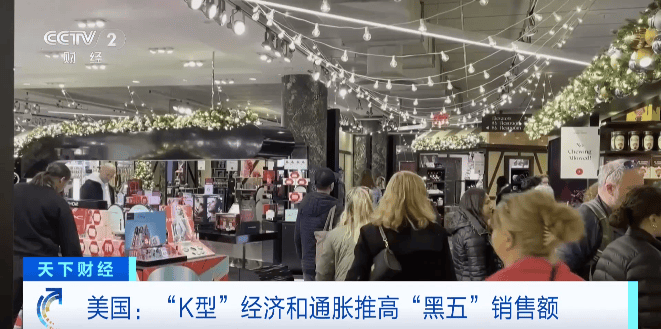
(央视财经《天下财经》)随着每年11月的第四个星期五、也就是"黑五"到来,欧美国家开启了年底购 物季。美国有线电视新闻网报道称,表面上看美国今年假日购物季显示出强劲的一面,但这恐怕不能代 表实际增长,销售额增长背后的现实是"K型"经济和通胀。 为了寻找更加实惠的价格,消费者在今年购物季倾向使用生成式人工智能。路透社报道称,根据统计范 围涵盖食品杂货等必需品类商品支出的软件公司Salesforce统计的数据,"黑五"期间受人工智能技术推 动的全球线上销售额达到142亿美元,其中美国市场大约为30亿美元。另据Adobe统计的数据,与去年 相比,人工智能工具的使用令美国零售网页的访问流量在"黑五"暴增805%。美国消费者线上购物支出 达118亿美元,同比增长9.1%。在即将到来的12月1日网购日"网络星期一",销售额或达142亿美元,同 比增长6.3%。 美国全国零售联合会预计,今年11月和12月的零售额将同比增长3.7%至4.2% ,这意味着美国消费总支 出可能超过1万亿美元,高于去年。分析认为,通胀带来的价格上涨,以及担忧关税增加购物成本导致 的提前消费,是增长的部分原因。 编辑:令文芳 根据万事达卡的公告,今 ...
外媒:黑五折扣节,AI购物暗藏新风险
Huan Qiu Wang Zi Xun· 2025-11-30 01:34
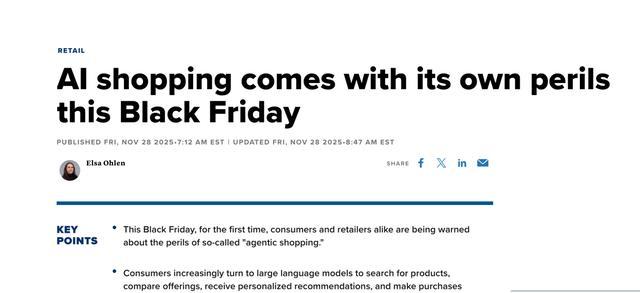
Core Insights - The rise of AI shopping is leading to increased digital fraud risks for consumers, despite the benefits of personalized recommendations and convenience [1][3] - Retailers are warned to be cautious of the risks associated with "smart shopping" as consumers increasingly rely on AI for product searches and purchases [3][4] Group 1: AI Shopping and Fraud Risks - The use of AI agents for shopping has increased by 200% in the past six months, while AI-related fraud has surged nearly tenfold [3] - Fraud prevention experts suggest that banning AI shopping may not be a viable solution, as AI users can bring high-quality traffic to platforms [3][4] Group 2: Consumer Behavior and Economic Context - The fashion industry sees AI and digital tools as the biggest opportunities before 2026, necessitating a reevaluation of marketing and e-commerce strategies [4] - Consumer confidence is low, with the EU's economic sentiment index below long-term averages since mid-2022, and U.S. consumer confidence hitting its lowest point since April [4][5] - A "K-shaped economy" is emerging, where high-income consumers maintain strong spending power while others cut back due to price pressures [4]
美国“黑五”销售额同比增4.1%,AI流量暴增600%,通胀和“K型经济”依旧是主题
Hua Er Jie Jian Wen· 2025-11-30 01:25
Core Insights - The resilience of American consumers during this year's Black Friday exceeded market expectations, leading to a robust growth in retail sales, but this growth masks the reality of limited purchasing power and increasing economic disparity under high inflation [1][2] - The spending behavior of affluent and low-income groups has shown a significant "K-shaped" divergence, with inflation anxiety and price sensitivity becoming core variables driving market sentiment [1][2] Retail Sales Performance - According to SpendingPulse, retail sales in the U.S. (excluding automobiles) increased by 4.1% year-on-year during Black Friday, surpassing last year's growth of 3.4% [1] - Adobe Analytics reported that online shoppers spent $11.8 billion, reflecting a 9.1% increase year-on-year, while Mastercard data indicated a 10.4% growth in online sales, significantly outpacing the 1.7% increase in physical store sales [3] Impact of AI on E-commerce - This year marked the first significant involvement of generative AI in consumer shopping decisions, with AI-related traffic to U.S. e-commerce sites surging by 600% compared to last year [2][3] - Approximately 48% of surveyed consumers indicated plans to use AI to assist in online shopping during the holiday season [3] Economic Disparity - The U.S. economy is exhibiting a clear "K-shaped" trend, with low and middle-income consumers reducing spending while high-income individuals continue to spend lavishly on luxury goods and travel [4] - Experts suggest that the nominal spending growth of 4.1% may translate to a real growth of only around 1% when accounting for the current inflation rate of approximately 3% [4] Consumer Behavior and Price Sensitivity - Price remains a decisive factor influencing consumer choices, with 85% of consumers anticipating further price increases due to potential tariffs under President Trump's policies [6] - Retailers that emphasize value for money, such as Walmart and TJ Maxx, have reported strong sales performance, while others like Target face challenges with lower foot traffic [6] Credit Pressure and Future Outlook - The usage of "Buy Now, Pay Later" payment options has significantly increased, with projected transaction volumes reaching $20.2 billion from November 1 to December 31, indicating cash flow pressures among some consumers [7] - Despite cost-of-living pressures, consumers still demonstrate spending capacity, with expectations for Cyber Monday sales to reach $14.2 billion, a 6.3% increase year-on-year [7]


美国零售股迎假日购物季大考!经济K型分化下沃尔玛、TJX受捧,梅西百货、柯尔百货承压
智通财经网· 2025-11-29 03:36
Group 1: Retail Performance Insights - Walmart and discount retailers like TJX and Ross are expected to attract budget-conscious consumers from traditional department stores like Macy's and Kohl's amid high inflation and limited consumer budgets [1][2] - Walmart's recent quarterly performance exceeded expectations, leading to an upward revision of its annual guidance, while Target's mixed results highlighted challenges in attracting its core middle-class customers [2][3] - Analysts note a shift in consumer preference towards discount retailers, with TJX expected to outperform Macy's and Kohl's in sales performance [2][3] Group 2: Consumer Behavior Trends - The holiday shopping season is anticipated to be more rational, with overall spending expected to remain flat while unit sales may decline by up to 2.5% [5][6] - A record 187 million consumers are expected to participate in the holiday shopping season, but average planned spending is projected to decrease by 4% to $622 [5][6] - Consumers are increasingly cautious, with many planning to use Black Friday promotions to stock up on essentials rather than indulge in luxury purchases [6][7] Group 3: Economic Context - The U.S. economy is exhibiting a K-shaped recovery, where wealth is concentrated among the affluent, while lower-income households face declining purchasing power due to inflation [8][9] - High-income households account for nearly 50% of total consumer spending, with their expenditures rising significantly compared to declines in spending among lower-income groups [9][10] - The economic outlook is heavily reliant on the spending behavior of the wealthy, raising concerns about the sustainability of this model if their consumption decreases [10]

AI浪潮引爆华尔街,美股新目标价出炉
Huan Qiu Wang· 2025-11-28 03:52
Core Viewpoint - The surge in artificial intelligence is reshaping the economy and financial markets, leading to optimistic stock market predictions from major investment banks for the S&P 500 index, with Deutsche Bank setting a target of 8000 points by the end of 2026, indicating a positive outlook for the market [1] Group 1: Investment Bank Predictions - Deutsche Bank forecasts the S&P 500 index to reach 8000 points by the end of 2026, suggesting nearly 17% upside from the current level of 6812.61 points [1] - Other banks like HSBC and JPMorgan have set their 2026 targets at 7500 points, with JPMorgan indicating a potential rise to 8000 points if the Federal Reserve adopts a more aggressive rate-cutting approach [1] - Morgan Stanley predicts the S&P 500 index will close at 7800 points by the end of 2026, while Wells Fargo also sets a target of 7800 points, expecting double-digit growth in the next 12 months [1] Group 2: Corporate Earnings and Economic Outlook - Strong corporate earnings are driving this optimism, with S&P 500 companies experiencing a 13.4% growth in earnings in Q3 this year according to FactSet [3] - Morgan Stanley believes the U.S. economic recession ended earlier this year, with policy support and strong earnings expected to continue into next year [3] - Wells Fargo anticipates a two-phase market rally next year, transitioning from "inflation hope" trades in the first half to a stronger AI-driven rally in the second half [3] Group 3: Structural Risks - Despite the optimism, investment banks have noted potential structural risks in the market, with Wells Fargo warning that the rise of artificial intelligence could lead to a bubble and that the market is increasingly intertwined with the overall U.S. economy [3] - JPMorgan's chief equity strategist highlights that while there are concerns about an AI bubble and valuation issues, the current high price-to-earnings ratios reflect above-trend earnings growth and increased capital spending on AI [3] - The ongoing "K-shaped economy," characterized by widening wealth gaps, could lead to economic recession if a bear market occurs, as noted by both Wells Fargo and JPMorgan [3]

STARTRADER外汇:美国季节性岗位预计大幅降低,客户消费能力下降
Sou Hu Cai Jing· 2025-11-28 02:55
Group 1 - The holiday shopping season in the U.S. is expected to continue the consumer spending trend, but the seasonal employment market is showing signs of significant cooling, potentially reducing the number of people able to find seasonal work to support this consumption surge [1][3] - Seasonal hiring plans for the 2025 holiday season have dropped to the lowest level in over a decade, with companies submitting the fewest seasonal hiring proposals since 2012, according to Challenger, Gray & Christmas [3] - Retailers are expected to hire between 265,000 to 365,000 seasonal workers this year, a significant decline of nearly 20% to 40% compared to 442,000 in 2024, indicating a potential decrease in retail activity [3] Group 2 - The overall job market is tightening, particularly in the retail sector, with the U.S. economy adding 119,000 jobs in September, primarily in healthcare, food services, and social assistance, while retail employment remained flat [4] - Consumer sensitivity to discounts has increased, leading to a more pronounced K-shaped economic recovery, which is causing some retailers to struggle [4] - A survey of 1,048 small businesses revealed that 68% reported a decline in customer spending power, and 59% expect holiday sales to be lower than last year, with only 5% actively hiring or expanding [4]
新一轮牛市已在路上?华尔街纷纷给美股定下高目标价
Sou Hu Cai Jing· 2025-11-28 01:31
Core Viewpoint - The rapid development of artificial intelligence is reshaping the economy and financial markets, leading to bold stock market predictions, including a target of 8000 points for the S&P 500 index by 2026 [1][2]. Group 1: Bullish Predictions for U.S. Stocks - Deutsche Bank has set a year-end target of 8000 points for the S&P 500 index by 2026, citing stronger capital inflows, buyback activities, and sustained earnings growth [2][3]. - As of the latest close, the S&P 500 index stood at 6812.61 points, indicating a potential upside of 17% based on Deutsche Bank's forecast [3]. - Other banks, such as HSBC and JPMorgan, have set their targets at 7500 points, with JPMorgan suggesting that if the Federal Reserve continues to cut rates, the upper limit could also reach 8000 points [3][4]. Group 2: Earnings Growth and Economic Outlook - The earnings growth for S&P 500 companies was particularly strong, with a reported increase of 13.4% in Q3, according to FactSet data [3]. - Morgan Stanley anticipates a strong performance for U.S. stocks in the coming year, projecting the S&P 500 index to reach 7800 points by the end of 2026 [3][4]. - Wells Fargo expects U.S. stocks to rise by double digits over the next 12 months, with a target of 7800 points for 2026, driven by a shift towards AI-based growth [4]. Group 3: Economic Disparities and Risks - Wells Fargo warns that the current economic environment, characterized by a "K-shaped economy," could lead to a recession if a bear market occurs, as the wealth gap widens [4][5]. - JPMorgan also notes that the expected high valuations reflect above-trend earnings growth and increased capital expenditures related to AI, despite concerns about potential bubbles [5][6]. - The economic transformation driven by AI is occurring within a polarized economic context, which may exacerbate existing disparities [6][7].
美国商家决战超级购物季 AI流量成新战场
Di Yi Cai Jing· 2025-11-27 21:32
Core Insights - The upcoming shopping season in the U.S. is expected to see a surge in consumer spending, but the impact of tariffs may weaken discounts offered by retailers, potentially affecting overall consumer expenditure [1][2]. Group 1: Consumer Behavior and Spending Trends - The National Retail Federation (NRF) predicts that the number of shoppers during the five-day shopping period from Thanksgiving to Cyber Monday will reach 186.9 million, a slight increase from 183.4 million last year [2]. - Total sales during this holiday season are expected to exceed $1 trillion for the first time, with a year-on-year growth of 3.7% to 4.2%, although this is lower than last year's growth of 4.8% [2]. - Consumer confidence has dropped to a seven-month low, influenced by concerns over tariffs, high inflation, and stagnant incomes, with the Michigan Consumer Sentiment Index also hitting historic lows [2][3]. Group 2: Retailer Strategies and Market Dynamics - Retailers are facing rising costs due to tariffs, which are impacting consumer spending patterns, particularly among lower-income households [2][3]. - NRF estimates that average spending on holiday-related items will be $890 per household, slightly down from $902 last year [3]. - The holiday shopping season is traditionally significant, accounting for about one-third of annual sales, prompting retailers to initiate promotions early [5]. Group 3: AI and Digital Transformation in Retail - Retailers are increasingly leveraging AI tools to attract consumers, with platforms like ChatGPT and Google's Gemini becoming integral in providing shopping recommendations [5][6]. - Companies are ramping up content production to adapt to the "AI decision-making" consumer landscape, which, while requiring high initial investment, is expected to lower customer acquisition costs and improve conversion rates in the long run [7]. - Despite the current low traffic from generative AI platforms to retail websites, companies are exploring new methods to enhance visibility and engagement through increased content output and specialized data channels [7][8].
