
可控核聚变

Search documents
超级周期!资金持续流入赛道
格隆汇APP· 2025-11-04 09:11
Core Viewpoint - The main issue in AI development is not the lack of computing power but the insufficient electricity supply to support the growing demand for data centers and AI infrastructure [2][11][14]. Group 1: AI and Electricity Demand - The rapid expansion of AI and data centers is leading to a significant increase in electricity demand, particularly in the United States, where the electricity consumption from data centers is projected to rise from 4.2% in 2024 to as high as 25% by 2030 according to various forecasts [18][21]. - Microsoft CEO Satya Nadella emphasized that the AI industry is facing challenges due to a lack of adequate power infrastructure rather than a shortage of chips [11][12][14]. - OpenAI has called for substantial investments in electricity infrastructure, suggesting a target of adding 100 GW of power capacity annually to meet the demands of AI [15][16]. Group 2: Market Trends and Investment Opportunities - The electric grid equipment sector has seen a surge in interest, with the only electric grid equipment ETF (159326) attracting over 5.27 billion in investments over the past 20 days, reaching a historical high in scale [4][31]. - Companies in the electric grid equipment sector, such as Shenma Electric and Moen Electric, have experienced significant stock price increases, with some stocks hitting their daily limit [10][29]. - The global nuclear fusion market is expected to exceed $40 trillion by 2050, indicating a long-term investment opportunity in energy technologies [10][11]. Group 3: Technological Innovations - Innovations such as the transition to 800V direct current (DC) power systems are being pursued to enhance the efficiency of data center power supply, with companies like NVIDIA leading the charge [22][34]. - Solid-state transformers (SST) are being recognized for their ability to meet the high power density demands of AI data centers, potentially reducing peak demand by about 5% [23][34]. - The ongoing global investment in electric grid infrastructure is expected to create a favorable environment for companies involved in power supply and distribution technologies [26][29].




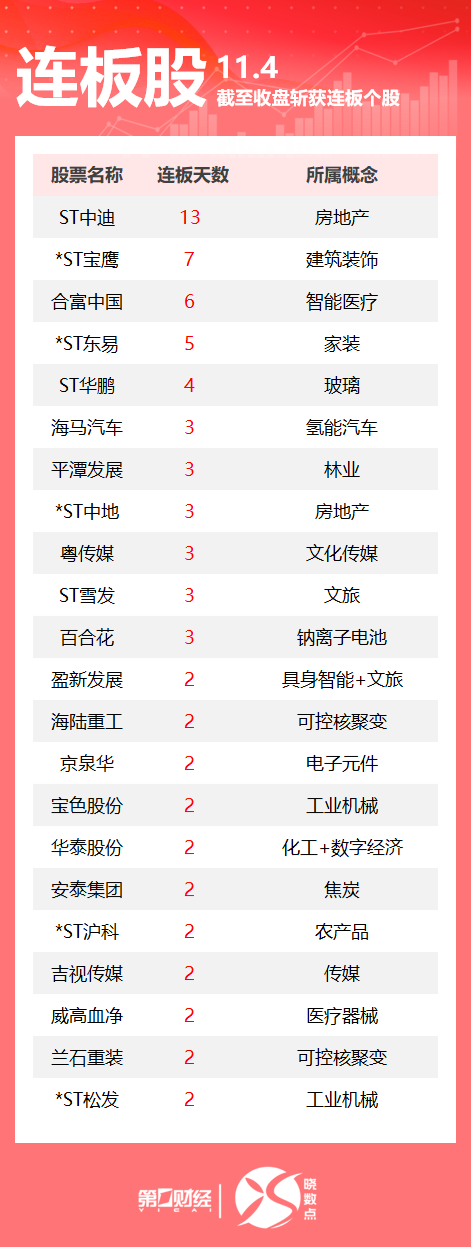
连板股追踪丨A股今日共68只个股涨停 这只医疗股6连板
Di Yi Cai Jing· 2025-11-04 08:00
Core Viewpoint - The A-share market saw a total of 68 stocks hitting the daily limit up on November 4, with notable performances in sectors such as medical and controllable nuclear fusion [1][2]. Group 1: Stock Performance - ST Zhongdi led with 13 consecutive limit-up days, primarily in the real estate sector [1]. - ST Baoying followed with 7 consecutive limit-ups in the construction decoration sector [1]. - HeFu China achieved 6 consecutive limit-ups, focusing on smart medical technology [1]. - HaiLu Heavy Industry and LanShi Heavy Industry both recorded 2 consecutive limit-ups in the controllable nuclear fusion sector [1][2]. Group 2: Sector Highlights - The medical sector showed strong performance with multiple stocks, including HeFu China and WeiGao Blood Purification, achieving 6 and 2 consecutive limit-ups respectively [1][2]. - The controllable nuclear fusion sector is gaining traction, as evidenced by HaiLu Heavy Industry and LanShi Heavy Industry's recent stock performance [1][2]. - Other sectors with notable performances include real estate, construction decoration, and industrial machinery, indicating a diverse range of investment opportunities [1][2].


A股“神奇两点半”再现!一个老段子又火了
Mei Ri Jing Ji Xin Wen· 2025-11-04 07:36
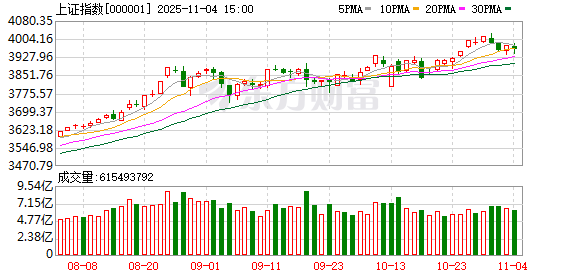
Market Overview - The market experienced a volume contraction with the ChiNext index dropping nearly 2% on November 4, while the Shanghai Composite Index fell by 0.41% and the Shenzhen Component Index decreased by 1.71% [2] - Over 3,600 stocks declined across the market, with total trading volume in the Shanghai and Shenzhen markets falling below 2 trillion yuan, a decrease of 191.4 billion yuan compared to the previous trading day [2] Sector Performance - The banking sector showed strength throughout the day, led by six major state-owned banks, with Xiamen Bank, linked to the Fujian Free Trade Zone, showing the largest gains [4] - Conversely, sectors such as precious metals, pharmaceuticals, and robotics experienced significant declines [2] Investment Sentiment - The strength of bank stocks is perceived as a sign of market stability and risk aversion, indicating a potential lack of momentum for further upward movement [6] - There is a sentiment of resignation among investors, with some expressing frustration over missing out on bank stock gains while their own investments declined [6] Market Dynamics - The market is currently in a phase of volume contraction and downward movement, lacking proactive trends [8] - November is seen as a critical period for style rotation, with historical trends indicating that the "spring market" often begins in December, making November an important time for portfolio adjustments [9] Institutional Behavior - In the fourth quarter, there is typically pressure for profit-taking among mainline sectors, leading institutions to shift from seeking excess returns to locking in profits [10] - This behavior may create a dynamic where one institution's profit-taking prompts others to follow suit, reinforcing the motivation for portfolio rebalancing [10] Sector Focus - The report highlights potential investment opportunities in emerging sectors such as quantum technology, controllable nuclear fusion, and commercial aerospace, which may attract thematic investment interest [10] - The tourism and ice and snow industries are gaining attention, with recent government policies aimed at boosting consumption through improved duty-free shop regulations and a surge in interest in outdoor skiing activities [12]
可控核聚变行业深度报告:核聚变产业化提速,聚焦链主及核心供应公司
CMS· 2025-11-04 05:32
Investment Rating - The report maintains an investment rating of "Recommended" for the controllable nuclear fusion industry [2][3]. Core Insights - The controllable nuclear fusion industry is accelerating its industrialization process, transitioning from experimental validation to engineering demonstration, with a focus on key suppliers and core component manufacturers that have achieved domestic substitution [2]. - The overall domestic production rate of key nuclear fusion equipment exceeds 96%, with significant advancements in materials performance being a core bottleneck for the feasibility of the technology route [2]. - The industry is entering a new phase characterized by "multiple routes racing + capital resonance," with significant milestones expected, such as the BEST device demonstrating power generation by 2027 [2]. Industry Scale - The industry comprises 118 listed companies, with a total market capitalization of 2114.6 billion and a circulating market capitalization of 1755.9 billion [3]. Performance Metrics - The absolute performance over 1 month, 6 months, and 12 months is 3.2%, 27.0%, and 26.1% respectively, while the relative performance is -0.5%, 2.4%, and 6.9% [5]. Key Companies and Financial Indicators - Notable companies include: - Xibu Superconductor (688122.SH) with a market cap of 50.1 billion and a strong recommendation [7]. - Antai Technology (000969.SZ) also strongly recommended with a market cap of 22.3 billion [7]. - Jiu Li Special Materials (002318.SZ) with a market cap of 25.0 billion and a strong recommendation [7]. - Other companies such as Guoguang Electric (688776.SH), Hezhu Intelligent (603011.SH), and Lianchuang Optoelectronics (600363.SH) are also highlighted, though they do not have specific investment ratings [7]. Material Innovation - Material innovation is identified as the current core bottleneck and breakthrough point for industrialization, with extreme operational environments requiring materials with high melting points, radiation resistance, and thermal fatigue performance [6]. - Domestic companies like Antai Technology and West Superconductor have made breakthroughs in tungsten-copper filters and superconducting materials, overcoming foreign monopolies [6]. Market Opportunities - The industry chain is witnessing incremental market growth across multiple segments, with energy equipment leaders establishing significant layouts and core component manufacturers benefiting from clear development paths [6]. - Companies such as Guoguang Electric, Hezhu Intelligent, and Lianchuang Optoelectronics are positioned to benefit significantly from local support [6].


超3700只个股下跌
第一财经· 2025-11-04 03:48
Core Viewpoint - The article discusses the performance of various sectors in the A-share market, highlighting significant declines in certain industries while noting gains in others, particularly in banking and real estate sectors. Market Performance - The A-share market saw declines with the Shanghai Composite Index down 0.19%, the Shenzhen Component Index down 1.27%, and the ChiNext Index down 1.51% [3] - The trading volume in the Shanghai and Shenzhen markets reached 1.22 trillion yuan, a decrease of 164.8 billion yuan compared to the previous trading day, with over 3,700 stocks declining [4] Sector Analysis - The pharmaceutical, gold, basic metals, shipping, and military industries experienced the largest declines [3] - Conversely, the banking sector showed resilience, with several banks like Xiamen Bank and Chongqing Bank seeing increases of over 5% [10] - The real estate sector also saw short-term gains, with companies like China Wuyi and Huaxia Happiness hitting the daily limit [5] Commodity and Futures - Lithium carbonate futures fell over 4%, currently priced at 78,820 yuan per ton [6] - The coal sector showed signs of recovery, with 37 listed coal companies reporting a total net profit of 29.942 billion yuan for the third quarter, a quarter-on-quarter increase of 22.83% [12] Notable Stocks - Baidu Group's autonomous driving service platform, Luobo Kuaipao, reported over 250,000 weekly orders, all being fully unmanned [9] - The precious metals sector opened lower, with companies like Xiaocheng Technology and Zhongjin Gold seeing declines of nearly 2% [13]

左手红利+右手电力!“可控核聚变含量第一”的电网设备ETF连续6日“吸金”
Ge Long Hui· 2025-11-04 02:51
Group 1 - The ETF market is experiencing a strong performance with both "Technology + Dividend" indices rising, particularly in sectors like semiconductor materials and equipment, as well as state-owned enterprise dividend indices [1] - Recent trends indicate a rebalancing in the A-share market, with AI hardware experiencing a pullback while dividend sectors have consistently outperformed the market since October [2] - Microsoft CEO Satya Nadella highlighted that the AI industry is facing a power supply issue rather than an excess of computing power, which is impacting the operation of GPUs [3] Group 2 - Amazon has accused a utility company under Berkshire Hathaway of failing to provide sufficient power for four new data center projects, illustrating the pressure on the power grid from rapid tech expansion [3] - According to a recent report from Debon Securities, large tech companies may experience a period of consolidation due to valuation concerns, while dividend sectors could see increased demand for risk aversion as the year-end approaches [3] - The report also mentions potential investment opportunities in emerging tech fields such as quantum technology and controllable nuclear fusion, as highlighted in the 14th Five-Year Plan [3] Group 3 - The "Dumbbell Strategy" products have shown notable performance, with the state-owned enterprise dividend ETF (513910) up by 0.67%, including major stocks like COSCO Shipping and China Petroleum [4] - The electric grid equipment ETF (159326) has increased by 0.96%, being the only ETF tracking the China Electric Grid Equipment Theme Index, with significant net inflows of 520 million yuan over the past 20 days [4]
规模再创新高,电网设备ETF(159326)涨幅全市场第一,中能电气涨停
Mei Ri Jing Ji Xin Wen· 2025-11-04 02:15
Group 1 - The A-share market saw a positive trend with the only ETF tracking power grid equipment (159326) rising by 2.34%, achieving a trading volume of 69.75 million yuan, with stocks like Neng Electric and Sifang Co. hitting the daily limit [1] - The power grid equipment ETF has experienced net inflows for six consecutive trading days, accumulating over 527 million yuan in the last 20 days, reaching a new high of 646 million yuan in total assets [1] - Recent breakthroughs in controllable nuclear fusion and the AI technology revolution are driving significant growth in electricity demand, which is pushing the global nuclear power industry and necessitating upgrades in power grid infrastructure [1] Group 2 - According to Everbright Securities, policies aim to establish a national unified electricity market by 2025, with full completion by 2029, focusing on cross-province power grid channels, digitalization, carbon markets, and electricity market construction [2] - The power grid equipment ETF (159326) tracks the CSI Power Grid Equipment Theme Index, with a strong representation in sectors such as transmission and transformation equipment, grid automation, and distribution equipment, where ultra-high voltage equipment holds a 64% weight [2] - The top ten holdings of the ETF include industry leaders like Guodian NARI, TBEA, and Sifang Electric, indicating a strong market position [2]

可控核聚变板块盘初拉升,兰石重装、海陆重工双双涨停
Xin Lang Cai Jing· 2025-11-04 01:35
Core Viewpoint - The controlled nuclear fusion sector experienced a significant surge at the beginning of trading, with notable stocks such as Lanston Heavy Industry and Hailu Heavy Industry hitting the daily limit up, while companies like China Nuclear Technology, Yongding Co., and Zhongzhou Special Materials also saw increases [1] Group 1: Company Performance - Lanston Heavy Industry reached the daily limit up during the trading session [1] - Hailu Heavy Industry also achieved a daily limit up, indicating strong investor interest [1] - China Nuclear Technology, Yongding Co., and Zhongzhou Special Materials followed suit with notable gains, reflecting a positive trend in the sector [1]

英杰电气:公司在可控核聚变领域可以提供磁场电源、辅助加热电源等全方位关键电源配套服务
Mei Ri Jing Ji Xin Wen· 2025-11-04 00:57
Group 1 - The company can provide comprehensive key power supply services for controlled nuclear fusion, including magnetic field power, auxiliary heating power, control system power, and auxiliary system power [2] - The inquiry was made by an investor on an interactive platform regarding the company's capability to supply power systems for both nuclear fission and nuclear fusion [2] - The response indicates the company's focus on the nuclear fusion sector and its ability to support various related equipment with power solutions [2]
英杰电气:可控核聚变领域可提供全方位电源配套服务
Xin Lang Cai Jing· 2025-11-04 00:24
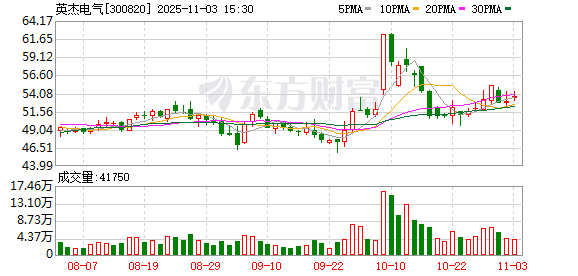
Core Viewpoint - The company provides comprehensive key power supply services in the field of controlled nuclear fusion, including magnetic field power, auxiliary heating power, control system power, and auxiliary system power [1] Group 1 - The company has responded to investors on November 4, indicating its capabilities in the nuclear fusion sector [1]