
人工智能

Search documents
河南县城85后,4年狂揽3000亿!
创业家· 2026-03-17 10:15
Core Viewpoint - The article discusses the rapid rise of MiniMax, an AI startup founded by Yan Junjie, highlighting its innovative approach and significant market success amidst the AI boom, particularly with the OpenClaw platform [5][6][10]. Group 1: Company Overview - MiniMax, founded by Yan Junjie, achieved a market valuation of HKD 380 billion (approximately RMB 335 billion) as of March 10, 2023, surpassing major internet companies like Baidu and JD [6]. - The company was listed on the Hong Kong Stock Exchange on January 9, 2026, setting a record for the fastest IPO for an AI startup, taking only four years from establishment to listing [5][65]. - MiniMax's revenue for 2024 reached RMB 214 million, marking a 782% year-on-year growth, with over 70% of its revenue coming from international markets [46]. Group 2: Founder Background - Yan Junjie, born in 1989 in Henan, has a strong mathematical background and a passion for AI, which he pursued through rigorous academic training, including a PhD from the Chinese Academy of Sciences [16][19]. - He previously worked at SenseTime, where he rose to a senior position, but left to pursue a vision of creating more general AI applications [22][28]. Group 3: Business Strategy - MiniMax operates on principles of user service, global outreach, and technology-driven development, focusing on creating a comprehensive suite of AI models across various domains, including language, voice, video, and music [31][36]. - The company has adopted a dual strategy of developing foundational AI models while simultaneously working on practical applications, which was initially seen as ambitious but has proven successful [31][36]. Group 4: Market Position and Competition - The AI industry is highly competitive, with major players like ByteDance and Alibaba entering the space, prompting MiniMax to focus on technological breakthroughs rather than competing on resources [44][45]. - Yan Junjie has emphasized the importance of innovation and efficiency, leading MiniMax to adopt a hybrid expert model (MoE) that has positioned the company among the top tier of global AI firms [46][58]. Group 5: Future Outlook - Despite the rapid growth and success, Yan Junjie acknowledges the ongoing challenges and uncertainties in the AI landscape, emphasizing the need for continuous innovation and adaptation [47][60]. - The company aims to maintain its competitive edge by focusing on high-quality technology and efficient operations, with a long-term vision of contributing positively to society through AI [67][68].


沃尔核材:一根铜线牵动算力浪潮!
市值风云· 2026-03-17 10:11
Core Viewpoint - The article highlights the impressive growth of沃尔核材 (002130.SZ), showcasing its strong revenue and profit increases, driven by advancements in high-speed communication cables and a solid market position in the radiation-modified materials sector [3][5]. Group 1: Financial Performance - In 2025, the company achieved a total revenue of 8.45 billion, representing a year-on-year growth of 22% [6]. - The net profit attributable to shareholders reached 1.135 billion, reflecting a significant increase of 33.95% compared to the previous year [5][6]. - The operating profit was reported at 1.415 billion, marking a 29.98% increase year-on-year [6]. Group 2: Market Position and Product Development - The company has established itself as a leader in the domestic radiation-modified materials market, particularly in heat shrink tubing, with a long-standing market share at the forefront of the industry [4]. -沃尔核材 has successfully developed and mass-produced high-speed communication cables, breaking the monopoly of international giants in this segment [7]. - The electronic communication business generated 2.666 billion in revenue during the first half of 2025, showing a year-on-year growth of 32%, becoming a key driver of the company's overall performance [7]. Group 3: Strategic Investments and Future Outlook - The company is in a phase of business expansion, with capital expenditures reaching 740 million in the first three quarters of 2025, the highest in its history [8]. - Despite a slight cash flow deficit of 115 million, these investments are aimed at meeting the surging demand for high-speed communication cables and positioning the company for future market share gains [9].


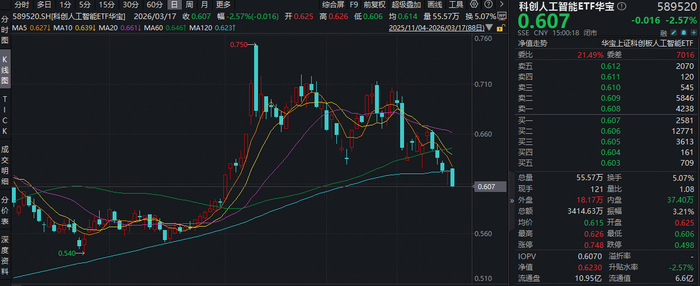
英伟达GTC大会如期而至!政策强催化+算力大爆发,华宝基金科创人工智能ETF(589520)近5日吸金3660万元!
Xin Lang Cai Jing· 2026-03-17 10:03
Core Insights - The A-share market indices collectively closed in the red, with the domestic AI industry-focused ETF (589520) experiencing a price drop of 2.57%, yet attracting significant investment of 36.6 million yuan over the past five trading days, indicating strong investor confidence in the domestic AI sector's future performance [1][3] Policy Insights - AI has been a prominent topic in this year's major meetings, being mentioned seven times in the government work report, with projections indicating that China's AI core industry will exceed 1.2 trillion yuan by 2025 and grow to over 10 trillion yuan by the end of the 14th Five-Year Plan [3] Industry Developments - At NVIDIA's annual GTC conference, CEO Jensen Huang projected that the new AI acceleration chip architecture, Blackwell, and the next-generation Rubin products will generate at least 1 trillion USD in revenue by the end of 2027, doubling last year's revenue forecast [3] - The demand for computing power is surging, with the concept of "Token inflation" introduced by Guolian Minsheng Securities, highlighting the rapid increase in API call volumes from platforms like Alibaba Cloud and Volcano Engine, which is expected to drive the computing power industry into a "full-chain inflation" cycle by 2026 [3] Investment Opportunities - The Huabao AI ETF (589520) and its linked funds focus on the domestic AI industry chain, including leading domestic GPU companies (e.g., Cambricon), ASIC leaders (e.g., Chipone), and AI application leaders (e.g., Kingsoft Office), with nearly half of its weight in the semiconductor sector and over 30% in software, indicating strong offensive potential [3] - The ETF serves as an efficient tool for investors looking to gain exposure to domestic computing power, being a financing and margin trading target [3]

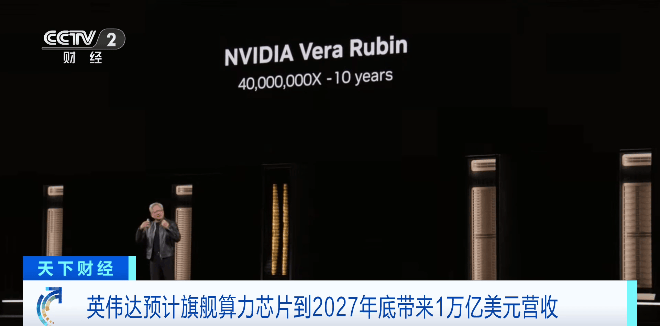
黄仁勋称2027年底英伟达AI加速芯片要创收1万亿美元
Sou Hu Cai Jing· 2026-03-17 09:56
Group 1 - The core message of the article is that NVIDIA expects its next-generation AI chips to generate at least $1 trillion in revenue by the end of 2027, reflecting the rapid growth of the AI infrastructure market [1][3]. - NVIDIA's main AI chip products, Blackwell and Rubin, are projected to collectively generate at least $1 trillion in revenue by the end of 2027, up from a previous estimate of $500 billion by the end of 2026 [3]. - The CEO of NVIDIA, Jensen Huang, stated that the AI inference market has reached a turning point, with demand for inference computing power experiencing exponential growth [5]. Group 2 - NVIDIA plans to collaborate with the startup "Grok" to launch AI server systems focused on low-cost, low-latency inference computing, supporting a trillion-level computing market [5]. - New products were showcased, including chip modules for space AI computing, aimed at deploying data center-level AI computing capabilities to satellites and orbital data centers [5]. - NVIDIA introduced the OpenClaw intelligent agent platform and the NemoClaw toolchain to promote the safe, controllable, and scalable implementation of AI agents in various scenarios, including industrial, office, and home environments [5].
闪送2025年营收达40亿,经调整净利润2亿元
Sou Hu Cai Jing· 2026-03-17 09:44
Core Insights - The company reported strong financial performance for Q4 2025, with revenue exceeding 1 billion yuan and an annual revenue of 4 billion yuan, indicating a solid growth trajectory [2][3] - The adjusted net profit for the year reached 200 million yuan, with a gross margin improvement from 11.0% in 2024 to 11.8% in 2025, showcasing the effectiveness of its business model [3][4] Financial Performance - In Q4 2025, the company achieved revenue of over 1 billion yuan and an adjusted net profit of 41.6 million yuan, with a gross profit of 110 million yuan [4] - For the entire fiscal year 2025, the company reported total revenue of 4 billion yuan and an adjusted net profit of 200 million yuan, reflecting consistent profitability over three consecutive years [3][4] - The company maintained a cash reserve of 950 million yuan, providing a solid financial foundation for future growth [3][4] Business Strategy - The company focuses on optimizing delivery quality through a professional rider team and specialized delivery equipment, enhancing service in vertical categories such as flowers, cakes, and electronics [5][8] - It is expanding service offerings to include new niches like gift delivery, digital rentals, and urgent luggage delivery, addressing diverse user needs [5][8] - The company is investing in technology, incorporating AI applications and exploring drone delivery services to improve operational efficiency and user experience [5][8][9] Rider Support and Community Engagement - As of the end of 2025, the company operates in 298 cities with a registered rider base of 3.1 million, emphasizing the importance of its rider network in meeting urban delivery demands [10] - The company is committed to enhancing rider development through training programs and community support initiatives, including emergency response training [10][11] - It has implemented a comprehensive care system for riders, including the establishment of "Rider Homes" in multiple cities to provide rest and support services [10][11]


AI,正在吞噬所有软件
虎嗅APP· 2026-03-17 09:37
Core Viewpoint - The article discusses the transformation of software in the age of AI, emphasizing that software is being consumed by AI, marking a significant shift in how software is created and utilized [9][14]. Group 1: Software Creation - In 2026, tools like Claude Code and Codex have made it possible for anyone to create software without needing programming skills, leading to a democratization of software development [21][22]. - The concept of "vibe coding" allows users to describe their needs in natural language, and AI generates the corresponding code, drastically reducing the time and cost of software development [23][29]. - The cost of software production has plummeted from hundreds of thousands to nearly zero, as AI tools can now generate complete applications that can be deployed directly [29][30]. Group 2: Software as a Commodity - Software is transitioning from being an asset, which requires significant investment and maintenance, to a consumable resource that can be easily replaced [33][42]. - The SaaS model, which thrived on the complexity and high costs of software, is facing challenges as many SaaS stocks have dropped significantly, indicating a shift in market dynamics [35][38]. - The traditional metrics for evaluating SaaS companies, such as Net Revenue Retention (NRR), are declining, reflecting a change in how software is perceived and utilized [46][48]. Group 3: Human-Machine Interaction - The rise of AI agents, exemplified by OpenClaw, is bridging the gap in human-machine interaction, allowing users to communicate their needs directly without navigating complex interfaces [49][53]. - Software, traditionally seen as a necessary intermediary, is being replaced by agents that can interpret user intentions and execute tasks autonomously [75][86]. - The future of product design may focus on creating skills for agents rather than traditional user interfaces, as agents will handle interactions and decision-making processes [92][117]. Group 4: Changing User Dynamics - In the agent era, the concept of users is evolving; agents themselves are becoming the primary users of skills, rather than humans directly interacting with software [91][99]. - As agents take over tasks traditionally performed by humans, the focus of product optimization will shift from user experience to agent interaction and efficiency [106][110]. Group 5: Disappearance of Intermediate Layers - The article posits that AI and agents are eliminating intermediate layers in both software and organizational structures, streamlining processes and reducing the need for traditional management roles [120][148]. - The historical trend of technological advancements has consistently led to the removal of intermediaries, and the current shift is no different, as AI consumes the software layer itself [121][128]. - Companies will need to adapt to this new reality, where the focus will be on the capabilities of skills and their integration into workflows rather than on traditional software interfaces [135][140].

诺瓦星云(301589) - 2026年3月17日投资者关系活动记录表
2026-03-17 09:33
Group 1: Industry Trends - The ultra-high-definition (UHD) video industry is transitioning from scale expansion to quality enhancement, with significant growth potential in 8K and beyond, as the industry is still in its early stages [2][3] - The National Radio and Television Administration has designated 2025 as the "Year of Ultra-High Definition Development," aiming for multi-faceted advancements in the UHD sector [2] Group 2: Company Product Development - The company has launched several MLED products, including the MLED Demura system and various core integrated circuits, which are now successfully applied in mass production [4] - Continuous high-intensity R&D investment will be maintained to promote product and technology upgrades in the MLED sector [4] Group 3: Market Expansion - MLED technology is expanding its application from outdoor to indoor settings, covering commercial and consumer markets, with current uses in virtual shooting, smart cities, and events [5] - The company is actively exploring high-value areas and potential applications in response to industry trends [5] Group 4: Event Support - The company provided comprehensive video display solutions for the main venue and four sub-venues of the 2026 CCTV Spring Festival Gala, enhancing the visual experience for viewers [6][7]
AI算力行业周报:Meta 27年底前推出四代自研AI芯片,OFC 2026大会于洛杉矶启幕-20260317
Huaxin Securities· 2026-03-17 09:29
Investment Rating - The report maintains a "Buy" rating for the companies mentioned, including 汇绿生态, 沪电股份, 天孚通信, 太辰光, while 长电科技 remains unrated [6]. Core Insights - Meta plans to launch four generations of self-developed AI chips by the end of 2027 to support its growing AI computing needs and reduce reliance on external suppliers. The chips include MTIA 300, MTIA 400, MTIA 450, and MTIA 500, with MTIA 300 already in mass production [3]. - The OFC 2026 conference in Los Angeles is expected to attract 16,000 participants and over 700 exhibitors, focusing on AI, optical innovation, and space optical networks [4]. - The report suggests focusing on companies such as 沪电股份, 长电科技, 天孚通信, 汇绿生态, and 太辰光 for potential investment opportunities [5]. Weekly Market Analysis - The electronic industry saw a decline of 1.23% from March 9 to March 13, ranking 20th among the 31 sectors, while the communication industry decreased by 0.12%, ranking 11th [12][15]. - The AI computing sector showed mixed performance, with the printed circuit board (PCB) sector increasing by 2.95%, while other power supply equipment sectors decreased by 4.61% [19]. Company Focus and Earnings Forecast - The earnings per share (EPS) forecasts for 2024, 2025E, and 2026E for the companies are as follows: - 汇绿生态: 0.08, 0.11, 0.22 with PE ratios of 540, 384, and 198.34 respectively [6] - 沪电股份: 1.35, 1.94, 2.61 with PE ratios of 60.13, 41.85, and 31.1 respectively [6] - 天孚通信: 2.43, 2.61, 4.18 with PE ratios of 133.74, 124.52, and 77.75 respectively [6] - 太辰光: 1.15, 1.83, 3.01 with PE ratios of 111.22, 70.06, and 42.49 respectively [6] - 长电科技: 0.90, 0.88, 1.19 with no rating [6]. Industry Dynamics - Tesla is advancing a large AI chip manufacturing project to support its AI and autonomous driving needs [45]. - Applied Materials and Micron are collaborating to build a semiconductor R&D center with an investment of $5 billion to develop next-generation AI storage solutions [46]. - The U.S. Department of Commerce has withdrawn a proposed rule on AI chip exports, reflecting internal disagreements on balancing national security and global competitiveness in the AI sector [47]. - Meta's announcement of new AI chips and a significant capital expenditure plan of $115 billion to $135 billion for expanding AI data center infrastructure indicates a growing trend among major tech companies to develop in-house AI capabilities [48].
黄仁勋凌晨发布英伟达版龙虾,特意提及中国龙虾热,Rubin Ultra算力较前代提升35倍
Xin Lang Cai Jing· 2026-03-17 09:27
Core Insights - The article highlights the significant impact of OpenClaw in China, showcasing its rapid popularity and adoption, surpassing Linux's achievements in just weeks [4] - NVIDIA's CEO Jensen Huang introduced several new AI platforms and technologies, including the Nemo Claw enterprise AI platform, emphasizing the integration of hardware and software in AI development [3][6] Group 1: OpenClaw and Nemo Claw - OpenClaw has become the most popular open-source project in history, demonstrating remarkable growth and ease of use for creating intelligent agents [4][6] - Nemo Claw, developed in collaboration with "Lobster Father" Peter Steinberg, integrates OpenShell for security, ensuring safe operation of intelligent agents within enterprise networks [8] Group 2: Vera CPU and Rubin Platform - The Vera CPU, designed for data centers, is expected to become a multi-billion dollar business, offering unmatched single-thread performance and efficiency [11] - The Rubin platform achieves a tenfold performance improvement over previous models, enabling data centers to generate significantly higher revenue [14] Group 3: Future Technologies and Models - The Feynman architecture is set to be NVIDIA's next-generation computing platform, designed to meet future demands for both copper and optical devices [20] - Six new open models were released, including Nemo Tron for language understanding and BioNemo for drug discovery, all positioned at the forefront of their respective fields [21][23]
东方国信(300166):首次覆盖报告:新业务迎来拐点,智算中心进入收获期
GUOTAI HAITONG SECURITIES· 2026-03-17 09:25
Investment Rating - The report assigns an "Accumulate" rating to the company with a target price of 15.36 CNY, based on a projected PS valuation of 6.5 times for 2026 [5][21]. Core Insights - The company is entering a critical growth phase with its new business, particularly the intelligent computing center, which is expected to generate stable revenue from long-term contracts with leading internet clients [2][21]. - The company provides enterprise-level solutions in big data, artificial intelligence, cloud computing, and industrial internet, positioning itself as a key IT support vendor for the digital transformation of major telecom operators [2][13]. - Revenue projections for 2025-2027 are estimated at 26.9 billion, 33.1 billion, and 42.0 billion CNY, respectively, with varying growth rates across different sectors [19][21]. Financial Summary - Total revenue for 2023 is projected at 2,383 million CNY, with a growth rate of 4.1%. The revenue is expected to increase to 2,793 million CNY in 2024, reflecting a growth of 17.2% [4][19]. - The net profit (attributable to the parent company) is forecasted to improve from a loss of 386 million CNY in 2023 to a profit of 29 million CNY in 2024, marking a significant turnaround [4][19]. - The company’s gross margin is expected to stabilize around 30.7% to 31.9% over the forecast period [19]. Revenue Breakdown by Sector - **Telecom Sector**: Expected revenue growth of 0%, 30%, and 35% for 2025-2027, with gross margins of 34.9%, 37.9%, and 38.9% respectively [13][16]. - **Financial Sector**: Anticipated revenue growth of -3%, 18%, and 20% for the same period, with gross margins of 18.2%, 21.2%, and 22.2% [14][16]. - **Industrial Sector**: Projected revenue growth of -30%, 15%, and 15%, with gross margins of 31.5%, 33.0%, and 34.0% [14][16]. - **Government Sector**: Expected revenue growth of 25% annually, with gross margins increasing from 29.1% to 30.6% [15][16].
