Feynman架构

Search documents
通信行业周报:GTC、OFC总结:光互联、全液冷大时代
KAIYUAN SECURITIES· 2026-03-23 00:45
Investment Rating - The industry investment rating is "Positive" (maintained) [2] Core Insights - The GTC 2026 conference showcased Nvidia's new Rubin system, which utilizes TSMC's 3nm EUV process and HBM4 memory, significantly enhancing performance and reducing costs [4][12] - The OFC 2026 conference highlighted advancements in AI optical interconnects, with multiple technical paths emerging, indicating a strong trend towards AI optical interconnects [5][16] - The concept of "Token Factory Economics" was introduced, suggesting that tokens will become a new commodity with tiered pricing based on performance, potentially leading to Nvidia's AI chip demand reaching at least $1 trillion by 2027 [15][24] Summary by Sections GTC Conference Highlights - Nvidia introduced seven new chips and five system architectures, with the LPU showing significant performance improvements and a tenfold reduction in token costs [12][13] - The next-generation Feynman architecture was previewed, designed for "world models," featuring a 1.6nm process and substantial performance gains [14] - The commercialization of tokens is anticipated, with Nvidia projecting substantial revenue growth driven by AI chip demand [15] OFC Conference Highlights - The XPO MSA was launched, addressing key bottlenecks in AI data center optical interconnects, with significant improvements in bandwidth density [16][17] - NPO technology was highlighted as a transitional solution for AI interconnects, with major manufacturers releasing high-performance products [18][19] - CPO technology is advancing, with major firms accelerating production and achieving significant energy efficiency improvements [20][21] - OCS technology is moving towards commercial scalability, supported by major tech companies, enhancing AI data center connectivity [22] - Hollow-core fiber technology was showcased, achieving significant reductions in loss and latency, positioning domestic manufacturers as leaders [23] Investment Recommendations - The report recommends focusing on four main investment lines: "Optical, Liquid Cooling, Domestic Computing Power, and Satellite" [6] - Specific recommended stocks include: Zhongji Xuchuang, Xinyi Sheng, Yingweike, and Huagong Technology among others [6][25][26]


7位专家拆解GTC,结论让英伟达难堪
雷峰网· 2026-03-19 00:41
Core Viewpoint - NVIDIA acknowledges that GPUs are not the optimal solution for inference, indicating a shift in the AI computing narrative towards specialized architectures and the organization of computing power [1][8]. Group 1: Shift in AI Infrastructure - At GTC 2026, Jensen Huang demonstrated that NVIDIA's focus has shifted from "stronger GPUs" to "how to organize computing power" [2][3]. - The transition from a training-centric phase to an inference-centric phase is evident, with data centers being redefined as "AI factories" [3][4]. - The introduction of LPU (Low Power Unit) suggests that inference may no longer be the primary domain of GPUs, leading to questions about the coexistence of specialized architectures and general computing power [4][6]. Group 2: Token Economy and AI Factory - Huang stated that the AI factory is now focused on producing tokens, with the efficiency of token output becoming a critical measure of success [17][19]. - By 2027, AI chip revenue is projected to reach at least $1 trillion, driven by a massive increase in computing demand [18][19]. - The concept of "global lowest token cost" is positioned as a competitive advantage, suggesting that companies with efficient token production will dominate the market [19][20]. Group 3: Technological Developments and Challenges - NVIDIA's deployment of the sixth-generation NVLink architecture and the introduction of the first CPO (Co-packaged Optics) Ethernet switch indicate a push towards advanced interconnect technologies [25][26]. - The complexity of NVIDIA's product matrix raises concerns about its ability to compete with simpler architectures like Google's, which have demonstrated superior efficiency [26][29]. - The introduction of OpenClaw as a next-generation operating system aims to redefine "intelligent agent computers," indicating a significant shift in SaaS towards AaaS (Agent as a Service) [31][33]. Group 4: Market Dynamics and Future Outlook - The emergence of LPU and the focus on specialized inference tasks signal a potential restructuring of the AI computing landscape, with GPUs still playing a role in complex tasks [9][12]. - The competitive landscape is evolving, with companies like Alibaba and NVIDIA vying for control over token production and distribution, which will shape the future of the AI industry [20][22]. - The integration of CPU and GPU capabilities will be crucial for companies to gain a competitive edge in the AaaS transition [35][36].

【招商电子】英伟达GTC 2026跟踪报告:25-27年DC收入超1万亿美元,Kyber将使用铜光等多种互连形式
招商电子· 2026-03-18 03:48
Core Insights - The article discusses the key announcements made by NVIDIA during the GTC 2026 conference, focusing on advancements in AI technology, data center revenue projections, and the introduction of new products and platforms that enhance computational capabilities and AI applications. Group 1: AI Technology Advancements - cuDF and cuVS technologies are set to handle structured and unstructured data, with a significant increase in computational demand, projected to grow by 1 million times [2][3] - DLSS 5 merges 3D graphics with AI, enhancing the generation of structured data and achieving remarkable results in visual fidelity [2][3] - The introduction of the Rubin platform, which includes multiple chips and a supercomputer, is expected to increase computational power by 40 million times over the next decade [3] Group 2: Data Center Revenue Projections - NVIDIA anticipates data center orders to reach $1 trillion by 2027, up from the previously mentioned $500 billion [3][61][62] - The company derives 60% of its revenue from the top five cloud service providers, with the remaining 40% from regional and sovereign clouds [3] Group 3: New Product Launches - The Rubin+LPX system has entered mass production, featuring advanced cooling and design innovations [2][3] - The Groq LPU, now in production, is designed to enhance token processing capabilities significantly [3][5] - The introduction of the OpenClaw platform aims to revolutionize personal agent services, positioning every IT and SaaS company as an AI-as-a-Service provider [4][6] Group 4: Industry Collaborations - NVIDIA has formed partnerships with major companies like IBM and Dell to accelerate data processing for AI applications [22][24] - Collaborations with cloud service providers such as Google Cloud and AWS are enhancing the capabilities of platforms like BigQuery and SageMaker [25][29][32] Group 5: Market Trends and Future Outlook - The AI industry is experiencing explosive growth, with venture capital investments reaching $150 billion, indicating a strong demand for computational resources [52] - The shift towards generative AI is transforming traditional computing paradigms, with NVIDIA positioned to lead this change [54][55] - The company emphasizes the importance of vertical integration in AI applications across various industries, including automotive, healthcare, and finance [41][46][47]
英伟达Feynman架构引爆PCB板块,沪电股份逼近涨停
Ge Long Hui· 2026-03-18 03:14
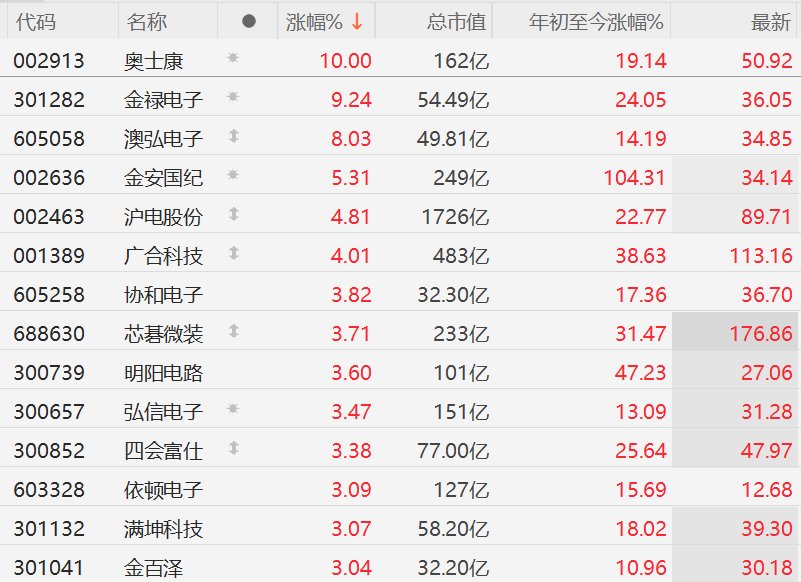
Group 1 - The A-share market saw a strong performance in PCB concept stocks, with notable gains from companies such as Aoshikang, which hit the daily limit, and Huhua Electronics, which approached the limit as well [1] - Key stocks included Jinhua Electronics with a rise of over 9%, Aohong Electronics up 8%, and Jin'an Guoji increasing by over 5% [1] - Other companies like Guanghe Technology, Xiehe Electronics, and Xinqi Microelectronics also experienced gains exceeding 3% [1] Group 2 - Aoshikang's stock price increased by 10%, with a total market value of 16.2 billion and a year-to-date increase of 50.92% [2] - Jinhua Electronics rose by 9.24%, with a market value of 544.9 million and a year-to-date increase of 36.05% [2] - Huhua Electronics saw an increase of 4.81%, with a market value of 172.6 billion and a year-to-date increase of 89.71% [2] Group 3 - Nvidia's recent GTC 2026 conference introduced the Feynman architecture, which sets extreme requirements for PCB layers (32-44 layers), thermal resistance, and signal transmission rates [1][3] - This development is expected to significantly increase the value of high-end multilayer boards (HLC) and high-density interconnect boards (HDI) [1] - The new architecture indicates a substantial increase in the number of trays per server, which translates to an increase in PCB demand [3]





黄仁勋凌晨发布英伟达版龙虾,特意提及中国龙虾热,Rubin Ultra算力较前代提升35倍
Xin Lang Cai Jing· 2026-03-17 09:27
Core Insights - The article highlights the significant impact of OpenClaw in China, showcasing its rapid popularity and adoption, surpassing Linux's achievements in just weeks [4] - NVIDIA's CEO Jensen Huang introduced several new AI platforms and technologies, including the Nemo Claw enterprise AI platform, emphasizing the integration of hardware and software in AI development [3][6] Group 1: OpenClaw and Nemo Claw - OpenClaw has become the most popular open-source project in history, demonstrating remarkable growth and ease of use for creating intelligent agents [4][6] - Nemo Claw, developed in collaboration with "Lobster Father" Peter Steinberg, integrates OpenShell for security, ensuring safe operation of intelligent agents within enterprise networks [8] Group 2: Vera CPU and Rubin Platform - The Vera CPU, designed for data centers, is expected to become a multi-billion dollar business, offering unmatched single-thread performance and efficiency [11] - The Rubin platform achieves a tenfold performance improvement over previous models, enabling data centers to generate significantly higher revenue [14] Group 3: Future Technologies and Models - The Feynman architecture is set to be NVIDIA's next-generation computing platform, designed to meet future demands for both copper and optical devices [20] - Six new open models were released, including Nemo Tron for language understanding and BioNemo for drug discovery, all positioned at the forefront of their respective fields [21][23]
黄仁勋狂扔“王炸”:1万亿营收、太空芯片、一键“养虾”…李彦宏牵头的AI生命科学公司被曝赴港上市;永辉公开喊话山姆丨邦早报
创业邦· 2026-03-17 00:09
Group 1 - NVIDIA CEO Jensen Huang announced a significant increase in computing demand, predicting it will reach $1 trillion by 2027, doubling the previous estimate of $500 billion, and introduced the concept of "token factories" for future data centers [2] - The next-generation Vera Rubin architecture was unveiled, featuring full liquid cooling and integration with Groq's deterministic flow processor technology, achieving a 350-fold increase in token generation speed [3] - NVIDIA's OpenClaw project was defined as the "Linux of the AI era," supporting AI agents in autonomously calling tools and executing code, marking a shift from SaaS to AaaS [3] Group 2 - Alibaba announced the establishment of the Alibaba Token Hub, aimed at enhancing AI business strategy collaboration and focusing on both B-end and C-end AI applications [4] - Meta plans to lay off approximately 20% of its workforce to offset the rising costs of AI infrastructure, with the timeline for layoffs yet to be determined [4] - BioMap, an AI life sciences company led by Baidu's Robin Li, has reportedly submitted a listing application in Hong Kong, aiming to raise hundreds of millions of dollars [5] Group 3 - Meta signed a five-year agreement with Nebius for AI infrastructure, potentially worth up to $27 billion, to secure dedicated computing power [6] - Yonghui Supermarket publicly urged Sam's Club to avoid forcing suppliers into a "choose one" situation, advocating for fair competition [6] - Zhiyun announced a 20% price increase for its new API model, marking the second price hike in recent months, with a total increase of 83% since Q1 2026 [11][25] Group 4 - Ant Group's offer to acquire Yao Cai Securities has been approved, with the transaction expected to complete by March 30, 2026, at a total value of approximately HKD 2.814 billion [11] - OpenAI is in talks with several private equity firms to establish a joint venture, with a pre-investment valuation of around $10 billion [12] - The gaming market in China saw a revenue of CNY 33.231 billion in February 2026, marking an 18.96% year-on-year increase, the highest growth rate in nearly ten months [25]

黄仁勋 GTC 2026 演讲实录:所有SaaS公司都将消失;Token成本全球最低;“龙虾”创造了历史;Feynman 架构已在路上
AI前线· 2026-03-16 23:30
Core Insights - The article emphasizes that NVIDIA has evolved from a graphics card company to a comprehensive provider of AI infrastructure, positioning itself as a key player in the multi-trillion-dollar AI foundational era [2]. Group 1: CUDA and Ecosystem Development - Huang emphasized the significance of the CUDA architecture, which has been central to NVIDIA's business for 20 years, creating a vast ecosystem of tools and libraries that support AI development [3][4]. - The "flywheel effect" of CUDA's installation base accelerates growth by attracting developers, leading to new algorithms and breakthroughs, which in turn expand the market and ecosystem [6][7]. Group 2: Data Processing Transformation - Huang highlighted a structural transformation in global data processing, focusing on the acceleration of both structured and unstructured data, which is crucial for AI applications [8][10]. - NVIDIA has developed core software libraries, cuDF for structured data and cuVS for unstructured data, to support this transformation and enhance data processing capabilities [13]. Group 3: AI Industry Growth and Investment - The AI industry has seen unprecedented growth, with venture capital investments reaching $150 billion, driven by the demand for massive computational power [15]. - Huang predicts that the revenue from NVIDIA's AI systems could reach at least $1 trillion by 2027, supported by a tenfold increase in computational demand over the past two years [17]. Group 4: AI Infrastructure and Token Economy - NVIDIA's advancements in AI infrastructure, including the NVFP4 computing architecture, have significantly reduced token costs, making it the most efficient platform for AI applications [20][25]. - The role of data centers is shifting from storage and computation to becoming "AI factories" that produce tokens, which are becoming a new digital commodity [27]. Group 5: Vera Rubin Supercomputer - The introduction of the Vera Rubin supercomputer marks a significant advancement in AI computing, featuring a fully integrated system designed for agentic AI workloads [28][31]. - This platform includes cutting-edge technologies such as liquid cooling and high-speed NVLink interconnects, enhancing performance and deployment efficiency [33][35]. Group 6: OpenClaw and Software Development - Huang praised the OpenClaw project for its rapid growth and potential to revolutionize software development, likening its impact to that of Linux and Kubernetes [52][55]. - The introduction of NemoClaw, an enterprise-level architecture built on OpenClaw, aims to address security challenges associated with deploying intelligent systems in corporate environments [56][58]. Group 7: Open Model Ecosystem - NVIDIA is advancing an open model ecosystem with nearly 3 million models across various domains, emphasizing the importance of collaboration and continuous improvement in AI model capabilities [59][60]. - The establishment of the Nemotron Coalition aims to further develop foundational models and ensure they meet diverse industry needs [61].
英伟达CEO黄仁勋:Feynman架构将采用定制高带宽内存(HBM)。
Xin Lang Cai Jing· 2026-03-16 20:35
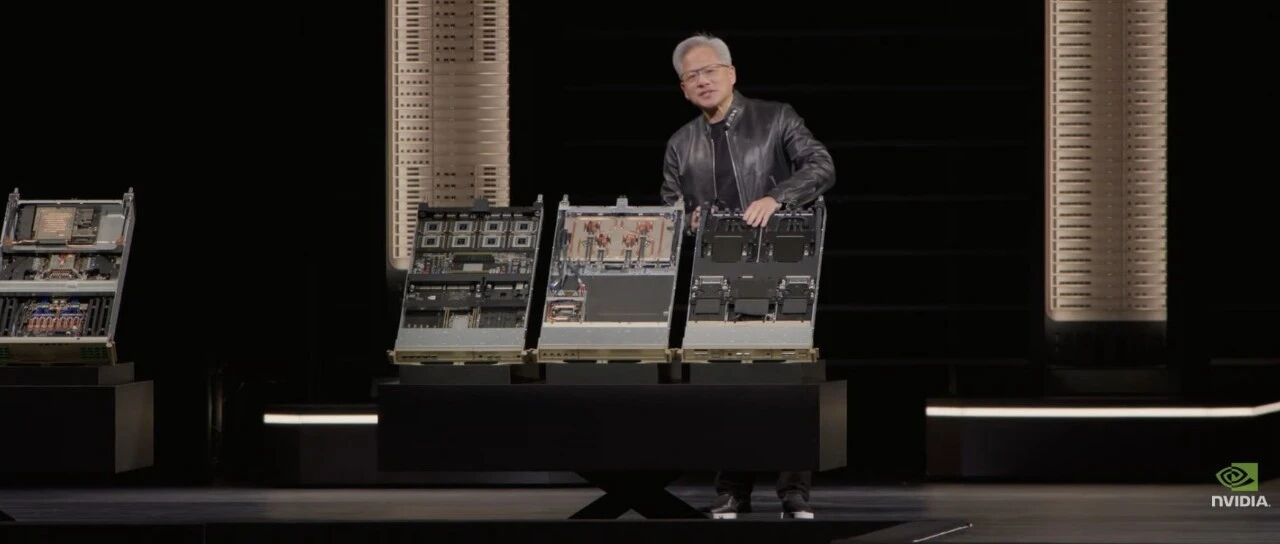
Group 1 - The core viewpoint of the article is that NVIDIA's CEO Jensen Huang announced that the upcoming Feynman architecture will utilize custom high bandwidth memory (HBM) [1] Group 2 - The adoption of custom HBM is expected to enhance the performance and efficiency of the Feynman architecture [1] - This move aligns with industry trends towards higher memory bandwidth solutions to support advanced computing tasks [1] - The Feynman architecture is anticipated to play a significant role in NVIDIA's future product offerings and competitive positioning in the market [1]
聚焦Rubin落地、Feynman前瞻与基础设施重构:英伟达GTC前瞻与基础设施重构
GUOTAI HAITONG SECURITIES· 2026-03-11 14:11
Investment Rating - The report assigns an "Overweight" investment rating for the industry [1] Core Insights - The focus of the GTC 2026 is not merely on individual chip specifications but on whether NVIDIA can successfully mass-produce the Rubin platform, advance the Feynman architecture, and integrate optical interconnects, power supply, and liquid cooling, thereby transitioning the AI industry from "buying GPUs" to "deploying AI factories" [3][28] Summary by Sections 1. Mass Production and Systematic Implementation of the Rubin Platform - The GTC 2026 will take place from March 16 to 19 in San Jose, California, covering various fields including agent-based AI, AI factories, and quantum computing [9] - The Rubin platform is evolving from a single GPU product to an integrated AI supercomputing platform comprising CPU, GPU, interconnects, and system components [10] - The market's focus is shifting from individual GPU performance to cabinet-level and rack-level configurations, indicating a transition in AI infrastructure delivery from boards to complete systems [11][12] 2. Feynman Architecture and Post-Rubin Era Inference Roadmap - The Feynman architecture is expected to be one of the first to adopt TSMC's A16 process and will focus on optimizing inference [19] - Feynman's anticipated power consumption will exceed 5000W, indicating a need for a comprehensive upgrade in power supply, cooling, and packaging systems [20] - The integration of Groq's LPU technology into NVIDIA's inference roadmap is expected to enhance low-latency processing capabilities [21][23] 3. Infrastructure Reconstruction Driven by Optical Interconnects, Power Supply, and Liquid Cooling - Optical communication is transitioning from traditional modules to CPO and NPO, marking a significant upgrade path for AI computing networks [25] - The next-generation power architecture is undergoing revolutionary upgrades due to rising power consumption, with 800V high-voltage direct current supply being a key development direction [26] - Liquid cooling is becoming a standard requirement for high-power AI platforms, with advancements in cooling materials and systems being critical for stable operation [27][28]
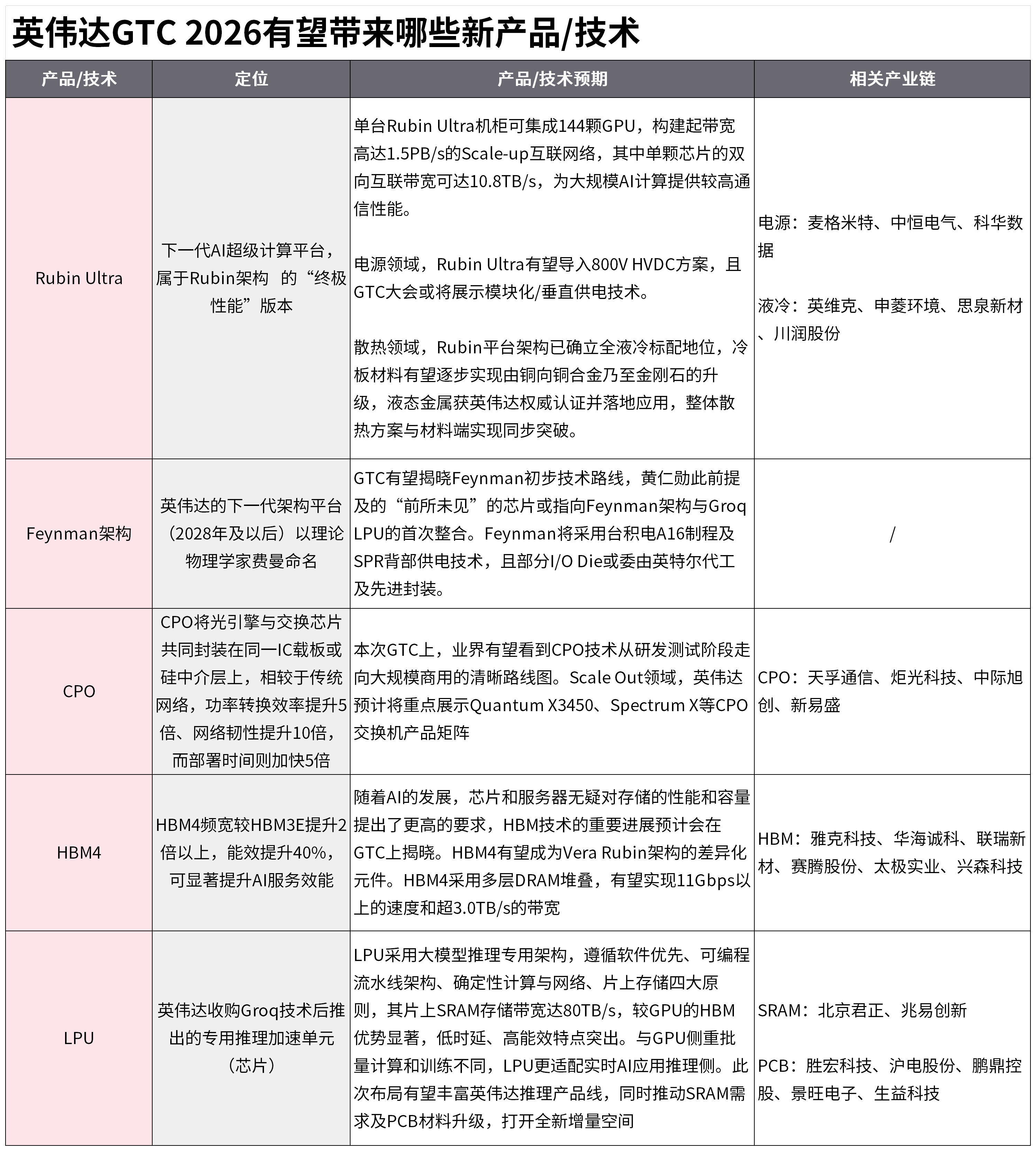
一文了解英伟达GTC2026有望带来哪些新产品/技术
Xuan Gu Bao· 2026-03-11 00:58
Group 1 - Nvidia's GTC 2026 is expected to introduce the Rubin Ultra, a next-generation AI supercomputing platform that represents the ultimate performance version of the Rubin architecture [1] - The Feynman architecture is planned for release in 2028 and beyond, named after physicist Richard Feynman, indicating a long-term vision for Nvidia's technological advancements [2] Group 2 - The CPO (Chip Package On) technology will integrate light engines with switching chips on the same IC substrate or silicon interposer, improving power conversion efficiency by 5 times, network resilience by 10 times, and reducing deployment time by 5 times compared to traditional networks [2] - HBM4 memory bandwidth is expected to exceed HBM3E by more than 2 times, with a 40% improvement in energy efficiency, significantly enhancing AI service performance [2] - Nvidia's acquisition of Groq technology has led to the development of a dedicated inference acceleration chip, known as LPU, which is anticipated to enhance AI processing capabilities [2]