
双碳

Search documents
中国建筑国际(3311.HK)赋能成长:海龙MiC破局开新篇,引领建筑产业革新浪潮
Ge Long Hui· 2025-10-30 00:55
Core Insights - The article highlights the rapid advancements in modular construction technology, particularly through the achievements of China State Construction Engineering Corporation (CSCEC) and its subsidiary, China Construction Haolong, in urban renewal and affordable housing projects across major cities in China and Hong Kong [1][2][3] Group 1: Company Overview - China Construction Haolong, established in 1993, has become a benchmark in the prefabricated construction industry, particularly in the Hong Kong and Macau markets, where it holds a leading market share [2][3] - The company has developed a modular integrated construction (MiC) technology that allows for efficient and high-quality building processes, significantly reducing construction time and labor costs [5][6][7] Group 2: Technological Advancements - MiC technology represents a paradigm shift in construction, enabling factory-based production and on-site assembly, akin to assembling Lego blocks, which enhances efficiency and quality control [6][7] - The company has established seven major production bases and 85 intelligent production lines, achieving an annual output capacity of 120,000 modular units, supporting over one million square meters of construction [12][15] Group 3: Market Trends and Opportunities - The demand for MiC technology is driven by three key trends: the need for carbon reduction in the construction industry, the pressure to address labor shortages, and the integration of digital technologies into construction processes [13][14][15] - The company is well-positioned to capitalize on these trends, with its MiC technology reducing carbon emissions by over 66% during construction and significantly lowering waste and energy consumption [13][14] Group 4: Project Examples and Impact - Notable projects include the rapid construction of emergency quarantine facilities in Hong Kong during the COVID-19 pandemic, showcasing the technology's ability to meet urgent public health needs [8][9][10] - The MiC technology has been applied in various sectors, including affordable housing, public services, and urban renewal, demonstrating its versatility and effectiveness in addressing diverse construction challenges [16][17] Group 5: Future Outlook - The company aims to continue expanding its MiC technology applications, contributing to the transformation of the construction industry towards more sustainable and efficient practices [18] - With ongoing investments in research and development, the company is set to lead the way in the evolution of construction methodologies in China and beyond [10][11]


中国石化驻苏企业:肩扛使命担当 展现高质量发展新作为
Ren Min Ri Bao· 2025-10-29 22:05
Core Insights - Jiangsu Province is a key area for Sinopec, covering the entire petrochemical industry chain and housing several major subsidiaries [1][2] - During the 14th Five-Year Plan period, Sinopec's subsidiaries in Jiangsu achieved significant revenue growth, exceeding 1.7 trillion yuan, a 20% increase compared to the previous five-year period [1][2] Group 1: Production and Revenue - Sinopec's subsidiaries in Jiangsu have a production capacity of over 330 million tons/year of oil and gas equivalent, 30.5 million tons/year of refining, and 8 million tons/year of ethylene [1] - Jinling Petrochemical is projected to process 17.29 million tons of crude oil in 2024, ranking second among Nanjing's top manufacturing enterprises [2] - Yangzi Petrochemical supplies approximately 12 million tons of high-quality petrochemical products annually [2] Group 2: Technological Innovation - The East China Petroleum Bureau has made significant advancements in shale oil exploration, with cumulative production exceeding 350,000 tons and resource estimates of 350 million tons [2][3] - Various subsidiaries have developed cutting-edge technologies, including a major PTA project and advanced imaging techniques for deep reservoirs [3][4][5] Group 3: Green Development Initiatives - Sinopec is committed to achieving carbon neutrality, with Jiangsu subsidiaries implementing CCUS projects and developing environmentally friendly products [6][7] - Jinling Petrochemical has established a carbon emission monitoring system and zero-emission projects [8] Group 4: Community Engagement and Social Responsibility - Sinopec's subsidiaries actively engage in community support, with initiatives such as educational assistance and environmental protection projects [11] - The company emphasizes the importance of the petrochemical industry in contributing to national economic development and improving people's lives [11][12]

新能源业务助力宇通重工业绩快增
Zheng Quan Ri Bao Zhi Sheng· 2025-10-29 17:13
Core Viewpoint - Yutong Heavy Industry reported a decline in revenue but a significant increase in net profit for the first three quarters of 2025, driven by growth in new energy equipment sales and investment gains from asset disposals [1][2] Financial Performance - For the first three quarters of 2025, Yutong Heavy Industry achieved operating revenue of 2.391 billion yuan, a year-on-year decrease of 4.58% [1] - The net profit attributable to shareholders was 187 million yuan, a year-on-year increase of 43.16% [1] - In Q3 2025, the company recorded operating revenue of 731 million yuan, down 28.65% year-on-year, while net profit was 68.49 million yuan, up 44.23% year-on-year [1] Business Segments - Yutong Heavy Industry's main business includes three segments: sanitation equipment, mining equipment, and basic engineering machinery [1] - Despite the overall revenue decline, the core products in the first three quarters showed growth, particularly in new energy mining equipment sales [1][2] Market Trends - The demand for new energy mining trucks is expected to rise, with projections indicating that sales in China will exceed 2,000 units by 2025 due to ongoing carbon reduction efforts in the mining industry [2] - The company has been a pioneer in developing and promoting new energy mining vehicles since 2018, covering over 100 mining areas [2] R&D Investment - Yutong Heavy Industry increased its R&D expenditure to 105 million yuan in the first three quarters of 2025, reflecting a commitment to innovation and adaptation to industry trends [2] - The growth in profit is attributed to the explosive growth of the new energy business, alongside structural optimization and asset disposal gains [2] Strategic Factors - The company's future success in maintaining industry leadership will depend on building technological barriers, consolidating market share, and advancing internationalization [2]

智领双碳 能绘新篇 | 第二届第四次新能源国际投资联盟业务交流会暨联盟大会在合肥成功举办
Sou Hu Cai Jing· 2025-10-29 15:47
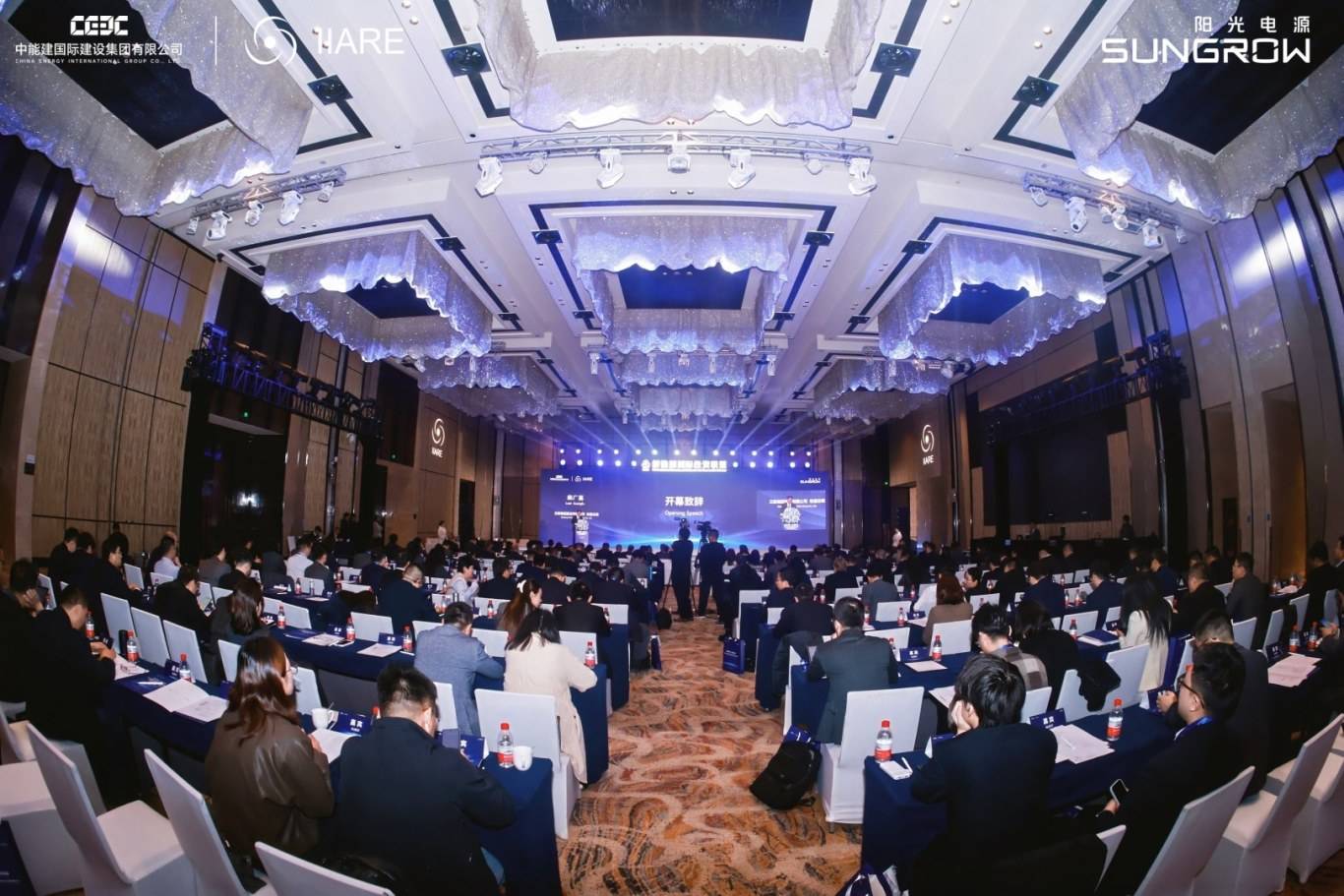
Core Viewpoint - The second session of the Fourth International Investment Alliance for New Energy Business Exchange Conference was successfully held, focusing on the theme of "Intelligent Leadership in Dual Carbon Goals and New Chapters" to explore high-quality development paths and opportunities in the global new energy industry, aiming for deeper international cooperation and a green low-carbon future [1]. Group 1: Conference Highlights - The conference was hosted by China Energy Construction International Group and the International Investment Alliance for New Energy, with participation from government departments, industry associations, international organizations, and member enterprises [1][2]. - Keynote speeches were delivered by prominent figures, including the Director of Overseas Operations at China Energy Construction and the Chairman of the International Investment Alliance for New Energy, who emphasized the importance of rational management, win-win cooperation, and sustainable development [3][5]. Group 2: Industry Insights - The International Investment Alliance has incubated over 40 GW of projects since its establishment, creating influential demonstration projects that support global new energy development [5]. - The conference highlighted the rapid development of Chinese enterprises in the new energy sector, providing valuable experience for countries like Sri Lanka in technology exchange and project investment [7]. - The Alliance serves as a comprehensive platform for China's new energy enterprises to expand into international markets and contribute to the green "Belt and Road" initiative [9]. Group 3: Regional Development - Anhui Province is actively promoting energy structure transformation and optimizing the new energy industry chain, establishing itself as a strategic hub for emerging industries [11]. - The conference aimed to deepen practical cooperation between domestic and foreign enterprises in the new energy sector, fostering a mutually beneficial and green low-carbon international energy development framework [11]. Group 4: Technological Innovation - The solar industry is entering a new phase focused on high quality, intelligence, and systemization, with companies like Sungrow committed to continuous technological innovation and optimizing energy structure [12][13]. - The conference featured discussions on technological innovation, smart operations, and international collaboration, addressing challenges faced by new energy enterprises in expanding into international markets [22][24]. Group 5: Collaborative Initiatives - The members of the International Investment Alliance jointly released the "High-Quality Development Initiative," aiming to build a modern new energy system characterized by safety, efficiency, cleanliness, intelligence, and collaboration [20]. - A closed-door meeting was held to discuss collaborative models and market opportunities, with participation from various stakeholders in the new energy sector [26].

前三季净利同比增长近五成 军信股份高质量发展成效显著
Zheng Quan Ri Bao Zhi Sheng· 2025-10-29 13:45
Core Insights - Hunan Junxin Environmental Protection Co., Ltd. reported strong financial performance for the first three quarters of 2025, with revenue of 2.163 billion yuan, a year-on-year increase of 23.21%, and net profit attributable to shareholders of 605 million yuan, up 48.69% [1] Financial Performance - The company processed 2.7004 million tons of municipal solid waste, a 7.89% increase year-on-year [1] - The electricity generated from waste incineration reached 1.294 billion kWh, growing by 17.53% [1] - Sales of industrial-grade mixed oil amounted to 22,600 tons, with an oil yield of approximately 7% [1] - The key operational efficiency metric, "electricity generated per ton of waste," improved to 479.1 kWh, reflecting a 4.72% year-on-year increase [1] Strategic Expansion - The company is expanding its overseas projects, particularly in Central Asia, with significant progress on the Bishkek project in Kyrgyzstan, expected to commence operations by the end of this year [2] - Agreements have been signed for waste management projects in Osh and Issyk-Kul in Kyrgyzstan, as well as an investment agreement for a waste-to-energy project in Almaty, Kazakhstan [2] - The company submitted an application for H-share listing on the Hong Kong Stock Exchange to enhance its international capital platform and competitiveness [2] Mergers and Acquisitions - The acquisition of Hunan Renhe Environmental Technology Co., Ltd. has contributed positively to the company's performance, exceeding performance commitments for 2023 and 2024 [2][3] - The acquisition has allowed the company to extend its business vertically into waste transfer and horizontally into kitchen waste management, creating an integrated operational model [3] Future Outlook - The company aims to align with national "dual carbon" strategies and the "Belt and Road" initiative, focusing on expanding domestic and international waste management and green energy markets [3] - Plans include exploring the integration of waste-to-energy with green computing and smart city technologies to enhance core competitiveness and long-term investment value [3]
浩云科技:携手华中科技大学与华智热工共拓智慧能源新篇章
Zheng Quan Ri Bao Wang· 2025-10-29 13:44
Core Viewpoint - The establishment of Huayun Smart Energy Technology (Wuhan) Co., Ltd. aims to leverage AI to enhance flexible and intelligent power generation, providing digital and smart solutions for the energy sector [1] Group 1: Company Developments - Haoyun Technology, along with its partners, has signed an investment agreement to establish Huayun Smart, holding a combined 51% stake [1] - The collaboration includes contributions from Huazhong University of Science and Technology and Huazhi Thermal Technology, focusing on the industrialization of technological achievements [1][5] - Huayun Smart integrates academic, engineering, and practical experience to create a comprehensive business model [5] Group 2: Market Opportunities - The Chinese government has introduced policies to accelerate the flexibility transformation of existing coal-fired power units, with a potential market size of 400 billion yuan [2] - The demand for digital and intelligent technologies in the traditional coal power industry is increasing due to the dual carbon goals and the need for flexibility upgrades [3] Group 3: Technological Innovations - Huayun Smart is developing three core technologies: IoT coal flow and quality monitoring, AI-based predictive control, and flexible execution technology [4] - The project has achieved a breakthrough in the load adjustment rate of coal-fired units, reaching a new global record of 3.5% per minute [4] - The technology has been adopted by nearly 20 power plants across five major power generation groups, showcasing its international leadership [4] Group 4: Strategic Alignment - The technology roadmap of Huayun Smart aligns with national policies on coal power decarbonization and modernization [5] - The small powder warehouse flexible intelligent solution has become a leading technology in the flexibility upgrade of thermal power generation [5] - The company aims to create an innovative service ecosystem covering the entire energy value chain through advanced technologies [6]

集体大涨,超8%!A股这一方向爆发
Zhong Guo Zheng Quan Bao· 2025-10-29 11:59
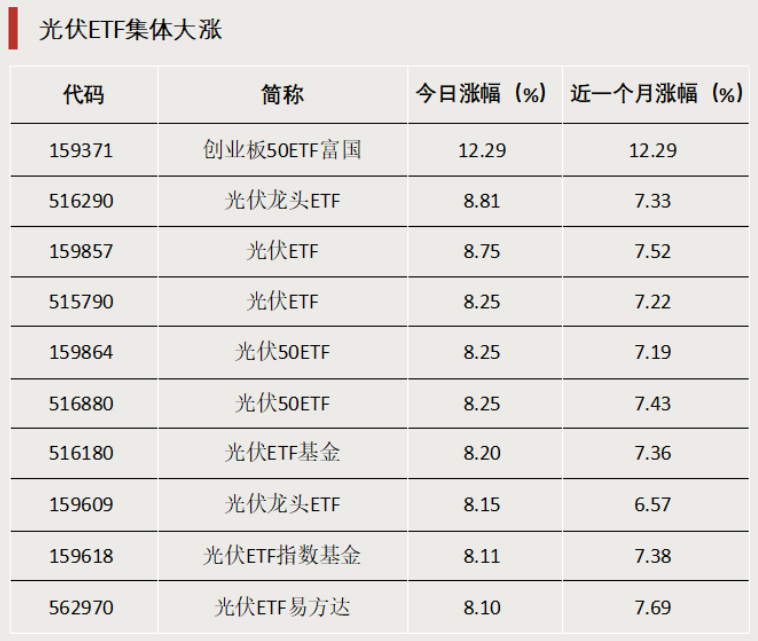
Group 1: Market Performance - On October 29, the new energy sector experienced a surge, with energy storage-related ETFs hitting the limit up, and photovoltaic-themed ETFs collectively rising, with the photovoltaic ETF leading the gains, all exceeding 8% [1][4] - The A-share market continued to rise, with the Shanghai Composite Index stabilizing above 4000 points and the ChiNext Index increasing nearly 3%, reaching a nearly four-year high [4] - The leading photovoltaic ETF (560980) surged by 7.90%, with a trading volume exceeding 1 billion yuan, and has increased over 46% year-to-date, outperforming its peers [4] Group 2: ETF Activity - Bond ETFs were actively traded, with eight ETFs, including short-term bond ETFs and Hong Kong securities ETFs, each exceeding 10 billion yuan in trading volume [2][9] - Several broad-based index ETFs attracted significant capital inflow on October 28, including the CSI 300 ETF and the SSE 50 ETF [3][11] - The largest battery ETF (159755) rose over 3%, with a recent scale exceeding 16.4 billion yuan and a net inflow of over 3.3 billion yuan in the past month, providing efficient tools for investors in the green energy sector [4][5] Group 3: Sector Highlights - The photovoltaic sector's performance was bolstered by a 31.79% month-over-month increase in new photovoltaic installations in China, totaling 9.7 GW in September [4] - The environmental protection and carbon neutrality ETFs also saw gains exceeding 3%, aligning with the current trend of energy structure transformation [5] - The rare metals and materials ETFs both rose over 3%, benefiting from strong demand in the new energy vehicle and high-end manufacturing sectors [5] Group 4: Bank ETFs - Bank-themed ETFs were among the worst performers on October 29, with declines exceeding 1.9% for several bank ETFs [7][8]
【快讯】每日快讯(2025年10月29日)
乘联分会· 2025-10-29 10:15
Domestic News - The 15th Five-Year Plan emphasizes boosting consumption, enhancing public service spending, and removing unreasonable restrictions on consumption such as those related to automobiles and housing [7] - China and ASEAN have agreed to consider each other's standards when formulating their own, particularly in the fields of new energy vehicles and electronics [8] - The upcoming 8th China International Import Expo will introduce new themes including automotive and cultural tourism, showcasing 461 new products and technologies [9] - Shenzhen has announced the cessation of its automobile replacement subsidy policy after reaching its budget limit for 2025 [10] - Changan Automobile has launched a purchase tax subsidy plan across all its brands to alleviate consumer concerns regarding tax benefits [11][12] - Aion, in collaboration with JD.com, is set to launch the Aion UT super model targeting the 100,000 yuan market [13] - Xiaomi has established a new department focused on the next-generation technology architecture for its electric vehicles, directly reporting to Lei Jun [14] - Seres has published a patent for torque control methods to prevent vehicle instability during high-speed driving [15] International News - In September, European car sales increased by 11% to 1.24 million units, with Tesla's registrations down by 19% and BYD's up by 272% [16] - Thailand's new car sales surged by 24% year-on-year in September, reaching 48,350 units [17] - Stellantis has partnered with NVIDIA, Uber, and Foxconn to explore the development of L4 autonomous vehicles for ride-hailing services [18] - Lucid Motors and NVIDIA are collaborating to launch the first L4 autonomous electric vehicles, leveraging NVIDIA's advanced driving technology [19] Commercial Vehicles - The cold chain logistics market in China has shown steady growth, with a total demand of 11.73 million tons in Q3, up 4.49% year-on-year [20][23] - The National Development and Reform Commission has introduced a 20% subsidy for green methanol projects, marking a significant step in supporting clean fuel technologies [21] - Guangso Future is collaborating with Serbia to develop a new ecosystem for electric trucks, focusing on autonomous commercial vehicle technology [22] - GAC's Lingcheng showcased its multi-energy route technology at the Greater Bay Area Commercial Vehicle Conference, emphasizing the integration of various energy sources [25]
绿色动力前三季度净利润同比增长24.39% 凸显环保龙头稳健发展动能
Zheng Quan Ri Bao· 2025-10-29 07:41
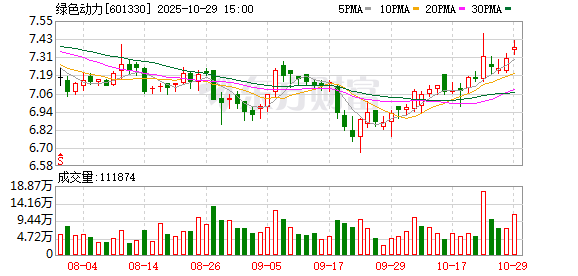
Core Insights - Green Power Environmental Group Co., Ltd. reported a revenue of 2.582 billion yuan for the first three quarters of 2025, representing a year-on-year increase of 1.49% [2] - The net profit attributable to shareholders reached 626 million yuan, up 24.39% year-on-year, while the net profit excluding non-recurring items increased by 24.55% [2] - The company processed 3.77 million tons of waste and generated 1,327.54 million kWh of electricity in the third quarter of 2025, indicating growth in both waste processing and electricity generation compared to the same period last year [2] Financial Performance - Revenue for the first three quarters of 2025 was 2.582 billion yuan, a 1.49% increase year-on-year [2] - Net profit attributable to shareholders was 626 million yuan, reflecting a 24.39% increase year-on-year [2] - Net profit excluding non-recurring items grew by 24.55% year-on-year [2] Operational Data - The company processed 3.77 million tons of waste in the third quarter of 2025 [2] - Electricity generation reached 1,327.54 million kWh, with grid-connected electricity at 1,092.98 million kWh and steam supply at 270,000 tons [2] Shareholder Structure - The controlling shareholder, Beijing State-owned Assets Management Co., Ltd., transferred 139 million shares to its wholly-owned subsidiary, maintaining a holding ratio of 44.42% [2] - The presence of two new long-term institutional investors among the top ten shareholders indicates market recognition of long-term value [2] Future Outlook - The company aims to strengthen its industry position through technological upgrades and business synergies, driven by the "dual carbon" policy [3] - The company's robust financial performance and operational efficiency position it favorably for upgrades in the environmental industry [3]

坚定“优质精品钢+系列稀土钢”战略方向 包钢股份第三季度营业收入同比增长14.29%
Zheng Quan Ri Bao Wang· 2025-10-29 07:26
Core Insights - Baosteel's revenue for the first three quarters of 2023 reached 48.08 billion yuan, with a net profit of 233 million yuan, an increase of 749 million yuan year-on-year [1] - In Q3 alone, Baosteel's revenue was 16.75 billion yuan, reflecting a year-on-year growth of 14.29% [1] - The company is transitioning from a steel manufacturer to a new materials service provider, aligning with national strategies for carbon neutrality and industrial upgrades [1][2] Financial Performance - Baosteel's production of specialty steel reached 7.11 million tons, an 18.1% increase year-on-year, while rare earth steel production rose by 8.28% [1] - The company achieved a significant increase in sales of oriented silicon steel by 375.27%, with other high-end products also showing strong growth [1] Strategic Initiatives - The company is focusing on "extreme cost reduction" as a core operational strategy, enhancing cost control across the entire supply chain [2] - Baosteel has reduced its steel manufacturing cost by 2.45% this year, building on a previous reduction of 2.8% [2] Industry Context - The Ministry of Industry and Information Technology's recent plan indicates an average annual growth of around 4% in the steel industry's added value from 2025 to 2026, emphasizing green, digital, and high-end development [3] - Baosteel's strategy of combining high-quality steel with rare earth steel is seen as a competitive advantage in the current industry landscape [3] Technological Advancements - The company is implementing 25 projects aimed at enhancing quality and efficiency, including the construction of a new refining furnace and upgrades to by-product technologies [4] - Baosteel has achieved advanced-level certification for smart manufacturing, indicating a commitment to digital transformation [5] Future Outlook - The company aims to deepen product structure adjustments and accelerate the transition to high-quality production, supported by technological advancements and cost reduction efforts [5]
